3 Sources
[1]
NVIDIA Introduces New Jetson Thor Computers to Advance Mainstream Robotics and Edge AI
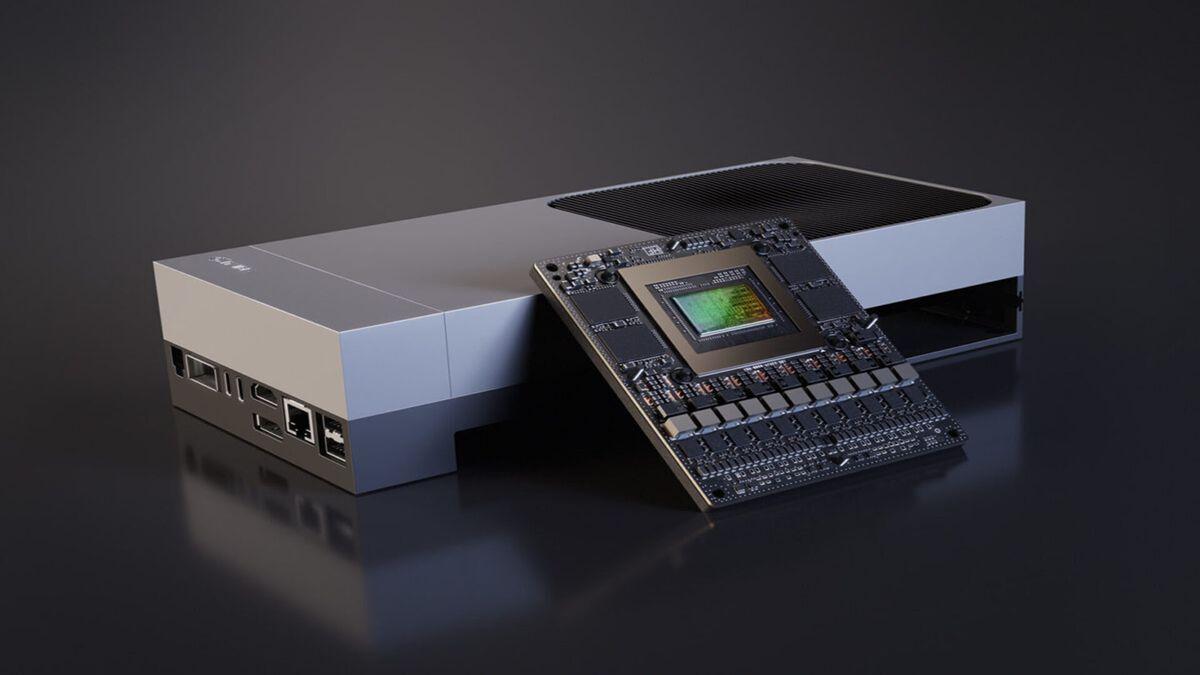
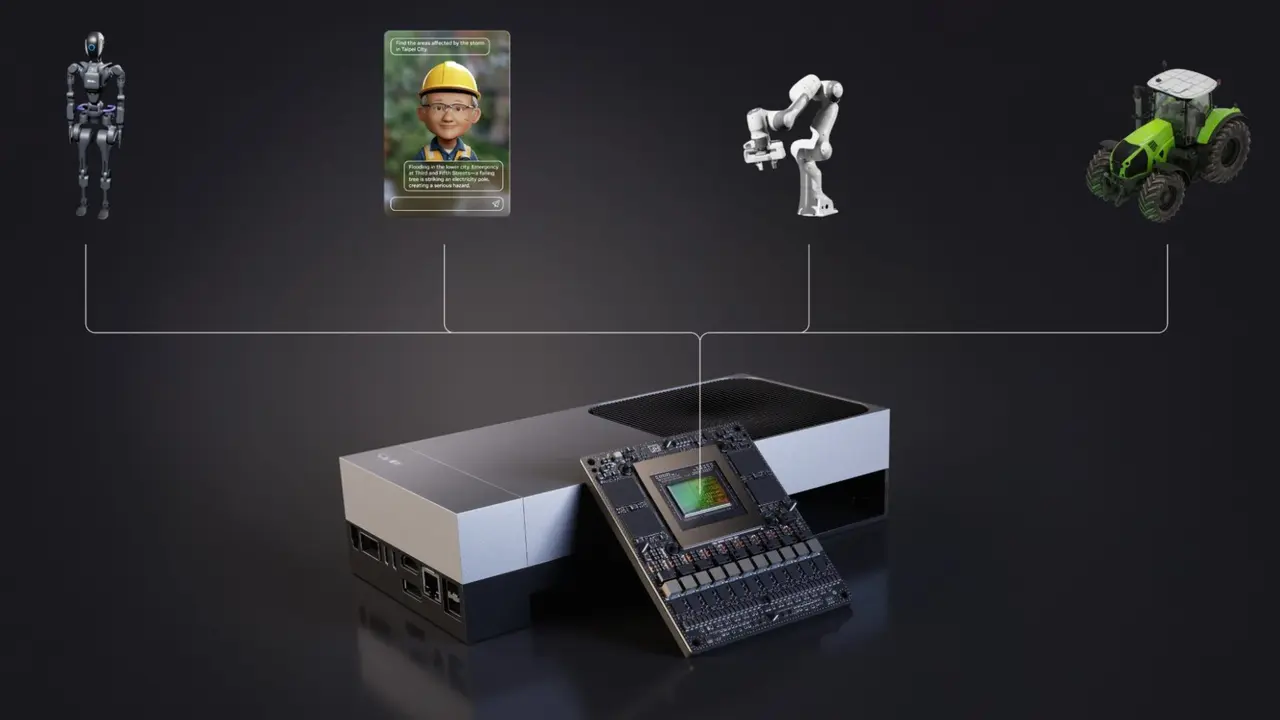
New NVIDIA Blackwell-powered T3000 and T2000 modules, paired with new NVIDIA Jetson software memory optimization and agent skills, help partners and customers move advanced robotics, visual AI and edge workloads onto compact, power-efficient systems. General-purpose robots and autonomous machines are moving from research labs to real-world mass-market deployment, creating demand for compact, power-efficient AI supercomputers capable of running foundation models at the edge. To meet that need, NVIDIA today introduced the T3000 and T2000, new modules based on the NVIDIA Thor architecture that enable mass-market robotics and edge AI applications at scale. Jetson AGX Thor is powering this next generation of humanoid and robotic systems, with growing adoption across industries. Leading companies -- including 1X, Agility, Agile Robots, Amazon Robotics, Boston Dynamics, FANUC, Hitachi, Medtronic, and Techman Robot -- are building on the platform. Unlocking Humanoid and Robotics Deployment With T3000 The hardware underpinning those capabilities starts with the Jetson and IGX T3000 modules, which delivers 865 FP4 teraflops of AI compute in a compact form factor roughly half the size and power of the T5000. Jetson T3000 combines an NVIDIA Blackwell GPU, an eight-core Neoverse Arm CPU, 32GB of LPDDR5X memory and 273GB/s of memory bandwidth, along with 25 GbE connectivity. IGX T3000 delivers the same performance with integrated functional safety while seamlessly running the NVIDIA Halos for Robotics full-stack safety system for robots operating alongside humans. Despite its smaller footprint, the T3000 achieves similar inference performance of the T5000 for multimodal workloads, including large language models, vision language models, vision language action models and world foundation models. Migrating to T3000 helps reduce costs amid high memory prices. Going Wide on Edge AI With T2000 The Jetson T2000 brings Thor architecture to a broader range of edge AI systems. With 400 FP4 teraflops of compute and 16GB of memory, it provides an entry point for developers building visual AI agents, autonomous mobile robots, industrial manipulators and other intelligent machines. With the introduction of the new NVIDIA Jetson modules, NVIDIA now offers a scalable edge AI platform spanning performance from 70 TOPS to 2,000 teraflops, enabling developers to address virtually any edge AI workload. New Agent Skills Automate Memory Optimization Across All Jetson Devices AI agents are transforming developer productivity by automating memory optimization, system configuration and deployment tasks that previously required manual effort and deep domain expertise. With the newly released Jetson agent skills, developers can optimize the entire software stack and achieve significant memory savings in days instead of weeks. These skills support the entire Jetson portfolio, including Jetson Thor and Jetson Orin, enabling developers to run more capable workloads on lower-memory configurations. The result is lower system cost, faster deployment and the flexibility to move down one memory SKU within the same product tier without compromising performance. Companies across industries and regions have accelerated development while achieving substantial memory savings through software optimization. Humanoid robotics leaders including UBTech and Agile Robots, along with industrial solutions provider Connect Tech, have reduced memory usage by up to 15GB, enabling them to move from NVIDIA Jetson AGX Orin 64GB to the 32GB module. In smart retail, SandStar reduced memory usage by up to 4GB, enabling deployment on the NVIDIA Jetson Orin NX 8GB module instead of the 16GB configuration. In companion robotics, GROOVE X, creator of the LOVOT robot, uses Jetson's heterogeneous AI accelerators to optimize workload distribution, reducing memory usage and enabling deployment on lower-memory configurations. In intelligent transportation, NoTraffic reduced memory usage by 30% on Jetson TX2 NX, creating headroom to add more AI capabilities into its smart traffic platform without increasing hardware requirements. With agent skills simplifying development and NVIDIA NemoClaw blueprints orchestrating intelligent agents, Jetson is an agentic-ready platform for physical AI, enabling advanced reasoning, autonomous decision-making and task automation at scale. Delivering Cosmos 3 Edge to NVIDIA Thor Lineup NVIDIA today expanded its NVIDIA Cosmos 3 frontier open world foundation model family -- built as a robot foundation model for embodied systems -- with a lightweight model compatible with NVIDIA Thor platforms. Cosmos 3 Edge is a 4-billion-parameter model helping embodied systems see the world, reason over it in real time, and predict and generate actions through on-device inference. Using the open Cosmos framework, developers can post-train Cosmos 3 Edge for specific embodiments and sensors in about a day -- closing the sim-to-real gap -- then deploy on Jetson Thor for real-time vision analysis and on-device robot policy. Start Development Today With Emulation Mode Sharing the same chip architecture and software stack in the NVIDIA Thor family, the new modules provide a seamless development path. Developers can begin building today using the Jetson AGX Thor developer kit available through channel partners and emulate the performance of T3000 and T2000 modules. Using NVIDIA's full physical AI software stack -- including NVIDIA Isaac for robotics simulation and perception -- alongside open models such as NVIDIA Nemotron, Cosmos 3 and Isaac GR00T, developers can accelerate the development of next-generation robots, autonomous machines and visual AI agents. Developers can begin using T3000 emulation mode later this month with JetPack 7.2.1. Support for T2000 emulation mode will follow in a future release. The Jetson T3000 and T2000 modules are scheduled to become available in Q1 2027. ADLINK, Advantech, AAEON, Aetina, Auvidea, AVerMedia, Connect Tech, ForeCR, JWIPC, NEXCOM Robotic Solutions, Realtimes, Seeed Studio, Twowin, TZTEK and YUAN are among other partners in the Jetson ecosystem already providing Thor-based solutions. Software partners such as Antmicro, Neurealm, REBOTNIX and RidgeRun will provide emulation and migration solutions for customers transitioning to the new modules. As physical AI and embodied AI move toward mainstream deployment, the new NVIDIA Thor computers give developers a scalable foundation for bringing intelligent humanoids and autonomous machines into the real world. Find a Jetson AGX Thor Developer Kit on the NVIDIA marketplace and start developing today.
[2]
NVIDIA Jetson Thor T3000 & T2000 Unveiled For Physical AI, Powering Mainstream Humanoids, Robotics and Edge AI
NVIDIA has unveiled its brand-new Jetson Thor solutions, expanding into mainstream robotics, humanoids & Edge AI with the T3000 & T2000. NVIDIA Jetson Thor T3000 Offers 865 TFLOPs of AI Compute For Humanoids & Robotics, While T2000 Pushes 400 TFLOPs For Edge AI We already told you that some big news was coming on the Physical AI side of things when Jensen landed in Japan yesterday, and the first of these announcements has been revealed in the form of the NVIDIA Jetson Thor T3000 and T2000. Kawasaki Heavy Industries provides technology designed to improve the overall efficiency of hospital operations, including with its FORRO, Nyokkey and NURABOT robots. The company plans to use NVIDIA Holoscan IGX, Isaac for Healthcare, Isaac GR00T and Cosmos to develop surgical support functions, nursing assistant and hospital transport robots. Direava is developing a surgical vision language model for real-time surgical video understanding and natural language interaction with surgical scenes. Direava aims to evolve this technology into an intelligence layer for future surgical AI and physical AI in the operating room. via NVIDIA Building upon the NVIDIA Jetson AGX Thor platform, the T3000 and T2000 computers drive mass-market robotics and edge AI applications at scale. To name a few, X, Agility, Agile Robots, Amazon Robotics, Boston Dynamics, FANUC, Hitachi, Medtronic, and Techman Robo, are some of the tech firms that are using these solutions to advance the Physical AI spectrum. Jetson Thor T3000 - Primed at Humanoids & Robotics The NVIDIA Jetson Thor T3000 is a streamlined version of the flagship Thor T5000 solution. It packs 865 TFLOPs of FP4 (AI) compute in a form factor that is roughly half the size and power of the T5000. Just like the higher-end solutions, the Thor T3000 packs an NVIDIA Blackwell GPU, up to eight Arm Neoverse CPU cores, 32 GB of LPDDR5X memory with 273 GB/s of bandwidth, 25 GbE connectivity, and the same safety features when running the NVIDIA Halos Robotics stack. NVIDIA claims that the T3000 offers roughly the same inference performance as the T5000 in multimodal workloads such as LLMs, VLMs, and World Foundation Models. The T3000 solution helps avert the rising memory costs with a balanced platform. The T3000 platform is rated at 70 Watts. Jetson Thor T2000 - Made For Edge AI For Thor T2000, NVIDIA is packing 400 TFLOPs of FP4 compute with 16 GB of memory. The T2000 platform aims to be an entry-level solution for Visual AI agents, autonomous mobile robots, and various intelligence-based operations. The T2000 platform is rated at 40 Watts. These new add-ons to the Jetston AGX Thor family now round up the product roadmap, covering all segments from the entry-level Orin computers to the higher-end Jetston Thor platforms. NVIDIA Unlocks Further Optimizations for Jetson Devices, Reducing Memory Usage Significantly NVIDIA has also released its new Jetson agent skills, which developers can leverage to optimize the entire software stack, resulting in significant memory savings. This allows customers to move one SKU down, saving costs and power. NVIDIA has shown various examples where Jetson AGX Orin achieves the same results within Industrial and Humanoid use-cases while reducing memory usage by 50%. Humanoid robotics leaders including UBTech and Agile Robots, along with industrial solutions provider Connect Tech, have reduced memory usage by up to 15GB, enabling them to move from NVIDIA Jetson AGX Orin 64GB to the 32GB module. In smart retail, SandStar reduced memory usage by up to 4GB, enabling deployment on the NVIDIA Jetson Orin NX 8GB module instead of the 16GB configuration. In companion robotics, GROOVE X, creator of the LOVOT robot, uses Jetson's heterogeneous AI accelerators to optimize workload distribution, reducing memory usage and enabling deployment on lower-memory configurations. In intelligent transportation, NoTraffic reduced memory usage by 30% on Jetson TX2 NX, creating headroom to add more AI capabilities into its smart traffic platform without increasing hardware requirements. The Jetson Thor T3000 will be available for use in emulation mode this month with JetPack 7.2.1, while T2000 will be available in a future release. Both modules are scheduled for launch in the first quarter of 2027. Partners providing these Thor-based solutions include ADLINK, Advantech, AAEON, Aetina, Auvidea, AVerMedia, Connect Tech, ForeCR, JWIPC, NEXCOM Robotic Solutions, Realtimes, Seeed Studio, Twowin, TZTEK, and YUAN. Follow Wccftech on Google to get more of our news coverage in your feeds.
[3]
Will NVIDIA's New Jetson Thor T3000 Transform Robotics?
NVIDIA introduced the Jetson Thor T3000 and T2000 AI modules on July 15 to support robotics and Edge AI applications. The new NVIDIA Blackwell-powered modules help developers build smarter robots and AI machines with less power and smaller hardware. The company plans to launch both modules in the first quarter of 2027. The launch comes as more industries adopt robots for real-world work. created the new Jetson Thor modules to run powerful AI models directly on robots and edge devices. This approach reduces cloud dependence while improving speed, safety, and overall performance. The Jetson Thor T3000 is the more powerful model in the lineup. It delivers up to 865 FP4 teraflops of AI performance and includes an eight-core Arm Neoverse CPU with 32GB LPDDR5X memory. NVIDIA said that the module is about half the size and uses nearly half the power of the larger T5000 while offering similar AI performance for language, vision, and robotics tasks. The targets developers looking for a more affordable option. It delivers up to 400 FP4 teraflops with 16GB memory and supports visual AI, autonomous mobile robots, and industrial machines. NVIDIA also introduced new software tools that reduce memory use and make advanced AI models easier to run on smaller systems. NVIDIA stated that companies like , Boston Dynamics, Agile Robots, Hitachi, 1X, and Techman Robot already use the Jetson Thor platform. Developers can test the T3000 through JetPack 7.2.1 emulation today, while T2000 support will arrive later. Both modules are expected to become available in the first quarter of 2027.
Share
Copy Link
NVIDIA introduced two new Blackwell-powered modules—Jetson Thor T3000 and T2000—designed to advance mainstream robotics and edge AI applications. The T3000 delivers 865 teraflops in a compact, power-efficient design, while the T2000 offers an entry point with 400 teraflops. Leading companies including Boston Dynamics, Amazon Robotics, and Agility are already building on the platform, with both modules scheduled for Q1 2027 launch.
NVIDIA has unveiled two new computing modules that aim to accelerate the deployment of humanoid robots and autonomous machines across industries. The Jetson Thor T3000 and Jetson Thor T2000, both powered by NVIDIA Blackwell architecture, address the growing demand for compact, power-efficient AI supercomputers capable of running foundation models directly at the edge
1
. The announcement signals a shift as general-purpose robots move from research labs toward real-world mass-market deployment, creating opportunities for developers to build smarter systems without relying heavily on cloud infrastructure3
.Leading technology companies—including 1X, Agility, Agile Robots, Amazon Robotics, Boston Dynamics, FANUC, Hitachi, Medtronic, and Techman Robot—are already building on the NVIDIA Jetson Thor platform
1
. Both modules are scheduled to launch in the first quarter of 2027, with the T3000 available for testing in emulation mode this month through JetPack 7.2.12
.
Source: Wccftech
The Jetson Thor T3000 serves as a streamlined version of the flagship T5000 solution, delivering 865 FP4 teraflops of AI compute in a form factor roughly half the size and power consumption of its larger counterpart
1
. The module combines an NVIDIA Blackwell GPU with an eight-core Arm Neoverse CPU, 32GB of LPDDR5X memory, and 273GB/s of memory bandwidth, along with 25 GbE connectivity1
.Despite its smaller footprint, the T3000 achieves similar inference performance to the T5000 for multimodal workloads, including large language models, vision language models, vision language action models, and world foundation models
1
. The platform is rated at 70 Watts, making it suitable for humanoid robots and advanced robotics systems that require substantial AI compute while operating within power constraints2
. The IGX T3000 variant delivers identical performance with integrated functional safety features, seamlessly running the NVIDIA Halos for Robotics full-stack safety system for robots operating alongside humans1
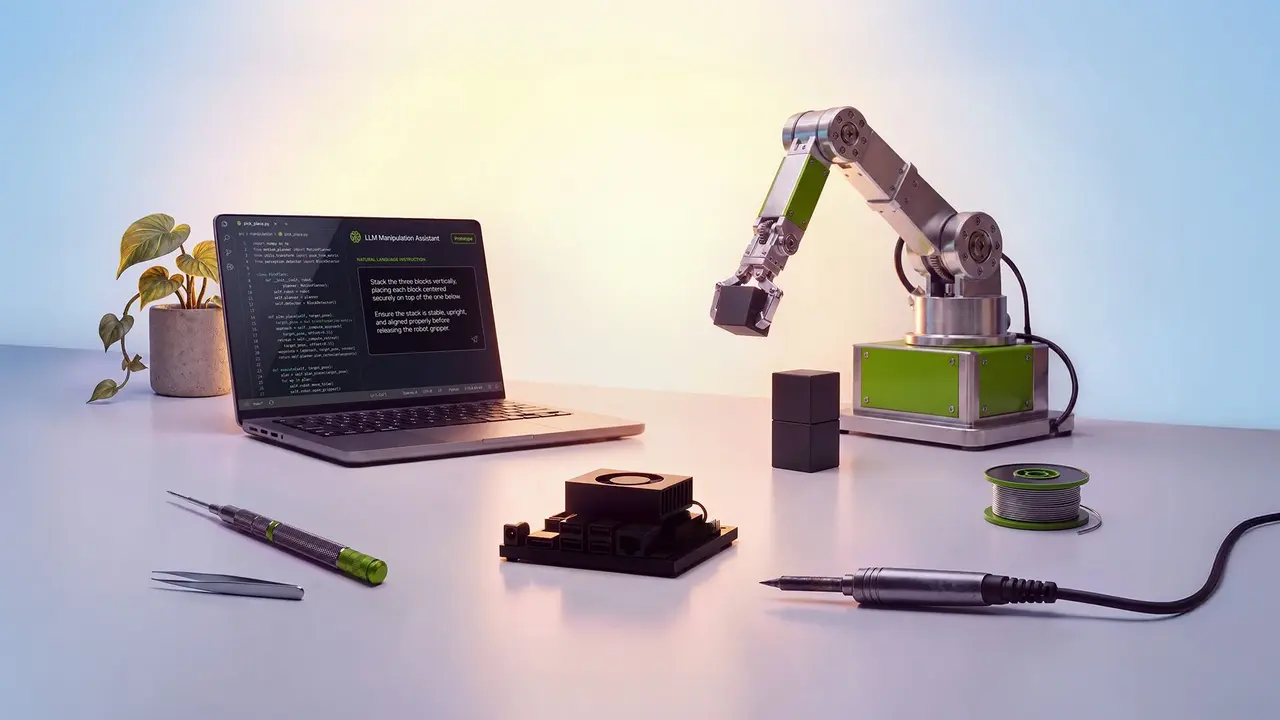
.The Jetson Thor T2000 brings the Thor architecture to a broader range of edge AI systems and autonomous machines. With 400 FP4 teraflops of compute and 16GB of memory, it provides an accessible entry point for developers building visual AI agents, autonomous mobile robots, industrial manipulators, and other intelligent machines
1
. The T2000 platform operates at 40 Watts, positioning it as a cost-effective solution for mainstream robotics and edge AI deployments that don't require the full power of the T30002
.With these new additions, NVIDIA now offers a scalable edge AI platform spanning performance from 70 TOPS to 2,000 teraflops, enabling developers to address virtually any edge AI workload across different price points and power envelopes
1
. This range allows companies to select the appropriate computing power for their specific physical AI applications without overprovisioning hardware.
Source: NVIDIA
Related Stories
NVIDIA introduced new Jetson agent skills that automate memory optimization across the entire software stack, delivering significant cost savings for developers. These AI-powered tools support the entire Jetson portfolio, including both Jetson Thor and Jetson Orin modules, enabling developers to run more capable workloads on lower-memory configurations
1
.Humanoid robotics leaders including UBTech and Agile Robots, along with industrial solutions provider Connect Tech, have reduced memory usage by up to 15GB, enabling them to move from NVIDIA Jetson AGX Orin 64GB to the 32GB module
1
. In smart retail, SandStar reduced memory usage by up to 4GB, enabling deployment on the NVIDIA Jetson Orin NX 8GB module instead of the 16GB configuration2
. The result is lower system cost, faster deployment, and the flexibility to move down one memory SKU within the same product tier without compromising performance1
.In intelligent transportation, NoTraffic reduced memory usage by 30% on Jetson TX2 NX, creating headroom to add more AI capabilities into its smart traffic platform without increasing hardware requirements
1
. These optimizations matter as memory prices remain elevated, and the ability to achieve similar performance on lower-cost hardware configurations directly impacts the economics of mass-market robot deployment.NVIDIA expanded its Cosmos 3 frontier open world foundation model family with Cosmos 3 Edge, a lightweight 4-billion-parameter model compatible with NVIDIA Thor platforms
1
. This model helps embodied systems see the world, reason over it in real time, and predict and generate actions through on-device inference. Using the open Cosmos framework, developers can post-train Cosmos 3 Edge for specific embodiments and sensors in about a day, closing the sim-to-real gap before deploying on physical AI applications1
.The integration of Cosmos 3 Edge with the Thor platform demonstrates how industrial automation and robotics companies can leverage pre-trained foundation models and customize them quickly for specific use cases. Partners providing Thor-based solutions include ADLINK, Advantech, AAEON, Aetina, Auvidea, AVerMedia, Connect Tech, ForeCR, JWIPC, NEXCOM Robotic Solutions, Realtimes, Seeed Studio, Twowin, TZTEK, and YUAN
2
. This ecosystem approach accelerates time-to-market for companies developing autonomous machines across healthcare, manufacturing, logistics, and retail sectors.Summarized by
Navi
[3]
1
Policy and Regulation

2
Technology

3
Technology