Nvidia releases Nemotron 3 Nano Omni with 30B params for edge AI agents and multimodal tasks


6 Sources
[1]
Nvidia releases Nemotron 3 Nano Omni: open multimodal model with 30B params, 3B active, for edge AI agents
Nvidia released Nemotron 3 Nano Omni on Tuesday, an open-weight multimodal AI model that unifies vision, audio, and language understanding in a single architecture designed to power autonomous AI agents on edge devices. The model has 30 billion parameters but activates only three billion per
[2]
Nvidia introduces Nemotron 3 Nano Omni with vision and speech for powerful agentic AI use - SiliconANGLE
Nvidia introduces Nemotron 3 Nano Omni with vision and speech for powerful agentic AI use Nvidia Corp. today launched a powerful reasoning artificial intelligence model that unifies text, vision and speech, capable of acting as the "brains" of faster, smarter agentic AI applications. Dubbed
[3]
Nvidia launches Nemotron 3 Nano Omni multimodal AI model
Nvidia unveiled Nemotron 3 Nano Omni, an open multimodal AI model that integrates vision, audio, and language capabilities into a single architecture. The model aims to address the issues of fragmented pipelines in enterprise AI systems by processing multiple input types, including text, images,
[4]
NVIDIA Launches Nemotron-3 Nano Omni, marking a new era of truly multimodal AI
NVIDIA has launched Nemotron-3 Nano Omni, a unified AI that combines sight, sound, and language in one system. The model marks a shift toward faster, more intuitive, and human-like AI capable of understanding real-world context in real time. In the ever-accelerating world of artificial
[5]

NVIDIA's New 30B Nemotron Model Tested : Mixture of Experts (MoE)
The NVIDIA Nemotron 3 Nano Omni features a 30-billion-parameter Mixture of Experts (MoE) architecture, designed to process diverse input formats such as video, audio, images, PDFs and text. According to All About AI, a recent evaluation highlighted the model's ability to deliver accurate outputs
[6]

What Is NVIDIA Nemotron 3 Nano Omni? The open multimodal model built for agentic AI
Most AI agent systems today are a patchwork. Need to process a screen recording? One model. Transcribe audio from a customer call? Another. Parse a PDF? A third. Each handoff between models adds latency, fragments context, and introduces fresh opportunities for error. NVIDIA's new Nemotron 3 Nano
Share
Copy Link
Nvidia launched Nemotron 3 Nano Omni, an open-weight multimodal AI model that unifies vision, audio, and language understanding in a single architecture. With 30 billion parameters but only 3 billion active per inference, the model delivers 9x higher throughput than comparable models while running on a single GPU. Early adopters include Foxconn, Palantir, and H Company, with Dell, Oracle, and Infosys evaluating it for production deployment.
Nvidia Unveils Nemotron 3 Nano Omni for Edge AI Deployment
Nvidia released Nemotron 3 Nano Omni on Tuesday, an open-weight multimodal AI model that consolidates vision, audio, and language understanding into a single architecture designed specifically for agentic AI applications on edge devices
1
. The model features 30 billion parameters but activates only 3 billion per forward pass through a mixture of experts architecture, enabling it to run on a single GPU while matching or exceeding the multimodal capabilities of models several times its size1
. This architectural approach addresses a critical constraint in edge computing: maximizing capability per active parameter rather than total parameters, since deployment is limited by compute per AI inference step rather than model size at rest1
.
Source: Geeky Gadgets
The release represents Nvidia's most direct move into the AI model market, complementing its dominance in GPU optimization and infrastructure. Available on Hugging Face under Nvidia's Open Model Agreement with full commercial use rights, the open source AI model can process text, images, audio, video, documents, charts, and graphical interfaces as inputs while producing text as output
1
. This means a single model can replace the fragmented collection of specialized vision, speech, and document-processing models that most enterprise AI deployments currently stitch together1
.
Source: ET
High Throughput Performance Through Mixture of Experts Architecture
Nvidia claims the Nemotron 3 Nano Omni delivers 9x higher throughput than comparable open multimodal models with equivalent interactivity, 2.9x faster single-stream reasoning on multimodal tasks, and roughly 9x greater effective system capacity for video reasoning
1
. The model tops six AI benchmarks across document intelligence, video understanding, and audio comprehension1
. In video reasoning tasks specifically, it achieves around 3x greater throughput with 2.75x lower compute power3
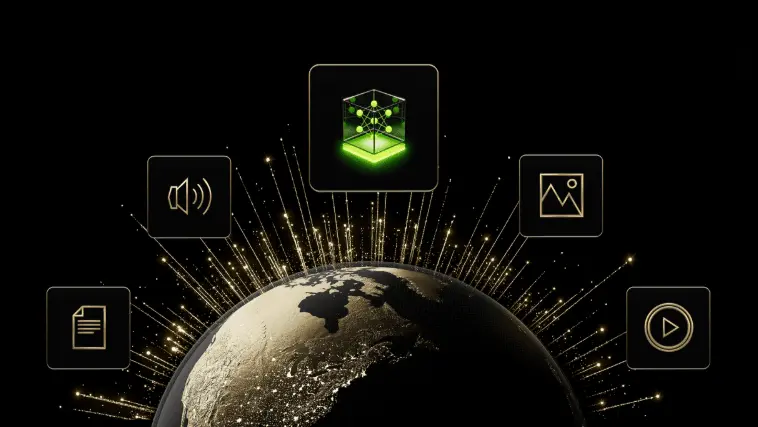
.The architecture employs a hybrid Mamba-Transformer architecture with 23 Mamba-2 selective state-space layers, 23 Mixture of Experts (MoE) layers with 128 experts routing to six per token plus a shared expert, and six grouped-query attention layers
1
. The vision encoder, C-RADIOv4-H, handles variable-resolution images with 16-by-16 patches scaling from 1,024 to 13,312 visual patches per image, while the audio encoder, Parakeet-TDT-0.6B-v2, processes speech and environmental audio1
. Video processing uses three-dimensional convolutions to capture motion between frames rather than treating video as a sequence of still images1
.
Source: SiliconANGLE
Low Latency Processing Enables Real-Time AI Agents
The model's low latency processing capability addresses a fundamental challenge in building practical AI agents: the need for near-instantaneous interpretation of complex inputs. "To build useful agents, you can't wait seconds for a model to interpret a screen," said Gautier Cloix, chief executive of H Company. "By building on Nemotron 3 Nano Omni, our agents can rapidly interpret full HD screen recordings -- something that wasn't practical before"
2
. The base text model was pretrained on 25 trillion tokens and supports a 256,000-token context window1
.Unlike traditional approaches that use separate specialist models stitched together in a pipeline, which introduces latency at each handoff, Nemotron 3 Nano Omni routes each token to six of 128 experts within a unified model
1
. Vision tokens, audio tokens, and text tokens all flow through the same architecture but activate different expertise depending on the modality, allowing the model to process a video feed, a spoken instruction, and a document simultaneously without inter-model latency1
. For enterprise AI deployments, this collapses the operational complexity of maintaining separate vision, speech, and language models with separate inference endpoints, monitoring, and versioning into a single model serving a single endpoint1
.Related Stories

Strategic Positioning in Full-Stack AI Ecosystem
Nvidia has spent the AI boom selling infrastructure through GPUs, networking, and the NVIDIA CUDA ecosystem that locks developers into its hardware
1
. The Nemotron model family, which has been downloaded more than 50 million times in the past year, represents a parallel strategy where Nvidia also provides the models that run on that infrastructure1
2
. The logic creates a full-stack ecosystem that competes with the model-plus-cloud offerings from Google, Amazon, and Microsoft: Nvidia's models are optimized for Nvidia's hardware, and Nvidia's hardware is optimized for Nvidia's models1
.The model is designed to run alongside other proprietary cloud models or other Nvidia Nemotron open models, such as Nemotron 3 Super for high-frequency execution or Super for complex planning
2
. This positioning extends the argument for small, domain-specific language models into multimodal applications: rather than calling a massive cloud model for every vision or audio task, enterprises can run a compact model locally that handles the full perceptual stack1
.Early Enterprise Adoption and Evaluation
Early enterprise adoption includes Foxconn, Palantir, Aible, ASI, Eka Care, and H Company, while Dell, DocuSign, Infosys, Oracle, and Zefr are evaluating the model for production deployment
1
3
. The use cases span factory-floor visual inspection, document processing, voice agent applications, and screen understanding for computer-use agents1
. The model is accessible on platforms including Hugging Face, OpenRouter, Amazon SageMaker JumpStart, Vultr, and over 25 partner platforms3
.Nvidia released Nemotron 3 Nano Omni with open weights, datasets, and training recipes for developer customization
3
. Testing with a React Vite-based application featuring drag-and-drop functionality demonstrated the model's ability to deliver accurate outputs across multiple tasks, including audio transcription, image description, and structured text extraction from PDFs5
. The model's smaller size allows it to be compressed enough to run on higher-end consumer hardware and execute efficiently on enterprise cloud deployments2
, with the architectural choices reflecting deployment on hardware announced at Nvidia's GTC 2026 developer conference, including the DGX Spark and DGX Station workstations1
.References
Summarized by

Navi
[1]
[2]
[3]
[5]
Related Stories
Nvidia launches Nemotron 3 Super with 5x throughput boost to power enterprise AI agents
11 Mar 2026•Technology
Nvidia Unveils Nemotron-Nano-9B-v2: A Compact AI Powerhouse with Toggle-On Reasoning
19 Aug 2025•Technology

Nvidia launches Nemotron 3 open source AI models as Meta steps back from transparency
15 Dec 2025•Technology

Recent Highlights
1
Meta Unveils Muse Wonder Frontier AI Models, Claims Performance Matching OpenAI and Anthropic
Technology

2
IMF Report Warns AI Market Correction Could Spark Global Financial Crisis With $1.4T at Risk
Business and Economy

3
OpenAI Releases 722 AI-Generated Math Solutions, Triggering Existential Crisis in Mathematics
Technology

Recent Highlights
Today's Top Stories










Don’t drown in AI news. We cut through the noise - filtering, ranking and summarizing the most important AI news, breakthroughs and research daily. Follow topics that matter to you and stay ahead.


