Trump's Controversial AI Chip Deal with Nvidia and AMD Reshapes US-China Tech Relations


6 Sources
[1]
US may purchase stake in Intel after Trump attacked CEO
Donald Trump has been meddling with Intel, which now apparently includes mulling "the possibility of the US government taking a financial stake in the troubled chip maker," The Wall Street Journal reported. Trump and Intel CEO Lip-Bu Tan weighed the option during a meeting on Monday at the White
[2]
China isn't welcoming Nvidia back with open arms after Trump clears way for H20 exports
Beijing is signaling to its tech firms that they must continue to support local AI chip companies, experts say.Nvidia secured what was seen as a major win last month when the U.S. government announced it would allow it to resume sales of its made-for-China H20 chip. But it has since become clear
[3]
Trump hiked tariffs on US imports. Now he's looking at exports - sparking fears of 'dangerous precedent'
Experts warn of destabilized trading relations after White House strikes deal with Nvidia to take a 15% cut of certain AI chip sales to Chinese companies Apple CEO Tim Cook visited the White House bearing an unusual gift. "This box was made in California," Cook reassured his audience in the Oval
[4]
Trump's unprecedented, potentially unconstitutional deal with Nvidia and AMD, explained: Alexander Hamilton would approve
The chips do appear to be quite significant to China, considering that the Cyberspace Administration of China held discussions with Nvidia over security concerns that the H20 chips may be tracked and turned off remotely, according to a disclosure on its website. The deal, which lifted an export ban
[5]
Nvidia and AMD's 'special treatment' from Trump shakes up an already tangled global chip supply chain
Donald Trump's decision to let Nvidia and AMD export AI processors to China in exchange for a cut of their sales will have repercussions far beyond the U.S. The semiconductor supply chain is global, involving a wide array of non-U.S. companies, often based in countries that are U.S. allies.
[6]

The Nvidia chip deal that has Trump officials threatening to quit
Dylan Matthews is a senior correspondent and head writer for Vox's Future Perfect section and has worked at Vox since 2014. He is particularly interested in global health and pandemic prevention, anti-poverty efforts, economic policy and theory, and conflicts about the right way to do
Share
Copy Link
The Trump administration strikes an unprecedented deal allowing Nvidia and AMD to sell AI chips to China in exchange for revenue sharing, sparking debates on legality and global trade implications.
Trump Administration's Unprecedented AI Chip Deal
In a surprising turn of events, the Trump administration has brokered an unconventional deal with tech giants Nvidia and Advanced Micro Devices (AMD), allowing them to resume sales of certain artificial intelligence chips to Chinese companies. This arrangement, however, comes with a significant caveat: the companies must share 15% of their revenue from these sales with the U.S. government
1
2
.
Source: CNBC
The Deal's Implications and Controversies
This unprecedented move has sparked intense debate among experts, policymakers, and industry leaders. The deal represents a dramatic shift from the administration's previous stance, which had blocked the export of these chips to China in April
3
. Critics argue that this arrangement could set a dangerous precedent, potentially destabilizing trading relations and undermining the integrity of export controls.Martin Chorzempa, a senior fellow at the Peterson Institute for International Economics, warned that this deal creates "the perception that export controls are up for sale," which could lead to a wave of lobbying for sensitive technologies
3
. The legality of the arrangement is also under scrutiny, with some experts questioning whether it constitutes an unconstitutional export tax4
.Global Repercussions and Supply Chain Impact
The deal's implications extend far beyond U.S. borders, affecting the intricate global semiconductor supply chain. While Nvidia and AMD are U.S. companies, their chips rely on components and manufacturing processes involving firms from Taiwan, the Netherlands, Japan, and South Korea
5
. This interconnectedness raises questions about how other countries and companies might respond to this new paradigm.Paul Triolo, a partner at the DGA-Albright Stonebridge Group, suggests that U.S. allies "will be glad to see a major stepping back from controls"
5
. This sentiment could potentially lead to a weakening of the multilateral export control regime that the U.S. has worked to establish.China's Response and Market Dynamics
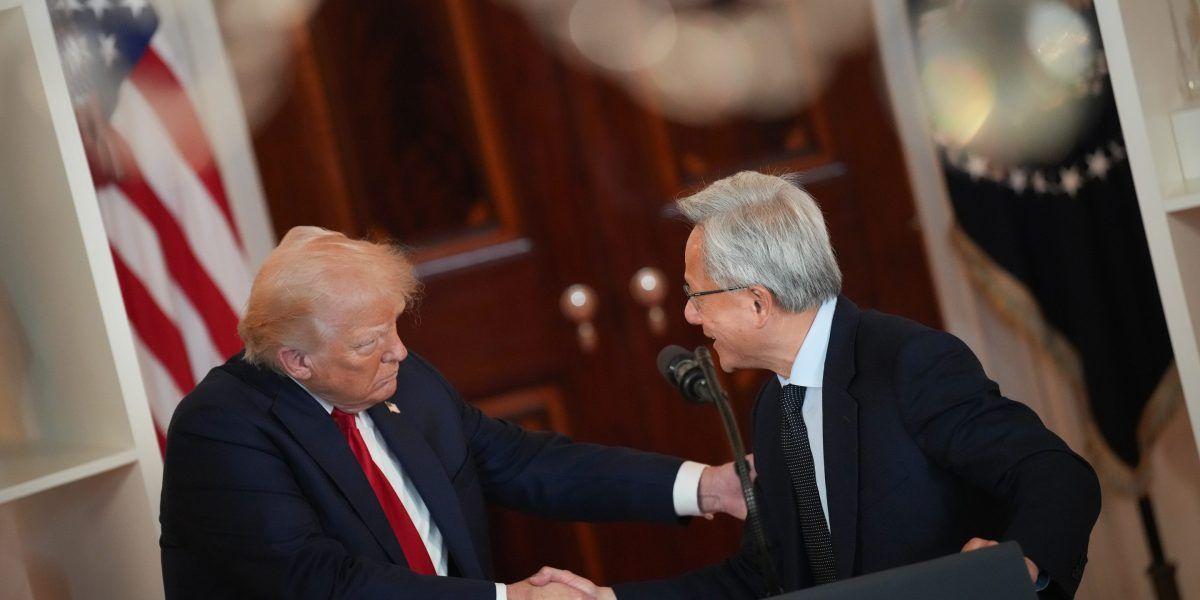
Source: Fortune
Despite the U.S. government's apparent concession, China's response has been cautious. Reports indicate that Beijing has urged its tech companies against using Nvidia's H20 chips, especially for government and national security applications
2
. This stance underscores China's commitment to developing its domestic chip industry and reducing reliance on U.S. technology.Related Stories

The Broader Context of U.S.-China Tech Relations
This deal comes amid ongoing tensions between the U.S. and China in the tech sector. It follows other controversial moves by the Trump administration, including potential government stakes in companies like Intel
1
. The administration frames this as a strategy to maintain U.S. dominance in AI technology while extracting economic benefits.
Source: Ars Technica
Future Implications and Industry Reactions
The semiconductor industry and policymakers are closely watching how this deal unfolds. Treasury Secretary Scott Bessent has suggested that this model could be expanded to other industries
4
, raising concerns about the long-term implications for U.S. trade policy and corporate autonomy.As the global tech landscape continues to evolve, this unprecedented deal may mark a significant shift in how governments approach technology exports and international competition in critical sectors like artificial intelligence.
References
Summarized by

Navi
[1]
[3]
Related Stories
U.S. Imposes 15% Revenue Share on Nvidia and AMD's AI Chip Sales to China Amid Escalating Tech Rivalry
05 Aug 2025•Policy and Regulation

Nvidia's H20 Chip Caught in US-China AI Trade Tensions
10 Aug 2025•Technology

Nvidia and AMD to Pay 15% of China AI Chip Sales Revenue to US Government
04 Aug 2025•Business and Economy

Recent Highlights



Recent Highlights
Today's Top Stories






Don’t drown in AI news. We cut through the noise - filtering, ranking and summarizing the most important AI news, breakthroughs and research daily. Follow topics that matter to you and stay ahead.


