30 Sources
[1]
Nvidia investing $1.5B in SoftBank data center developer behind OpenAI project
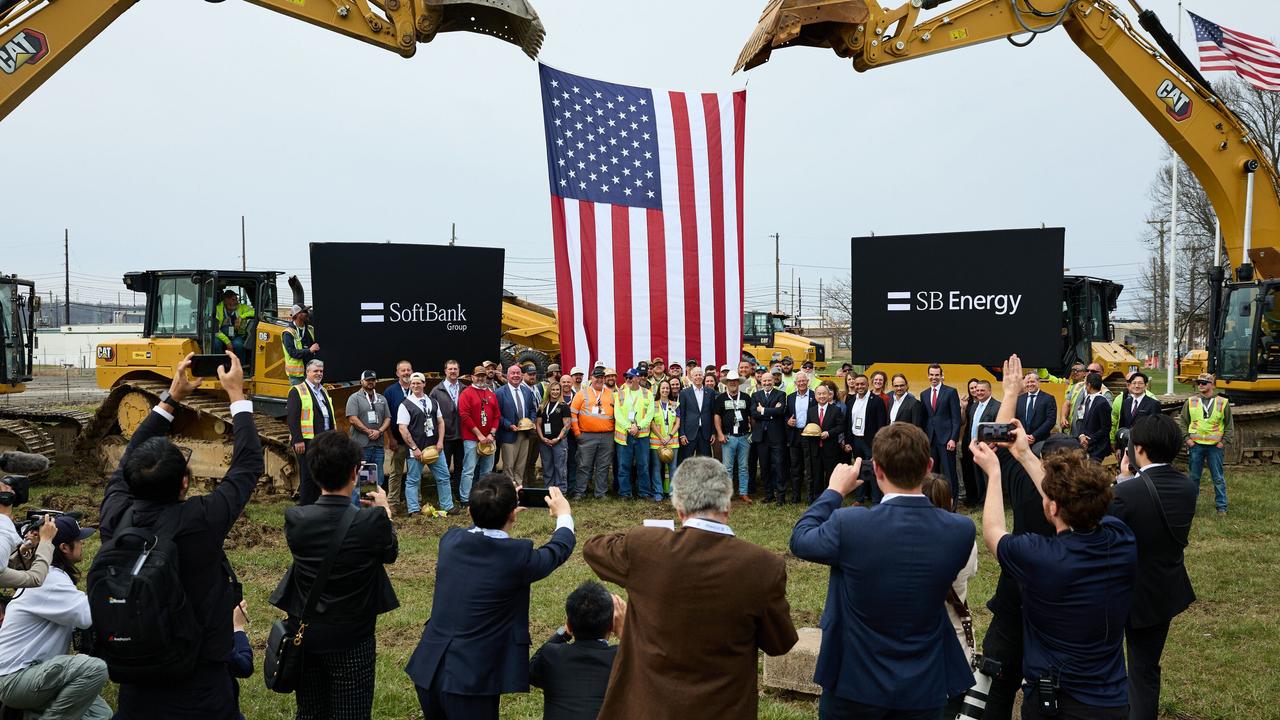
Nvidia said on Monday that it will invest $1.5 billion in SB Energy, a data center linked to SoftBank and OpenAI. The investment ensures that Nvidia will be the sole supplier of compute infrastructure at OpenAI's Ports-Pike data center near Cincinnati, Ohio. Nvidia will also provide up to $105 billion in credit to help build the facility, which could scale from an initial 4.25 gigawatts to 8 gigawatts in size, according to documents the company filed with the SEC. SB Energy's existing investors include SoftBank and OpenAI. SoftBank had previously held $5.8 billion worth of Nvidia stock, which it sold in November to help fund other AI investments. The data center and power developer will build a 9.2 gigawatt natural gas power plant on the site, which is land owned by the U.S. Department of Energy. The site previously enriched uranium for the U.S. nuclear arsenal and for U.S. Navy submarines. The power plant is expected to cost $33 billion. The steep sum reflects the skyrocketing costs of building natural gas power plants, which have risen 66% in the last two years, according to BloombergNEF. By the time SB Energy's power plant and others are completed, they'll be competing for natural gas with export markets, a confluence that could triple natural gas prices in some parts of the country.
[2]
Nvidia to invest $100bn for OpenAI data centre in Ohio
Chipmaker also invests $1.5bn into SB Energy, an energy company founded as part of SoftBank Group Nvidia has agreed to provide a more than $100bn backstop for a huge new OpenAI data centre in Ohio that is being developed alongside a SoftBank-led energy company, in one of the biggest AI infrastructure deals yet. The AI chipmaker will also invest $1.5bn into SB Energy, an energy company founded as part of the SoftBank Group in 2019 that has recently focused on data centre development after striking a $1bn alliance with OpenAI in January. The deal is the latest example of how Big Tech companies including Nvidia, Google and Amazon are using their balance sheets to strike alliances with OpenAI and Anthropic, betting hundreds of billions of dollars that demand for AI services will continue to surge in the coming years. OpenAI plans to lease as much as 8 gigawatts of AI computing power at the PORTS-Pike Technology Campus in Pike County, Ohio, which will take until 2032 to complete. The ChatGPT maker said the first 800 megawatts is expected to come online in 2028, as it races to secure new computing power to fuel its growth. SB Energy will build, own and operate the data centre, with OpenAI taking a 20-year lease to become its main customer. "We expect to use this capacity to meet growing demand for advanced AI and maintain our lead as the frontier AI research laboratory in pursuit of our mission," OpenAI said, adding that the Ohio project would help to "establish the data centre as a model for future next-gen supercomputer design". Nvidia will provide credit support for the "land, power and shell" for the facility capped at $105bn, it said in a regulatory filing, backstopping the development of the property, energy and warehouses that will ultimately house more than 1mn of its AI chips. One condition of Nvidia's obligation is that the Ohio facility will be ready to begin operating in 2028. The deal comes after last week's landmark $500bn agreement between Nvidia and a consortium of Wall Street firms to fuel AI infrastructure development. Jensen Huang, Nvidia's chief executive, denied that the latest arrangement with OpenAI and SB Energy amounted to "circular financing". He argued in a blog post on Monday that the world's most valuable company was using its "scale and long-term visibility" to facilitate the build-out. "LPS [land, power and shell] has become a critical constraint on AI factory deployment," Huang said. "Nvidia is selectively securing exceptional sites where we can host multiple generations of Nvidia compute and serve durable customer demand." Nvidia stands to generate $150bn to $200bn in revenue from the site, he said, as the exclusive supplier of the computing systems that will underpin what could eventually become one of the world's largest AI data centres. OpenAI's spending on Nvidia chips could reach as much as $600bn by 2030 if the company extends the Ohio project beyond its initial 4.25GW commitment.
[3]
Nvidia backs financing for OpenAI data center in Ohio
* Nvidia will provide the credit and compute for an OpenAI data center in Ohio * SB Energy will build and manage the data center in Pike City, Ohio * The deal is Nvidia's latest to support the sprawling artificial intelligence data center buildout In this article * OPENAI.FG * NVDA Follow your favorite stocksCREATE FREE ACCOUNT Jensen Huang, chief executive officer of Nvidia Corp., speaks to members of the media following the company's "Japan AI Ecosystem" reception in Tokyo, Japan, on Thursday, July 16, 2026. Kiyoshi Ota | Bloomberg | Getty Images Nvidia on Monday said it will provide the credit and compute for a new artificial intelligence data center for OpenAI in Ohio. The credit will support an initial 4.25 gigawatts of computing capacity with the option for an additional 3.75 gigawatts. Capacity is expected to come online in phases in 2028. SB Energy will build and manage the datacenter at the PORTS-Pike Technology Campus in Pike City, Ohio, through a 20-year lease to OpenAI. The frontier lab has a stake in the company, and OpenAI CEO Sam Altman was also an early investor in SB Energy. "We are securing long-lived infrastructure for NVIDIA compute so OpenAI can deploy the most productive AI factories that can be upgraded repeatedly with each new generation delivering more intelligence and better economics," said Nvidia CEO Jensen Huang in a release. CNBC previously reported that Nvidia was in discussions with OpenAI to provide a backstop of up to $250 billion that would let the model maker raise debt for a 10-gigawatt data center at the Ohio location. The Wall Street Journal reported last week that Nvidia was set to cut that guarantee to less than $120 billion for the buildout. The deal is Nvidia's latest in a string of financing maneuvers to support the sprawling AI data center buildout, which has raised concerns about circular financing in the AI trade. Last week, Nvidia lined up $500 billion in financing for customers to buy its hardware for data center projects. As part of the Ohio deal, SB Energy and SoftBank will build power sources supporting 10 gigawatts of energy and invest at least $4.2 billion in grid infrastructure for the region. Nvidia will invest $1.5 billion in SB Energy. OpenAI said the new data center will support 35,000 new construction jobs through 2032 and 2,500 long-term positions. Read more CNBC tech news watch now VIDEO5:3705:37 OpenAI President Greg Brockman: Compute is becoming the new oil of the AI age Squawk Box Choose CNBC as your preferred source on Google and never miss a moment from the most trusted name in business news.
[4]
Nvidia to Back Ohio Data Center With as Much as $105 Billion
Sign up for the On Tech newsletter. Get our best tech reporting from the week. Get it sent to your inbox. Nvidia said on Monday that it had agreed to spend as much as $105 billion to back one of the world's largest data centers, which is being built in Ohio and will be leased to OpenAI. The sum is one of the largest from Nvidia toward supporting A.I. labs that are seeking more computing power. Jensen Huang, Nvidia's chief executive, said in a blog post that the company would use the money to guarantee "lease and power payments" at the site. He added that A.I. labs "are growing faster than their balance sheets and long-term credit profiles can support." Nvidia's financing for the Ohio data center, a project that could cost as much as $500 billion, is part of the complex deal-making behind the A.I. boom. Using unusual arrangements with chipmakers, cloud computing providers and governments, start-ups like OpenAI and Anthropic are gaining access to computing power that they could not afford by themselves. Many of these deals are circular, with an A.I. start-up receiving billions of dollars from technology giants before spending those billions on the same companies to pay for chips, cloud computing and other services. Nvidia previously invested $30 billion in OpenAI, and the data center in Ohio will use only Nvidia's chips. Mr. Huang said in the blog post that Nvidia's financing for the Ohio data center was not circular because "OpenAI will pay the lease." In turn, OpenAI said in a blog post that it would lease the Ohio site "only as completed capacity becomes available," meaning it may not pay anything until the data center starts coming online in 2028. OpenAI agreed to a 20-year lease for the site, which will provide it 8 gigawatts of computing capacity, or enough electricity to power about six million households in the United States. Nvidia's financing will support 4.25 of those gigawatts, though the company could extend its arrangement to the remaining gigawatts. Nvidia and OpenAI had previously discussed the chipmaker providing a $250 billion in financial backing for the Ohio data center. Nvidia also said on Monday that it had agreed to invest $1.5 billion in SB Energy, a subsidiary of the Japanese conglomerate SoftBank that will build, own and operate the data center in Ohio. Nvidia has taken other steps to finance the A.I. boom. Last week, the company and six giant asset managers, private equity firms and banks announced an effort to raise $500 billion in financing for Nvidia's customers to pay for chips, data centers and computing power. (The New York Times sued OpenAI and Microsoft in 2023, claiming copyright infringement of news content related to A.I. systems. The two companies have denied those claims.)
[5]
Nvidia's $105bn Ohio guarantee covers buildings, not OpenAI
Nvidia signed the Ohio deal on Monday and capped its exposure at $105bn, down from the $250bn first reported in July. The cut matters less than the rewrite. The guarantee now covers what the buildings are worth, not what OpenAI owes, and OpenAI has agreed to repay anything Nvidia pays out. A residual value guarantee is a promise about an object, not about a tenant. Someone builds a thing. Someone else rents it. A third party promises the thing itself will still be worth a set amount. If the renter walks, the owner relets or sells. The guarantor covers only the shortfall. It is the structure behind a car lease. It now underpins the largest data centre project yet announced. Nvidia confirmed the arrangement on Monday. It has secured land, power and shell capacity at the PORTS-Pike Technology Campus in Pike County, southern Ohio. SB Energy will build, own and operate the campus. OpenAI has signed a 20-year lease as the customer. The initial phase covers 4.25 IT-gigawatts, and Nvidia holds an option on the remaining 3.75. "Now is the time to scale the AI infrastructure that will power the next industrial revolution," said Jensen Huang, Nvidia's founder and chief executive. What Nvidia actually promised The Wall Street Journal reported the terms first, in a piece by Anissa Gardizy. Nvidia backs the value of the completed data centres rather than the rent. In return it becomes the exclusive chip provider for the first half of the site and takes an equity stake in SB Energy. It can extend the commitment to the full campus later. The mechanics sit in a filing Nvidia made on Monday. Payment is triggered only if OpenAI defaults on a lease or becomes insolvent. Several things must happen before that reaches Nvidia. SB Energy has to try to relet the site at the same price. If that fails, it has to try to sell. Only the remaining shortfall is Nvidia's, and the cumulative obligation is capped at $105bn. Nvidia also picks the remedy. It can assume the lease, force a reletting, start a sale, allow termination, or defer for up to a year while covering project costs. The guarantee attaches to finished buildings, not to anything under construction. It expires three ways: if OpenAI wins a satisfactory credit rating, if OpenAI ends a lease on its own terms, or 20 years after each lease begins. One clause sits further down. OpenAI has agreed to reimburse and indemnify Nvidia for any amount Nvidia actually pays out. The company being backstopped has promised to repay the backstop. That is worth less than it sounds, because a claim against an insolvent OpenAI would not be worth much. It does show what the structure is: a bridge, not a subsidy. The number that fell, and the one that was halved In late July the Journal reported that Nvidia was discussing a guarantee across all 10 gigawatts, worth roughly $250bn. Nvidia shares fell 5%. By Friday the company had halved that promise, and the filed figure is lower again. Size is the part everyone counted. The instrument is the part that changed. The Information reported on Saturday that Nvidia was weighing as much as $3bn in SB Energy, split in two: half on signing, half at the developer's flotation. Reuters carried the report the same day. Nvidia has now confirmed $1.5bn, which is the first half. SB Energy is working with bankers on a listing as soon as next month. Nvidia earns from the site either way. It plans to sell hundreds of billions of dollars of chips into the initial phase, according to people familiar with the deal. That is the circularity its critics keep naming. It struck a similar arrangement with six finance giants last week, and Google did the same for Anthropic in July. 9.2 gigawatts of gas on a uranium site The campus is a reindustrialisation of the Portsmouth Gaseous Diffusion Plant, a Cold War uranium enrichment site. It spans private land and federal land leased from the Department of Energy. SB Energy and SoftBank plan at least 10 gigawatts of new generation, including 9.2 gigawatts of natural gas. The gas plant is owned by the US government and financed by Japan under a recent trade deal. Power is the part local residents will feel. SB Energy and AEP Ohio will spend at least $4.2bn on new transmission, including 765-kilovolt lines and four substations. OpenAI says the project pays those costs itself and will not shift them onto Ohio ratepayers. It says cooling runs closed-loop and air-cooled, with ongoing water use comparable to an office building. Those are the company's own published commitments. The job figures have grown between documents. A Department of Energy fact sheet in March projected more than 10,000 construction jobs over four years, and more than 2,000 operating roles. OpenAI now says 35,000 construction jobs across a six-year buildout to 2032, and 2,500 long-term operating jobs. The buildout window lengthened between the two. OpenAI has promised an annual public report on hiring, water and energy use. "This is going to be a huge site, with enough computing power to help millions of people use AI to do things we can only start to imagine today," said Sam Altman, OpenAI's chief executive. None of it is built Nothing at PORTS-Pike is running yet. The first 800 megawatts are expected in 2028, largely on existing AEP infrastructure. Everything beyond that needs new power plants, new transmission, permits, environmental reviews and financing. OpenAI starts paying only as completed capacity becomes available to lease. Nvidia's guarantee, in the same way, attaches only once buildings finish and leases commence. The ground around the paperwork is less settled. More than 500 US jurisdictions now ban or restrict data centres. Nvidia's credit-default swaps hit a record last month on precisely these circular-financing worries. And the guarantee dissolves the moment OpenAI earns a credit rating strong enough to borrow on its own name. OpenAI told investors this month that its enterprise revenue has overtaken its consumer business. Rent will come from that growth plus money it raises, the company says. So the test has a date on it. If the first 800 megawatts energise in 2028 and OpenAI is paying without a claim landing on Nvidia, the structure worked. If OpenAI holds a credit rating by then, Nvidia never needed to write it.
[6]
Securing the Infrastructure of Intelligence
Land, power and shell: The next critical resource for AI factories. AI factories are the defining infrastructure of the AI era -- where compute transforms energy and data into intelligence that powers every business, industry and country. In the AI economy, compute is revenue. AI factories require a full stack of critical resources: advanced chips, packaging, memory, and networking - as well as land, power and shell. Just as NVIDIA has used its scale, long-term visibility and supply-chain partnerships to secure critical semiconductor resources, we are now applying that same discipline to secure LPS capacity exclusively for NVIDIA AI factories. Today, we are partnering with SB Energy to secure LPS capacity at the exceptional PORTS-Pike Technology Campus in Portsmouth, Ohio, to host NVIDIA compute. OpenAI will be the tenant. LPS: The Next Strategic Resource For the vast majority of NVIDIA customers, securing LPS has long been a part of their infrastructure strategy. The world's largest cloud service providers and investment-grade enterprises have balance sheets, infrastructure expertise, and long-term contracts to secure LPS independently. They build and operate AI factories using NVIDIA accelerated computing, networking, systems and software. This model will continue to represent most of NVIDIA's business. But frontier AI labs are different. Frontier AI labs have extraordinary demand for training and inference compute, but many are growing faster than their balance sheets and long-term credit profiles can support. They may have strong customer demand and rapidly growing revenue yet still lack the decades-long infrastructure contracts and investment-grade financing capacity needed to secure the AI factory infrastructure independently. Their growth is increasingly constrained not by algorithms or customer demand, but by the availability of compute. For these companies, more compute means more intelligence, more products, more users and more revenue. NVIDIA is helping provide the infrastructure that powers this flywheel. PORTS-Pike: A Site for Generations of NVIDIA Compute OpenAI will build and operate a world-class AI factory at PORTS-Pike. The AI factory will use NVIDIA's full-stack DSX AI factory platform, including GPUs, CPUs, networking, and infrastructure software. The initial deployment is expected to provide 4.25 gigawatts of AI factory capacity. Each generation of NVIDIA AI factory systems deployed at PORTS-Pike could represent approximately 1.5 million NVIDIA GPUs, or approximately $150 billion to $200 billion in NVIDIA revenue. Over 20 years, the site can support multiple upgrade cycles. This is the essential economic point: the LPS commitment secures a long-lived AI factory site, while the NVIDIA compute inside can be upgraded repeatedly. Each new generation can deliver greater production, more intelligence and better economics. NVIDIA may also choose to extend the arrangement at PORTS-Pike beyond the initial 4.25 gigawatts to secure the remaining capacity of 3.75 gigawatts. OpenAI and NVIDIA Expanding Compute Opportunity More broadly, OpenAI has committed to substantial deployments of NVIDIA AI infrastructure through 2030. OpenAI's existing and planned commitments represent approximately 12 gigawatts of NVIDIA compute, with an opportunity to expand to approximately 16 gigawatts if NVIDIA extends the PORTS-Pike arrangement beyond the initial 4.25 gigawatts. At these levels, the opportunity represents roughly $600 billion of NVIDIA compute through 2030. The Important Questions What is NVIDIA guaranteeing, and for how long? NVIDIA is supporting the LPS infrastructure at PORTS-Pike for approximately 4 gigawatts over a 20-year term, securing a site on which NVIDIA compute will be exclusively deployed. Our support is limited to defined portions of lease and power payments, along with a specified residual-value commitment -- not the full cost of the site or all of the tenant's obligations. The guarantee will become effective in phases as data centers are placed in service between 2028 and 2030. As OpenAI makes lease payments and capacity comes online, NVIDIA's remaining exposure declines. Why is NVIDIA guaranteeing PORTS-Pike? LPS has become a critical constraint on AI factory deployment. NVIDIA is selectively securing exceptional sites where we can host multiple generations of NVIDIA compute and serve durable customer demand. The productive life of the site extends through multiple generations of NVIDIA systems, each capable of producing more intelligence and more revenue than the generation before. Is this circular financing? No. OpenAI will pay the lease. NVIDIA uses its scale and long-term visibility to secure PORTS-Pike to host NVIDIA compute. This is the same discipline we apply to supply-chain management: we secure critical inputs when we have visibility into customer demand and when doing so enables long-term productive capacity. What happens to PORTS-Pike if OpenAI does not use the site in the future? NVIDIA compute is versatile, fungible and broadly adopted. The capacity can be resold to another qualified tenant across NVIDIA's global ecosystem of cloud service providers, enterprises, AI labs and startups. CUDA makes NVIDIA compute more than hardware. It gives developers and NVIDIA engineers a common platform to continually improve installed systems. CUDA makes NVIDIA compute versatile. Versatility makes it fungible. Fungibility drives utilization and durability -- making NVIDIA compute a productive asset: rentable and financeable. The value of an exceptional site, like PORTS-Pike, is not limited to one customer or one generation of compute. NVIDIA's standardized platform, broad developer ecosystem and large market of potential users support the ability to redeploy productive capacity over time. How much LPS will NVIDIA secure? It will be strategic and disciplined. Most NVIDIA customers will continue to secure their own LPS. The vast majority of LPS hosting NVIDIA compute will continue to be secured directly by CSPs, enterprises, sovereign AI builders and other customers. NVIDIA will focus selectively on exceptional sites where visible, durable demand can support multiple generations of NVIDIA compute. The Infrastructure of Intelligence PORTS-Pike represents the next step in NVIDIA's journey. We began by building accelerated computing chips. We then expanded to systems, networking, CUDA and full-stack AI factories. Today, we are helping secure the critical infrastructure required to build these factories. NVIDIA is the full-stack AI infrastructure platform. We are investing in the long-lived foundations of AI factories so our customers can deploy the most productive compute platform in the world, generation after generation. By securing the critical resources needed to host NVIDIA compute, we can help the world's most innovative companies build the AI factories that will power the age of intelligence.
[7]
OpenAI's Ohio data center project to have 8 GW of compute capacity
OpenAI, SoftBank's SB Energy, and Nvidia announced a massive 20-year data center site in Pike County, central Ohio. The facility will feature 8 IT gigawatts of computing capacity powered by 10 gigawatts of energy. The project sits partly on federal property once dedicated to enriching uranium. OpenAI stated that the goal is to generate 35,000 construction jobs and 2,500 permanent positions. Running exclusively on Nvidia hardware, the data center will be supported by a $4 billion-plus local energy infrastructure investment from SoftBank and SB Energy. OpenAI expects the data center's initial computing capacity to come online starting in 2028, marking the first phase in bringing the mega-campus fully operational. "This is going to be a huge site, with enough computing power to help millions of people use AI to do things we can only start to imagine today, from finding new medicines to starting businesses and solving hard problems," said Sam Altman, CEO of OpenAI. This huge structure will be supported by complex financial structure. Nvidia agreed to guarantee up to $105 billion in conditional lease and power payment obligations, stepping in as the financial backstop should OpenAI default. In exchange, Nvidia gets exclusive rights to supply the chips, along with a direct $1.5 billion equity investment in SB Energy. "AI is becoming infrastructure - the foundation for intelligence in every industry - and land, power and shell have become vital in the age of AI. Now is the time to scale the AI infrastructure that will power the next industrial revolution," said Jensen Huang, founder and CEO of NVIDIA. "We are securing long-lived infrastructure for NVIDIA compute so OpenAI can deploy the most productive AI factories that can be upgraded repeatedly with each new generation delivering more intelligence and better economics," Huang added in the press statement. Critics immediately flagged the structure, warning it echoes "circular" financing where suppliers, buyers, and investors prop up one another's balance sheets. Huang pushed back firmly against those concerns. "Is this circular financing? No," Huang declared, stressing that OpenAI remains directly on the hook for rent payments. According to Huang, Nvidia is simply using its scale and long-term visibility to secure durable physical locations. That strategy allows them to repeatedly upgrade hardware over multiple chip generations at a single mega-site. Reportedly, the initiative supports a broader federal effort to convert Cold War nuclear sites into natural gas-backed AI hubs. In July, NextEra Energy and Brookfield revealed preliminary plans with the US Department of Energy to redevelop Kentucky's decommissioned Paducah uranium enrichment complex. To counter widespread public pushback over data centers' heavy electricity and water use, OpenAI and SB Energy pledged that local residents will not bear any energy or infrastructure costs for their new facility. The Ohio campus will launch with 4.25 gigawatts of capacity and an option to expand by 3.75 gigawatts. The new Ohio deal builds on a broader arms race among tech giants to secure huge gigawatt computing infrastructure. It follows last year's $500 billion "Stargate" announcement, which is a multiyear project led by OpenAI, Nvidia, SoftBank, and Oracle targeting 10 gigawatts across multiple sites. It also surpasses other massive tech investments, including Meta's planned 5-gigawatt facility in Louisiana and SpaceX's 1-gigawatt Colossus data center network across Tennessee and Mississippi.
[8]
Nvidia puts $1.5bn into SoftBank's SB Energy to power OpenAI's Ohio data centre
The chipmaker will take up to 8 gigawatts of capacity at an Ohio campus being built for OpenAI, in another deal that ties Nvidia's fortunes ever closer to the customers buying its chips. Nvidia has agreed to invest $1.5 billion in SB Energy, the US power and infrastructure developer backed by SoftBank and OpenAI, in a deal that hands the chipmaker up to 8 gigawatts of AI computing capacity at an Ohio campus being built for OpenAI. It is the latest move in a familiar pattern, one in which Nvidia keeps financing the very customers that buy its chips, and it folds neatly into the sprawling Stargate buildout that OpenAI and SoftBank have been assembling across the American Midwest. The mechanics are more concrete than the arithmetic. The capacity sits at the PORTS-Pike Technology Campus near Piketon, Ohio, where SB Energy is developing a site for OpenAI, with an initial 4.25 gigawatts running on Nvidia processors and networking gear. Alongside it, SB Energy and SoftBank say they will build at least 10 gigawatts of new power generation and pour $4.2 billion into Ohio grid infrastructure, the unglamorous plumbing that all of this depends on and that tends to vanish behind the trillion-dollar talk. SB Energy is not a new name in this story either. Founded in 2019, it took $1 billion from OpenAI and SoftBank back in January, split evenly between the two, earmarked for precisely this kind of data-centre infrastructure. Nvidia's cheque extends that arrangement rather than starting it, drawing the chipmaker formally into a partnership it had already been circling for the better part of a year. Moreover, Nvidia has spent the past year bankrolling the ecosystem that consumes its chips, guaranteeing debt, taking equity stakes, and offering compute now for payment later, a strategy that has kept demand roaring while unsettling anyone who remembers how circular financing tends to end. The company was, at one point, in talks to backstop as much as $250 billion of OpenAI's data-centre borrowing, a promise it has since pared back while showing investors the equity it holds instead. For OpenAI, the appeal is straightforward, since its credit is not investment grade and its appetite for power is close to bottomless. Nvidia's balance sheet lets SB Energy borrow on better terms, and the gigawatts keep coming, from Ohio to a planned 3.2GW site in Georgia. Seen from Brussels, where regulators are already circling the concentration of AI infrastructure in a handful of American hands, the whole thing looks less like a partnership than a closed loop, with one company quietly underwriting the demand, the supply, and increasingly the electricity too. Competition officials on this side of the Atlantic have a long memory for arrangements in which a dominant supplier also happens to fund its own market. None of which is illegal, and much of it may prove shrewd if the demand for compute holds. But the credit markets have started to notice, with Nvidia's own credit default swaps hitting records as its web of commitments has widened, and the more the firm guarantees, the more its fortunes and OpenAI's converge into a single trade. A $1.5 billion cheque is small change against that backdrop, and it is the direction of travel, rather than the size of any one payment, that ought to give European regulators, and perhaps a few Nvidia shareholders, pause.
[9]
OpenAI announces massive Ohio data center with Nvidia guarantee
Why it matters: The facility -- which will be built and owned by SoftBank's SB Energy -- illustrates the immensity of the computing and power needed to fuel the growth of the AI economy. * It's also likely to reignite fears of a "circular" AI bubble that could create systemic financial risks. Zoom in: The data center will have 8 IT-gigawatts of computing capacity, powered by 10 gigawatts of new energy generation, on private land and federal property formerly used for uranium enrichment. * Nvidia -- which will be the exclusive provider of chips to the site -- agreed to guarantee up to $105 billion in conditional lease and power payment obligations to SB Energy, according to an SEC filing. * The so-called "land, power and shell" deal structure could allow for multiple upgrade cycles for new generations of Nvidia infrastructure at the site, Nvidia CEO Jensen Huang said on X. Zoom out: The deal comes amid a wider Trump administration push to bring big, natural gas-powered data center campuses to several Cold War-era nuclear sites. * Last month, NextEra Energy and investment giant Brookfield announced early stage plans with the Energy Department for development at the Paducah Site, a large Cold War-era uranium enrichment complex in Kentucky that has ceased operations. A massive 9.2 gigawatts of new gas-fired power is ultimately envisioned for the Ohio project, which U.S. officials say Japan is funding under the 2025 trade and investment deal. * SB Energy and SoftBank "will build at least 10 GW of new energy generation," a joint announcement from Nvidia, OpenAI and SB Energy states. * Nvidia also said today that it's investing $1.5 billion in SB Energy to back its "continued evolution into a leading AI infrastructure developer." Friction point: Huang took to X to reject suggestions that the deal is part of the "circular" AI trend in which customers, investors and suppliers are invested in each other, potentially creating the conditions for a messy collapse if something goes wrong. * "Is this circular financing? No. OpenAI will pay the lease," Huang said on X, adding that Nvidia is using "its scale and long-term visibility to" enable the site to happen. What's next: OpenAI said the initial capacity will be available starting in 2028. Additional reporting by Ben Geman
[10]
NVIDIA Guarantees SB Energy's PORTS-Pike Technology Campus in Ohio to Exclusively Host NVIDIA AI Compute
* NVIDIA will be the exclusive AI compute infrastructure provider at PORTS-Pike. * NVIDIA to provide credit support on land, power, and shell buildout to secure initial 4.25 IT-GW, with an option to take the remaining 3.75 IT-GW * OpenAI will be the customer for 8-IT GW * PORTS-Pike campus project will create tens of thousands of Ohio jobs, pay for its power infrastructure, and invest hundreds of millions in the community anchored by an initial $80 million community benefits fund. * NVIDIA to invest $1.5B in SB Energy now to support SB Energy's growth and commitments to the Ohio community. NVIDIA announced that it has secured land, power and shell (LPS) capacity through a partnership with SB Energy at the PORTS-Pike Technology Campus in Pike County, Ohio, to host NVIDIA compute. OpenAI will be the customer. SB Energy will build, own and operate the data center under a 20-year lease to OpenAI. Demand for AI is growing at an extraordinary pace. AI is becoming infrastructure, requiring a full stack of critical resources, including LPS. To meet this moment, NVIDIA is securing the LPS capacity at PORTS-Pike to exclusively host NVIDIA AI factories. This unique campus development will lay the foundation for tomorrow's breakthroughs, enabling communities to drive scientific discovery, health care advances and regional economic development. OpenAI will utilize the capacity at the site. The AI factory will use NVIDIA's full-stack DSX AI factory platform, including GPUs, CPUs and networking. The initial deployment is designed to support 4.25 IT-GW of AI factory capacity. NVIDIA has the option to extend the opportunity at PORTS-Pike beyond the initial capacity. The DSX AI factory architecture used at PORTS-Pike will deliver resiliency across the full stack - facilities, hardware, and software together - reducing infrastructure overhead and accelerating time to tokens for the next generation of AI factories. "AI is becoming infrastructure - the foundation for intelligence in every industry - and land, power and shell have become vital in the age of AI. Now is the time to scale the AI infrastructure that will power the next industrial revolution," said Jensen Huang, founder and CEO of NVIDIA. "We are securing long-lived infrastructure for NVIDIA compute so OpenAI can deploy the most productive AI factories that can be upgraded repeatedly with each new generation delivering more intelligence and better economics." "Infrastructure is vital for the AI economy. With SoftBank Group, OpenAI and NVIDIA, SB Energy is building power-first infrastructure at unprecedented scale while strengthening the communities that make it possible - protecting ratepayers, creating tens of thousands of well-paying jobs, and investing in infrastructure to revitalize Southern Ohio that has long shaped America's future," said Rich Hossfeld, co-CEO of SB Energy. "This is going to be a huge site, with enough computing power to help millions of people use AI to do things we can only start to imagine today, from finding new medicines to starting businesses and solving hard problems," said Sam Altman, CEO of OpenAI. "We're proud to build it in Pike County, a place that is once again at the heart of American industry and leading the future. We want the people who live here to feel the benefits too, through good jobs, more opportunity for local businesses, and investment in the community for years to come." "The next era of intelligence will transform every industry -- and require infrastructure built at unprecedented speed and scale. Together with our partners, SoftBank will help unlock the power of AGI and move humanity forward," said Masayoshi Son, Chairman and CEO of SoftBank Group Corp. Campus to Bring New Jobs and Benefits to Ohio SB Energy's PORTS-Pike Technology Campus is reindustrializing the decommissioned Portsmouth Gaseous Diffusion Plant and the surrounding area, bringing a new generation of jobs to Appalachian Ohio, while creating an opportunity for the region to play an important role in the next era of American industry. Spanning private and federal land, the campus is being developed in collaboration with AEP Ohio, the U.S. Department of Energy, and the U.S. Department of Commerce. The planned capacity is expected to come online in phases beginning in 2028. In support of the surrounding Ohio community, SB Energy and SoftBank will build at least 10 GW of new energy generation, which results in 8 IT-GW of AI factory capacity, and invest at least $4.2 billion in new regional grid infrastructure through an innovative partnership with AEP Ohio designed to protect ratepayers. OpenAI has agreed to build on SB Energy's originally announced $40 million community benefits fund with an incremental $40 million designed to support local priorities, including affordable energy, job creation and workforce development, and community and economic development. NVIDIA Invests in SB Energy NVIDIA will invest $1.5 billion in SB Energy, joining existing investors SoftBank Group and OpenAI. The investment supports SB Energy's continued evolution into a leading AI infrastructure developer, while supporting Pike County and other local communities, with the vast opportunity ahead to deliver compute infrastructure at speed and scale. This press release shall not constitute an offer to sell or a solicitation of an offer to buy any securities, nor shall there be any sale of any securities in any state or other jurisdiction in which such offer, solicitation or sale would be unlawful prior to the registration or qualification under the securities laws of any such state or other jurisdiction. Advisors Goldman Sachs and JP Morgan served as financial advisors for SB Energy. Morgan Stanley served as NVIDIA's financial advisor.
[11]
Nvidia cuts $130B+ from OpenAI's Ohio 10GW campus guarantee: Reports
Nvidia has reportedly cut its proposed financial guarantee for OpenAI's massive Ohio data center project to less than $120 billion. The chipmaker had considered a guarantee of about $250 billion in late July. Investor concerns over the financial risks tied to the project have now prompted Nvidia to reconsider the scale of its backing. The change could reshape one of the most ambitious AI infrastructure projects in the US. OpenAI plans to build a 10-gigawatt data center campus in Pike County, Ohio. Nvidia's proposed support would not amount to a direct $250 billion investment. Instead, the company would reportedly guarantee financing arranged by lenders for the planned campus. That structure could help OpenAI secure large amounts of debt. It could also give lenders greater confidence in financing a project tied to a company without an investment-grade credit rating. The original proposal raised questions about how much financial risk Nvidia should assume. Investors have increasingly scrutinized the chipmaker's expanding financial ties with major AI customers. Nvidia is also discussing a separate arrangement involving as much as $350 billion in AI chips for the facility. That proposal would remain separate from the data center guarantee. The distinction matters because the two commitments would carry different financial structures. Nvidia would supply computing hardware through the chip arrangement instead of directly funding construction. SB Energy, SoftBank's energy subsidiary, is developing the Ohio campus for OpenAI. The site could eventually consume 10 gigawatts of power at full scale. That figure would make the project one of the largest data center developments ever proposed. Its scale reflects the enormous electricity demand generated by advanced AI computing. The first phase could deliver about 800 megawatts by 2028. Reaching the full 10-gigawatt target would require years of additional construction and power infrastructure. Engineers would need to solve several problems beyond installing servers. The campus would require high-capacity electrical systems, advanced cooling, and dense computing infrastructure. At full scale, the facility could support hundreds of thousands of advanced AI processors. Those systems could train and run large language models and other generative AI applications. The reduction highlights the financial challenges behind the AI infrastructure boom. Companies now plan data centers that require enormous capital commitments before they generate returns. OpenAI's Ohio project could cost more than $500 billion if completed at its proposed scale. That figure makes the financing structure almost as important as the physical engineering. For Nvidia, the change also reflects the complexity of its relationship with the AI industry. The company supplies processors powering the AI boom while exploring financing arrangements around the infrastructure that houses them. Cutting the proposed guarantee could limit Nvidia's financial exposure without removing its role in the project. The terms remain subject to negotiations, and no final agreement has been announced. The Ohio campus still represents a major test for US AI infrastructure. Power availability, financing, and construction capacity will determine how far the project ultimately goes.
[12]
OpenAI data center deal with Nvidia comes in $145 billion lower than reported -- signaling concerns of artificial demand for chips | Fortune
What came first -- the chicken or the egg? Or in AI's case, the investment or the revenue? Nvidia is guaranteeing up to $105 billion for OpenAI's planned data center campus in Pike County, Ohio, coming in lower than the roughly $250 billion guarantee it was considering, according to reporting by the Wall Street Journal and CNBC. The deal moved through at least two known checkpoints before landing at its final size: the Journal reported August 14 that Nvidia had already cut the guarantee to "less than $120 billion," before the companies settled on $105 billion when the partnership was signed Monday. Nvidia disclosed the final figure -- an "aggregate payment obligation" capped at $105 billion -- in an SEC filing tied to the announcement. The partnership deal was signed yesterday. The reduction represents a recurring concern among AI investors -- the circular cycle of money in the AI ecosystem. Nvidia and OpenAI did not respond to requests for comment from Fortune. The Ohio data center is a test of whether the AI boom can generate enough outside revenue to justify the spending being financed from within the AI industry. There is already evidence of market concern from the deal. When reports surfaced in July that Nvidia could guarantee as much as $250 billion, the company's shares fell about 4.5% intraday from investor reaction to concerns of circular financing. Reuters also noted anxiety about the sustainability of AI investment remains despite record market performance, with investors increasingly focused on enormous capital expenditures, rising debt and uncertainty over when that spending will generate returns. Nvidia's funding is designed to help SB Energy, the SoftBank-backed company developing the campus, secure financing by supporting certain lease and power payments and guaranteeing the value of parts of the completed infrastructure if OpenAI were to default. The structure of the deal substantially reduces Nvidia's financial exposure to risk. The rollback comes as Nvidia faces growing questions about a financing model in which the world's dominant AI-chip maker is increasingly helping finance the infrastructure that ultimately creates the demand for its own chips. The self-funding cycle has been ongoing for years -- Nvidia has invested in AI companies and data center operators that purchase its hardware, while also developing financing arrangements intended to make it easier for those customers to acquire more computing capacity. Last week, Nvidia partnered with six major financial institutions to launch compute-financing platforms targeting more than $500 billion in third-party funding for AI infrastructure -- a push that recently got a regulatory tailwind. SEC staff guidance issued in July concluded that certain data-center debt falls outside Dodd-Frank securitization rules requiring sponsors to retain a share of the risk on their own books, making it easier for Nvidia to mobilize outside capital rather than carry the exposure itself. But Nvidia CEO Jensen Huang disputes the circular financing model. Huang said in a press release the company was "securing long-lived infrastructure for Nvidia compute so OpenAI can deploy the most productive AI factories that can be upgraded repeatedly with each new generation delivering more intelligence and better economics." In the Ohio project, OpenAI will lease the data center from SB Energy for as long as 20 years, while Nvidia will be the exclusive chip provider for the initial phase. The campus is ultimately expected to reach as much as 8 gigawatts of computing capacity, and Nvidia is also investing $1.5 billion in SB Energy. "The first 800 megawatts are expected to become available in 2028 largely using existing AEP infrastructure," OpenAI shared in a note. "Further development will require new power plants connected to the grid, including natural gas generation, as well as new transmission lines and associated infrastructure." SB Energy plans to build the campus at a former US Department of Energy uranium-enrichment site, with approximately 9.2 gigawatts of natural-gas generation planned to support the broader development. SoftBank and SB Energy are expected to invest billions more in regional power infrastructure. Nvidia's graphics processing units, or GPUs, have become the primary computing workhorse for training and running many of the world's most advanced AI models. Unlike CPUs, GPUs can perform many numbers of calculations simultaneously, making them well-suited to the matrix operations used by machine-learning systems. Nvidia also built a software ecosystem around its chips, including its CUDA programming platform, making its hardware deeply embedded in the development of AI applications. Nvidia's investor materials described the OpenAI partnership as an integrated infrastructure offering encompassing architecture, chips, systems, networking, data centers, software, operations and financing. Nvidia said each gigawatt of infrastructure would require roughly $50 billion to $60 billion in total spending, while OpenAI would need to reinvest future revenue to fund its buildout. The web of deals extends past OpenAI and Nvidia, with partnerships with Microsoft, Oracle, SoftBank, Coreweave and other companies to secure computing capacity to train and operate its models. Many of these arrangements involve companies simultaneously investing, purchasing computing capacity, and building infrastructure from one another. "We expect to use this capacity to meet growing demand for advanced AI and maintain our lead as the frontier AI research laboratory in pursuit of our mission," OpenAI said.
[13]
OpenAI to lease massive new AI data center in US, backed by Nvidia
San Francisco (United States) (AFP) - ChatGPT-maker OpenAI will lease a massive new data center in the United States for 20 years, backed by a $105 billion financing commitment from Nvidia, according to a regulatory filing published Monday. The project will be built on the site of a former Cold War-era uranium enrichment plant in Ohio and could eventually grow to have 8 gigawatts of capacity, making it the largest single data center for artificial intelligence (AI). The data center will also run "exclusively" on Nvidia chips. SoftBank and the data center's owner, a subsidiary called SB Energy, will invest more than $4 billion into local energy infrastructure and "build at least 10 GW of new energy generation" to power the data center. OpenAI will commit $40 million to "support local priorities." Additionally, Nvidia will invest $1.5 billion into SB Energy, though the company preemptively pushed back on critiques about so-called circular financing, which has fueled fears about an AI bubble that will eventually burst. "OpenAI will pay the lease," Nvidia wrote in a blog post on Monday, and continued that the deal was made with "the same discipline we apply to supply-chain management." However, Nvidia's financing guarantee, its largest, marks a shift in scale for a practice that has become common in the sector: despite explosive revenue growth, AI developers still depend on financial backing from their own suppliers to build the giant infrastructure underpinning this technological revolution. 'Huge site' Nvidia previously considered providing a backstop of $250 billion dollars, according to the Wall Street Journal and Bloomberg in July. Nvidia's shares fell by 5 percent after those reports but they're up by more than 19 percent this year. "This is going to be a huge site, with enough computing power to help millions of people use AI to do things we can only start to imagine today," OpenAI CEO Sam Altman said in a statement. OpenAI expects the project to create 35,000 temporary construction jobs over six years and 2,500 "long-term operating jobs," it said in a blog post. Promises about jobs and energy investments are a response to growing hostility toward data centers, which need heavy amounts of electricity and water to operate. More than 70 percent of Americans oppose building them near their homes, according to a Gallup poll from March, and rising electricity bills, attributed in part to these sites, are fueling debate in the midterm elections. OpenAI and SB Energy maintain that they will cover the data center's energy and infrastructure costs without passing them on to local residents. It will initially have 4.25 GW of capacity with the possibility of adding an additional 3.75 GW. A nuclear power plant can provide around 1 GW of energy. The entire city of San Francisco consumed just over 5 GW of energy in 2024, according to state data. Last year, OpenAI, Nvidia and SoftBank - alongside other partners including Oracle - also announced a $500 billion, multiyear data center project called Stargate, in which they've committed to building out 10 GW of capacity across multiple sites. Half of that capacity is being built in UAE. Elon Musk's SpaceX, which now owns his AI subsidiary SpaceXAI, has 1 GW of capacity at its Colossus data centers across Tennessee and Mississippi. Meta has a 5 GW data center project in Louisiana.
[14]
OpenAI leases 10-gigawatt AI data center campus from SoftBank's SB Energy
OpenAI leases 10-gigawatt AI data center campus from SoftBank's SB Energy OpenAI Group PBC today announced that it has signed a 20-year lease for a sprawling data center cluster in Ohio. The campus is being built on the premises of a former uranium processing plant. The construction project is led by SB Energy, a SoftBank Group Corp. unit that develops data centers and energy infrastructure. SB Energy will own and operate the Ohio campus once construction is complete. According to OpenAI, the site will be supported by at least 10 gigawatts of new energy infrastructure. SB Energy plans to build a $33 billion power plant and link it to the data center campus using $4.2 billion worth of power transmission lines. OpenAI didn't disclose how much the campus itself will cost. According to the Wall Street Journal, the site is set to host hundreds of billions of dollars worth of Nvidia Corp. chips. The graphics card giant is backstopping the first 4.25 gigawatts of data center capacity. The Journal's sources stated that Nvidia could extend the credit support to the entire campus. Furthermore, the company has reportedly agreed to cover SB Energy's losses if OpenAI scraps the lease and no other tenant is found. Nvidia will reportedly "pay any difference in the value, up to $105 billion" if the SoftBank unit has to sell the site. "We are securing long-lived infrastructure for Nvidia compute so OpenAI can deploy the most productive AI factories that can be upgraded repeatedly with each new generation delivering more intelligence and better economics," said Nvidia Chief Executive Officer Jensen Huang. Traditional data center cooling systems evaporate a portion of the water they use to absorb server heat. As a result, they have to be continuity refilled. OpenAI says that its campus will use less water thanks to "closed-loop, air-cooled cooling systems" that don't require refills. The company didn't detail how the systems will work. The coolant in closed-loop cooling equipment is usually a mix of water and a food additive called propylene glycol. The latter material prevents the coolant from freezing when it's not supposed to and thus reduces corrosion. The water, in turn, usually goes through a filtering process that removes any minerals it may contain. That makes it less conductive, which lowers the risk to data center electronics. Pumps circulate the coolant through server racks to absorb the heat generated by the graphics cards inside. From there, the warm water is routed outside the data center, where fans cool by running air over the pipes through which it flows. The coolant subsequently returns to the server racks and the process repeats. OpenAI expects construction to run through 2032. According to the company, the project will create 35,000 construction jobs and 2,500 long-term data center maintenance roles. The first 800 megawatts of computing capacity is scheduled to come online in 2028. Nvidia is buying a $1.5 billion stake in SB Energy to support the project. The chipmaker could realize a return on its investment well before construction is complete: the SoftBank unit reportedly plans to go public as early as next month. SB Energy is reportedly seeking a valuation of up to $50 billion.
[15]
Nvidia shifts focus from chip dominance to AI infrastructure investment
Nvidia's strategy is increasingly focused on leveraging its financial resources to maintain its leadership in artificial intelligence as competition intensifies. The company has seen its substantial technological advantage eroded by competitors such as Advanced Micro Devices (AMD) and Google, prompting a shift from a pure focus on chip manufacturing to capital deployment. Following a recent agreement with Wall Street firms to secure $500 billion in financing for its graphics processing units (GPUs), Nvidia announced on August 18, 2026, it will provide up to $105 billion towards a significant OpenAI data center in Ohio, which serves as a safety net for the ChatGPT developer. Nvidia's approach acknowledges the insatiable demand for AI infrastructure, primarily driven by a select few companies known as hyperscalers, which account for a large portion of purchases. With its free cash flow soaring 18-fold in the past three years to reach $48.5 billion in the last quarter, Nvidia is leveraging its strong balance sheet to ensure continued growth after experiencing 12 consecutive quarters of revenue increases over 55%. Ram Bala, an associate professor of AI and analytics at Santa Clara University, noted, "They remain dominant, but they're very paranoid about making sure they don't lose ground." This sentiment indicates the pressure Nvidia feels as rivals gain traction in the AI space. While some analysts express concerns that Nvidia's financial maneuvers may be a way to essentially buy revenue, analysts at Cantor have reiterated their buy rating, emphasizing that this latest agreement signals a prolonged investment cycle in AI. They stated, "We view this less as circular and more facilitating the coming AI buildout while at the same time creating additional competitive moats that will continue to enable NVDA to remain the AI leader." Nvidia's financial health is robust. The company announced in May it would increase its quarterly dividend to 25 cents per share from one penny and revealed an $80 billion stock buyback plan, pledging to return approximately 50% of its free cash flow to shareholders this year. As part of its strategy to invest in the AI landscape, Nvidia has made significant equity investments in various companies within the AI ecosystem, holding $30.2 billion in marketable equity securities as of the last quarter, a rise from $12.9 billion the previous year. This includes a $30 billion investment in OpenAI, which relies on Nvidia's advanced training capacity. Furthermore, Nvidia's agreement includes a $1.5 billion investment in SB Energy, a SoftBank affiliate responsible for constructing the Ohio data center, which will operate under a 20-year lease to OpenAI. Nvidia also committed to supporting the development of 4 gigawatts of power at the Ohio site, with contracts for infrastructure expected to extend from 2028 to 2030. Nvidia CEO Jensen Huang emphasized the importance of the company's financial strength in facilitating the AI infrastructure growth, stating, "Frontier AI labs have extraordinary demand for training and inference compute, but many are growing faster than their balance sheets and long-term credit profiles can support." In a separate announcement, Huang highlighted Nvidia GPUs' potential as a new asset class during a CNBC event alongside prominent Wall Street financiers. He indicated that the upcoming phase of AI development will see funding from third-party investors looking to invest in GPUs as they would real estate. Huang noted, "These are revenue-generating assets now. They're productive, they're long-lived, they're fungible, they're flexible." To secure financing for borrowers, Nvidia plans to backstop 25% of every loan, further embedding its technology into the market amid rising competition from Google, AMD, and specialized chipmakers like Cerebras. Google recently began recognizing revenue from its TPU system sales, contributing to an 82% growth in its cloud unit. Meanwhile, AMD reported over 100% growth in its data center business. Paul Meeks, head of technology research at Freedom Capital Markets, stated that increased competition is pressuring Nvidia's margins, prompting the company to diversify its strategy. He remarked, "Part of their thinking is let's broaden our reach. We just can't ride this one horse, which is GPUs." Advocates for Nvidia argue that the company is merely responding to market demand, noting a current shortage in capacity rather than chips. AI companies like Anthropic reported a sevenfold increase in their annualized revenue run rate to $65 billion in July, and OpenAI's run rate has recently reached $40 billion. Matthew Vegari, head of research at Clearwater Analytics, suggested that claims of a fragile AI market structure are misguided, indicating that while overcapacity may occur in the future, it is not currently an issue.
[16]
Nvidia invests $1.5 billion in Ohio AI campus to boost local economy
Nvidia will invest $1.5 billion in SB Energy to develop an 8-gigawatt AI data center campus in Pike County, Ohio. OpenAI has secured a 20-year lease to operate the facility, which will utilize Nvidia's computing resources exclusively. The investment positions Nvidia as a shareholder in SB Energy alongside SoftBank Group and OpenAI. SB Energy will manage the construction and operation of the data center, which will be situated on the site of the former Portsmouth Gaseous Diffusion Plant, now being repurposed for this project. OpenAI plans to secure approximately 8 gigawatts of IT capacity, with Nvidia providing credit support to ensure the necessary infrastructure, including an initial 4.25 gigawatts of capacity. Nvidia CEO Jensen Huang emphasized the importance of securing long-term infrastructure to support AI operations, stating that it is vital for the future of AI deployment. The project will include a significant investment in power generation, with plans for SB Energy and SoftBank to develop at least 10 gigawatts of new energy production to meet the IT requirements. The initial phase aims to generate 800 megawatts of power by 2028, utilizing existing infrastructure while later phases will need to establish new power facilities. According to OpenAI, the development is expected to create around 35,000 construction jobs and 2,500 permanent positions in the region, which has faced economic challenges following the decline of its industrial base. OpenAI has also pledged an additional $40 million to a fund that will support Ohio college and technical students. The total community benefits from OpenAI's involvement are projected to exceed $160 million, with substantial contributions aimed at revitalizing the local economy and providing educational support.
[17]
Nvidia to provide up to $105 billion guarantee for OpenAI's Ohio data centre
The new deal is the latest example of Nvidia financing the infrastructure built around its chips, a strategy that helps drive demand but has also raised questions about circular funding flows between the chip giant and its customers. Huang said the new deal was not circular financing and that Nvidia is using "its scale and long-term visibility" to help. Nvidia has agreed to provide a guarantee of up to $105 billion to help OpenAI lease a sprawling data centre in Ohio being developed by SoftBank-owned SB Energy, in one of the chipmaker's largest infrastructure financing commitments. The Jensen Huang-led firm said on Monday it will also invest $1.5 billion in SB Energy, months after a $1 billion investment from OpenAI and SoftBank to expand data centre infrastructure. The new deal is the latest example of Nvidia financing the infrastructure built around its chips, a strategy that helps drive demand but has also raised questions about circular funding flows between the chip giant and its customers. Last week, scrutiny of such funding deepened after Nvidia partnered with six major financial institutions including BlackRock to launch financing platforms targeting more than $500 billion in third-party funding for AI infrastructure. Huang said the new deal was not circular financing and that Nvidia is using "its scale and long-term visibility" to help. "We are securing long-lived infrastructure for Nvidia compute so OpenAI can deploy the most productive AI factories that can be upgraded repeatedly with each new generation delivering more intelligence and better economics," Huang said. The company will be the exclusive chip provider for the facility in Pike County, Ohio, which will have a total capacity of as much as 8 gigawatts, with the first 800 megawatts expected to come online in 2028. OpenAI is leasing the site for 20 years. Land, power are key hurdles for data centres Land and power are increasingly becoming a hurdle for data centres due to the aging and strained U.S. grid and growing opposition to new construction from communities worried about higher electricity prices as well as potential water wastage. Nvidia said its guarantee covers a portion of the lease and power payments, as well as a commitment to ensure the site retains a minimum value, rather than the full cost of the project or all of OpenAI's obligations. OpenAI will pay the rent, but if it defaults, Nvidia will cover the gap between that guaranteed minimum value and whatever the owner can recoup by re-leasing or selling the site. Nvidia said it plans to selectively lock up prime sites where its chips can run for multiple generations in the future. "Investors are right to be worried about what seems to be a never-ending loop of AI deals but realistically the field of players isn't all that vast and there was always going to be a degree of circular financing," said Danni Hewson, head of financial analysis at AJ Bell. "The biggest test is whether these investments ultimately generate decent returns for all those laying out cash and that's something that can only be figured out further down the line." Huang said the site, which would have an initial capacity of 4.25 gigawatts, could contribute as much as $200 billion to Nvidia's revenue. One gigawatt of computing power is enough electricity to power roughly 750,000 U.S. homes on average. Overall, Nvidia could make $600 billion in revenue from OpenAI by 2030 by selling it 16 gigawatts of computing power, including an expansion of the Ohio site by 3.75 gigawatts. To support the site, SoftBank and SB Energy plan to build at least 10 gigawatt of new power generation and invest $4.2 billion in new regional grid infrastructure through a partnership with AEP Ohio. The project is expected to create about 35,000 construction jobs through 2032 and about 2,500 long-term operating jobs, the ChatGPT maker said.
[18]
Elon Musk Warns Nvidia-Backed $105 Billion Ohio Data Center for OpenAI Will Take 'Much Longer' to Come On
On Tuesday, Elon Musk raised doubts about the timeline for an Ohio data center project backed by Nvidia Corp (NASDAQ:NVDA) and intended to support OpenAI's growing artificial intelligence infrastructure needs. Musk Doubts Timeline for Nvidia-Backed Data Center Musk responded to a report that Nvidia has agreed to provide a guarantee of up to $105 billion tied to OpenAI's lease of a sprawling data center being developed by SoftBank Group (OTC:SFTBF) (OTC:SFTBY)-owned SB Energy in Pike County, Ohio. "This will take much longer to bring online than they think," Musk said in a post on X. Nvidia Caps Ohio Data Center Commitment at $105 Billion According to documents Nvidia filed with the Securities and Exchange Commission, its aggregate payment obligations under the initial commitment are capped at $105 billion and subject to certain conditions. Those include the data center meeting applicable ready-for-service requirements, with the first commitments expected to begin in 2028. Tech Nvidia Stock Has 55% Upside, Analyst Says -- Here's What Investors Miss Nvidia is committing billions to the AI ecosystem. Bank of America says the market may be underpricing the strategy, with 55% upside. 4 min read Read this article Nvidia also plans to invest $1.5 billion in SB Energy, following a $1 billion investment from OpenAI and SoftBank earlier this year. Latest Private Market Opportunities Join 400,000+ Investors The Ohio campus is expected to eventually support as much as 8 gigawatts of power capacity, with an initial 800 megawatts targeted to come online in 2028. OpenAI has agreed to lease the site for 20 years, while Nvidia will serve as its exclusive chip provider. Why Musk's Warning Matters Musk's skepticism comes as his own companies race to build massive AI computing infrastructure. Earlier this month, Musk said Space Exploration Technologies Corp (NASDAQ:SPCX) would exclusively use Nvidia GPUs and is targeting roughly 10 gigawatts of AI compute capacity by the end of 2027, compared with about 1.4 gigawatts currently. Nvidia's AI Infrastructure Push The project underscores Nvidia's increasingly central role in the AI infrastructure boom. The company's data center revenue reached $75 billion last quarter, marking a 92% year-over-year increase. Last week, Nvidia announced a partnership with six major Wall Street asset managers to unlock more than $500 billion in financing for AI infrastructure. Price Action: Nvidia closed Tuesday at $219.74, down 2.34%. The shares slipped another 0.21% to $219.28 in after-hours trading, according to Benzinga Pro. According to Benzinga Edge Rankings, Nvidia ranks in the 99th percentile for growth and maintains positive short-, medium- and long-term price trend ratings. Disclaimer: This content was partially produced with the help of AI tools and was reviewed and published by Benzinga editors. Tech Cisco, Nvidia, Amazon and Nokia: The Customer List Behind Fabrinet's AI Boom Fabrinet's latest earnings showed Cisco, Nvidia, Amazon and Nokia as its largest customers, highlighting the company's expanding role in AI infrastructure. 3 min read Read this article Photo courtesy: IAB Studio on Shutterstock.com Market News and Data brought to you by Benzinga APIs To add Benzinga News as your preferred source on Google, click here.
[19]
Nvidia partners with Wall Street to unlock $500 billion for AI
Nvidia has formed strategic partnerships with major Wall Street investment firms to secure financing for its artificial intelligence (AI) infrastructure initiatives, seeking to raise over $500 billion. The partnerships include Apollo Global Management, BlackRock's Global Infrastructure Partners, Blackstone, Brookfield Asset Management, Goldman Sachs, and KKR. CEO Jensen Huang aims to address the financial challenges AI companies face in acquiring the necessary capital for data centers and AI factories. The model proposed by Nvidia relies on creating independent "compute financing platforms" that allow various stakeholders, including AI firms, cloud providers, and governments, to access the funding needed to develop AI infrastructure. This system will enable these entities to build and operate data centers and utilize Nvidia's technology without the burden of securing large sums of capital upfront. The urgency for funding stems from the growing demand for AI capabilities, which are no longer just a software race but part of a significant infrastructure investment challenge. Key components requiring investment include GPUs, data centers, power plants, network investments, cooling systems, fiber optic lines, and land acquisition. Nvidia's financial performance reflects this shift, with revenues soaring to $215.9 billion in its fiscal year 2026, marking a 65 percent annual growth. Huang has identified a critical barrier for companies: the inability to secure funding despite high demand for AI technologies and infrastructure. This situation has prompted Nvidia to adopt a financing model akin to those used by automakers, which also create financial ecosystems to facilitate vehicle purchases. In this case, Nvidia is not selling cars but rather computational power, which is essential for driving the AI economy. The collaboration with Wall Street investment firms presents Nvidia with an opportunity to tap into a new asset class focused on AI infrastructure. Major firms like Apollo, Blackstone, BlackRock, and KKR are now looking at AI factories as a substantial investment avenue, blurring the lines between technology and finance. However, this model carries risks, particularly the potential for "circular financing" risks, where investments may inadvertently inflate demand for products, complicating the distinction between genuine demand and artificially created demand. Nvidia's evolution from a GPU manufacturer to a central player in the AI ecosystem underscores its significant transformation. The company has transitioned from producing graphics processors to becoming a cornerstone of AI infrastructure, now stepping into the role of organizing the capital needed for the data centers it supplies technology for. As the Financial Times noted, "Nvidia becomes the bank of AI," illustrating its pivotal role in shaping the future of AI funding and infrastructure development.
[20]
Nvidia scales back funding guarantee for Ohio OpenAI data centre: WSJ
According to the report Nvidia and OpenAI are nearing an agreement, with the chipmaker expected to provide a financial backstop only for the first phase of the project. A deal could be signed as early as this weekend, the report said. The change were made after investors raised concerns about Nvidia's risk exposure tied to large financing commitments. Nvidia has revised its plans to support a proposed OpenAI data center project in Ohio and is now expected to initially guarantee less than $120 billion, down from the $250 billion previously discussed, the Wall Street Journal reported on Friday, citing people familiar with the matter. The Journal said Nvidia and OpenAI are nearing an agreement, with the chipmaker expected to provide a financial backstop only for the first phase of the project. A deal could be signed as early as this weekend, according to the report. The change were made after investors raised concerns about Nvidia's risk exposure tied to large financing commitments, the newspaper said. This came after Nvidia on Monday partnered with six major financial institutions to launch compute financing platforms aimed at raising over $500 billion in third-party capital for AI infrastructure. OpenAI is still discussing a binding lease for the full 10-gigawatt project in Ohio, WSJ said. The site is being developed by SB Energy, a subsidiary of SoftBank, and would be the largest data center project announced to date if completed. Nvidia did not immediately respond to a request for comment outside regular business hours. OpenAI declined to comment. The project would help OpenAI move toward owning AI infrastructure, although its ability to fund large-scale commitments remains under scrutiny because the company is unprofitable despite a valuation of $852 billion.
[21]
Nvidia to Back OpenAI's Massive Ohio AI Data Center with Up to $105 Billion in Guarantees
Those concerns have become more prominent following Nvidia's partnership with six major financial institutions, including BlackRock, to establish financing platforms designed to mobilise more than $500 billion in third-party capital for AI infrastructure. Nvidia is set to provide up to $105 billion in guarantees to support OpenAI's long-term lease of a massive AI data center in Pike County, Ohio, marking one of the biggest infrastructure-financing commitments tied to the rapidly expanding AI ecosystem. The facility is being developed by SB Energy, a SoftBank-owned energy and infrastructure company, as part of a broader effort by OpenAI and its partners to secure the computing capacity required to train and deploy increasingly sophisticated artificial intelligence models. Alongside the guarantees, Nvidia has announced a $1.5 billion investment in SB Energy. The move follows a $1 billion investment by OpenAI and SoftBank earlier this year, highlighting the growing alignment between AI model developers, chipmakers and data center operators. The strategy could strengthen Nvidia's position as AI infrastructure spending accelerates globally. However, it is also drawing attention from investors and industry observers concerned about the possibility of circular financing, where chipmakers help finance customers or infrastructure projects that ultimately generate additional demand for the chipmaker's own products. The scale of the project underscores the enormous power and computing requirements associated with next-generation AI systems. As AI models become larger and inference workloads expand, hyperscale data centers are increasingly being designed around dedicated AI accelerators and high-density computing infrastructure. This blended financing model would allow the project to spread its capital requirements across equity and debt investors while using OpenAI's long-term lease commitment as an important foundation for the infrastructure investment. AI developers require enormous amounts of computing power, while chipmakers need large-scale deployments of GPUs and AI accelerators. Data center developers, energy companies, financial institutions and infrastructure investors are consequently becoming increasingly interconnected within the AI ecosystem. For Nvidia, the Ohio agreement could help secure long-term demand for its next generations of AI computing technology. For OpenAI, the project offers access to dedicated infrastructure capable of supporting future AI workloads at unprecedented scale. With 8GW of planned capacity, a 20-year OpenAI lease and Nvidia-backed financing of up to $105 billion, the Ohio project could become a major test case for how the next generation of AI infrastructure will be financed and built.
[22]
Nvidia-OpenAI Deal Isn't 'Circular Financing' - NVIDIA (NASDAQ:NVDA)
Nvidia-OpenAI Deal Isn't 'Circular Financing,' Says Jensen Huang, Sees $600B Compute Opportunity Nvidia (NASDAQ:NVDA) CEO Jensen Huang pushed back Monday on the "circular financing" label for Nvidia's support of OpenAI's massive Ohio AI buildout. "No. OpenAI will pay the lease," Huang wrote, adding that OpenAI's broader infrastructure plans could represent roughly $600 billion in Nvidia compute through 2030. Nvidia Backs OpenAI's 20-Year Ohio AI Factory SB Energy, the privately held SoftBank-backed developer behind the project, will build, own and operate the physical infrastructure at PORTS-Pike. Nvidia is investing $1.5 billion in the company. According to OpenAI's announcement, the company has agreed to secure about 8 GW of compute capacity at the campus. Nvidia's credit support covers the initial 4.25 GW, with an option to extend the arrangement to the remaining 3.75 GW. The campus will exclusively host Nvidia GPUs, CPUs, networking and software. Latest Private Market Opportunities Join 400,000+ Investors The Wall Street Journal reported that Nvidia had initially considered guaranteeing OpenAI's full data-center commitments upfront, potentially around $250 billion, before the structure was scaled back amid investor concerns over the chipmaker's risk exposure. Huang Says Nvidia Is Securing Supply, Not Financing Demand Huang framed Nvidia's support as a way to secure scarce infrastructure rather than finance demand. If OpenAI leaves the Ohio site, SB Energy would first seek another tenant or buyer, with Nvidia covering any remaining loss in value up to $105 billion, according to the Journal. Huang also noted that frontier AI labs are "growing faster than their balance sheets and long-term credit profiles can support." Nvidia agreed in February to invest $30 billion in OpenAI. The Journal also reported that Nvidia has discussed financing OpenAI's purchases of Nvidia chips for the Ohio campus. OpenAI says it expects to fund its lease commitments through revenue, cash flow and investor capital. Polymarket traders currently give OpenAI about a 20% chance of completing an IPO this year, suggesting private capital may remain central to the buildout. Why Huang Sees a $600 Billion OpenAI Opportunity OpenAI's existing and planned Nvidia deployments total about 12 GW of compute, potentially rising to 16 GW if Nvidia expands its Ohio commitment. Huang estimates that could represent roughly $600 billion in Nvidia compute through 2030. The economics also assume repeat business. Huang said each hardware generation at the Ohio site could involve about 1.5 million Nvidia GPUs and generate $150 billion to $200 billion in revenue, with the 20-year campus supporting multiple upgrade cycles. "In the AI economy, compute is revenue," Huang wrote. The $600 billion figure is Nvidia's estimate of the broader OpenAI opportunity, not a single signed contract. Image: Shutterstock Markets SpaceX Launches 2 Rockets Just 38 Minutes Apart, Setting New Record for Musk's Launch Machine SpaceX launches 2 rockets just 38 minutes apart, setting what Space.com called a new record for the shortest time between orbital flights. 2 min read Read this article Market News and Data brought to you by Benzinga APIs To add Benzinga News as your preferred source on Google, click here.
[23]
Nvidia scales back funding guarantee for Ohio OpenAI data center, WSJ reports - The Korea Times
Nvidia has revised its plans to support a proposed OpenAI data center project in Ohio and is now expected to initially guarantee less than $120 billion, down from the $250 billion previously discussed, the Wall Street Journal reported on Friday, citing people familiar with the matter. * The Journal said Nvidia and OpenAI are nearing an agreement, with the chipmaker expected to provide a financial backstop only for the first phase of the project. A deal could be signed as early as this weekend, according to the report. * The change was made after investors raised concerns about Nvidia's risk exposure tied to large financing commitments, the newspaper said. * This came after Nvidia on Monday partnered with six major financial institutions to launch compute financing platforms aimed at raising over $500 billion in third-party capital for AI infrastructure. * OpenAI is still discussing a binding lease for the full 10-gigawatt project in Ohio, WSJ said. The site is being developed by SB Energy, a subsidiary of SoftBank, and would be the largest data center project announced to date if completed. * Nvidia did not immediately respond to a request for comment outside regular business hours. OpenAI declined to comment.
[24]
OpenAI Ohio Data Center Secures Major Financial Support from NVIDIA
NVIDIA has agreed to support a major OpenAI data center project in Pike County, Ohio. The chipmaker may provide up to $105 billion in credit backing for the development. OpenAI plans to lease computing capacity from the site for 20 years. Meanwhile, SB Energy will build, own and operate the facility. NVIDIA will back financing for the site's land, power systems and building shell. The arrangement could help SB Energy raise tens of billions of dollars for construction. The commitment depends on the first part of the facility becoming operational in 2028. NVIDIA disclosed the terms in a regulatory filing. Its support does not cover the AI chips themselves. OpenAI would buy NVIDIA systems separately or arrange additional financing as construction nears completion. The site could eventually contain more than one million NVIDIA chips. NVIDIA also plans to invest $1.5 billion in . SoftBank Group established the energy company in 2019, and it now focuses partly on data center development. The investment follows SB Energy's $1 billion agreement with OpenAI in January. Morgan Stanley advised NVIDIA, while Goldman Sachs and JPMorgan advised SB Energy on the Ohio transaction.
[25]
Nvidia provides $105B in financing toward OpenAI's massive Ohio data center -- will be one of biggest in world
Chip-making giant Nvidia will provide up to $105 billion in financing toward a massive AI data center in Ohio that will be leased by Sam Altman's OpenAI and is expected to be one of the largest of its kind in the world, the companies announced Monday. OpenAI has inked a 20-year deal for the site, which will ultimately provide about eight gigawatts of computing capacity that will help support products like ChatGPT, the companies said. In energy terms, a single gigawatt can power about 750,000 homes. "This is going to be a huge site, with enough computing power to help millions of people use AI to do things we can only start to imagine today, from finding new medicines to starting businesses and solving hard problems," Altman said in a statement. OpenAI said the data center project is "expected to create 35,000 construction jobs during its six-year buildout through 2032 and 2,500 long-term operating jobs." Nvidia will serve as the exclusive computer chip provider for the facility, to be located in Ohio's Pike County. The first 800 megawatts of "compute" is expected to be available for use by 2028. As part of the arrangement, Nvidia is also pouring $1.5 billion into SB Energy, a data center firm that's a subsidiary of Masayoshi Son's SoftBank. "We are securing long-lived infrastructure for Nvidia compute so OpenAI can deploy the most productive AI factories that can be upgraded repeatedly with each new generation delivering more intelligence and better economics," Nvidia CEO Jensen Huang said in a press release. The company has come under scrutiny for providing funding for AI labs even as those companies buy its expensive AI computer chips and other data center-related infrastructure. Huang said the arrangement was not a form of "circular financing" and noted that OpenAI would pay the lease. Nvidia's financing will backstop "defined portions of lease and power payments" rather than the full cost of the project, he added. In all, OpenAI's commitments to buy Nvidia hardware and compute capacity will reach $600 billion by 2030, according to Huang. The Ohio project will be closely watched on Wall Street, where investors have grown increasingly concerned about the huge sums being paid by AI firms as they race to develop advanced AI. Other critics have focused on the huge energy demands associated with AI models and raised concerns that soaring costs will be passed on to ordinary Americans. Recent months have seen a series of headline-grabbing anti-data center protests, though more than half of Americans have a favorable view toward artificial intelligence, a survey found.
[26]
Nvidia weighs $3 bln in SB Energy for Ohio AI data center - The Information By Investing.com
Investing.com-- Nvidia (NASDAQ:NVDA) is in talks to invest as much as $3 billion in SB Energy, a SoftBank (TYO:9984) Group-backed developer of a planned data center campus in Ohio for OpenAI, The Information reported on Saturday, citing people familiar with the discussions. The investment is being discussed as part of separate negotiations involving Nvidia, OpenAI and SB Energy over the chipmaker providing about $100 billion in credit support for the planned Ohio data center campus, the report said. Get real-time updates on market-moving news with Investing.com -- at 55% off now The talks highlight Nvidia's expanding role in financing and supporting the infrastructure needed to power the rapid growth of artificial intelligence, alongside its core business of supplying AI chips. The discussions remain ongoing, and the terms of any potential investment could change, according to the report.
[27]
NVIDIA Weighs $3 Billion SB Energy Bet in AI Infrastructure Push
NVIDIA may invest as much as $3 billion in SoftBank-backed SB Energy as discussions advance around financing major AI infrastructure. The talks also involve OpenAI and roughly $100 billion in credit support for a proposed Ohio project. The information could invest about $1.5 billion when the Ohio project agreement takes effect. Another $1.5 billion could come through SB Energy's planned initial public offering. Meanwhile, SB Energy is targeting an IPO as soon as September. The company could seek to raise at least $5 billion through the offering.
[28]
Nvidia cuts planned OpenAI data center guarantee to below $120 billion - WSJ By Investing.com
Investing.com -- Nvidia (NASDAQ:NVDA) has reduced its planned financial guarantee for OpenAI's proposed data center in Ohio to less than $120 billion initially, down from the $250 billion previously discussed, the Wall Street Journal reported on Friday. Nvidia and OpenAI are nearing an agreement that would see the chipmaker provide a financial backstop only for the project's first phase, according to people familiar with the discussions. A deal could be signed as soon as this weekend. The companies revised the arrangement after investors raised concerns about Nvidia's exposure to the risks associated with large financing commitments, the report said. Nvidia did not immediately respond to a request for comment outside regular business hours. OpenAI declined to comment. The proposed 10-gigawatt data center is being developed by SB Energy, a subsidiary of SoftBank Group (TYO:9984). It would be the largest data center project announced to date if completed in full. OpenAI remains in talks over a binding lease covering the entire project, indicating that its broader plans for the site have not been abandoned despite the smaller initial guarantee. The project would support OpenAI's effort to gain greater control over the infrastructure used to train and operate its AI models. Questions remain over the company's capacity to fund large-scale commitments. OpenAI is still unprofitable despite being valued at $852 billion, according to the report. Nvidia's revised commitment follows its announcement on Monday of partnerships with six large financial institutions to establish compute-financing platforms. The initiative aims to raise more than $500 billion in third-party capital for AI infrastructure, allowing outside investors to help fund data centers and computing equipment. The Ohio negotiations illustrate the growing use of complex financing structures to support AI infrastructure spending, alongside investor concerns about the financial exposure being taken by chipmakers, technology companies and project developers.
[29]
Nvidia teams up with SB Energy to secure LPS capacity for OpenAI
OpenAI will build and operate a world-class AI factory at PORTS-Pike, using Nvidia's DSX full-stack AI factory platform, including GPUs (Graphics Processing Unit), CPUs (Central Processing Unit), networking and infrastructure software. The initial deployment is expected to provide 4.25 gigawatts of AI factory capacity. Each generation of Nvidia AI factory systems deployed at PORTS-Pike could represent about 1.5 million GPUs, or roughly $150bn to $200bn in revenue for Nvidia. Over 20 years, the site can support multiple upgrade cycles. "This is the key economic point: the LPS commitment guarantees a durable AI factory site, while the Nvidia computing capacity inside it can be upgraded repeatedly. Each new generation can deliver higher output, greater intelligence and better economics," Nvidia said. The designer and supplier of programmable graphics processors for artificial intelligence added that it could also choose to extend the PORTS-Pike agreement beyond the initial 4.25 gigawatts to secure the remaining 3.75 gigawatts of capacity. More broadly, OpenAI has committed to deploying substantial AI infrastructure with Nvidia through 2030. OpenAI's current and planned commitments represent about 12 gigawatts, with the option to increase that capacity to about 16 gigawatts. At those levels, this opportunity represents about $600bn of Nvidia computing capacity by 2030.
[30]
Nvidia scales back funding guarantee for Ohio OpenAI data center, WSJ reports
Aug 14 (Reuters) - Nvidia has revised its plans to support a proposed OpenAI data center project in Ohio and is now expected to initially guarantee less than $120 billion, down from the $250 billion previously discussed, the Wall Street Journal reported on Friday, citing people familiar with the matter. o The Journal said Nvidia and OpenAI are nearing an agreement, with the chipmaker expected to provide a financial backstop only for the first phase of the project. A deal could be signed as early as this weekend, according to the report. o The change was made after investors raised concerns about Nvidia's risk exposure tied to large financing commitments, the newspaper said. o This came after Nvidia on Monday partnered with six major financial institutions to launch compute financing platforms aimed ?at raising over $500 billion in third-party capital for AI infrastructure. o OpenAI is still discussing a binding lease for the full 10-gigawatt project in Ohio, WSJ said. The site is being developed by SB Energy, a subsidiary of SoftBank, and would be the largest data center project announced to date if completed. o Nvidia did not immediately respond to a request for comment outside regular business hours. OpenAI declined to comment. o The project would help OpenAI move toward owning AI infrastructure, although its ability to fund large-scale commitments remains under scrutiny because the company is unprofitable despite a valuation of $852 billion. (Reporting by Mrinmay Dey in Mexico City; Editing by Tom Hogue)
Share
Copy Link
Nvidia commits up to $105 billion to guarantee OpenAI's massive Ohio data center at PORTS-Pike Technology Campus, while investing $1.5 billion in SoftBank-linked data center developer SB Energy. The deal positions Nvidia as the exclusive chip provider for what could become one of the world's largest AI infrastructure projects.
Nvidia announced on Monday a $1.5 billion investment in SB Energy, a data center developer linked to SoftBank and OpenAI
1
. The investment ensures Nvidia will be the sole supplier of compute infrastructure at OpenAI's PORTS-Pike Technology Campus near Cincinnati, Ohio1
. SB Energy, an energy company founded as part of the SoftBank Group in 2019, will build, own and operate the data center2
. The deal represents one of the biggest AI infrastructure arrangements yet, positioning Nvidia to generate between $150 billion to $200 billion in revenue from the site as the exclusive chip provider2
.
Source: NVIDIA
OpenAI plans to lease as much as 8 gigawatts of AI computing power at the Ohio facility, with completion expected by 2032
2
. The first 800 megawatts is expected to come online in 2028, as OpenAI races to secure new computing power to fuel its growth2
. The ChatGPT maker signed a 20-year lease to become the main customer at the site, which will ultimately house more than 1 million Nvidia AI chips2
. OpenAI stated the capacity would help "establish the data center as a model for future next-gen supercomputer design"2
. If OpenAI extends the project beyond its initial 4.25 gigawatt commitment, spending on Nvidia chips could reach as much as $600 billion by 20302
.
Source: Axios
Nvidia will provide credit support for the land, power and shell of the facility capped at $105 billion, according to documents filed with the SEC
1
. This represents a significant reduction from the $250 billion guarantee initially discussed in July5
. The arrangement functions as a residual value guarantee covering what the buildings are worth, not what OpenAI owes5
. Payment is triggered only if OpenAI defaults on a lease or becomes insolvent, and SB Energy must first attempt to relet or sell the site before Nvidia's obligation kicks in5
. OpenAI has agreed to reimburse and indemnify Nvidia for any amount the chipmaker actually pays out5
. One condition of Nvidia's obligation is that the Ohio facility will be ready to begin operating in 20282
.Jensen Huang, Nvidia's chief executive, denied that the arrangement with OpenAI and SB Energy amounted to circular financing
2
. He argued in a blog post on Monday that Nvidia was using its "scale and long-term visibility" to facilitate the AI data center buildout2
. "LPS [land, power and shell] has become a critical constraint on AI factory deployment," Huang said, adding that "Nvidia is selectively securing exceptional sites where we can host multiple generations of Nvidia compute and serve durable customer demand"2
. Huang emphasized that OpenAI will pay the lease, distinguishing the structure from circular arrangements4
. The deal follows last week's landmark $500 billion agreement between Nvidia and a consortium of Wall Street firms to fuel AI infrastructure development2
.
Source: New York Post
Related Stories
SB Energy and SoftBank will build power sources supporting 10 gigawatts of energy, including a 9.2 gigawatt natural gas power plant on the site
3
5
. The power plant is expected to cost $33 billion, reflecting the skyrocketing costs of building natural gas power plants, which have risen 66% in the last two years according to BloombergNEF1
. The companies will invest at least $4.2 billion in grid infrastructure for the region, including 765-kilovolt transmission lines and four substations3
5
. The site sits on land owned by the U.S. Department of Energy, previously used as a uranium enrichment site for the U.S. nuclear arsenal and Navy submarines1
5
.OpenAI said the new data center will support 35,000 construction jobs through 2032 and 2,500 long-term operating positions
3
5
. These figures represent a significant increase from earlier projections in March, which estimated more than 10,000 construction jobs over four years and more than 2,000 operating roles5
. OpenAI has committed to publishing an annual public report on hiring, water and energy use5
. The company stated that cooling will run closed-loop and air-cooled, with ongoing water use comparable to an office building, and that the project will pay transmission costs itself without shifting them onto Ohio ratepayers5
. The deal represents the latest example of how Big Tech companies including Nvidia, Google and Amazon are using their balance sheets to strike alliances with OpenAI and Anthropic, betting hundreds of billions of dollars that demand for AI services will continue to surge in the coming years2
.Summarized by
Navi
[5]
27 Jul 2026•Business and Economy

06 Oct 2025•Business and Economy

22 Sept 2025•Business and Economy