OpenABE gene editor achieves 36x efficiency boost, advancing next-generation gene therapy


2 Sources
[1]
New OpenABE gene editor improves editing efficiency by up to 36 times
A joint research team led by Professor Daesik Kim (Department of Medicine, Sungkyunkwan University), along with Professor Yong-Sub Kim (University of Ulsan College of Medicine) and Professor Jae-Hyun Park (Sungkyunkwan University School of Medicine), has announced the development of 'OpenABE' (Open
[2]
Sungkyunkwan University Research Team Successfully Advances AI-Designed Base Editors, Paving the Way for Next-Generation Gene Therapy | Newswise
Credit: Hye-Yeon Hwang, Nabukenya Mariam, Jiyeon Kweon, Hwalin Yi, Gayoung Jang, Jiyoo Roh, Kayeong Lim, Jae-Hyun Park, Yongsub Kim, Daesik Kim, Structure-guided engineering of AI-derived adenine base editors for nuclear and mitochondrial DNA editing, Nucleic Aci Newswise -- A joint research team
Share
Copy Link
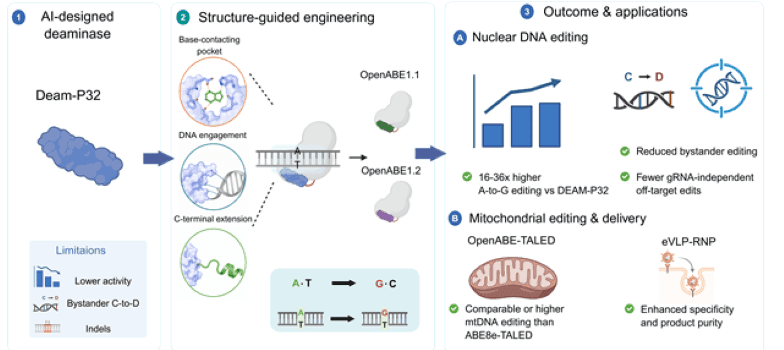
Researchers at Sungkyunkwan University developed OpenABE, an AI-designed gene-editing tool that improves editing efficiency by up to 36 times over existing AI models. Using AlphaFold predictions and structure-guided protein engineering, the team created editors that match gold-standard performance while dramatically reducing off-target effects, opening new paths for treating genetic disorders in both nuclear and mitochondrial DNA.
OpenABE Transforms AI-Designed Gene Editors with Structure-Guided Engineering
A research collaboration led by Professor Daesik Kim at Sungkyunkwan University has unveiled OpenABE (Open Adenine Base Editor), an AI-designed gene editor that delivers editing efficiency up to 36 times greater than previous AI-generated models
1
. Working alongside Professor Yong-Sub Kim from the University of Ulsan College of Medicine and Professor Jae-Hyun Park from Sungkyunkwan University School of Medicine, Kim's team applied structure-guided protein engineering to overcome critical limitations that have plagued early AI-designed base editors. The breakthrough addresses a fundamental challenge in gene therapy: how to harness artificial intelligence for designing gene-editing tools while maintaining the precision and safety required for clinical applications.Adenine Base Editors represent a sophisticated gene-editing tool that identifies and corrects specific DNA errors, converting incorrect adenine letters to proper guanine letters within the genetic code. While AI has recently enabled rapid design of novel gene editors not found in nature, these initial models struggled with low efficiency and safety concerns. Early AI-generated editors frequently caused off-target and bystander effects, altering unintended genetic sequences outside the target site and limiting their viability for patient treatment
2
.
Source: Newswise
AlphaFold Predictions Unlock Structural Insights for Enhanced Performance
The research team leveraged AlphaFold-based predictions to meticulously analyze the three-dimensional structure of base editors, examining them like detailed 3D maps. This structural analysis revealed critical regions that enable the editor to firmly grasp target DNA without losing contact. By introducing customized mutations to these key regions and attaching a specialized tail structure derived from top-performing conventional base editors, the team engineered two variants: OpenABE 1.1 and OpenABE 1.2
1
.These next-generation gene therapy tools demonstrated editing capabilities 16 to 36 times stronger than existing AI-designed gene editors, achieving performance comparable to ABE8e, the current gold-standard gene editor used in laboratories worldwide. Crucially, the team dramatically reduced off-target effects surrounding target genes, a chronic issue in AI gene editors, achieving high precision that cleanly corrects only intended genes
2
.Mitochondrial DNA Editing Opens New Therapeutic Frontiers
The study demonstrated that precise editing is achievable not only for DNA inside the nucleus but also for mitochondrial DNA, which has proven difficult to edit due to its unique structure. Mitochondria produce cellular energy and harbor their own genetic material, representing a distinct therapeutic target for genetic disorder therapeutics. By encapsulating these gene editors into engineered virus-like particles (eVLPs) for cellular delivery, the team secured high safety standards that allow selective editing of only one or two target genes requiring treatment
1
.
Source: News-Medical
"This study represents a landmark innovation where human scientists overcame the limitations of early AI-designed gene editors using structure-guided protein engineering," stated Professor Daesik Kim. "By opening a path to safely cure the causes of genetic diseases in both the nucleus and mitochondria, we expect this work to significantly accelerate the development of therapeutics for genetic disorders," he added
2
. The findings appeared in Nucleic Acids Research, drawing widespread attention from the global scientific community.Related Stories

OpenCRISPR-1 Complements Base Editor Advances
The research team also recently revealed OpenCRISPR-1, another AI-designed gene-editing tool that maintains gene-editing efficiency comparable to conventional Cas9 while reducing off-target mutations by up to 553 times. By applying OpenCRISPR-1 to prime editing technology and eVLP delivery systems, they demonstrated potential for expansion into a highly efficient and precise next-generation gene therapy platform
1
. This complementary work suggests that structure-guided engineering approaches can systematically improve AI-generated gene editors across multiple platforms, potentially accelerating the path from laboratory research to clinical treatments for previously intractable genetic diseases.References
Summarized by

Navi
Related Stories
AI-Powered 'Pythia' Tool Revolutionizes Precision in CRISPR Gene Editing
13 Aug 2025•Science and Research
CRISPR-GPT: AI-Powered Gene Editing Assistant Accelerates Drug Development
17 Sept 2025•Science and Research

AI Breakthrough: Designing Synthetic DNA Switches for Precise Gene Control
24 Oct 2024•Science and Research

Recent Highlights
1
Microsoft and Nvidia Launch Surface Laptop Ultra: A $2,599 AI-Ready PC With RTX Spark Chip
Technology

2
OpenAI Releases 722 AI-Generated Math Papers on GitHub, Igniting Fury Among Mathematicians
Science and Research

3
Trump Consulted Grok AI Before Ordering Venezuela Invasion and Capture of Nicolás Maduro
Policy and Regulation

Recent Highlights
Today's Top Stories












Don’t drown in AI news. We cut through the noise - filtering, ranking and summarizing the most important AI news, breakthroughs and research daily. Follow topics that matter to you and stay ahead.


