OpenAI Deploys AI War Rooms to Combat Election Misinformation as Chatbot Use Surges


4 Sources
[1]
Another election year, another tech company war room.
OpenAI is the latest tech company (and according to Politico, the first major AI company) to set up a command center for fighting election misinfo and abuse of its systems, approaching the second major AI-era US election: The Election Operations Center will begin running this week until all votes
[2]
Tech Giants Try to Curb A.I.-Generated Misinformation About the Midterm Elections
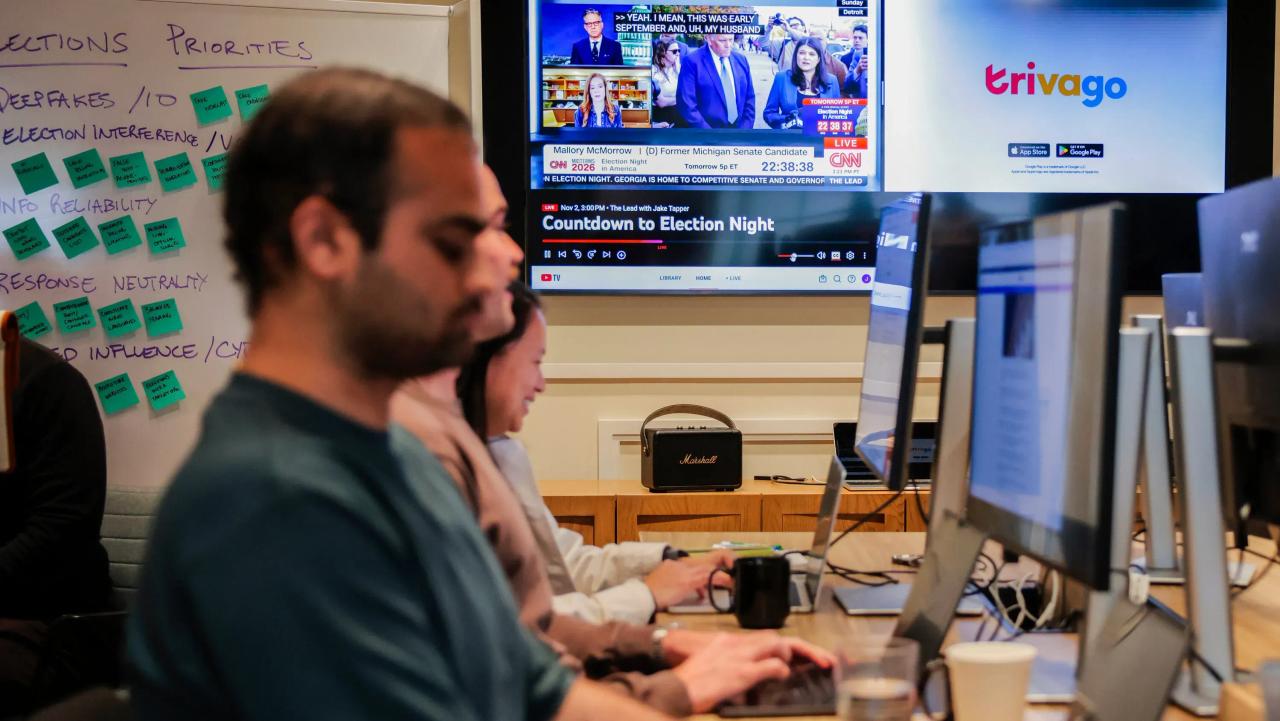
OpenAI, Anthropic and other tech companies have vowed to protect Tuesday's elections from efforts to undermine democracy. In a small conference room off the cafeteria at one of OpenAI's offices in San Francisco, a team of more than a dozen people are working around the clock to prevent anyone from
[3]
OpenAI launches 'war room' to monitor midterm elections
A group of select OpenAI employees will spend Nov. 3 in the AI giant's new midterm election "war room," tasked with monitoring ChatGPT's role in the political machine. The company announced, via Politico, that it would convene its own Election Operations Center ahead of next week's nationwide
[4]
Inside AI giants' Election Day 'war rooms'
Artificial intelligence firms are on high alert for Election Day, taking a page out of social media firms' playbook to manage the flurry of information expected online in the coming days. After a dramatic few months for the AI industry, companies like OpenAI and Anthropic are under pressure to
Share
Copy Link
OpenAI activated its Election Operations Center alongside Anthropic's first-ever war room to monitor ChatGPT misuse during the 2026 midterms. With one billion ChatGPT users and growing threats from deepfakes and cyberattacks, AI companies face mounting pressure to prevent their tools from undermining democracy.
OpenAI Launches Election Operations Center for 2026 Midterms
OpenAI has activated its Election Operations Center ahead of the 2026 midterm elections, marking a significant expansion from its initial efforts during the 2024 presidential race
1
2
. The command center, staffed by more than a dozen people working around the clock in a conference room at OpenAI's San Francisco office, will operate until all votes are counted to identify election misinformation and combat misuse of AI models like ChatGPT2
3
. Josh Lawson, head of civic and strategic risk at OpenAI, leads the operation focused on real-time monitoring and enforcing policies against disinformation while fielding reports of policy violations1
3
.
Source: NYT
AI War Rooms Expand Across Tech Giants
OpenAI isn't alone in deploying AI war rooms for safeguarding electoral integrity. Anthropic has established its first-ever war room, assembling analyst teams in cells across San Francisco, New York, and Washington to monitor its Claude chatbot
2
. Google and Meta have also pledged robust efforts to prevent AI-generated misinformation from undermining democratic processes2
. Meta reactivated its Elections Operations Center, which has operated since 2018, and implemented a restriction period prohibiting new political ads4
. These coordinated efforts reflect growing industry recognition of AI's expanding role in elections and the urgent need to enforce policies against disinformation.Threats Evolve Beyond Text to Deepfakes and Cyberattacks
The threat landscape has transformed dramatically since 2024, when ChatGPT had only one-fifth of its current one billion users
2
3
. "The most available technology at the time in 2024 was text," Lawson explained. "We're not just monitoring text anymore"2
. Potential threats now include deepfakes, cyberattacks, and foreign and domestic influence operations that can be created and launched with simple prompts2
. Research from the Brennan Center found that guardrails in major AI models, including Google's Gemini and Meta AI, were failing to prevent fake election images, though ChatGPT showed some improvement3
. However, NewsGuard testing revealed ChatGPT Images 2.5 repeatedly generated lifelike images of political candidates when prompted3
.
Source: The Hill
Related Stories

Voters Increasingly Rely on AI for Voting Information
A growing number of Americans are turning to ChatGPT and other AI models for voting information, candidate research, and even ballot completion
3
4
. Research indicates voters increasingly trust AI chatbots and AI-generated search results when seeking election information4
. To ensure accuracy, OpenAI partnered with Democracy Works for voter registration, deadlines, and polling locations, while collaborating with The Associated Press for real-time voting results4
. Anthropic features banners linking to TurboVote, Democracy Works's nonprofit resource, when users submit election queries4
. Lawson noted AI's search function has "significantly improved" since 2024, with models now searching first rather than relying solely on baseline training4
.Persistent Gaps in AI Guardrails Raise Concerns
Despite industry efforts to combat AI-generated misinformation, significant vulnerabilities remain. A September study from the Institute of Strategic Dialogue found nearly one-third of AI chatbots' election responses were incomplete, outdated, or inaccurate
4
. NewsGuard reported that disinformation campaigns directed by foreign governments have increased ahead of election day, primarily amplified on platforms like X, where Community Notes failed to identify more than 93 percent of such posts3
. More than half of Americans were fooled by election misinformation, according to NewsGuard's research3
. Lawmakers including Senators Mark Warner and Alex Padilla wrote to tech CEOs emphasizing their "great responsibility" in America's elections, noting platforms play a significant role in generating and disseminating election information4
. As AI in elections becomes increasingly integrated into political life, companies face mounting pressure to close these gaps and demonstrate their tools can be trusted to support rather than undermine democracy.References
Summarized by

Navi
[4]
Related Stories
OpenAI Introduces Anti-Deepfake Safeguard in ChatGPT to Combat Election Misinformation
27 Oct 2026•Technology
AI Chatbots Spread Misinformation as 2026 Midterms Expose Accuracy Crisis
26 Oct 2026•Policy and Regulation

AI Political Ads Dominate 2026 Midterm Elections Despite Disclosure Gaps and Growing Safety Concerns
21 Sept 2026•Policy and Regulation
Recent Highlights


Recent Highlights
Today's Top Stories







Don’t drown in AI news. We cut through the noise - filtering, ranking and summarizing the most important AI news, breakthroughs and research daily. Follow topics that matter to you and stay ahead.


