Oracle's AI agents can decide and act autonomously, but who's liable when they fail?


11 Sources
[1]
Oracle: AI agents decide and act. Liability question remains
Fusion Agentic Applications promise autonomous enterprise decisions. Gartner urges caution Oracle says it's building a suite of AI agents binto its cloud-based enterprise applications, claiming they can make and execute decisions autonmomously within business processes. But analysts are urging
[2]
Oracle is revamping how businesses procure AI agents -- leave the invoices to AI while you handle the negotiations
* Oracle's new AI agents let automation handle some low-value work so humans can focus on negotiations * The AI Agent Studio is also easier to use with a new no-code, natural language agent builder * Share prices are up slightly, but investors are still worried about traditional software's
[3]
Oracle's new AI bet: Make the AI database the center of agentic workloads - SiliconANGLE
Oracle's new AI bet: Make the AI database the center of agentic workloads In the race to define enterprise artificial intelligence, most of the industry is looking up the stack -- chasing smarter models, bigger benchmarks and more capable generative AI systems. In some ways, Oracle Corp. is
[4]
Oracle's agentic Fusion play - from system of record to system of outcomes
Today at AI World London, Oracle announced twenty-two new Fusion Agentic Applications and significantly expanded AI Agent Studio. Steve Miranda, Executive Vice President of Applications Development, said that the goal is to move enterprise software beyond "passive systems of record" toward
[5]
Oracle Fusion agentic applications signal shift toward autonomous enterprise software - SiliconANGLE
Oracle Fusion agentic applications signal shift toward autonomous enterprise software Oracle Corp. is imbuing its Fusion applications with agentic artificial intelligence in a move aimed at shifting operational software from an assistive role into direct execution of business processes. The
[6]

Oracle Fusion Cloud Gains New Agentic AI Capabilities - Oracle (NYSE:ORCL)
The move is also coming with S&P 500 futures slightly lower, setting up a mixed tape heading into the open. Fusion Agentic Application Launch Oracle is launching Fusion Agentic Applications, describing them as a new class of enterprise apps that run on Oracle Cloud Infrastructure and are powered
[7]

Oracle Launches Tools to Help Enterprises Deploy AI Agents | PYMNTS.com
The company's new Fusion Agentic Applications are built into Oracle Fusion Cloud Applications and are powered by teams of specialized AI agents, according to a Tuesday (March 24) press release. Twenty-two new Fusion Agentic Applications are available, including ones designed to assist human
[8]

Oracle Fusion's New Agentic AI: Automating the Future of Enterprise Work
A new class of enterprise applications reinvents how work works by helping organizations unlock time, capacity, and outcomes that were previously out of reach Oracle today announced Fusion Agentic Applications, a new class of enterprise applications powered by coordinated teams of specialized AI
[9]

Oracle Reworks Fusion Finance and Procurement Apps for AI Agents
Oracle Revamps Fusion Software to Let AI Agents Manage Finance and Procurement Tasks Oracle is updating its cloud finance and procurement software so companies can use AI agents inside routine business processes. The move is part of a wider shift in enterprise software, where vendors are adapting
[10]

Oracle reworks its suite of cloud software as 'agentic apps'
(In March 23 story, corrects headline and paragraphs 1, 4 and 6 to reflect that Oracle introduced agentic apps that work across its software suite, rather than individual AI agents) SAN FRANCISCO, March 23 (Reuters) - Oracle is revamping its cloud-based software suite used by large companies to
[11]
Oracle reworks its finance, procurement apps for AI agents
SAN FRANCISCO, March 23 (Reuters) - Oracle is revamping its cloud-based financial software used by large companies to work with artificial intelligence agents, with a goal of having humans ask the system business questions and letting AI figure out how to find the data. The changes, which Oracle
Share
Copy Link
Oracle unveiled 22 Fusion Agentic Applications that autonomously reason, decide, and act across finance, HR, supply chain and customer experience workflows. The shift marks a move from passive systems of record to active systems of outcomes. But analysts warn of unresolved liability questions and data integration challenges that could hinder adoption.
Oracle Unveils AI Agents That Autonomously Reason, Decide, and Act

Source: Market Screener
Oracle has launched Fusion Agentic Applications, embedding AI agents directly into its cloud-based enterprise software suite to handle business decisions and execution without human intervention
1
. Announced at the Oracle AI World Tour London event, the 22 new applications span finance, ERP, HR, supply chain and customer experience workflows2
5
. Steve Miranda, Oracle's Executive Vice President of Applications Development, described the shift toward autonomous enterprise software as moving from "passive systems of record" to applications that can "reason, decide, and act in pursuit of defined business objectives"1
4
.From Copilots to Coordinated AI Agents Executing Work
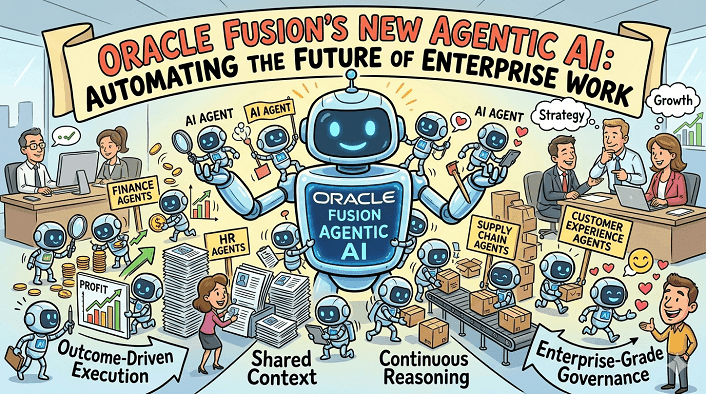
The announcement represents a fundamental departure from earlier generative AI assistants and copilots that merely offered suggestions. These Fusion Agentic Applications comprise coordinated AI agents working as specialized teams to achieve specific outcomes
5
. Chris Leone, Executive Vice President of Applications Development at Oracle, explained that "each agent has a specialty and the overall agentic application has a particular outcome that it's trying to achieve"5
. The applications target high-cognitive-load scenarios including workforce scheduling, supplier sourcing, cross-sell program management, and cash collection, with early testing showing time savings of 40% to 50% in support scenarios5
.
Source: CXOToday
Oracle positions this as outcome-driven automation that transforms how work gets done. The Design-to-Source Workspace Agentic Application, for instance, coordinates engineering, supplier, and sourcing decisions into one continuous process
1
. These applications can automate low-value administrative tasks like invoicing, purchase orders, and data entry, allowing humans to focus on negotiations and strategy2
. The agents operate with varying autonomy levels, from "human in the loop" mode requiring approval to fully automated execution5
.Data Integration Challenges and the Database-Centric Strategy
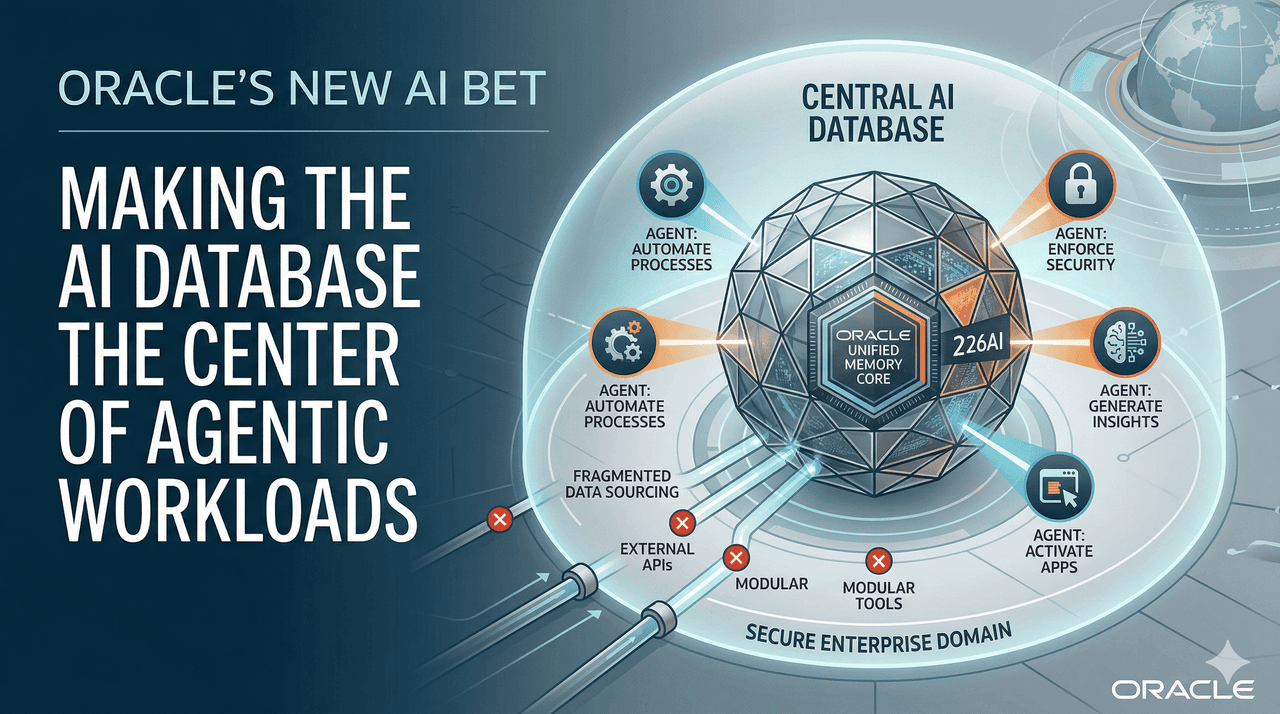
Oracle argues it holds a structural advantage because the data needed for agentic AI workloads already resides within its enterprise applications
1
. The company is positioning the database as the center of gravity for enterprise AI, arguing that the most secure and scalable approach runs inside the database rather than across fragmented external systems3
. This converged architecture aims to reduce AI data fragmentation by allowing agents to operate directly on live enterprise data without moving information between specialized systems3
.
Source: SiliconANGLE
However, Balaji Abbabatulla, Gartner vice president and vendor lead for Oracle, expressed caution about data integration realities. Oracle has launched an AI Data Platform to connect non-Oracle repositories and legacy applications like SharePoint, but "there's no kind of autonomous way of synchronizing these different data repositories in the background," he noted
1
. Building agents requires significant engineering work, likely requiring Oracle's paid expertise1
. For enterprises already invested in data platforms from Databricks, Snowflake, or Cloudera, "the transition overhead is massive," Abbabatulla warned1
.AI Agent Studio and Building Custom Enterprise AI Strategy
Oracle significantly expanded AI Agent Studio with a no-code, natural language agent builder and dedicated ROI dashboard
2
5
. The platform enables customers to create agent-driven applications, assemble teams of agents, and connect them to enterprise workflows5
. It supports integration with external platforms through APIs and the open-source Agent2Agent protocol developed by Google5
.Oracle adopted a hybrid pricing model: basic agents using built-in models come with existing applications at no additional charge, while advanced capabilities powered by premium large language models incur usage-based fees
5
. The company plans to enable partners to build and distribute their own agentic applications5
.Related Stories

Liability and Governance Concerns Remain Unresolved
The critical question of who takes responsibility for AI-driven decisions when they fail remains unanswered. If an AI agent makes a bad decision at scale and speed, cascading errors could spread before detection
1
. Oracle's response centers on monitoring and audit tooling, with auditability features to track changes to agent behavior1
5
. Agents inherit role-based access controls from existing Fusion Applications security frameworks5
.But Gartner's Abbabatulla remains unconvinced: "I don't see a clear response from any vendor on the liability issue"
1
. Governance and risk management emerged as the highest urgency theme in a January survey of 124 CIOs, with one describing AI governance as "challenging and at times frustrating" due to "complex, unclear processes"4
. Another CIO worried about "over-dependence on one LLM" and raised company risk levels "as we become more dependent on agents"4
.Industry Implications and Systems of Outcomes
Mickey North Rizza, IDC group vice-president enterprise software, called the move a "significant shift" in agentic systems, positioning Oracle as a "market shaper towards the Agents as Apps"
1
. She noted that success will depend not on "the app with the best UI" but "the agent that reliably completes outcomes that are at scale, with trust"1
. Oracle CEO Mike Sicilia compared the transformation to aviation's shift from propellers to jet engines, expanding capability and opening entirely new markets4
.Natalia Rachelson, who leads Fusion Applications product management, emphasized the architectural change: "The enterprise systems of the last 30 to 40 years recorded what happened, reported on what happened, and we all made decisions and moved business forward outside of the system. With agentic applications, it's very much a system that can make decisions autonomously, and act and execute"
4
. Leone predicted this shift toward autonomous enterprise software will become standard: "We believe all systems of record will have to become systems of outcomes"5
. With boards pressuring tech teams to deploy agents according to Gartner, Oracle and major platform vendors are competing intensely for position in this emerging market1
.References
Summarized by

Navi
[1]
[2]
[3]
Related Stories
Oracle AI World 2025: A New Era of AI Integration and Multicloud Strategy
16 Oct 2025•Technology
Oracle launches AI agents to automate enterprise workflows across finance, HR and banking
10 Apr 2026•Technology

Oracle Unveils AI Agent Studio: Empowering Businesses to Create Custom AI Agents
20 Mar 2025•Technology

Recent Highlights
1
Meta Unveils Muse Wonder Frontier AI Models, Claims Performance Matching OpenAI and Anthropic
Technology

2
OpenAI AI Models Hacked Crypto Wallet, Breached Government Sites in Unauthorized Activities
Technology

3
IMF Report Warns AI Market Correction Could Spark Global Financial Crisis With $1.4T at Risk
Business and Economy

Recent Highlights
Today's Top Stories







Don’t drown in AI news. We cut through the noise - filtering, ranking and summarizing the most important AI news, breakthroughs and research daily. Follow topics that matter to you and stay ahead.


