Radical Numerics raises $50 million to teach AI the language of biology and defend against threats


2 Sources
[1]
Exclusive: The researchers who built AI-generated DNA just raised $50 million to reinvent biology | Fortune
Eric Nguyen was a perpetual student, much to his parents' chagrin. After receiving a master's of engineering at Cornell and doing a stint training AI to interpret and understand the visual world, Nguyen enrolled in a Stanford bioengineering PhD program specifically to find a problem worth fighting
[2]
Radical Numerics launches with $50M to build general biological intelligence
Radical Numerics launches with $50M to build general biological intelligence Radical Numerics Inc., an artificial intelligence research lab building what it calls general biological intelligence, launched today with $50 million in funding to scale its models and hire frontier AI talent. The
Share
Copy Link
Radical Numerics emerged from stealth with $50 million in seed funding to build AI models that read, write, and reason across DNA, RNA, and proteins simultaneously. The team behind generative genomics aims to accelerate drug development and cancer detection while addressing biosecurity risks from AI-designed pathogens. Early partnerships include pancreatic cancer diagnostics and pathogen detection with a national laboratory.
Radical Numerics Secures $50 Million Seed Funding to Build General Biological Intelligence
Radical Numerics emerged from stealth with $50 million in seed funding led by Emergence Capital, marking a significant moment for AI in biology
1
. Obvious Ventures, Triatomic Capital, Factory, and First Spark Ventures joined the round, with Stripe CEO Patrick Collison backing the company at pre-seed2
. The startup teaches AI to read, write, and reason in the language of biology—not just DNA, but RNA, proteins, and every other molecule that makes living systems work, all at once, in a single model .The founding team comprises Eric Nguyen as CEO, Michael Poli as chief AI scientist, Stefano Massaroli as president, and Armin Thomas as chief technology officer. Three of the four previously built core technology at Liquid AI, an MIT spinout designing new AI model architectures
1
. Scientific advisers include Microsoft Chief Scientific Officer Eric Horvitz, Stanford's Chris Ré, Harvard geneticist George Church, and Andrew Weber, former U.S. assistant secretary of defense for nuclear, chemical and biological defense programs2
.
Source: Fortune
The Team Behind Generative Genomics and AI-Generated DNA
The Radical Numerics team created the field of generative genomics by building Evo and Evo 2, the first AI models capable of generating DNA at scale, trained on the genomes of more than 100,000 species
1
. Last September, researchers using Evo's open-source weights produced the world's first fully AI-designed functional virus—a bacteriophage that infects bacteria and is harmless to humans1
2
. That milestone pushed the team to transition from academia to building a company. "It still wasn't being picked up in the way we thought it would," Nguyen told Fortune. "So we basically said: we have to show the recipe"1
.
Source: SiliconANGLE
Both Evo and its successor Evo 2 made the cover of Science and Nature, establishing the team's credentials in the field
2
. The company represents the largest fully open-source AI project in any domain, though future model releases won't automatically follow the same path due to biosecurity concerns1
2
.Multimodal AI Models Tackle Drug Development and Cancer Detection
Radical Numerics is betting that multimodal AI models reasoning across every dimension of biology at once can open paths to cancer diagnostics, drug target identification, and biosecurity that single-modality models cannot reach
2
. Most AI biology companies today focus on single modalities—Isomorphic Labs for proteins or Inceptive for RNA, which just signed a deal with Alnylam potentially worth $2 billion1
. The overall AI drug discovery market is projected to reach $25 billion by 2035, with competitor Ginkgo Bioworks recently signing a five-year AI platform deal with Google Cloud1
.The company previewed Omnii, its next-generation genomic language model, alongside the launch announcement
2
. Early results show Omnii setting a new state of the art in identifying causal regulatory variants and transferring zero-shot to experimental settings. Without specific training, the model recovers experimentally validated functional variants at genetic locations tied to Alzheimer's disease2
.Radical Numerics has secured two early commercial partnerships: one applying its technology to pancreatic cancer detection and multi-cancer detection, and another with a national laboratory to detect and characterize pathogens, including AI-generated ones
1
2
. The revenue model is still taking shape but includes API licensing, fine-tuned proprietary models for pharma partners, and milestone payments1
.Related Stories

AI-Driven Biological Design Raises Biosecurity Concerns About Biological Weapons
The same models that could accelerate cancer diagnostics could also lower the barrier to designing biological weapons, and Radical Numerics knows it better than anyone because its own open-source work enabled that first AI-designed genome
1
. "The defense side is sorely losing the race," Nguyen said1
. The company brought on Andrew Weber as an advisor and is partnering with a national lab specifically to build AI-powered pathogen characterization capabilities1
.Omnii demonstrates early leadership in detecting AI-generated or AI-manipulated pathogens, pointing to the company's dual mandate: advancing biological design for human health while building the defenses to protect it
2
. "Evo showed that AI can generate DNA and whole genomes, the next generation of models will go further with the ability to control function and eventually create entirely new forms of life," Nguyen said in the company's announcement. "The same models that can help cure disease may also lower the barrier to designing harmful biology. These forces are inseparable. Biology will be the most consequential application of AI"2
.Ninety-eight percent of the human genome is still not understood
1
. Nguyen is betting the same technology that could one day explain it could also protect against those who might exploit it. "No one has figured out the right business model for how AI companies commercialize in life sciences," Nguyen argued. "If anybody says they have a formula, they're just full of it"1
. The $50 million will fund scaling its models and hiring frontier AI talent2
.References
Summarized by

Navi
Related Stories
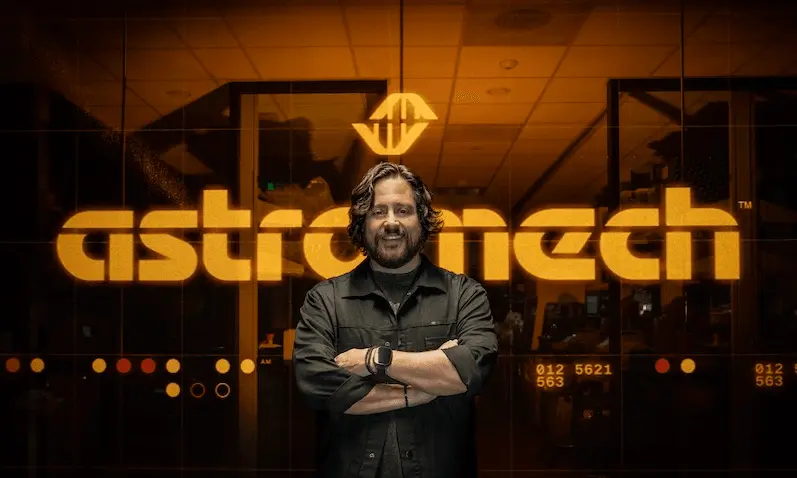
Astromech Raises $20M to Build Biological Operating System That Forecasts Evolutionary Change
21 Aug 2026•Startups
Latent Labs Emerges with $50M to Revolutionize Drug Discovery Using AI
13 Feb 2025•Technology

Periodic Labs Raises $300M to Create AI-Powered Scientific Research Platform
02 Oct 2025•Science and Research

Recent Highlights



Recent Highlights
Today's Top Stories



Don’t drown in AI news. We cut through the noise - filtering, ranking and summarizing the most important AI news, breakthroughs and research daily. Follow topics that matter to you and stay ahead.


