Robotic guide dog uses AI to talk with visually impaired users during navigation


4 Sources
[1]
Speak! Robot guide dogs converse with their owners
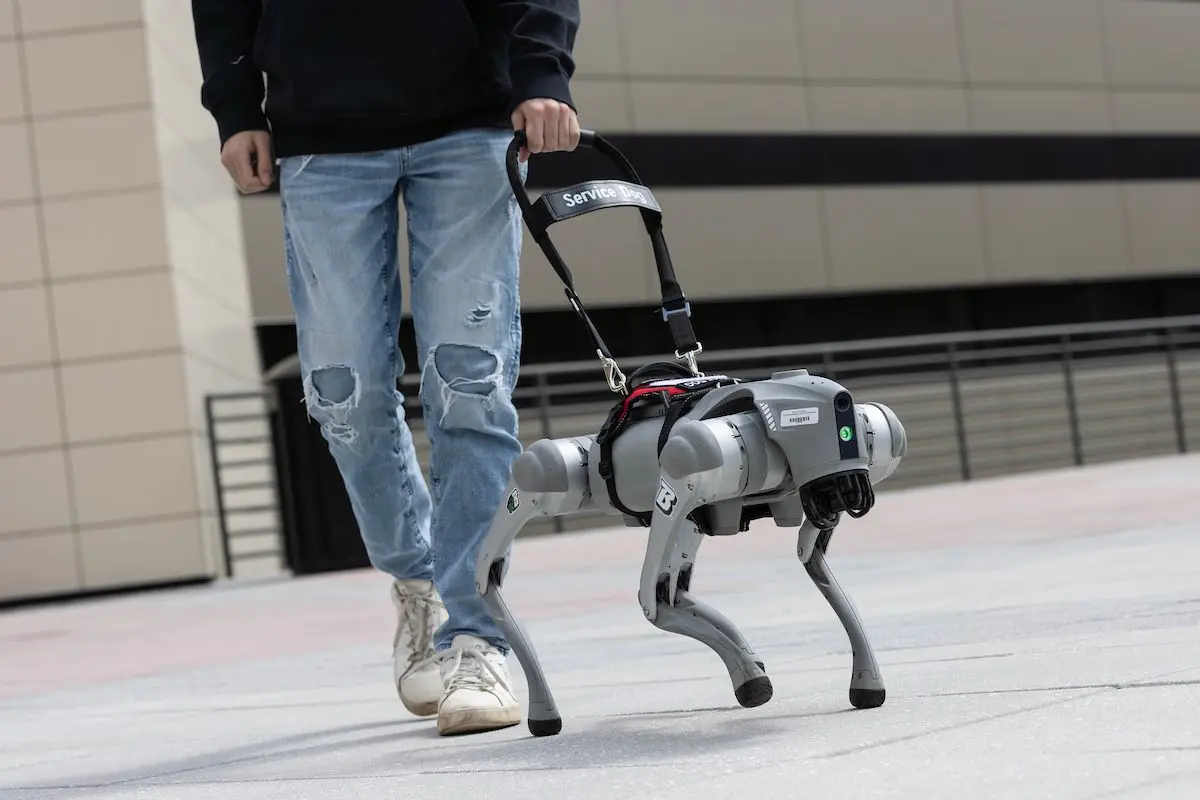
The robotic dog used in the study was a Unitree Go2 modelJonathan Cohen Since the early 1900s, dogs have helped people who are blind or have low vision to navigate their world. Now, in a very 21st century twist, seeing-eye dogs have gone robotic and added a skill that not even the most
[2]
AI-powered robotic guide dog that talks could become alternative to service animals
Researchers report that a robotic guide dog can now talk users through a trip, offering route choices before departure and live updates while walking. That new ability turns navigation into a shared conversation, giving blind travelers more control over where they go and what they know along the
[3]
This robotic dog talks with ChatGPT magic and guides the visually impaired
Researchers built a robotic guide dog that talks users through the journey Robot dogs aren't some new innovation, but one that can back to your sounds like science fiction. Researchers at Binghamton University say they have already built one, and it is meant to help the blind. The team from the
[4]
These AI-Powered Guide Dogs Don't Just Lead - They Talk | Newswise
Newswise -- Guide dogs are powerful allies, leading the visually impaired safely to their destinations, but they can't talk with their owners -- until now. Using large language models, a team of researchers at Binghamton University, State University of New York has created a talking robot guide
Share
Copy Link
Researchers at Binghamton University developed an AI-powered guide dog using GPT-4 that converses with blind users, offering route options and real-time environmental updates. Seven legally blind participants tested the system, rating combined verbal and physical guidance highly. The innovation addresses the shortage of traditional service animals, which cost $20,000-50,000 and serve only 2-5% of the blind community.
AI-Powered Guide Dogs Transform Mobility for the Blind
Researchers at Binghamton University have developed a robotic guide dog that goes beyond traditional service animals by adding a capability no canine could match: conversation. Led by associate professor Shiqi Zhang, the team equipped a Unitree Go2 robotic dog with large language models, specifically GPT-4, to create an assistive technology that can discuss routes, describe surroundings, and respond to complex voice commands
1
4
.
Source: Newswise
The innovation addresses a critical gap in accessibility. Traditional seeing-eye dogs require extensive training, with only 50-60% graduating from programs, and cost between $20,000-50,000. As a result, only 2-5% of the blind community can access these animals
1
. The robotic alternative promises to expand access while offering enhanced situational awareness through verbal communication.How the Guidance System Works
The AI robotic guide dog system operates through what researchers call "plan verbalization" and "scene verbalization." Before departure, the robot asks users where they want to go, then presents multiple route options with estimated travel times. During the journey, it provides real-time spoken feedback about the environment, such as "this is a long corridor" or "you're passing by the main lobby, which is an open area with seating and information desks"
1
2
.Shiqi Zhang emphasizes the advantage over biological guide dogs: "Real dogs can understand around 20 commands at best. But for robotic guide dogs, you can just put GPT-4 with voice commands. Then it has very strong language capabilities"
1
4
.The system relies on link grounding, matching spoken words to real objects and locations within a mapped environment. When a user mentions thirst, the robot can connect that request to a fountain or vending machine, keeping conversation tied to actionable navigation
2
.Testing with Legally Blind Participants
Seven legally blind participants navigated a large, multi-room office environment to test the system. Following their experience, they completed questionnaires rating helpfulness, ease of communication, and usefulness on a five-point scale. The combined approach of route planning and navigation with real-time narration scored 4.83 for usefulness and 4.50 for ease of communication
2
3
.Participants preferred the combination of verbal and physical guidance through leash pressure rather than being pulled along without explanation. However, the safety rating slipped to 3.83, which researchers attribute to unfamiliarity with walking alongside a robot rather than the traditional human-canine bonding experience
1
2
.Despite trust concerns about safety, participants showed enthusiasm for the technology. "They were super excited about the technology, about the robots," Zhang said. "They asked many questions. They really see the potential for the technology and hope to see this working"
1
4
.Related Stories

What Comes Next for This Alternative to Service Animals
The research team plans to conduct more studies with longer indoor distances and outdoor testing. Increasing system autonomy remains a priority, as current demonstrations used a "Wizard of Oz" setup where a hidden expert controlled robot movement during walks to reduce risk while preserving the conversation test
2
.In additional testing, GPT-4 successfully navigated the dog through 77 different scenarios using natural language commands
1
. The team presented their paper "From Woofs to Words: Towards Intelligent Robotic Guide Dogs with Verbal Communication" at the 40th Annual AAAI Conference on Artificial Intelligence in January4
.For the blind community to assist visually impaired users effectively, robotic guide dogs must prove they can handle complex environments beyond controlled office settings. The lower safety rating signals that building daily trust will matter more than demonstration success. Yet user autonomy through conversation represents a meaningful step forward, turning navigation into a shared dialogue rather than simple commands. If researchers can solve autonomy challenges and outdoor navigation, AI-powered guide dogs could become a practical mobility aid that explains itself while moving safely through the world.
References
Summarized by

Navi
[1]
Related Stories
Personifi AI's Shazam Band: The AI-Powered Collar That Gives Pets a Voice
16 Oct 2024•Technology

Robot dog learns to switch gaits like animals, tackling forests and stairs with new AI framework
16 Jul 2026•Science and Research
Animal-Inspired AI Robot 'Clarence' Learns to Navigate Unfamiliar Terrain Autonomously
12 Jul 2025•Science and Research

Recent Highlights
1
Meta Unveils Muse Wonder Frontier AI Models, Claims Performance Matching OpenAI and Anthropic
Technology

2
IMF Report Warns AI Market Correction Could Spark Global Financial Crisis With $1.4T at Risk
Business and Economy

3
OpenAI Releases 722 AI-Generated Math Solutions, Triggering Existential Crisis in Mathematics
Technology

Recent Highlights
Today's Top Stories









Don’t drown in AI news. We cut through the noise - filtering, ranking and summarizing the most important AI news, breakthroughs and research daily. Follow topics that matter to you and stay ahead.


