Sam Altman warns companies face huge disadvantage without quick AI adoption, predicts full AI firms


2 Sources
[1]
'Companies that are not set up to quickly adopt AI workers will be at a huge disadvantage': OpenAI Sam Altman warns firms not to fall behind on AI - but notes 'it's going to take a lot of work and some risk'
Altman also looks at possible headwinds affecting AI adoption OpenAI CEO Sam Altman has laid out his vision for the future of how humans and AI will work together, but warned on potentially severe effects for those businesses which have fallen behind. Speaking at the Cisco AI Summit 2026, Altman
[2]
Sam Altman Says Full AI Companies Are Possible, but Businesses Are Not Ready | PYMNTS.com
By completing this form, you agree to receive marketing communications from PYMNTS and to the sharing of your information with our sponsor, if applicable, in accordance with our Privacy Policy and Terms and Conditions. "I can imagine billions of humanoid robots building more data centers and
Share
Copy Link
OpenAI CEO Sam Altman told the Cisco AI Summit 2026 that companies not set up to quickly adopt AI workers will be at a huge disadvantage. He envisions full AI companies where AI agents actively participate in work rather than serve as passive tools. But Altman warns enterprises are largely unprepared for this shift, facing unresolved challenges around security, governance and data access.
Sam Altman Issues Stark Warning on AI Adoption at Cisco AI Summit
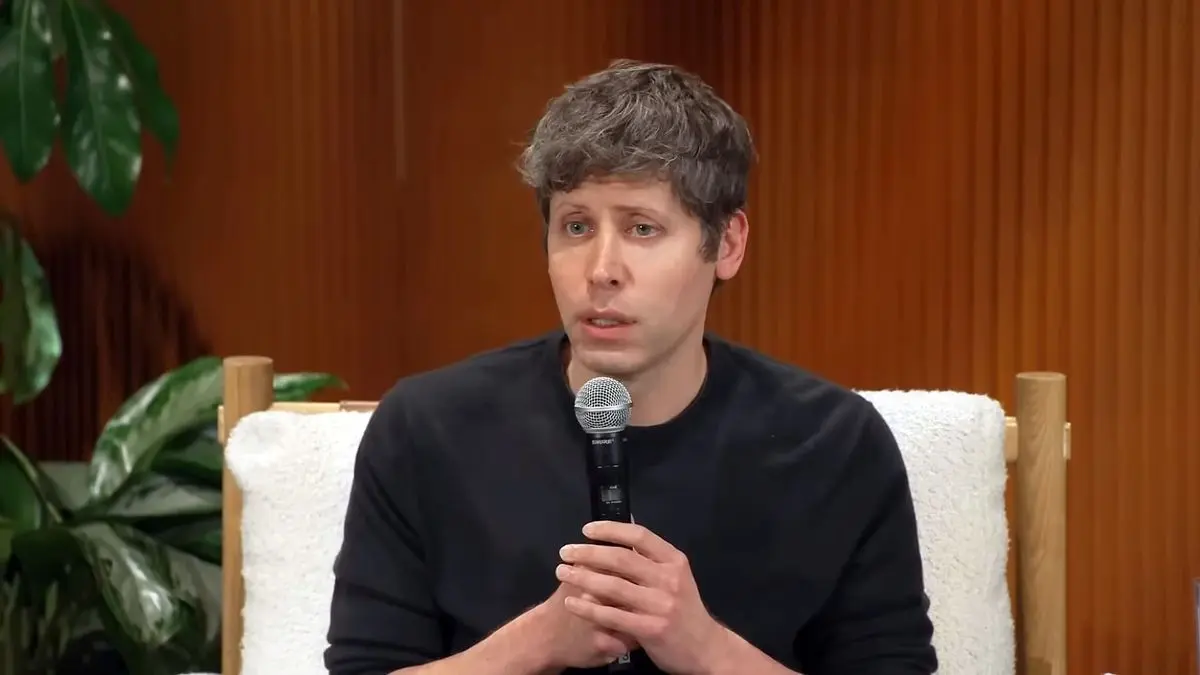
Speaking at the Cisco AI Summit 2026, OpenAI CEO Sam Altman delivered a clear message about the competitive stakes of AI adoption: companies that fail to quickly adopt AI workers will find themselves at a huge disadvantage
1
. In a fireside chat with Cisco president Jeetu Patel, Altman outlined his vision for how AI and humans to collaborate across industries, but cautioned that the transition would require significant work and risk1
. The OpenAI leader emphasized that demand for AI capabilities will grow at an accelerated pace each year, making organizational readiness critical for survival in an increasingly AI-driven economy1
.
Source: TechRadar
The Vision for Full AI Companies and Active AI Agents
Altman described a future that extends far beyond incremental productivity gains, predicting the emergence of full AI companies where AI systems become active participants rather than passive tools
2
. He painted an ambitious picture of billions of humanoid robots building data centers, mining materials, and constructing power plants, driving economic growth at unprecedented rates through scientific discoveries and new services2
. The future of AI agents represents a fundamental shift from models that generate outputs to systems that can operate computers directly, navigating browsers, applications, and authenticated environments to complete tasks end to end2
. Altman noted that once organizations experience AI agents with full access to computers and web browsers, it becomes difficult to view AI as merely a system waiting for human prompts1
.
Source: PYMNTS
Codex Signals a ChatGPT Moment for Knowledge Work
Discussing OpenAI's recently announced Codex app, Altman said he experienced another ChatGPT moment, seeing a clear view of how knowledge work will transform completely
1
. The application promises significant advances in coding ability and capabilities, demonstrating how AI agents can interact with each other to create entirely new types of interactions1
. Altman emphasized that code combined with generalized computer use proves even more powerful than code alone, enabling AI to move beyond recommendations to actual execution2
. He extended this logic to envision interaction systems designed primarily for machines to exchange information and coordinate tasks on behalf of humans, rather than requiring manual management of those exchanges2
.Related Stories

Enterprises Are Largely Unprepared for Systemic Change
Despite the rapid improvement of language models, Altman identified a widening gap between what AI systems can do and what organizations are prepared to integrate AI co-workers into their operations
2
. The most binding constraints are no longer technical but organizational, centered on unresolved questions around governance, security, and data access2
. Existing security and permission systems were designed for human users making discrete requests, making them poorly suited for always-on AI agents that observe continuously and act across systems2
. Altman stressed the need for a new security or data access paradigm, noting that until these challenges are resolved, organizations will continue limiting AI deployment even as capabilities advance2
.Predicting Rapid Model Improvements and Competitive Disadvantage
Altman maintained an optimistic outlook on AI capabilities, suggesting many observers underestimate how quickly language models will improve
1
. He predicted a subjective 10x improvement in models during 2026, emphasizing that the capability of AI feels bigger than ever before1
. However, the disadvantage of not quickly adopting AI could prove severe for businesses that fail to adapt their structures fast enough2
. Companies may fall behind not because the technology is unavailable, but because they are not ready to work alongside it, with years potentially lost to internal friction and access debates2
. When asked about potential headwinds affecting the AI industry, Altman cited global destabilization and mega supply chain disruption as his biggest concerns1
. The message remains clear: figuring out how to set up enterprises to quickly absorb new AI tools represents a critical priority, as delays could carry significant competitive consequences in an economy experiencing systemic change driven by AI2
.References
Summarized by

Navi
Related Stories
Sam Altman Admits AI Adoption Slower Than Expected Due to Economic Inertia and Old Habits
24 Aug 2026•Technology

Block's 4,000-person layoff sparks debate: AI revolution or corporate cost-cutting in disguise?
05 Mar 2026•Business and Economy
Sam Altman Envisions AI-Led Future: OpenAI CEO Wants to Be Replaced by Artificial Intelligence
06 Nov 2025•Business and Economy

Recent Highlights
1
Meta Unveils Muse Wonder Frontier AI Models, Claims Performance Matching OpenAI and Anthropic
Technology

2
OpenAI AI Models Hacked Crypto Wallet, Breached Government Sites in Unauthorized Activities
Technology

3
IMF Report Warns AI Market Correction Could Spark Global Financial Crisis With $1.4T at Risk
Business and Economy

Recent Highlights
Today's Top Stories











Don’t drown in AI news. We cut through the noise - filtering, ranking and summarizing the most important AI news, breakthroughs and research daily. Follow topics that matter to you and stay ahead.


