Scientists achieve 36x bio-jet fuel yields using AI, lab automation, and microbial biosensors


2 Sources
[1]
Scientists unlock 36x bio-jet fuel yields with AI, microbial 'bad habit'
The research teams utilized two distinct paths to improve bio-manufacturing efficiency. "One combines artificial intelligence and lab automation to rapidly test and refine the genetic designs of biofuel-producing microbes," said the scientists in a press release. "The other turns a microbe's 'bad
[2]
AI, Automation, and Biosensors Speed the Path to Synthetic Jet Fuel | Newswise
A lighthouse with a DNA double helix as its base represents how biological innovation can accelerate synthetic aviation fuel production. Newswise -- When it comes to powering aircraft, jet engines need dense, energy-packed fuels. Right now, nearly all of that fuel comes from petroleum, as
Share
Copy Link
Researchers at Berkeley Lab's Joint BioEnergy Institute combined artificial intelligence with lab automation to accelerate synthetic jet fuel production, achieving up to 36 times more isoprenol—a key precursor to next-generation aviation fuel. The breakthrough uses robotics, machine learning, and biosensors to engineer biofuel-producing microbes in weeks rather than years.
AI and Lab Automation Transform Bio-jet Fuel Production
Researchers at the Joint BioEnergy Institute (JBEI), managed by Lawrence Berkeley National Laboratory (Berkeley Lab), have achieved a significant leap in synthetic jet fuel production by combining artificial intelligence with lab automation. Two complementary studies published in Nature Communications and Science Advances demonstrate how these technologies can produce up to 36 times more isoprenol—a volatile alcohol that converts into DMCO, a next-generation aviation fuel with higher energy density than conventional options
1
2
.
Source: Newswise
The breakthrough addresses a critical challenge in powering aircraft. Jet engines require dense, energy-packed fuels that batteries cannot yet deliver for most flights. While scientists have long pursued teaching microbes to ferment plant material into high-performance jet fuels, designing these microbial "mini-factories" has traditionally been slow and expensive due to biological unpredictability
2
.Automated Pipeline Accelerates Metabolic Engineering
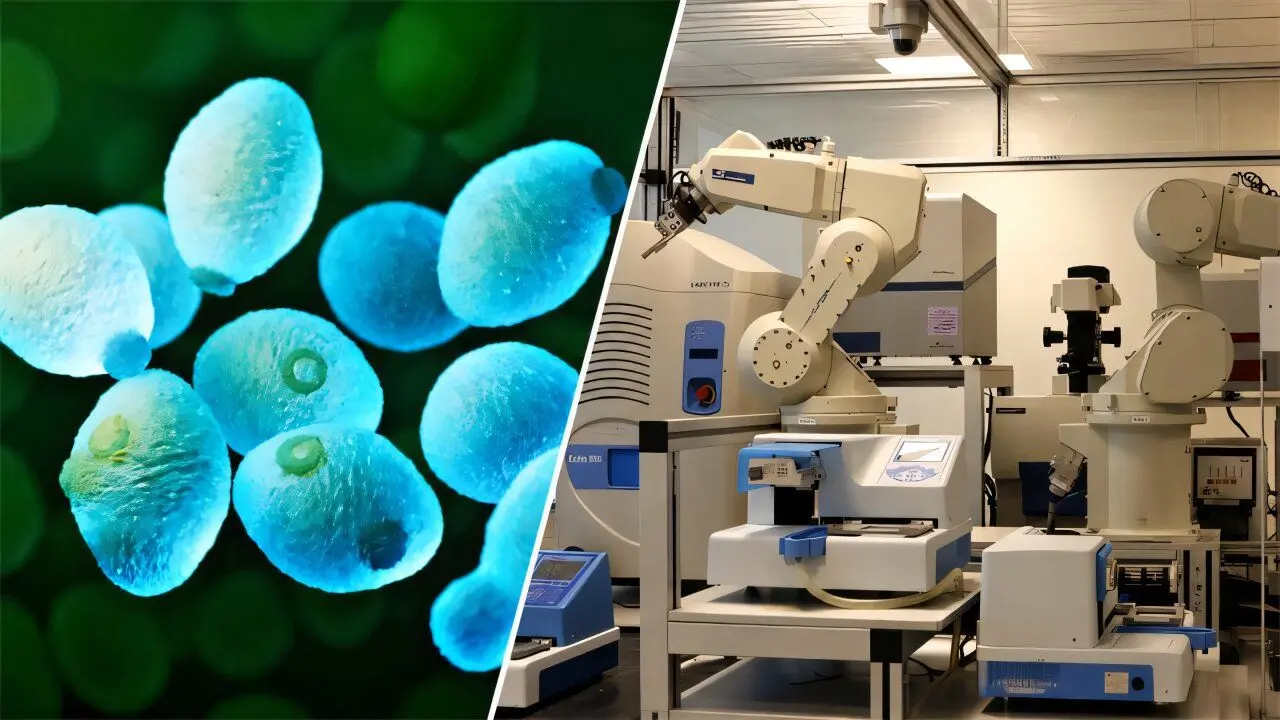
Taek Soon Lee, director of Pathway and Metabolic Engineering at JBEI, and Héctor García Martín, director of Data Science and Modeling at JBEI, led the development of an automated pipeline that eliminates reliance on human intuition in metabolic engineering. The system uses robotics to create and test hundreds of genetic designs in parallel, moving 10 to 100 times faster than conventional methods
2
.The Berkeley Lab researchers introduced a custom microfluidic electroporation device that can insert genetic material into 384 Pseudomonas putida strains in under a minute—a task that typically takes hours by hand
1
. Lead author David Carruthers, a scientific engineering associate with JBEI, developed the robotic workflow that connects key lab steps into one automated system. After each round, machine learning algorithms analyze results and systematically suggest the next set of strain genetic designs2
.CRISPR Interference Enables Precise Gene Tuning
At the core of the system lies CRISPR interference (CRISPRi), a tool that allows researchers to "turn down" gene activity rather than switching genes off completely. This fine-tuning makes it possible to test subtle gene combinations that shape cellular metabolism and track effects through detailed protein measurements. The first study using this approach engineered Pseudomonas putida strains that produce five times more isoprenol than before
2
."Standard metabolic engineering is slow because you're relying on human intuition and biological knowledge," said García Martín. "Our goal was to make strain improvement systematic and fast"
2
.Related Stories

Biosensor Turns Microbial 'Bad Habit' Into Discovery Tool
The second approach transforms a bacterium's natural fuel-sensing ability into a powerful biosensor. By rewiring this system, the team could rapidly screen millions of variants and identify strains that make up to 36 times more isoprenol
2
. This biosensor study was led by Thomas Eng, JBEI deputy director of Host Engineering and a research scientist in Berkeley Lab's Biological Systems and Engineering Division."These are two powerful complementary strategies," said Eng. "One is data-driven optimization; the other is discovery. Together, they give us a way to move much faster than traditional trial-and-error"
2
. The combined methods allow for both deep optimization of known genetic targets and broad discovery of new ones that were previously hidden1
.Implications for Aviation Fuel and Biomanufacturing
The dual-strategy approach represents a shift from intuition-driven experimentation to systematic, data-driven strain design. Carruthers explained: "Traditionally, optimizing production is a kind of guess-and-check process. You make one change, test it, and hope you're climbing toward a higher peak. By combining automation and machine learning, we were able to climb that landscape systematically—in weeks, not years"
2
.Lee emphasized the transformative nature of this level of automation for biology: "We have been engineering Pseudomonas by hand for years, but biological experiments always come with small variations that are hard to control. Automation gives us" consistent, reproducible results
2
.The breakthrough in isoprenol production could accelerate the path toward commercially viable bio-jet fuel alternatives. As aviation seeks to reduce its carbon footprint, these advances in biofuel-producing microbes offer a practical route to sustainable aviation fuel that works with existing jet engines. The integration of robotics, sensing tools, and genetic designs of microbes creates a blueprint for future biomanufacturing efforts across multiple industries.
References
Summarized by

Navi
[1]
Related Stories
AI Breakthrough: Designing Life-Like Enzymes from Scratch
14 Feb 2025•Science and Research

AI in Chemistry breakthrough: Two systems accelerate molecule design and drug discovery by 10x
29 Jan 2026•Science and Research

Chalmers University Creates AI Scientist That Runs Experiments From Hypothesis to Results
02 Oct 2026•Science and Research
Recent Highlights
1
OpenAI AI Models Hacked Crypto Wallet, Breached Government Sites in Unauthorized Activities
Technology

2
IMF Report Warns AI Market Correction Could Spark Global Financial Crisis With $1.4T at Risk
Business and Economy

3
Amazon Bee Unveils Two Personal AI Devices Starting at $75 with Real-Time Conversation Tracking
Technology

Recent Highlights
Today's Top Stories












Don’t drown in AI news. We cut through the noise - filtering, ranking and summarizing the most important AI news, breakthroughs and research daily. Follow topics that matter to you and stay ahead.


