Seagate's Hard Drives See Massive Demand as AI Storage Boom Extends Capacity Commitments to 2028


7 Sources
[1]
AI storage boom is keeping Seagate's hard drives spinning
The AI infrastructure boom isn't just eating all the memory - it's also driving demand for storage, giving high-capacity hard drives a new lease of life, according to Seagate. The storage veteran says cloud operators are buying ever more mass-capacity hardware as AI applications generate and
[2]
Seagate forecasts upbeat quarter on strong AI-driven storage demand
July 28 (Reuters) - Seagate Technology (STX.O), opens new tab forecast quarterly revenue and profit above estimates on Tuesday, as the rapid buildout of AI infrastructure fuels robust demand for its high-capacity hard disk drives. Shares of the Singapore-based company, which have more than doubled
[3]
AI infrastructure fuels rising cloud storage demand across data centres
Enterprise customers are consuming more Seagate hard drives * AI growth keeps enterprise hard drive demand climbing across global cloud infrastructure * Cloud providers continue expanding storage despite massive investment in AI accelerators * Enterprise storage remains essential as artificial
[4]
Seagate Hits Record Margins Amid AI Storage Boom - Seagate Technology Hldgs (NASDAQ:STX)
Seagate reported quarterly earnings of $5.71 per share, which beat the Street estimate of $5.09 by 12.18%, according to Benzinga Pro data. Quarterly revenue came in at $3.63 billion, which beat the consensus estimate of $3.49 billion and was up from $2.44 billion in the same period last
[5]

BofA sees more upside in Seagate's AI storage trade
Seagate Technology (STX) makes high-capacity hard drives used by cloud providers and large corporate data centers. Those drives store training files, model outputs, videos, customer records, and other data created by artificial intelligence applications. Cloud customers have been reserving
[6]
Wedbush raises the bar for two AI storage stocks
Seagate Technology (STX) and Western Digital (WDC) supply high-capacity hard drives used by cloud providers to store the growing volumes of data produced by artificial intelligence workloads. The companies have become two of the market's most closely watched AI infrastructure stocks as
[7]

Seagate Sees a Better-Than-Expected Quarter on AI-Driven Demand
Seagate expects Q1 revenue of $4.1bn, plus or minus $100m, along with adjusted EPS of $7.30, both well above analysts' estimates. The hard-drive maker is benefiting from strong demand from cloud service providers, which are investing heavily in storage capacity to support the expansion of
Share
Copy Link
Seagate reports cloud providers now account for 90% of its exabyte shipments as AI infrastructure boom drives unprecedented demand for high-capacity hard drives. The company has already allocated most nearline drive capacity through calendar 2028, with customers now planning storage requirements into 2029.
Seagate Hard Drives Experience Unprecedented AI-Driven Demand
Seagate Technology is experiencing a dramatic surge in demand for high-capacity hard drives as the AI infrastructure boom transforms cloud storage requirements. The company reports that cloud data center demand now represents approximately 90% of its exabyte shipments
1
, with most nearline drive capacity already allocated through calendar 2028. Chairman and CEO Dave Mosley told analysts that based on long-term supply agreements currently in place, the vast majority of nearline exabytes are committed into 2028, and customers are now seeking additional capacity extending into 2029 and beyond3
.
Source: Benzinga
The AI-driven storage demand has propelled Seagate's financial performance to record levels. For fiscal fourth quarter ended July 3, the company reported revenue of $3.63 billion, up 50% from $2.44 billion a year earlier
1
. Full-year revenue increased 34% from $9.1 billion to $12.2 billion. The company shipped 218 exabytes in the June quarter, up 34% year-over-year, with data center customers representing 89% of total shipments4
. Data center shipments reached 195 exabytes, increasing 11% sequentially and 43% year-over-year, while data center revenue rose to $2.9 billion, up 17% quarter-over-quarter and 57% year-over-year.Record Gross Margins Reflect Pricing Power and Product Mix
Seagate achieved a record adjusted gross margin of 52.7% in the fourth quarter, expanding 570 basis points sequentially from 47% in the prior quarter
4
. This performance exceeded Bank of America's estimate of 50.2%5
. The margin expansion was driven by pricing execution and favorable product mix as customers adopt higher-capacity drives. Bank of America analyst Wamsi Mohan calculated Seagate's year-over-year incremental gross margin at 83.2% for the fourth quarter, meaning the company generated about 83 cents of additional gross profit for every extra dollar of revenue compared with the same quarter a year earlier5
.CFO Gianluca Romano explained that capacity growth has primarily come from shipping drives with more disks and heads rather than selling more physical units. "If you look at our last year, and if you look at the number of disks and the number of heads inside the box, they probably grew between 15 and 20 percent and the units were absolutely flat," he said
1
. This configuration allows Seagate to sell more storage capacity without proportionally increasing completed drive production, contributing to improved margins.AI Workloads Drive Enterprise Storage Requirements
The transition from AI model training to inference and agentic applications is generating unprecedented data volumes that must be retained for historical context, compliance, and future reuse. Mosley explained that as datacenter environments become larger and more complex, customers must balance performance, energy consumption, and cost
1
. Cloud operators are addressing these challenges through tiered storage solutions combining high-performance memory and SSDs with mass-capacity hard drives.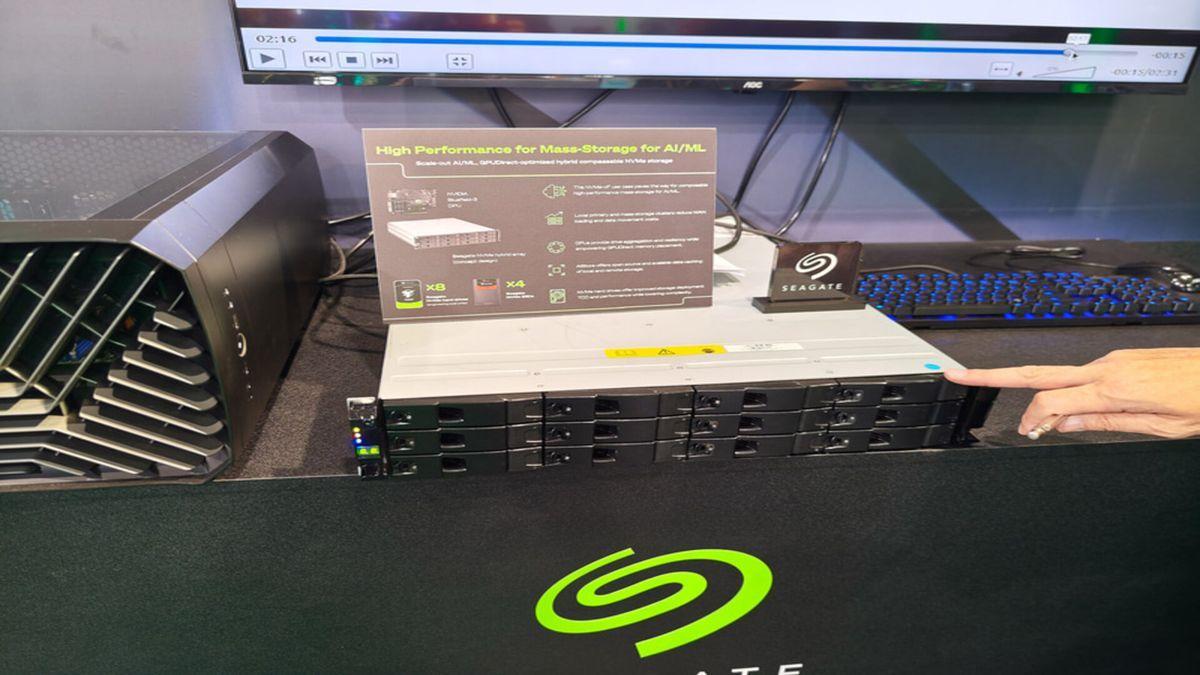
Source: TechRadar
A recent white paper with SK hynix illustrates the importance of tiered storage for inference and agentic applications, which rely on persistent context across user interactions
1
. Key-value cache is used to retain and reuse context efficiently. By distributing KV cache data across memory, SSD, and hard drive tiers, organizations can retain more context and avoid recomputing previously generated data. This approach increases demand for hard drive capacity while reducing GPU resources spent recomputing old context, leaving more compute available for revenue-generating AI workloads.Related Stories
HAMR Technology and Mozaic Platform Drive Capacity Leadership
Seagate is ramping production of its Mozaic 4 platform, which supports drives of up to 44 TB, for major cloud providers
1
. The platform uses heat-assisted magnetic recording (HAMR technology), which briefly heats a small area of a disk so more data can be written into the same physical space5
. HAMR products accounted for about 40% of Seagate's nearline exabyte shipment run rate at the end of fiscal 2026. The next-generation Mozaic 5 remains on track for qualification shipments in late 2027 and is expected to deliver more than 5 TB per platter.
Source: Reuters
Moving cloud providers toward Mozaic 4+ and HAMR technology has been instrumental in Seagate's margin expansion. Bank of America attributed the company's margin growth to higher prices, a larger mix of high-capacity products, and lower production costs
5
. Additional exabytes available above contracted volumes are being sold at higher prices because customer demand exceeds supply.Strong Outlook Reflects Sustained Enterprise Demand
Seagate expects first quarter fiscal 2027 revenue of approximately $4.1 billion, plus or minus $100 million, representing year-over-year growth of 56%
1
. The outlook includes non-GAAP operating expenses of around $300 million, a non-GAAP operating margin of around 50%, and non-GAAP earnings per share of $7.30, plus or minus $0.204
. Bank of America maintained a Buy rating with a $1,150 price target, representing about 54% upside, and raised its fiscal 2027 revenue estimate to $17.47 billion from $16.86 billion5
.Mosley emphasized that the company is not seeing customers pull back on planning horizons, suggesting hyperscalers remain committed to reserving hard drive capacity years in advance
1
. Cloud customers have recorded three consecutive years of sequential quarterly exabyte growth with no indications of demand slowing4
. Enterprise demand also improved, with enterprise nearline revenue increasing for the fifth consecutive quarter as customers increasingly adopt modern tiered storage architectures across public cloud, private cloud, and on-premise environments. The company expects physical AI applications, including robotics and autonomous vehicles, to drive additional storage demand as these systems require significant volumes of historical and synthetic data for training and real-world operations.References
Summarized by

Navi
[1]
[4]
[5]
Related Stories
AI Boom Triggers Storage Crisis: HDD and SSD Prices Surge Amid Supply Shortages
16 Sept 2025•Technology
AI-Driven Data Surge to Fuel Massive Growth in Cloud Storage, Seagate Survey Reveals
14 Jan 2025•Technology

AI Demand Sells Out Western Digital Hard Drives Through 2026, Long-Term Agreements Lock Supply
15 Feb 2026•Business and Economy

Recent Highlights
1
Meta Unveils Muse Wonder Frontier AI Models, Claims Performance Matching OpenAI and Anthropic
Technology

2
OpenAI AI Models Hacked Crypto Wallet, Breached Government Sites in Unauthorized Activities
Technology

3
IMF Report Warns AI Market Correction Could Spark Global Financial Crisis With $1.4T at Risk
Business and Economy

Recent Highlights
Today's Top Stories






Don’t drown in AI news. We cut through the noise - filtering, ranking and summarizing the most important AI news, breakthroughs and research daily. Follow topics that matter to you and stay ahead.


