Sereact Raises $110 Million to Scale AI Robotics Software That Predicts Robot Actions


5 Sources
[1]
AI Startup Sereact Raises $110 Million for Robots That Predict Consequences
Sereact, a German robotics software company, has raised $110 million in fresh funding to develop its artificial intelligence model that makes robots smarter and more adaptable to different tasks. The Series B funding round was led by venture capital firm Headline, with other new investors
[2]
Sereact raises $110 million to scale its AI that makes any robot adaptable
The round is led by Headline, with new investors Bullhound Capital, Felix Capital, and Daphni. Valuation is undisclosed. Sereact's vision language action models already run in BMW, Daimler Truck, and logistics customers. The $110M is more than four times the €25M Series A raised just 15 months
[3]
Sereact raises $110M to scale AI 'robotic brain' and expand into the US - SiliconANGLE
Sereact raises $110M to scale AI 'robotic brain' and expand into the US German robotics startup Sereact GmbH announced today that it had raised $110 million in new funding to scale its artificial intelligence "robotic brain" platform and expand into the U.S. Founded in 2021 by Ralf Gulde and Marc
[4]
Sereact Raises $110 Million to Scale AI Robotic Brain | PYMNTS.com
By completing this form, you agree to receive marketing communications from PYMNTS and to the sharing of your information with our sponsor, if applicable, in accordance with our Privacy Policy and Terms and Conditions. The company announced the Series B funding round Sunday (April 26), saying it
[5]

German Robotics Firm Sereact Raises $110 Million for AI Model Expansion
German robotics software company Sereact has secured $110 million in a Series B funding round. The company said the capital will support the development of its latest AI model, Cortex 2.0, and expansion into the United States market. The Stuttgart-based firm builds AI systems for used in
Share
Copy Link
German robotics software company Sereact has secured $110 million in Series B funding to develop Cortex 2.0, an AI model that enables robots to predict consequences before acting. The Stuttgart-based startup, backed by Headline and deploying systems at BMW and Daimler Truck, plans to expand into the US market while scaling its vision-language-action technology across manufacturing and logistics operations.
Sereact Secures $110 Million Series B Funding for AI Robotics Expansion
Sereact, a Stuttgart-based robotics software company, has raised $110 million in Series B funding led by venture capital firm Headline, with participation from new investors including Bullhound Capital, Felix Capital, and Daphni, alongside existing backers
1
2
. The funding round, more than four times the €25 million Series A raised just 15 months ago, brings Sereact's total capital raised to over $140 million3
. The company declined to disclose its valuation but confirmed that most of the capital will fuel development of Cortex 2.0, its latest AI model, and support expansion into the US market1
.
Source: Analytics Insight
Founded in 2021 by Ralf Gulde and Marc Tuscher, both former AI researchers at the University of Stuttgart, Sereact develops AI-powered software for industrial robots that enables machines to perform tasks they haven't been explicitly trained on
1
3
. The company's name derives from "sense, reason, act," reflecting its core technical approach.Cortex 2.0 Enables Robots That Predict Consequences
The centerpiece of Sereact's technology is Cortex 2.0, an AI robotic brain that augments Vision Language Action Models with a world model to help robots anticipate errors before they occur
4
. Unlike traditional industrial robotics that operate on pre-programmed sequences, Cortex 2.0 generates candidate future movements from a robot's current state, runs them against a learned model of physics and object behavior, and scores each option for stability, risk, and efficiency before acting3
.This capability allows robots to adjust their actions in real-time, similar to how a human might modify their grip when picking up a coffee cup to avoid spills
1
. CEO Ralf Gulde drew comparisons to newer reasoning models from OpenAI and Anthropic, but applied to the physical world. "We bet early that you can't build real robotics AI in a lab," Gulde said. "You build it with a data flywheel fed by real deployments - shipping into production, living with the failures, and letting the model learn from what actually happens on the floor"4
.
Source: Bloomberg
Vision Language Action Models Power Real-World Deployments
Sereact's technical approach centers on Vision Language Action Models (VLAMs), AI systems that combine computer vision, natural language understanding, and action planning into a single model
2
. This allows robots to perceive their environment, interpret instructions, and execute physical tasks without requiring complex programming or environment-specific pre-training. The software-first approach explicitly positions Sereact against hardware-first strategies of most robotics companies, making robots adaptable to variation without engineers reprogramming them for each new object type or layout change2
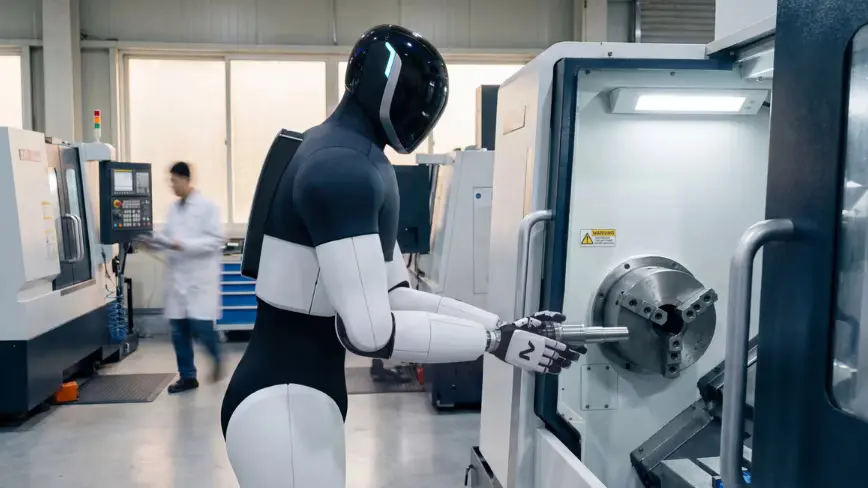
.The company already has 200 robotics systems running on its Cortex model across Europe and the United States
1
5
. These systems include single-arm robotics, dual-arm systems, and wheeled mobile robotics. Sereact has completed more than 1 billion production picks, with roughly one intervention per 53,000 requests requiring remote human intervention3
. Cortex 2.0 is trained on this real production data rather than synthetic data common in research labs4
.Related Stories


Manufacturing and Logistics Customers Validate Physical AI Approach
Sereact's customer base includes BMW, Daimler Truck, PepsiCo, and European e-commerce logistics operators Bol and Active Ants
3
4
. The deployments at automotive manufacturers like BMW and Daimler Truck represent production environments where robot failures are measured in line stoppages, distinguishing Sereact from AI robotics companies still operating at demonstration stage2
.Gulde said the company is targeting a growing market need: processing returned goods in retail and e-commerce. Unpacking and restocking items can be expensive, and warehouse robots equipped with Sereact's technology can help retailers sort through products, assess item condition, and cut costs
1
. The startup is in talks with H&M for such applications. The company first deployed its technology to warehouses because no other environment offers the same mix of data points: billions of real interactions, every object shape imaginable, hard throughput constraints, and consequences when robots make errors4
.
Source: SiliconANGLE
Expansion Into US Market and Humanoid Robots
Sereact plans to use the funding to expand into the US market, opening its first American office in Boston and hiring commercial, application, and engineering staff locally
3
. Besides Stuttgart, the company already maintains offices in Zurich and Boston. The expansion comes as global investment in robotics more than tripled year-over-year to $27.6 billion in 2025, according to PitchBook data1
.The company's software-first approach positions it to compete in the emerging humanoid robot market, which is projected to grow from under $1 billion in 2023 to exceed $38 billion by 2030
2
. Sereact's hardware-agnostic software runs across robotic arms, mobile manipulators, and humanoid robots from multiple suppliers3
. This positions the company to capture value as humanoid robots from Figure AI, Boston Dynamics, and Tesla's Optimus move from controlled tests to commercial production in manufacturing and logistics2
.Trevor Neff, growth partner at Headline, said: "The physical AI opportunity is one of the largest we've seen in a generation and we believe it will rewire global supply chains and manufacturing. Behind great opportunities and great companies are great founders and Ralf and Marc are building into that opportunity the right way: real deployments, real data and a model that compounds and gets better with every single pick"
3
. The investment thesis mirrors strategies that made Mobileye valuable in autonomous vehicles: the highest-margin position in robotics may not be the robot itself but the intelligence running it2
.References
Summarized by

Navi
[3]
[5]
Related Stories
Recent Highlights
1
Meta Unveils Muse Wonder Frontier AI Models, Claims Performance Matching OpenAI and Anthropic
Technology

2
IMF Report Warns AI Market Correction Could Spark Global Financial Crisis With $1.4T at Risk
Business and Economy

3
OpenAI Releases 722 AI-Generated Math Solutions, Triggering Existential Crisis in Mathematics
Technology

Recent Highlights
Today's Top Stories






Don’t drown in AI news. We cut through the noise - filtering, ranking and summarizing the most important AI news, breakthroughs and research daily. Follow topics that matter to you and stay ahead.


