9 Sources
[1]
ServiceNow raises annual subscription revenue forecast again on AI-driven demand
July 22 (Reuters) - ServiceNow (NOW.N), opens new tab on Wednesday raised its forecast for annual subscription revenue for the second time after beating second-quarter revenue and profit estimates, driven by growing demand for its AI-powered software. Shares of ServiceNow rose over 5% in volatile extended trading. They have fallen about 37% so far this year. The results come as software giants are grappling with concerns of a "SaaSpocalypse" - a term reflecting the gloom around software-as-a-service companies amid growing capabilities of new AI tools provided by ā startups like OpenAI and Anthropic. But ServiceNow is expanding its AI agent portfolio across domains like IT and customer service, helping enterprise clients to automate complex, time-consuming workflows. Earlier this year, ServiceNow launched Otto, an AI experience designed to handle requests from employees and complete complex cross-department workflows. It also enhanced its capabilities by acquiring cybersecurity startup Armis and AI startup Moveworks. ServiceNow said its AI platform has seen widespread adoption across the public sector, with nearly all 50 U.S. states now using it ā to improve citizen services and modernize operations. The company now expects full-year 2026 subscription revenue of $15.760 billion to $15.780 billion, up from its earlier projection of $15.735 billion to $15.775 billion. Second-quarter subscription revenue of $3.88 billion and adjusted profit per share of 90 cents exceeded LSEG-compiled analysts' average ā estimates of $3.82 billion and 85 cents, respectively. However, the company's forecast for third-quarter subscription revenue of $3.975 billion to $3.980 billion came in below the average estimate of about $4 billion. ServiceNow said its ā current remaining performance obligations, contract revenue expected to be recognized within the next 12 months, hit $13.20 billion as of June 30, a 21% increase from ā a year earlier. "Our $29 billion in remaining performance obligations is fueled by longer customer commitments and skyrocketing demand from our partner ecosystem," CEO Bill McDermott said in a statement. Reporting by Jaspreet Singh in Bengaluru; Editing by Shailesh Kuber Our Standards: The Thomson Reuters Trust Principles., opens new tab
[2]
Will ServiceNow's strong Q2 earnings beat finally allow the company to escape the SaaSpocalypse? | Fortune
The stock entered Wednesday down roughly a third for the year and about 50% off its 52-week high, even as revenue kept climbing north of 20%. ServiceNow CEO Bill McDermott kept saying his company was "the enterprise gateway for agentic AI," and he kept showing impressive growth figures to prove it. But the market just wasn't buying. During Wednesday's regular trading session, before ServiceNow announced its second quarter earnings, shares fell another 6.5% following a report that OpenAI planned to build an enterprise product, called Presence, designed to weave AI agents into the internal machinery of large organizations -- precisely the territory ServiceNow has staked out with its AI Control Tower product. But then ServiceNow released its numbers. And, perhaps finally, traders decided McDermott was not just blowing smoke. Shares jumped as much as 7% in after-hours trading, wiping out the regular-session decline before paring the gains slightly. "We are who we said we were," McDermott told Fortune in an interview Wednesday, conducted hours before the results were made public. "We've become the agentic front door to the enterprise, and we're managing everything for our customers from workflow to cybersecurity." ServiceNow reported second-quarter subscription revenue of $3.88 billion, up 24.5% year over year, and total revenue just shy of $4 billion, up 24%. Both beat the high end of the company's own guidance. Adjusted earnings came in at 90 cents per share, ahead of the roughly 86 cents Wall Street analysts expected. The company raised its full-year subscription-revenue guidance to a range of $15.76 billion to $15.78 billion. Current remaining performance obligations -- a metric closely watched by investors that measures revenue that customers have already contracted for and which ServiceNow will deliver in the next 12 months -- rose 21%, to $13.2 billion. Total remaining performance obligations reached $29 billion, also up 21%. ServiceNow's AI products crossed $1 billion in annual contract value for the first time, a threshold McDermott has been promising for a year; the company says agentic deployments have grown ninefold in nine months. It closed 123 deals worth more than $1 million in net new annual contract value, up nearly 40% from a year earlier. The company's non-GAAP operating margin held at 29.5%. Management reiterated its long-term targets: $30 billion-plus in subscription revenue and a "Rule of 60" by 2030. ("Rule of 60" means that ServiceNow's revenue growth rate added to its profits margin would equal or exceed 60. Investors traditionally expected enterprise software companies to operate with a "Rule of 40." McDermott said ServiceNow is currently running at a "Rule of 56.") Increasingly, McDermott sees cybersecurity as ServiceNow's key enterprise sales driver. He claims ServiceNow, bolstered by its acquisitions of Armis and Veza, has become "the fastest growing cybersecurity company in enterprise software" and the eighth-largest cybersecurity company overall. "The attack surface is exploding because of AI," he said, arguing that every ungoverned agent and machine identity widens the "blast radius" companies must police. His pitch is that once customers buy the control tower to govern their AI agents, the rest of ServiceNow's platform follows: "Everybody is going to need our control tower, and so I expect that to sell like hotcakes." Notably, McDermott declined to join fellow enterprise-software CEOs, such as Microsoft's Satya Nadella and Palantir's Alex Karp, who have been warning customers away from reliance on AI models from frontier AI labs over claims that the companies mine customer data to build competing products. "I'm not agreeing with that narrative. I actually fully support the frontier models," McDermott said, framing ServiceNow instead as their distribution channel into the enterprise. "AI thinks, but workflow acts," he said. Companies won't "bet a business process on 'probably it's right,'" he argued, and most enterprise AI runs on cheaper, domain-specific models anyway: "We don't need Lamborghinis to deliver the mail." The open question is whether Wednesday's beat and share price jump is just a blip, or the catalyst that convinces investors to give the stock a more durable re-rating. McDermott has been putting strong numbers on the board for more than a year without much reward. "Innovating for the enterprise, it's a lot like politics -- it's easy to make noise, very hard to make progress," he said, casting the quarter as another entry in "seven years of defying all the naysayers." Some skeptics aren't fully convinced. Bears continue to flag the company's rich valuation -- the company trades at a trailing price-to-earnings ratio of close to 60 -- and concerns about the pricing of ServiceNow's products. Some analysts warned that the company's July 1 pricing change pulled renewals forward, potentially borrowing backlog strength from later quarters. ServiceNow itself acknowledged that part of the revenue beat came from on-premise deals -- driven by strong U.S. federal demand -- that landed in the second quarter rather than the third. But the after-hours move suggests investors are willing to entertain the idea that ServiceNow as a winner of the agentic AI era, rather than a victim.
[3]
ServiceNow beats estimates and raises outlook as AI passes $1B in bookings
Shares in ServiceNow Inc. were up more than 3% in late trading today after the enterprise software company beat Wall Street targets across every headline metric in its fiscal second quarter and raised its full-year subscription revenue outlook, as its artificial intelligence products crossed $1 billion in annual contract value for the first time. For the quarter that ended on June 30, ServiceNow reported adjusted earnings of 90 cents per diluted share, up from a split-adjusted 82 cents in the same quarter a year earlier, on revenue of $3.99 billion, up 24% year-over-year. Both topped the 86 cents per share and revenue of $3.93 billion expected by analysts. Subscription revenue, the bulk of the total, rose 24.5% to $3.88 billion, or 23% in constant currency. Adjusted operating margin came in at 29.5%. Current remaining performance obligations, booked revenue the company expects to recognize over the next 12 months, climbed 21% to $13.2 billion and total remaining performance obligations reached $29 billion, also up 21%. The AI business was the figure investors had been waiting on. ServiceNow said its AI portfolio passed $1 billion in annual contract value during the quarter and Chairman and Chief Executive Bill McDermott said agentic deployments of the software climbed ninefold over the past nine months. The company closed 123 deals worth more than $1 million in net new annual contract value in the quarter, up nearly 40% from a year earlier and ended June with 658 customers, each paying more than $5 million a year. "ServiceNow's exceptional Q2 results solidify our position as the fastest-growing major enterprise software and cybersecurity company," McDermott said in the earnings release. "With our AI Control Tower as the market standard, agentic deployments of ServiceNow AI increased ninefold in just nine months. We are who we said we were: a defining company that is only just getting started." ServiceNow raised its full-year subscription revenue guidance to between $15.76 billion and $15.78 billion, growth of about 22.5%, citing continued strength in net new annual contract value. The company said strong U.S. federal demand pulled some on-premises subscription revenue forward from the third quarter into the second. For the third quarter, it guided to subscription revenue of about $3.98 billion, up 20.5%. President and Chief Financial Officer Gina Mastantuono said net new AI bookings again outpaced expectations and that the AI Control Tower was fueling growth in the company's security and risk business. The report was among the more closely watched on the software calendar. ServiceNow shares had fallen about 35% this year heading into the results, and options traders had positioned for a swing of more than 12% in either direction.
[4]
ServiceNow AI Contract Value Crosses $1 Billion Milestone, Stock Soars - ServiceNow (NYSE:NOW)
ServiceNow, Inc. Common Stock (NYSE:NOW) shares are surging premarket on Thursday as it reported strong second-quarter earnings on Wednesday. Earnings Snapshot Adjusted EPS of 90 cents beat the Street estimate of 85 cents, according to Benzinga Pro data. Revenue clocked in at $3.99 billion, which beat the analyst consensus estimate of $3.93 billion. Subscription revenue rose 24.5% year-over-year (Y/Y) to $3.88 billion, 1.5 percentage points above guidance. Current remaining performance obligations (RPO) increased 21% Y/Y to $13.2 billion, while total RPO reached nearly $29 billion, up 21% Y/Y in the quarter. Adjusted operating margin came in at 29.5%, 300 basis points above guidance, supported by revenue outperformance and cost discipline. Remaining performance obligations of $29 billion as of second quarter 2026, representing 21% Y/Y growth. Key Metrics AI adoption accelerated, with AI annual contract value (ACV) surpassing $1 billion and tracking toward the company's $1.5 billion 2026 target. AI net new ACV growth increased over 40% sequentially, and deals involving five or more AI products grew 5.5x Y/Y. Customers deploying agentic AI in production rose 9x over the past nine months. ServiceNow secured 123 deals with more than $1 million in net new ACV, up 40% Y/Y. The company ended the quarter with 658 customers generating over $5 million in ACV, including 32 more customers above the $20 million threshold. Renewal rates remained strong at 98%, highlighting continued customer adoption. Cybersecurity also surpassed $1 billion in revenue, supported by acquisitions such as Armis and Veza. Outlook & Management Commentary ServiceNow raised its fiscal year 2026 subscription revenue guidance midpoint by $15 million to approximately $15.77 billion, implying 21% Y/Y growth. This is supported by strong U.S. federal demand and accelerating AI adoption. For the third quarter of 2026, the company expects subscription revenue of $3.975 billion-$3.980 billion and cRPO growth of 20% Y/Y in constant currency. The company maintained expectations for a 31.5% operating margin and 35% free cash flow margin for the fiscal year 2026. Management reaffirmed its long-term target of reaching $32 billion in revenue by 2030 while sustaining a Rule of 60+ growth profile. ServiceNow executives expressed confidence in the company's third quarter and full-year outlook. The CEO highlighted an upcoming announcement around a conversational service desk experience and noted that cybersecurity has grown into a 10-figure business for the company. Experian & TeamViewer Partnership NOW Stock Price Activity: ServiceNow shares were up 7.46% at $102.58 during premarket trading Thursday. Photo via Shutterstock Market News and Data brought to you by Benzinga APIs To add Benzinga News as your preferred source on Google, click here.
[5]
ServiceNow CEO Bill McDermott Hails '10-Figure Cybersecurity Business' as Q2 Subscription Revenue Surges
Financial Beat & Cyber Growth McDermott emphasized that ServiceNow is rapidly expanding beyond traditional IT workflows into security orchestration, accelerated by recent acquisitions like Armis and Veza. "We now have a 10-figure cybersecurity business that's growing faster than all the other top cybersecurity companies," McDermott stated during the earnings call. He added that the performance solidifies ServiceNow's position as the "fastest-growing major enterprise software and cybersecurity company," declaring, "We are who we said we were: a defining company that is only just getting started." The enterprise software provider delivered non-GAAP earnings of $0.90 per share, topping Wall Street expectations of $0.85 per share. Following the strong second quarter performance, ServiceNow raised its full-year 2026 subscription revenue guidance to $15.77 billion, representing 21% year-over-year growth. Accelerating Enterprise AI Adoption ServiceNow's AI annual contract value (ACV) crossed $1 billion during the quarter, keeping the firm on track to hit $1.5 billion by year-end. Management reported that deployments of agentic AI increased ninefold over the last nine months. Current remaining performance obligations (cRPO) closed at $13.20 billion, up 21.5% year-over-year in constant currency. Analyst Perspective on AI Moat Boloor added that ServiceNow acts as the control layer for "any agent, any workflow, any model," highlighting that 50% of the company's net new business is already non-seat-based. How Has NOW Performed In 2026? NOW shares declined 37.69% year-to-date, up 2.63% over the last month, and lower by 50.40% over the year. It closed 6.47% lower at $95.46 per share on Wednesday, and it was up 7.24% in premarket on Thursday. Benzinga's Edge Stock Rankings indicate that NOW maintains a weak price trend in the short, long, and medium terms, with a solid growth score. Photo courtesy: bluestork / Shutterstock.com Market News and Data brought to you by Benzinga APIs To add Benzinga News as your preferred source on Google, click here.
[6]
Goldman says ServiceNow is writing a totally new playbook
Seven years ago, on an earnings call, ServiceNow CEO Bill McDermott promised the company would become the defining enterprise software company of the 21st century, according to a transcript published by Benzinga. That promise rested almost entirely on IT ticket routing, the unglamorous software that logs a broken laptop or a locked account. It was a modest foundation for such a large claim. This year tested that promise in a way McDermott could not have foreseen. Enterprise software spent the first half of 2026 gripped by what Fortune called a "SaaSpocalypse," the fear that AI agents could simply perform the work software licenses used to gate. If an autonomous agent can resolve a support ticket on its own, the logic went, why keep paying per seat for the software that used to route it to a human? ServiceNow absorbed that fear directly. Shares had fallen close to 50% over the prior year heading into the company's second quarter report. Wall Street was not debating whether ServiceNow made good software. It was debating whether AI made the entire subscription model obsolete. The company reported second-quarter results on July 22, beating estimates on revenue, earnings, and bookings, according to the company's earnings release. "Q2 was an outstanding quarter that highlights ServiceNow's broad based demand," said ServiceNow President and CFO Gina Mastantuono in the release. Subscription revenue rose 24.5% year over year to $3.877 billion, and NOW shares initially fell before recovering after hours as investors digested the numbers. Two days later, Goldman Sachs raised its price target on the stock to $152 from $145 while keeping a buy rating, according to a Goldman Sachs research note shared with TheStreet. That target reboot did not lean on the subscription beat. Goldman analysts led by Gabriela Borges wrote that the single biggest driver of a ServiceNow rerating will be whether the company proves its relevance inside the enterprise AI stack, not whether it keeps beating quarterly guidance. That distinction reframes what investors should actually be tracking. The ServiceNow $1 billion AI milestone ServiceNow's AI annual contract value crossed $1 billion for the first time this quarter, and Goldman noted the company reiterated confidence in exceeding a $1.5 billion target by the end of 2026. That pace also puts ServiceNow ahead of its own long-term goal of AI reaching 30% of total ACV by 2030. Goldman views that AI revenue as more valuable than a comparable dollar of core workflow revenue, because AI deployments deepen customer entrenchment and create room for future consumption growth. Net new AI bookings grew more than 40% quarter over quarter, and the number of customers running AI in production increased ninefold over nine months. Deal volume among first time AI buyers grew 45% year over year. Bloomberg / Getty Images Automating the IT help desk ServiceNow's Level 1 IT service management product went generally available in May and now resolves 80% to 85% of service requests without human intervention, Goldman's note revealed. That statistic matters because it is happening inside the same category that built the company's original business, not a bolted-on side project. The bank also flagged a new voice capability, citing one airline customer now routing all customer service calls, roughly 5 million annually, through ServiceNow's Voice AI. As agents take on more complex tasks, Goldman expects assists and consumption to rise, which is where the actual monetization shows up. The Guggenheim counterpoint Guggenheim's John DiFucci upgraded the stock to buy on July 1 for the opposite reason Goldman is bullish. He expects AI monetization to disappoint and still views AI as a real threat to the software model, according to TIKR. He upgraded purely because the stock had gotten too cheap. Goldman's own note lists disintermediation by competing AI technologies as a named downside risk, alongside elongated sales cycles and federal spending delays. McDermott has already previewed his rebuttal to that exact fear. "We don't need Lamborghinis to deliver the mail," he told Fortune, arguing most enterprise AI runs on cheaper, purpose-built models rather than the frontier systems that bears worry will replace ServiceNow's platform. In other words, the same bank raising the target is also naming the scenario in which the thesis fails. Which companies get to keep their multiple? ServiceNow's stock has now had one violent post-earnings drop and one sharp rally within the same year, evidence that investors have not settled on how to value AI exposure in enterprise software. The company that once described itself as a ticket routing tool is now being priced on whether it becomes infrastructure that AI runs through, rather than a layer AI erases. That question extends well beyond one Santa Clara software company. Every enterprise vendor with a seat-based business model is now being asked to prove the same thing ServiceNow just tried to prove, and the next few quarters of AI ACV disclosures across the sector will show which of them actually can. The Arena Media Brands, LLC THESTREET is a registered trademark of TheStreet, Inc. This story was originally published July 26, 2026 at 7:37 AM.
[7]
Bank of America spots ServiceNow's overlooked AI advantage
Bank of America reiterated its Buy rating and $130 price target on ServiceNow (NOW) after the software company reported stronger-than-expected second-quarter contract growth. The target represents about a 36% upside from the $95.46 share price listed in BofA's July 23 report. According to the report, ServiceNow's subscription revenue rose 24.5% to $3.88 billion, and current remaining performance obligations (contracted revenue expected within the next 12 months) increased 21% to $13.2 billion. Both measures exceeded Wall Street expectations. BofA highlighted a less obvious point in the report: ServiceNow's AI agents may benefit from the workflow history and infrastructure records already stored on its platform. Analyst Tal Liani said ServiceNow can draw on that context when an agent encounters an enterprise problem that does not have a simple, documented solution. Because ServiceNow already stores those records, its agents could handle difficult cases with fewer data-integration steps than an outside AI product, according to the report. BofA says enterprise context can help ServiceNow handle harder cases A basic service-desk agent can reset a password, classify a support ticket, or approve software access by following a documented process. An application outage presents a more complicated task. Before taking action, an agent may need to identify which servers support the application, review recent configuration changes, check which other services depend on it, and confirm who has authority to approve a repair. The product debate is shifting from simple L1 automation ... to broader agentic workflows. ServiceNow can provide that background through customers' workflow histories, its Configuration Management Database (CMDB) and newer knowledge tools. The CMDB records applications, servers, services, and the relationships among them. ServiceNow's Context Engine adds information about people, roles, company policies, and prior decisions. Those records can help an agent determine which systems could be affected before it changes a configuration or restarts a service. A customer deploying a third-party AI tool may need to extract records from several systems, explain how those records relate to one another, and return the agent's output to the software where employees complete the work. ServiceNow can give an agent access to existing workflows, system relationships, permissions, and approval rules on the same platform. BofA said the setup could reduce deployment costs and complexity while allowing the agent to complete a larger portion of the process. The approach could become more useful as companies move beyond repetitive support requests. Poorly documented incidents, unusual security events, and work spanning several departments require agents to interpret company-specific information before choosing an action. BofA views ServiceNow's position inside those workflows as its key strategic advantage over third-party AI tools. But the firm also cautioned that the advantage still depends on pricing, the quality of agents' results, and customers' willingness to expand their usage. Sundry Photography / Getty Images ServiceNow's AI products are gaining paid adoption ServiceNow's second-quarter results provide early commercial evidence for BofA's argument. The company's AI products surpassed $1 billion in annual contract value during the quarter. The number of customers running ServiceNow's agentic AI in production increased ninefold over the past nine months. ServiceNow is also charging more when customers upgrade to packages containing its newest AI products. CFO Gina Mastantuono said that pricing increases for the company's established Pro Plus packages remained above 30%. Upgrades to recently introduced AI-native packages produced increases of 20% to 30%, in line with the range ServiceNow had previously outlined. Security is one example of how ServiceNow can combine enterprise information with an automated response. ServiceNow's security and risk products appeared in 16 of its 20 largest second-quarter deals, and the company completed 24 security deals worth more than $1 million each, according to BofA. Products added through Armis and Veza provide information about devices, vulnerabilities, and user identities. ServiceNow can connect those records to workflows that assign a problem, route an approval, and document the steps taken to resolve it. BofA said traction from AI Control Tower, Armis and Veza helped drive the quarter's security results. ServiceNow's key second-quarter AI indicators * More than $1 billion: AI annual contract value * Ninefold: Increase in customers running agentic AI in production over nine months * 20% to 30%: Pricing increase from upgrades to AI-native packages * 24: Security deals worth more than $1 million each The cost of running AI remains the next test BofA's argument depends on three unresolved questions: whether ServiceNow's agents consistently produce reliable results, whether customers expand their usage, and whether the company can charge enough to cover the costs of running AI workloads. ServiceNow's second-quarter gross margin fell to 77.9%, down from 81% a year earlier, and came in below BofA's 79.3% estimate. The firm reduced its fiscal 2026 gross-margin estimate by 45 basis points to 78.9%. A lower gross margin means a larger portion of ServiceNow's revenue is being consumed by the cost of delivering its products. BofA expects AI adoption and increased use of hyperscaler infrastructure to remain near-term expenses. The integration of recent acquisitions adds further costs. The company offset some of that pressure elsewhere in the income statement. Its adjusted operating margin reached 29.5%, about 270 basis points above Wall Street expectations, helped by stronger subscription revenue and the timing of spending. Management maintained its full-year operating-margin forecast of 31.5%, however, as AI usage and acquisition integration continue to weigh on expenses. The quarter's subscription-revenue outperformance also received help from U.S. federal customers. Strong demand shifted some on-premise revenue recognition from the third quarter into the second. ServiceNow forecast third-quarter subscription revenue of $3.975 billion to $3.980 billion, slightly below the roughly $4 billion that analysts expected. The pull-forward means investors cannot attribute the entire second-quarter beat to AI demand. ServiceNow has shown that customers will deploy its AI products and pay more for upgraded packages. Sustaining BofA's bullish view now requires those agents to resolve complex cases accurately and cheaply enough to expand usage without pushing gross margins lower. The Arena Media Brands, LLC THESTREET is a registered trademark of TheStreet, Inc. This story was originally published July 24, 2026 at 9:33 AM.
[8]
Oppenheimer reiterates ServiceNow stock rating on AI momentum By Investing.com
Investing.com - Oppenheimer reiterated an Outperform rating on ServiceNow (NYSE:NOW) with a $140.00 price target following the company's second-quarter performance. The target aligns closely with InvestingPro's Fair Value analysis, which suggests the stock is currently undervalued at its current price of $95.46. The firm said most of ServiceNow's second-quarter key performance indicators beat consensus estimates. The AI business momentum remains strong and is on track to exceed the 2026 $1.5 billion annual contract value target. Management disclosed that the cybersecurity business exceeds $1 billion and the organic portion's growth is accelerating. The cybersecurity disclosures represent a positive development, since the category should garner a disproportionate share of new enterprise IT spending over the near- and medium-terms because of the substantial risks involved in the significant growth and fragmentation of agents entering enterprise IT systems. The company's strong fundamentals are reflected in its impressive gross profit margin of 76.56% and revenue growth of 21.72% over the last twelve months, with total revenue reaching $13.96 billion. InvestingPro identifies ServiceNow as a prominent player in the Software industry, with 14 additional ProTips available to subscribers, along with comprehensive Pro Research Reports covering this and 1,400+ other US equities. The second-quarter beat magnitudes are smaller than over the last twelve months, and the company results and guidance show signs of continuing decelerating growth. ServiceNow's business is sustaining faster growth than its peers, which supports multiples. Oppenheimer stated: "We reiterate our Outperform rating on ServiceNow after most of its 2Q KPIs beat consensus estimates." In other recent news, ServiceNow reported its second-quarter fiscal 2026 results, surpassing Wall Street expectations. The company achieved adjusted earnings per share of $0.90, exceeding the consensus estimate of $0.86. Revenue reached $3.99 billion, slightly above the forecasted $3.93 billion, marking a 23% increase in constant currency. This performance prompted Citizens to reiterate a Market Outperform rating with a price target of $157.00. Additionally, ServiceNow raised its full-year subscription revenue outlook, driven by accelerating demand related to AI. Despite some concerns about margin pressure and timing effects in federal government business, the company's earnings beat has been well-received by analysts. These developments reflect ServiceNow's strong position in the market as it continues to grow its revenue and earnings. This article was generated with the support of AI and reviewed by an editor. For more information see our T&C.
[9]
Why is ServiceNow stock surging today? By Investing.com
Investing.com -- ServiceNow stock is surging 7.1% in pre-open trading after the enterprise workflow automation company delivered a decisive Q2 2026 earnings beat on Wednesday evening, reporting total revenue of $3.99 billion against analyst expectations of $3.93 billion and adjusted earnings per share of $0.90, ahead of the $0.86 consensus estimate. The results reversed a painful narrative that had weighed on the stock for months: shares had fallen sharply following each of the prior two quarterly reports and had shed roughly 28-33% year-to-date heading into the print, making the bar for a positive reaction relatively low. The standout detail from the report was the momentum in artificial intelligence. ServiceNow's AI annual contract value surpassed $1 billion in Q2, with net new AI ACV accelerating more than 40% sequentially, keeping the company on track toward its $1.5 billion AI ACV target by year-end. Management also raised its full-year 2026 subscription revenue outlook to $15.760-$15.780 billion, the second upward revision of the year, signaling confidence in sustained demand. Adding to the positive tone, TeamViewer and ServiceNow announced a multi-year strategic technology partnership today to integrate TeamViewer's endpoint management and remote connectivity capabilities with the ServiceNow AI Platform, broadening the company's ecosystem reach. The broader market is providing little tailwind this morning, with the S&P 500 down 0.3%, the Dow Jones off 0.3%, and the Nasdaq lower by 0.5%, meaning ServiceNow's pre-market rally is driven entirely by its own fundamentals rather than macro sentiment. Ahead of the earnings release, Morgan Stanley had assumed coverage of the stock with an Overweight rating, and at least one other analyst reiterated a buy rating, helping to frame the setup positively even as 38 analysts had cut EPS estimates in the prior 90 days. Taken together, a clean beat-and-raise quarter, a landmark AI revenue milestone, a new strategic partnership, and a stock that had been deeply discounted heading into the report created the conditions for a sharp pre-market recovery, allowing ServiceNow to claw back a meaningful portion of its year-to-date losses in a single session. This article was generated with the support of AI and reviewed by an editor. For more information see our T&C.
Share
Copy Link
ServiceNow reported second-quarter subscription revenue of $3.88 billion, beating estimates and raising its full-year forecast for the second time. The company's AI annual contract value surpassed $1 billion for the first time, with agentic AI deployments growing ninefold in nine months. Shares jumped over 7% in after-hours trading, potentially signaling an escape from the SaaSpocalypse that has plagued software-as-a-service companies.
ServiceNow delivered strong Q2 earnings that exceeded Wall Street expectations across every major metric, potentially marking a turning point for a stock that had fallen roughly 37% year-to-date heading into the announcement
1
. The enterprise software company reported second-quarter subscription revenue of $3.88 billion, up 24.5% year-over-year, surpassing analyst estimates of $3.82 billion1
. Total revenue reached just shy of $4 billion, up 24%, while adjusted earnings came in at 90 cents per share, beating the consensus estimate of roughly 85 cents2
. Shares jumped as much as 7% in after-hours trading, wiping out a 6.5% decline during the regular session2
.
Source: Benzinga
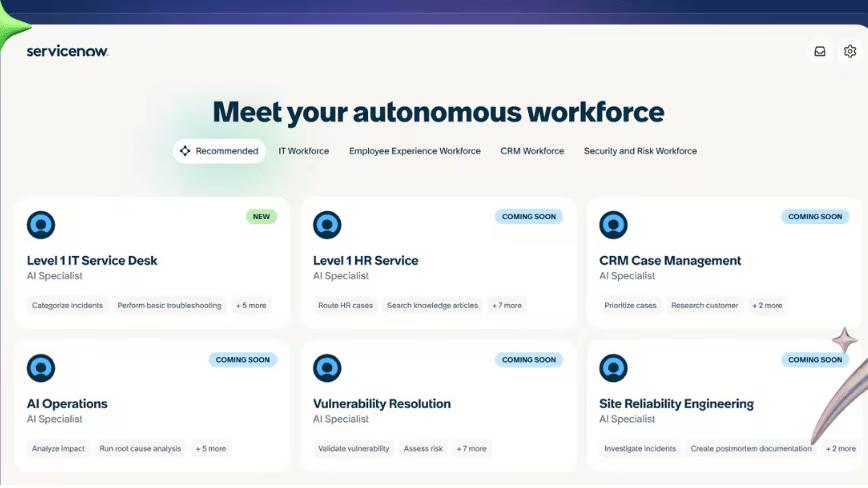
The most closely watched metric delivered: ServiceNow's AI portfolio surpassed $1 billion in annual contract value for the first time, a threshold CEO Bill McDermott has been promising for a year
2
. The company reported that agentic AI deployments increased ninefold over the past nine months, with AI net new annual contract value growth rising over 40% sequentially4
. Deals involving five or more AI products grew 5.5 times year-over-year, while customers deploying agentic AI in production rose nine times during the same period4
. The company remains on track to hit its $1.5 billion AI annual contract value target for 20265
.For the second time this year, ServiceNow raised its full-year 2026 subscription revenue guidance to a range of $15.76 billion to $15.78 billion, up from its earlier projection of $15.735 billion to $15.775 billion
1
. The revised forecast implies approximately 21% year-over-year growth, supported by strong U.S. federal demand and accelerating AI adoption4
. Current remaining performance obligations reached $13.2 billion as of June 30, representing a 21% increase from a year earlier, while total remaining performance obligations hit $29 billion, also up 21%3
. "Our $29 billion in remaining performance obligations is fueled by longer customer commitments and skyrocketing demand from our partner ecosystem," Bill McDermott said in a statement1
.
Source: SiliconANGLE
The results arrive as software giants grapple with concerns of a "SaaSpocalypse"āa term reflecting gloom around software-as-a-service companies amid growing capabilities of AI tools from startups like OpenAI and Anthropic
1
. ServiceNow's stock had been down roughly a third for the year and about 50% off its 52-week high, even as revenue kept climbing north of 20%2
. "We are who we said we were," McDermott told Fortune in an interview. "We've become the agentic front door to the enterprise, and we're managing everything for our customers from workflow to cybersecurity"2
. The company's AI Control Tower has become central to its strategy, with McDermott claiming "Everybody is going to need our control tower, and so I expect that to sell like hotcakes"2
.Related Stories
ServiceNow's cybersecurity business has grown into what McDermott calls a "10-figure" operation, surpassing $1 billion in revenue and positioning the company as the eighth-largest cybersecurity firm overall
2
. The growth has been bolstered by acquisitions including cybersecurity startup Armis and AI startup Moveworks, along with Veza1
. McDermott claims ServiceNow has become "the fastest-growing major enterprise software and cybersecurity company," arguing that "the attack surface is exploding because of AI" as every ungoverned agent and machine identity widens the "blast radius" companies must police2
. The company closed 123 deals worth more than $1 million in net new annual contract value during the quarter, up nearly 40% from a year earlier3
.

Source: Reuters
The open question is whether Wednesday's beat and stock soars represent just a blip or a catalyst for more durable re-rating
2
. Some skeptics continue to flag the company's rich valuationātrading at a trailing price-to-earnings ratio close to 60āand concerns about pricing2
. The company's third-quarter subscription revenue forecast of $3.975 billion to $3.980 billion came in below the average estimate of about $4 billion1
. Management maintained expectations for a 31.5% operating margin and 35% free cash flow margin for fiscal year 2026, while reaffirming long-term targets of reaching $32 billion in revenue by 2030 with a "Rule of 60+" growth profile4
. The company ended the quarter with 658 customers generating over $5 million in annual contract value, with renewal rates holding strong at 98%4
.Summarized by
Navi
[4]
24 Jul 2025ā¢Business and Economy

24 Oct 2024ā¢Business and Economy

24 Apr 2025ā¢Business and Economy

1
Science and Research

2
Technology

3
Technology