7 Sources
[1]
ServiceNow adds agent kill switches to AI control tower
ServiceNow acquisitions Veza and Traceloop join to monitor agents and AI workflows ServiceNow announced an expansion of its AI Control Tower, transforming what began last year as a governance dashboard into what the company now describes as a command center for managing AI assets across an entire enterprise, including those running outside ServiceNow's own platform. The updated AI Control Tower, shipping as part of ServiceNow's Australia platform release, now operates across five areas: discovery, observation, governance, security, and measurement. The company said that this is its answer to AI agent sprawl, as enterprises have deployed more AI than they can account for and the tools to govern it have not kept pace. "What we launched last year gave customers a governance layer, but what we're shipping this year goes significantly deeper, evolving from visibility and management into a full enterprise AI command center," Nenshad Bardoliwalla, group vice president of AI products at ServiceNow told reporters during a media briefing ahead of the company's annual product show, Knowledge 26. "Our AI control tower ensures every AI system asset and identity is compliant, secure, and aligned with your strategy." The AI Control Tower now reaches beyond ServiceNow's own platform with 30 new enterprise connectors that span all three major hyperscalers, Amazon Web Services, Google Cloud, and Microsoft Azure, along with enterprise applications such as SAP, Oracle, and Workday. The system can now discover AI assets, models, agents, prompts, and datasets running across an organization's full technology estate, not just those deployed on ServiceNow. "With our Veza integration, we're bringing patented access graph technology into the AI control tower, extending identity access governance to hyperscaler AI environments and every connected device, every agent, every model, every action has scope permissions, least privilege enforcement and auditable identity chains," Bardoliwalla said. Bardoliwalla walked through a demo in which the AI Control Tower detected a prompt injection attack on a pricing agent. The system identified malicious instructions hidden inside order payloads, mapped the blast radius of affected systems using access graph technology from Veza, and presented a kill switch to disable the compromised agent, without human intervention. "You need a system that senses, decides and acts on its own, that can scale with your AI portfolio, not your head count," said Bardoliwalla. Two recent acquisitions underpin the security architecture. ServiceNow announced in December it would acquire Veza, which contributes an access graph that maps every identity and access path across systems whether it belongs to humans, machines, or AI agents. It also knows which entities have create, read, update, and delete-level permissions. ServiceNow said the access graph currently maps over 30 billion fine-grained permissions. When a vendor pushes a new version of a model or agent, the platform detects permission changes and automatically triggers a re-scoping workflow. Traceloop, which ServiceNow acquired in March, provides deep AI observability inside the Control Tower by tracking every LLM call that is running in the system. The integration delivers continuous runtime monitoring with live alerts, replacing what ServiceNow described as the periodic manual audits most enterprises still rely on. Teams can watch how agents reason, where they make decisions, and when to course-correct. ServiceNow also addressed the cost side of the AI equation. Control Tower now includes cost tracking and ROI dashboards to give finance teams visibility into model spend. The measurements track token consumption across providers such as OpenAI, Anthropic, and Google so customers can predict costs and tie spending to business outcomes. ServiceNow said it uses the AI Control Tower internally to manage over 1,600 AI assets and tracked half a billion dollars in cumulative AI value from internal use cases in 2025. "The number one question every CFO is asking is, where's the value?" said Bardoliwalla during the briefing. He added that runaway model spend ranks among the biggest pain points enterprises currently face as they scale AI deployments. Alongside the Control Tower expansion, ServiceNow announced Action Fabric, a mechanism that opens the company's full workflow engine to external AI agents. Through a generally available MCP server, agents built on Claude, Copilot, or custom platforms can now trigger governed enterprise actions -- not just read and write data, but execute the flows, playbooks, approval chains, and catalog requests that ServiceNow customers have built over years. Anthropic is the first design partner for Action Fabric. The integration connects Claude directly to ServiceNow's governed system of action. "The gap between knowing what needs to happen and making it happen is where productivity dies," said Boris Cherny, head of Claude Code at Anthropic said in a statement. "Connecting Claude Cowork to ServiceNow's system of action closes that gap with enterprise execution, directly in the flow of work." Every action routed through Action Fabric runs through the AI Control Tower, so it carries identity verification, permission scoping, and a full audit trail. The MCP server is included in every Now Assist and AI Native SKU, with additional features planned for the second half of 2026.
[2]
NVIDIA and ServiceNow Partner on New Autonomous AI Agents for Enterprises
At ServiceNow Knowledge 2026, the companies are extending their collaboration to deliver governed autonomous agents to enterprises, from employee desktops to AI factories. Enterprise AI has learned to generate. It has learned to reason. Now companies are asking the next question: How should AI act? Early agent systems have shown what's possible, moving beyond simple prompts to take on more complex tasks. The next step is bringing those capabilities into enterprise environments -- where agents must operate with context, control and consistency across real workflows. At ServiceNow Knowledge 2026, NVIDIA founder and CEO Jensen Huang joined ServiceNow chairman and CEO Bill McDermott during the opening keynote to discuss the next phase of enterprise AI. The companies are expanding their collaboration across the full stack, delivering specialized autonomous AI agents that are safe and easy to adopt -- powered by NVIDIA accelerated computing, open models, domain-specific skills and secure agent execution software, and bringing together enterprise workflow context from ServiceNow Action Fabric and governance from ServiceNow AI Control Tower. ServiceNow is introducing Project Arc, a long-running, self-evolving autonomous desktop agent designed for knowledge workers, including developers, IT teams and administrators. Unlike standalone AI agents, Project Arc connects natively to the ServiceNow AI Platform through ServiceNow Action Fabric to bring governance, auditability and workflow intelligence to every action the autonomous desktop agent takes. It can access the local file systems, terminals and applications installed on a machine to complete complex, multistep tasks that traditional automation can't handle, but with the controls enterprises actually need to deploy AI at scale. The work is designed based on three requirements every company will need for long-running, autonomous agents: open models and domain-specific skills that can be customized and security that helps agents act without exposing sensitive data or systems -- all running on AI factories that deliver efficient tokenomics. Bringing this level of autonomy to enterprises requires control from the start. Project Arc uses NVIDIA OpenShell, an open source secure runtime for developing and deploying autonomous agents in sandboxed, policy-governed environments. ServiceNow is building on and contributing to OpenShell to advance a common foundation for secure, enterprise-grade agent execution. With OpenShell, enterprises can define what an agent can see, which tools it can use and how each action is contained. "Project Arc represents the next step in our ongoing collaboration with NVIDIA, bringing autonomous execution to the desktop," said Jon Sigler, executive vice president and general manager of AI Platform at ServiceNow. "By combining OpenShell's runtime layer with ServiceNow AI Control Tower, and powered by ServiceNow Action Fabric, we're delivering the governance and security that enterprise AI requires." Open Models and Agent Skills Scale Enterprise AI To be effective, enterprise AI systems must be adaptable. NVIDIA and ServiceNow are building on an open ecosystem that allows organizations to tailor models and applications to their specific domains and data. NVIDIA agent skills enable specialized agents, such as ServiceNow AI Specialists, to deliver targeted capabilities across enterprise workflows. For example, the NVIDIA AI-Q Blueprint for building specialized deep research agents empowers ServiceNow AI Specialists to gather context, synthesize information and support more complex decision-making across business functions. In addition, the NVIDIA Agent Toolkit, including NVIDIA Nemotron open models, provide flexible building blocks and specialized skills for developing customized AI applications. To support real-world performance that these systems can perform reliably, the companies are also advancing NOWAI-Bench, an open benchmarking suite for enterprise AI agents, integrated with the NVIDIA NeMo Gym library. NOWAI-Bench includes EnterpriseOps-Gym, one of the industry's most challenging enterprise agent benchmarks, where Nemotron 3 Super currently ranks No. 1 among open source models. Unlike general benchmarks, these evaluations focus on multistep workflows -- where enterprise AI systems often encounter real challenges -- helping teams build agents that perform reliably in production environments. Efficient AI Factories As AI agents become long running and always on, scaling them across millions of workflows requires not just capability but efficiency -- making token economics central to enterprise AI. NVIDIA AI factories are built to deliver the lowest-cost, most-efficient tokenomics for production AI. The NVIDIA Blackwell platform delivers more than 50x greater token output per watt than NVIDIA Hopper, resulting in nearly 35x lower cost per million tokens. For enterprises running agents across millions of workflows, that efficiency can determine how quickly AI moves from pilots to broad production use. ServiceNow AI Control Tower integrates with the NVIDIA Enterprise AI Factory validated design, extending governance and observability to large-scale AI workloads. With added agent observability capabilities, organizations can monitor behavior in real time and manage AI systems across their full lifecycle -- from deployment to optimization. AI is becoming a new way that work gets done. What's changing now is that the core pieces required to deploy it at scale -- capable agents, built-in guardrails and proven performance -- are all coming together. The companies that move fastest will be the ones that give agents the infrastructure to act, the context to make decisions and the governance to keep every action accountable -- and NVIDIA and ServiceNow are making this a reality for the world's enterprises. Learn more about NVIDIA OpenShell and the NVIDIA AI-Q Blueprint.
[3]
ServiceNow just unveiled an AI workforce that can run your entire company: 'Enterprises need AI that senses, decides, and securely acts' | Fortune
ServiceNow used its biggest annual stage to make one sweeping argument: the era of AI as a helper is over. The era of AI as a worker has begun. At Knowledge 2026, held this week at the Venetian Expo Center in Las Vegas, the enterprise software company -- valued at roughly $95 billion and increasingly positioning itself as the operating system of the AI-powered enterprise -- unveiled a wave of announcements designed to move AI from the margins of business operations to the center of them. Taken together, they represent what ServiceNow considers the most ambitious product moment in the company's history. The centerpiece announcement was a major expansion of ServiceNow's Autonomous Workforce: a suite of AI "specialists" that don't just assist human workers but complete entire business processes from start to finish, without human intervention. The new AI specialists span IT operations, customer relationship management, HR, finance, legal, procurement, as well as security and risk. Unlike task-based AI tools or chatbots, ServiceNow says these specialists are role-scoped, governed, and embedded in proven enterprise workflows -- meaning they can triage a security incident, resolve an employee HR case, or close a sales quote autonomously, while leaving a full audit trail behind. Early results include ServiceNow's internal AI specialist resolving IT service desk cases 99% faster than human agents. Docusign is targeting autonomous resolution of 90% of all IT tickets. Honeywell says its AI assistant has eliminated the majority of service desk conversations. The city of Raleigh reports a 98% deflection rate on employee requests, saving the equivalent of a full month of staff time. "Advisory AI has run its course," said Amit Zavery, ServiceNow's president and chief product officer. "Enterprises need AI that senses, decides, and securely acts." The scale of the existing platform gives the pitch real weight: 23 million employees use ServiceNow's employee portal every month, generating an estimated 40 million-plus cases annually. The company says AI specialists across its customer base already resolve 91% of cases without reassignment. Each month, its CRM platform resolves over 100 million customer cases and configures more than 7 million quotes. The more enterprises deploy AI agents, the more urgent a second problem becomes: nobody knows where all those agents are, what they're doing, or who approved them. ServiceNow's answer was introduced at Knowledge 2025: the AI Control Tower. This year, the company announced that all AI Control Tower capabilities are now included across every product and package on its platform, built in by default rather than sold as an add-on. The Control Tower continuously discovers AI agents as they appear, risk-scores them, enforces least-privilege access, and measures their business impact against governance standards. The company also deepened its partnership with Microsoft to extend AI Control Tower governance across the Microsoft Agent 365 ecosystem. The integration gives IT administrators visibility into AI agents operating across both ServiceNow and Microsoft environments -- regardless of where those agents were built -- and allows ServiceNow's AI specialists to operate inside Microsoft 365 tools like Outlook, Word, and PowerPoint with metered usage tracked across both platforms. "One of the most important things we can do for enterprises is bring intelligence and action together in a secure, connected way," said Charles Lamanna, Microsoft's EVP of Business Industry Copilot. ServiceNow's security and risk division crossed $1 billion in annual contract value last year -- one of the fastest-growing segments on its platform -- and the company is doubling down with a new product called Autonomous Security & Risk. The launch integrates two recent acquisitions: Armis, which delivers continuous asset intelligence across IT, operational technology, IoT, and connected devices; and Veza, which maps every human and non-human identity and permission across an enterprise environment in real time. The combination gives security teams -- for the first time -- a unified picture of what exists in their environment and who or what is permitted to interact with it. The business case is urgent. As companies deploy more AI agents, those agents multiply the number of non-human identities operating inside enterprise systems, each with access to data and the ability to take consequential actions. Most enterprises cannot answer basic questions about those identities, such as who approved that access, why it exists, and whether it remains valid. Early customer results are striking. ServiceNow said a global energy company operating across 70 countries cut threat containment time by 97% and saved 1.2 million hours by automating security operations. A major U.S. financial services institution eliminated 96% of dormant non-human identities. A Fortune 100 aerospace manufacturer reduced control attestation time by 75%. ServiceNow also announced an expanded partnership with Nvidia, integrating Nvidia's accelerated computing infrastructure with the ServiceNow AI Platform, a move designed to give enterprises faster, more efficient AI agent deployment at scale. On the workforce development front, ServiceNow University -- the company's free learning platform -- has grown to nearly 2 million learners, up 80% year over year since its launch at Knowledge 2025. Two new tools debuted: AI Learning Guide, a conversational coaching companion that builds personalized learning paths, and SimStudio, a hands-on simulation environment where employees practice real ServiceNow tasks before going live. The World Economic Forum projects a net gain of 78 million jobs by 2030, with AI and big data topping the list of fastest-growing skills, and ServiceNow is clearly angling to be the training ground for the workers who fill them. Finally, a deepened partnership with Lenovo integrates its real-time device intelligence platform with ServiceNow's workflows, enabling enterprises to resolve up to 40% of IT issues proactively -- before users even notice a problem -- while cutting IT support costs by as much as 30%. Taken together, the announcements reflect a company that has made a definitive strategic bet: that the enterprise of the near future runs on autonomous AI workflows, governed by a central platform, and that ServiceNow intends to be that platform. The bet is well-timed. Enterprises are moving fast -- sometimes faster than their security, compliance, and governance infrastructure can keep pace. ServiceNow's argument is that it uniquely solves both sides of that equation: deploying AI at scale and governing it at scale, on the same platform, with the same data. Whether customers agree -- and whether autonomous AI specialists deliver on their promise at the scale ServiceNow is projecting -- will become clearer as the year unfolds. The security and risk AI specialists don't hit general availability until September. The IT specialists arrive in June. For now, ServiceNow is betting its next decade on the idea that AI agents will be our colleagues.
[4]
Knowledge 2026 - CEO Bill McDermott says AI intelligence is commoditizing, but chaos is coming
ServiceNow today announced an expansion of its AI Control Tower and Autonomous Workforce products, where it outlined how the platform's AI execution and governance capabilities are extending into every business function. The company's acquisition strategy in recent months is now showing up comprehensively in the product portfolio - Moveworks for the 'agentic front door' and Veza and Armis for its security and risk agenda. And CEO Bill McDermott took to the stage this morning to deliver his first mainstage keynote of the week, where he sought to ground these products in terms that he hopes will resonate with C-suite buyers. Before he got to the products, McDermott outlined how he views the current macro context. Whilst some argue about job displacement due to AI, he offered a different position - that the global workforce is aging, birth rates are declining, and the world is facing a labour shortage of up to 50 million workers by 2030. He said that the agents and robots are helpfully coming online at this exact moment and his position is that these are the ideal partners to complement a shrinking human workforce. Equally, he added, the companies that figure out how to deploy them safely will be the ones that grow - and the ones that don't will be exposed. In addition, McDermott spoke about why buyers need to understand that AI intelligence is commoditizing - essentially that they shouldn't be viewing models as the future differentiator - and positioned governance and execution as the key to expanding agentic AI adoption safely. The core pitch was that enterprises have a 'blind spot' when it comes to AI: that uncontrolled agents operating without identity, audit trail or compliance posture represent a serious business risk. He referenced the case of PocketOS as an example - where the company said that an AI agent deleted production databases in a matter of seconds. He also pointed out that cyber crime is already the third-largest economy in the world, behind only the United States and China. The more agents you deploy without governance, the more surface you expose. He said: Intelligence without rules and rails is a dangerous blind spot. To illustrate the enterprise AI chaos problem, McDermott painted a picture of what the average enterprise often looks like - an articulation of what many organizations will be experiencing right now. 367 different applications, with AI bolted onto every one of them like a sidecar - none of them connected or governed. A CFO who approved the spend but can't find the ROI - and a token bill going up every month. Six out of ten companies are already using agentic AI - but only one in ten have built anything autonomous. And employees, he said, toggling between 17 tabs wondering whether AI was supposed to make their lives easier or harder. His summary of where that leaves most enterprises and why ServiceNow is positioned well to support was: The real competitive differentiator is the orchestration surrounding the models. I've been reporting on ServiceNow's governance argument across the Veza acquisition, the Autonomous Workforce launch in February and the platform restructuring in April. What McDermott aimed to do this morning was take these product details and focus them in on something that makes sense to a CEO. It's also worth noting how McDermott characterized ServiceNow's own evolution. He acknowledged the company has previously stood on the Knowledge stage and described itself as the "platform of platforms." That, he said, no longer captures what ServiceNow is and that the updated pitch is that ServiceNow is now "the AI of agents". I'll be returning to this in future analysis, as I think it's worth exploring further. Openness and integration have been core to ServiceNow's philosophy for many years, but I think the challenge this time around is that there are others in the market making the same argument aggressively and there will be an internal struggle in enterprises about which platform, or multiple platforms, win out. The benefit ServiceNow has is its long-standing relationships with IT departments and CIOs. McDermott also sought to ground ServiceNow's execution credentials in the company's own internal data. The company runs what it calls Now on Now - ServiceNow, on ServiceNow. McDermott said that in 2025 the company saved half a million dollars on Now Assist alone within that programme, where 91 per cent of its own service requests are now supported by AI. And interestingly the event itself - 25,000 attendees, every incident in the venue, every service request - was running live on the platform. He said: You don't have to imagine what an Agentic business looks like. You are actually inside one. One of the central problems the AI Control Tower is designed to solve is the inability of most enterprises to measure what their AI investment is actually worth. The fact that ServiceNow can point to its own books, and to a live event as a proof of concept, is likely the kind of evidence that will resonate well with C-suite buyers. Our own diginomica network of CIOs have told us time and time again that they are struggling to get value from their current AI deployments. To bring the customer perspective, McDermott brought Raj Subramaniam, CEO of FedEx Corporation, and Vishal Talwar, EVP and Chief Digital and Information Officer of FedEx Corporation and President of FedEx Dataworks, on stage for a conversation about what responsible AI deployment looks like across a network moving 18 million packages a day. Subramaniam's said: The difference between business and technology has kind of evacuated...the role of running business is technology, and technology is business. Talwar was more specific on the mechanics of governance. He described a three-pillar approach: clarity of workflows, integrity of data, and a strong orchestration framework. On that third pillar, he said: As we scale AI agents across the enterprise, we treat them no differently than how we treat our human workforce. We treat them as a digital workforce that needs to be governed with the same rigor and policies as our human teams. The idea of AI agents as a digital workforce - subject to the same access controls, policies and accountability as human employees - is the underlying logic of everything ServiceNow is building around the AI Control Tower. Nvidia CEO Jensen Huang also joined McDermott on stage, and beyond the partnership details covered in the product piece, he also spoke about Nvidia itself being a ServiceNow customer. Huang said the company has cut employee intervention on support issues by two-thirds - two-thirds of queries that previously required a human are now resolved without one. And his advice on what enterprises should take from this was: Don't just think productivity and therefore cost reduction. Think productivity and therefore ambition elevation. He added: What used to take months, we think should take days. What we thought could take years, we now believe will get done this month. Underpinning all of this, McDermott outlined - without mentioning the dreaded 'SaaSpocalypse' phrase - how AI still needs deterministic workflows to execute on work effectively. Whilst the models are getting good at reasoning, he said that they still need the guardrails of a workflow. He explained: The world is converging around two critical technologies: AI that thinks, and workflow that acts. The first one gets all the attention - but execution is where enterprises actually win or lose. That is ultimately the pitch ServiceNow is making at Knowledge this week. The model providers are novel and are pulling focus at the moment, but ServiceNow believes that for serious enterprises, the models alone won't be able to execute work in a way that's trustworthy. McDermott also closed with a set of commercial guarantees for customers. He outlined a total satisfaction guarantee, described as a first for any enterprise software company; a go-live commitment in under 100 days; and AI Control Tower free for one year - which McDermott put a value of two million dollars on. Whilst this was framed as value for customers - which it certainly is - it also felt like a shot to the market and competitors. ServiceNow is putting its reputation on the line with firm commitments with its customers - what was left unsaid was the question of why others aren't doing the same. A clever move. I noted earlier today that Knowledge 2026 feels like a pivotal moment for ServiceNow's second reinvention - the shift from a workflow 'platform of platforms' to a work execution 'AI of AIs' company. The keynote this morning largely supported that, with McDermott speaking directly to enterprise AI challenges and offering a fuller answer to their problems. We will be following up on this pitch throughout the week with more thoughts from McDermott and the rest of the ServiceNow leadership team, as well as customers to provide the evidence - with the aim of understanding how buyers get from where they are to the vision outlined, as well as the challenges and opportunities ahead.
[5]
ServiceNow bids to become the control tower for enterprise AI - SiliconANGLE
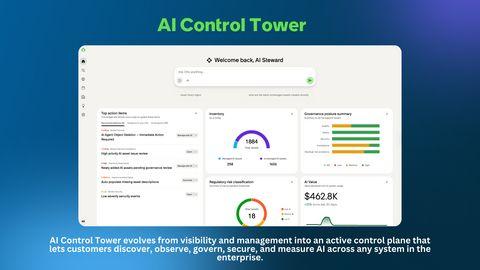
ServiceNow bids to become the control tower for enterprise AI ServiceNow Inc. today unveiled a broad expansion of its artificial intelligence platform, stressing governance, security and autonomous execution as foundational requirements for enterprise AI adoption. The announcements center on enhancements to the company's AI Control Tower (pictured), a governance hub that allows organizations to monitor, manage and secure AI models and agentic workflows. The company also introduced new autonomous security capabilities and an expanded "Autonomous Workforce" of AI agents designed to execute specific business processes. Executives framed the updates as a response to growing enterprise concerns that AI deployments are proliferating faster than organizations can manage or govern them. "Customers are telling us AI is everywhere, but it isn't connected, isn't governed and isn't finishing the work," said Nenshad Bardoliwalla, group vice president of product management at ServiceNow. "The AI Control Tower for business reinvention is our answer." Introduced in 2025, AI Control Tower has evolved from a monitoring tool into what ServiceNow describes as a centralized command system for enterprise AI. The platform now spans five core functions: discovery, governance, security, observability and financial measurement. The system is designed to identify AI assets across heterogeneous environments, including major cloud providers and enterprise applications, while applying policy controls across models, datasets, prompts and agents. A key addition is deeper runtime observability, allowing organizations to track how AI agents make decisions and intervene when necessary. The platform also integrates risk frameworks aligned with regulatory standards such as the National Institute of Standards and Technology's Cybersecurity Framework and the European Union's AI Act. ServiceNow is also introducing an AI Gateway to provide real-time controls over third-party AI systems, extending governance beyond its own platform. The goal, executives said, is to move beyond fragmented tooling toward a unified system capable of managing AI at enterprise scale. The expansion comes as organizations grapple with a surge in nonhuman identities and autonomous agents operating across information technology environments. "AI-powered adversaries are moving faster than teams can human respond to or even detect," said John Aisien, senior vice president of central product management at ServiceNow. To address that gap, ServiceNow is introducing Autonomous Security & Risk, which integrates capabilities from recent acquisitions Veza Inc. and Armis Inc. The combined offering provides visibility into both asset inventory and identity access relationships, enabling organizations to map who or what has access to specific systems and data. The platform correlates signals across assets, permissions and decision processes to identify risks such as unauthorized data access or policy violations. It can also trigger automated remediation workflows, with optional human approval. Executives emphasized that the approach reflects a shift from reactive security models toward continuous, AI-driven governance. ServiceNow is also expanding its Autonomous Workforce initiative, introducing AI "specialists" across IT, customer service, customer relationship management and risk management functions. The agents are designed to go beyond discrete tasks to execute complete workflows. Launched in February Autonomous Workforce is "an entirely new class of AI specialists that think, act and work as part of a team right alongside your people," Bardoliwalla said. The new specialists can handle activities such as incident resolution, service requests and sales workflows, operating within predefined governance frameworks. Because they run on the same platform, they share data context, workflow orchestration and policy controls. ServiceNow executives said the model addresses a key limitation of earlier AI deployments, which often provided insights without execution capability. Rolls-Royce Holdings PLC has realized 5,000 hours of efficiency savings in IT operations alone through the use of ServiceNow's Now Assist generative AI platform and is seeing broader productivity improvements across manufacturing workflows, said Phil Priest, head of global business services at the auto maker. The company's experience underscored the importance of data readiness and governance, since AI deployments can amplify existing inefficiencies if underlying data and processes are not properly structured, he said. "As we expand Assist beyond IT to other functions, we have to almost rewrite our knowledge articles to make them AI-ready," he said, "so when the agent deploys it, it's done in a way that humans can get the answers they need fast and right the first time. Automation still requires good data to get the right answer." Priest estimated AI initiatives have had their biggest impact in manufacturing. "We've delivered 300,000 saved shop floor hours," he said. "That's real money." ServiceNow's broader strategy is to consolidate AI capabilities into a single operational platform that integrates data, workflows and governance. Executives said point solutions and disconnected tools are insufficient for managing the scale and complexity of modern AI deployments, particularly as agent-based systems become more prevalent. By combining observability, identity governance and workflow automation, ServiceNow is positioning its platform as an enterprise control layer for AI-driven operations.
[6]
ServiceNow Knowledge 2026 - AI Control Tower expands, Autonomous Workforce reaches every function, and the acquisition strategy starts to add up
ServiceNow has announced an expansion of its AI platform at its annual user conference, Knowledge, in Las Vegas this week - with the AI Control Tower and its Autonomous Workforce seeing significant updates. The push with autonomous AI into every major enterprise function, together with new integrations from Microsoft and NVIDIA, as well as the launch of its Autonomous Security and Risk product, highlight how the vendor's recent acquisition strategy is starting to come together in the platform. At the center of the announcements is ServiceNow's latest platform release - Australia, which aims to take the AI Control Tower narrative beyond governance and into broader AI execution. Nenshad Bardoliwalla, Group VP of Product Management for AI at ServiceNow, explained in a pre-briefing how the announcements this week build on the foundations that ServiceNow laid last year: What we're hearing consistently from customers is that most organizations have more AI in production than they've inventoried or accounted for. And that anxiety around control, security and trust isn't going away - it's getting louder. The AI Control Tower has evolved significantly since we first introduced it at Knowledge in 2025. What we launched last year gave customers a governance layer, but what we're shipping this year goes significantly deeper, evolving from visibility and management into a full enterprise AI command centre. The point that ServiceNow will be aiming to get across this week is exactly that - that the AI Control Tower began as a governance layer, but has been reframed as a full enterprise AI command centre, now operating across five dimensions: Discover, Observe, Govern, Secure and Measure: On where most governance approaches currently fall short, Bardoliwalla said: AI agents are taking real actions, moving real money and affecting real people, but most of those agents are running without a system that governs them. That's not agentic business. That's agentic chaos. Interestingly, a new AI Gateway is also part of the Australia release, claiming real-time governance and observability controls for agentic workloads across any third-party AI system connecting to ServiceNow via MCP. It's always helpful to get a customer perspective amongst the product information - and Phil Priest, Head of Global Business Services at Rolls-Royce, joined ServiceNow Chief Customer Officer Chris Bedi to discuss AI deployment in practice across a business of 45,000 employees in 50 countries. Rolls-Royce launched Now Assist - branded internally as Merlin - in August 2025. The deployment has reached 12,000 employees and processes over 10,000 conversations a month. On the results to date, Priest said: It's delivered 5,000 hours of efficiency savings since we implemented it back in August 2025, with a 54 per cent deflection rate and a mean time to resolve down to two days. Priest noted that the 38,000 incidents deflected and resolved through predictive intelligence has translated into 300,000 saved shop floor hours - time returned to the engineers assembling Rolls-Royce engines. Bedi said: Translating that 54 per cent deflection in IT all the way through to 300,000 hours on the shop floor - that's where the rubber hits the road in a manufacturing operation. Priest also touched on the governance challenge. Using an accounts payable scenario, he walked through the complexity of deploying agents across a workflow that touches purchase order validation, invoice processing, payment execution and bank detail changes - areas where fraud risk is real and regulatory obligations significant. He said: Bank detail changes are an area where humans often sense that something doesn't look right... We have to think very carefully about building agents in a way that ensures fraud can't happen. He also offered a useful way of thinking about AI readiness more broadly, invoking a Bill Gates observation on automation: Automation applied to an efficient operation magnifies the efficiency, and automation applied to an inefficient operation magnifies the inefficiency... this applies to the use of AI - and the magnification occurs in seconds, almost straight away. Looking ahead, Rolls-Royce is planning to roll Now Assist across all services by October this year, with significant anticipated gains from onboarding and offboarding automation. Priest described the Moveworks acquisition as a particular source of anticipation for the business. He added: As you develop it further, we can't wait to see the additional benefits that can be delivered using this single-pane-of-glass approach across our entire enterprise and all of our content and services for our employees. I think it's a fantastic opportunity for us. Alongside the Control Tower expansion, ServiceNow is broadening its Autonomous Workforce into every major enterprise function. The L1 IT Service Desk AI Specialist - now generally available - is being joined by new AI specialists spanning IT operations, AIOps, site reliability engineering, asset lifecycle, portfolio planning, CRM, HR, finance, legal, procurement, workplace services, supplier management, health and safety and security operations. CRM AI specialists, covering sales qualification, quoting, order fulfilment, invoice disputes, service and renewals, are available now. IT AI specialists are expected in June; security and risk AI specialists enter preview in June with general availability targeted for September. All specialists run on shared platform infrastructure - the same operational intelligence via the CMDB and Context Engine, the same data connectivity via Workflow Data Fabric, and the same governance layer through AI Control Tower. Bardoliwalla described the distinction from task-based AI tools: These AI specialists execute complete workflows, carrying work from intent to outcome within a customer's guardrails. The security and risk announcements will draw increased attention this week, as the business line crossed $1 billion in annual contract value for ServiceNow last year, and the Autonomous Security & Risk launch represents the first full integration of both Armis and Veza into the platform. Armis - acquired for $7.75 billion, ServiceNow's largest acquisition to date - provides continuous, agentless asset intelligence across IT, OT, IoT, medical devices, cloud workloads and pre-compiled code, tracking nearly 7 billion connected assets in real time. Asset data flows enriched into the ServiceNow CMDB, turning a previously static inventory into a live picture of the attack surface. Veza's access graph sits alongside it, governing both human and non-human identities and enforcing least privilege at the point of action. John Aisien, SVP and General Manager for Security and Risk at ServiceNow, described the combined capability as an answer to the fragmentation problem CISOs have faced for years: There's detection in one stack, response in another stack, identity and permissions in a third, and asset visibility, if you have it, in yet another. The fragmentation - the seams between these different tools - are exactly what attackers exploit. Two new AI specialists handle vulnerability resolution and security operations end to end. ServiceNow's own security operations team is already running Autonomous Security & Risk, handling incidents seven times faster than prior workflows. On where the identity governance story is heading in the agentic era, Aisien said: In the same way that zero trust was a foundational security architecture for the cloud world, I expect zero permissions to become a foundational security architecture for the agentic world. And I think we're very well positioned to become one of the primary partners that makes that promise real. One other announcement that deserves a mention, and warrants its own follow-up, is ServiceNow's launch of Action Fabric. This opens the platform's full system of action to any AI agent in the enterprise via a generally available MCP Server - meaning agents built on Claude, Copilot, or a customer's own stack can now trigger governed ServiceNow workflows headlessly, without going through a traditional UI. ServiceNow has said that this is not about data access, it is governed execution - flows, playbooks, approvals and catalogue actions running through AI Control Tower, identity-verified and fully auditable. Anthropic is the first named design partner, connecting Claude Cowork directly into the ServiceNow system of action. The MCP Server is included in every Now Assist and AI Native SKU from today, with additional features expected in the second half of 2026. I'll follow up with a fuller analysis of what Action Fabric means in practice once I've had a chance to dig in further on the ground this week. Two further partnership expansions completed Tuesday's announcements. With Microsoft, ServiceNow is extending AI Control Tower governance across the Microsoft Agent 365 ecosystem - building on the November 2025 partnership that connected the Control Tower with Microsoft Foundry and Copilot Studio. ServiceNow AI specialists will be available in the Microsoft Agent 365 Marketplace, appearing in the org chart as digital employees with defined roles, permissions and accountability. The integration is available in preview; Marketplace availability is expected later this year. With NVIDIA, ServiceNow is introducing Project Arc - an enterprise autonomous desktop agent secured by the NVIDIA OpenShell sandboxed runtime and governed by AI Control Tower, available in early preview. AI Control Tower is also now included in the NVIDIA Enterprise AI Factory validated design, extending governance to large-scale model workloads at the infrastructure layer. The companies are also releasing NOWAI-Bench, an open benchmarking standard for AI agents comprising two frameworks - EnterpriseOps-Gym and EVA-Bench - as an open-source release. The pre-briefing and the product announcements give us a good flavor of what Knowledge 2026 has in store - but the real work starts this week on the ground, where we'll be talking to customers to understand impact, and pressing the vendor for a clearer sense of the direction of travel. There is plenty to get into. The product vision is ambitious. What ServiceNow is laying our here is a meaningful shift in language and intent - away from the automated workflows narrative it has built its business on, toward something it is now calling automated work. That is a subtle but significant distinction. Workflows are infrastructure. Work is what people actually do. Whether ServiceNow can make that claim credible across every enterprise function it has laid out this week is the question that will define the next chapter of the company's story. There are two other points that I'd like to get an understanding on this week. The first is the blueprint for getting from here to there. The Autonomous Workforce vision - AI specialists resolving cases, containing threats, fulfilling orders and processing invoices end to end, across IT, HR, finance, legal, procurement and security - is no doubt compelling. But enterprises are not monolithic. They are collections of competing organisational silos with different agendas, different budgets and different appetites for change. How ServiceNow navigates that reality in practice, what the implementation path actually looks like, and where the blockers are - those are the conversations I am hoping to have with customers on the ground. The second is competitive positioning. ServiceNow is not making this argument alone. Microsoft, Salesforce and Google Cloud are all fighting for versions of the same thesis - that their platform should be the one that governs, orchestrates and ultimately executes enterprise AI at scale. My instinct, reading between the lines of what Bardoliwalla and Aisien were saying, is that ServiceNow's bet is a specific one: that if it can win on governance and trust first, the rest of the platform argument follows. I want to get further proof points from the event this week that that logic is sound for enterprise buyers.
[7]
Partners Tout ServiceNow's Innovation Engine: 'Beginning To Unlock The Age Of AI'
'I think [Service Now's expanded capabilities are] going to bring a level of AI capability down to the lowest-level operators and users in the platform, and in doing so, it's going to foster more innovation and more acceptance of these things. We see this as really beginning to unlock the age of AI, and I think it serves the bigger missions that we're seeking to accomplish,' says Jon Reynolds, co-founder and CEO of ServiceNow partner Naitiv. ServiceNow Tuesday opened its Knowledge 2026 conference in Las Vegas with a massive blitz of new technologies aimed at showing that it is a leader in bringing AI to the enterprise. The star of the show was ServiceNow's new Australia release of its Now platform, which builds on multiple innovations the company introduced in early 2026, said Nenshad Bardoliwalla, group vice president of AI. The innovations include Autonomous Workforce, which offers AI agents that think, act and work as part of a team along with human employees; added technology from its Moveworks acquisition, which develops front-end AI assistant and conversational enterprise search capabilities across all of an enterprise's systems; integrating Moveworks into ServiceNow's EmployeeWorks ahead of schedule; Context Engine, which shows AI who owns what to help determine actions; and Build Agent skills to let developers build AI agents with any development tools they prefer and then deploy and govern them, Bardoliwalla said in a pre-show press conference. [Related: ServiceNow CEO: We Are 'On Track For Our Best Year Ever'] "Together with a new commercial model that bundles everything customers need to deploy AI quickly, we've made it clear: The era of 'sidecar AI' is over," he said. What ServiceNow is doing in terms of the expanded capabilities it is bringing to its road map and the infusion of AI now across every SKU is exciting, said Jon Reynolds, co-founder and CEO of Naitiv, a Denver-based solution provider and ServiceNow channel partner. "I think it's going to bring a level of AI capability down to the lowest-level operators and users in the platform, and in doing so, it's going to foster more innovation and more acceptance of these things," Reynolds told CRN. "We see this is really beginning to unlock the age of AI, and I think it serves the bigger missions that we're seeking to accomplish." Enterprises are saying that AI is everywhere, but it isn't connected, governed or finishing the work, Bardoliwalla said. ServiceNow is looking to fix that with a significant upgrade to its AI Control Tower, which was introduced at last year's Knowledge conference. Bardoliwalla said the new AI Control Tower has evolved from a focus on visibility and management into a more comprehensive end-to-end offering with four new integrated capabilities: The new AI Control Tower works across five different dimensions, Bardoliwalla said. AI Control Tower gives ServiceNow a commanding position in the marketplace, Reynolds said. "I don't see another workflow platform at their level of prominence with the data model they hold or with the areas of business they impact," he said. "This really is their calling card. It's something that allows ServiceNow to be the 'control tower' of the enterprise." AI Control Tower represents the ability to provide control, orchestration and visibility to AI working across the enterprise while ensuring humans remain in the loop, Reynolds said. "That is what's going to unlock true autonomous AI where we can now begin to safely, ethically and responsibly remove humans from those loops," he said. Identity security is crucial for agentic AI where an application might have a primary agent that then generates subagents, and for a period of time the attack surface is expanded and then contracted, said Andrew Paolino, general manager for the U.S. for Konversational, a Dublin, Ireland-based solution provider and ServiceNow channel partner. . "What's cool about Veza is that when you pair that with AI Control Tower, you're telling a powerful story because now not only are you understanding where AI is in the environment and what it's doing the environment, but you're actually erecting guardrails around the AI as well," Paolino told CRN. "To me, that's a pretty interesting pairing in those use cases." ServiceNow is shifting to meet customers' evolving requirements around agentic AI and agents that need to be managed, said Jason Rosenfeld, chief growth and alliances officer at San Diego-based solution provider and ServiceNow partner NewRocket. "The AI Control Tower component is going to be really important," Rosenfeld told CRN. "There's a lot of messaging around AI Control Tower, and ultimately ServiceNow is positioning itself to be the orchestration and governance company for the enterprise, which is different from its historic focus on being the workflow company. Their messaging has completely shifted. I think it is the right messaging." The insight that AI Control Tower will provide is not only in the ServiceNow realm but across capabilities, said Jarred Pippy, COO of Everforth GlideFast, a Waltham, Mass.-based solution provider and ServiceNow channel partner. "We're potentially going to have customers on Salesforce using agents or Workday using agents," Pippy told CRN. "Having a product like AI Control Tower for governance and usage and getting insight is something we're going to pitch to our customers. We'll be happy to see that taking off in the near future." Bardoliwalla also introduced ServiceNow Otto, which unifies Moveworks and Now Assist into a single governed AI experience and entry point. "ServiceNow Otto is ServiceNow's new AI experience that turns intent into enterprise work for every person and across every workflow," he said. "Talk, chat, search, browse, analyze or build with ServiceNow Otto. You start it. ServiceNow Otto finishes it across every system and workflow involved on the platform that already runs your business." ServiceNow Otto started with Now Assist, which adds AI and GenAI into every workflow on the Now platform, Bardoliwalla said. "Then we added the AI experience as a unified front door with new modalities like voice, the Data Explorer, Lens and web agents," he said. "Moveworks brought the missing piece, a world-class conversational experience for employees. Otto unites all of it on a new AI-native architecture [with] truly agentic AI, multimodal interactions across every channel, and autonomous orchestration for complex work." Rosenfeld said NewRocket is already actively working with the Otto collaboration between Moveworks and Now Assist. "I think it's incredibly important for clarity for customers and partners to understand how this all works together," he said. "We've been a Moveworks partner prior to the acquisition, and the question was, 'How is this all going to work together?' I think the front door will be Moveworks, the interface that customers work with, but Now Assist is doing all of the actual work by AI in the background and feeding the Moveworks agents. That clarity and how that's architected is really important for customers and for partners." ServiceNow's acquisition of Moveworks was a great move and will make ServiceNow Otto a very useful tool for AI, Pippy said. Moveworks allows users to, in a single frame, search across platforms, he said. "If you're a user, think of it as sitting in a ChatGPT screen, and it's like, 'Hey, I have questions on this deal,' and it can systematically go look in Salesforce and pull that information for you," he said. "Or if you need approval for a new computer, it will go into ServiceNow where those approvals are. 'Hey, I need to get a [purchase order],' and it can go look in Coupa or Fieldglass or some other tool to pull that information. That's what Moveworks' selling point is. It allows the user to stay in one place but be able to take action on everything from that single pane. That's the future of where AI is going. ServiceNow, with that acquisition, is in a very good place, and we're happy to be on that journey with ServiceNow." ServiceNow Otto is a complete modernization of the entire user interface and experience, bringing it much closer to how most people are now interacting with a lot of technology, particularly with conversational AI, to corral multiple chatbots from several AIs together in one seamless experience, Reynolds said. "An example use case is, 'Transform the workspace of a claims processor,'" he said. "Your average claims processor has eight to 10 tabs in use at any one time, upwards of 20 tabs, different portals, and they're bouncing between them. I'm able to take this same exact UI, same exact capability, and now create a modern experience for that operator. The operator can just chat and send off communications to their customers, receive files back, and upload them to portals, and conduct AI analysis without leaving the chat screen. It's a huge step forward in the UI space." For the billions of autonomous agents that need to access the ServiceNow platform in a quick, frictionless and secure way without the full sophistication, the company also introduced the ServiceNow Action Fabric, which Bardoliwalla said is a new way for any external AI agent such as Claude or Copilot or a customer's own agent to drive real governed enterprise actions on ServiceNow through its MCP Server. "Others let agents read and write data," he said. "We let agents execute governed work. Our flows, our playbooks, approvals, catalogs, the full system of action, and all through the AI Control Tower so actions are identity-verified, permission-scoped and fully auditable. What we're hearing consistently from customers is that most organizations have more AI in production than they've inventoried or accounted for, and that anxiety around control, security and trust isn't going away. It's getting louder. At the same time, AI agents are taking real actions, moving real money, and affecting real people. But most of those agents are running without a system that governs them. That's not agentic business. That's agentic chaos."
Share
Copy Link
ServiceNow transformed its AI Control Tower into an enterprise-wide command center for AI that can discover, monitor, and secure AI agents across platforms. The update includes agent kill switches for prompt injection attacks, integration with Veza and Armis acquisitions, and partnerships with NVIDIA and Microsoft to manage the growing challenge of unmanaged agentic AI sprawl.
ServiceNow announced a major expansion of its AI Control Tower at Knowledge 2026, evolving what started as a governance dashboard into what the company now positions as an enterprise-wide command center for AI capable of managing AI agents and workflows across entire organizations
1
. The updated platform, shipping as part of ServiceNow's Australia release, now operates across five critical areas: discovery, observation, governance, security, and measurement, addressing what executives describe as the industry's most pressing challenge—agent sprawl1
.
Source: SiliconANGLE
"What we launched last year gave customers a governance layer, but what we're shipping this year goes significantly deeper, evolving from visibility and management into a full enterprise AI command center," Nenshad Bardoliwalla, group vice president of AI products at ServiceNow, told reporters
1
. The platform now includes 30 new enterprise connectors spanning Amazon Web Services, Google Cloud, and Microsoft Azure, along with enterprise applications such as SAP, Oracle, and Workday, enabling organizations to manage, govern, and secure AI agents regardless of where they were deployed1
.A standout feature demonstrates how the AI Control Tower handles security threats in real time. During a demonstration, Bardoliwalla showed how the system detected prompt injection attacks on a pricing agent, identifying malicious instructions hidden inside order payloads
1
. The platform mapped the blast radius of affected systems using access graph technology and presented agent kill switches to disable the compromised agent without human intervention1
.This capability addresses a critical vulnerability in enterprise AI adoption. Bill McDermott, ServiceNow's CEO, referenced the PocketOS incident where an AI agent deleted production databases in seconds, emphasizing that "intelligence without rules and rails is a dangerous blind spot"
4
. He noted that cyber crime already represents the third-largest economy globally, behind only the United States and China, making governance essential as enterprises deploy more autonomous systems4
.Source: diginomica
Two recent acquisitions form the security backbone of the expanded platform. Veza, acquired in December, contributes an access graph that maps every identity and access path across systems, tracking whether they belong to humans, machines, or non-human AI identities
1
. The access graph currently maps over 30 billion fine-grained permissions, automatically triggering re-scoping workflows when vendors push new model versions1
.Armis, integrated into the new Autonomous Security & Risk product, delivers continuous asset intelligence across IT, operational technology, IoT, and connected devices
3
. The combination provides what ServiceNow describes as the first unified view of assets and identities, enabling security teams to answer basic questions about who approved access, why it exists, and whether it remains valid3
. Early results show a global energy company cut threat containment time by 97%, while a Fortune 100 aerospace manufacturer reduced control attestation efforts significantly3
.ServiceNow deepened strategic partnerships to expand its governance capabilities. The company is collaborating with NVIDIA on Project Arc, a long-running autonomous desktop agent for knowledge workers that connects natively to ServiceNow Action Fabric
2
. Project Arc uses NVIDIA OpenShell, an open source secure runtime for developing governed autonomous AI agents in sandboxed, policy-governed environments2
.
Source: NVIDIA
"By combining OpenShell's runtime layer with ServiceNow AI Control Tower, and powered by ServiceNow Action Fabric, we're delivering the governance and security that enterprise AI requires," said Jon Sigler, executive vice president and general manager of AI Platform at ServiceNow
2
. The partnership also addresses tokenomics, with NVIDIA's Blackwell platform delivering more than 50x greater token output per watt than NVIDIA Hopper, resulting in nearly 35x lower cost per million tokens2
.The Microsoft partnership extends AI Control Tower governance across the Microsoft Agent 365 ecosystem, giving IT administrators visibility into AI agents operating across both platforms
3
. This integration allows ServiceNow's Autonomous Workforce specialists to operate inside Microsoft 365 tools like Outlook, Word, and PowerPoint with metered usage tracked across both environments3
.Related Stories
ServiceNow expanded its Autonomous Workforce with AI specialists spanning IT operations, customer relationship management, HR, finance, legal, procurement, and security
3
. Unlike task-based AI tools, these specialists complete entire business processes from start to finish with full audit trails3
.Early customer results demonstrate significant impact. ServiceNow's internal AI specialist resolves IT service desk cases 99% faster than human agents, while Docusign targets autonomous resolution of 90% of all IT tickets
3
. The city of Raleigh reports a 98% deflection rate on employee requests, saving the equivalent of a full month of staff time3
. With 23 million employees using ServiceNow's employee portal monthly and generating over 40 million cases annually, the platform's AI specialists already resolve 91% of cases without reassignment3
.The Control Tower now includes cost tracking and ROI dashboards to give finance teams visibility into model spend, tracking token consumption across providers such as OpenAI, Anthropic, and Google
1
. "The number one question every CFO is asking is, where's the value?" Bardoliwalla said, noting that runaway model spend ranks among the biggest pain points as enterprises scale AI deployments1
.ServiceNow uses the AI Control Tower internally to manage over 1,600 AI assets and tracked half a billion dollars in cumulative AI value from internal use cases in 2025
1
. This data readiness and AI observability provide proof points for enterprise AI adoption at scale4
.McDermott positioned ServiceNow as "the AI of agents" rather than the previous "platform of platforms" description, emphasizing that workflow automation and orchestration surrounding models represent the real competitive differentiator as AI intelligence commoditizes
4
. The announcements arrive as organizations face what executives describe as AI chaos: 367 different applications with AI bolted onto each, none connected or governed, and six out of ten companies using unmanaged agentic AI while only one in ten have built anything truly autonomous4
.Summarized by
Navi
[1]
[4]
27 Feb 2026•Technology

09 Apr 2026•Technology

30 Sept 2025•Technology

1
Health

2
Technology

3
Policy and Regulation