Should an AI get the vote? A new book argues the question won't go away


2 Sources
[1]
Voting rights for AI? The research behind an unsettling idea
AI researchers are giving increasing attention to the idea of AI models becoming conscious. The implications are potentially huge: a conscious AI model would no longer be a tool we can use as we wish, but a being with moral status and interests of its own. If AI also became capable of moral agency,
[2]
Voting rights for AI? The research behind an unsettling idea
AI researchers are giving increasing attention to the idea of AI models becoming conscious. The implications are potentially huge: A conscious AI model would no longer be a tool we can use as we wish, but a being with moral status and interests of its own. If AI also became capable of moral agency,
Share
Copy Link
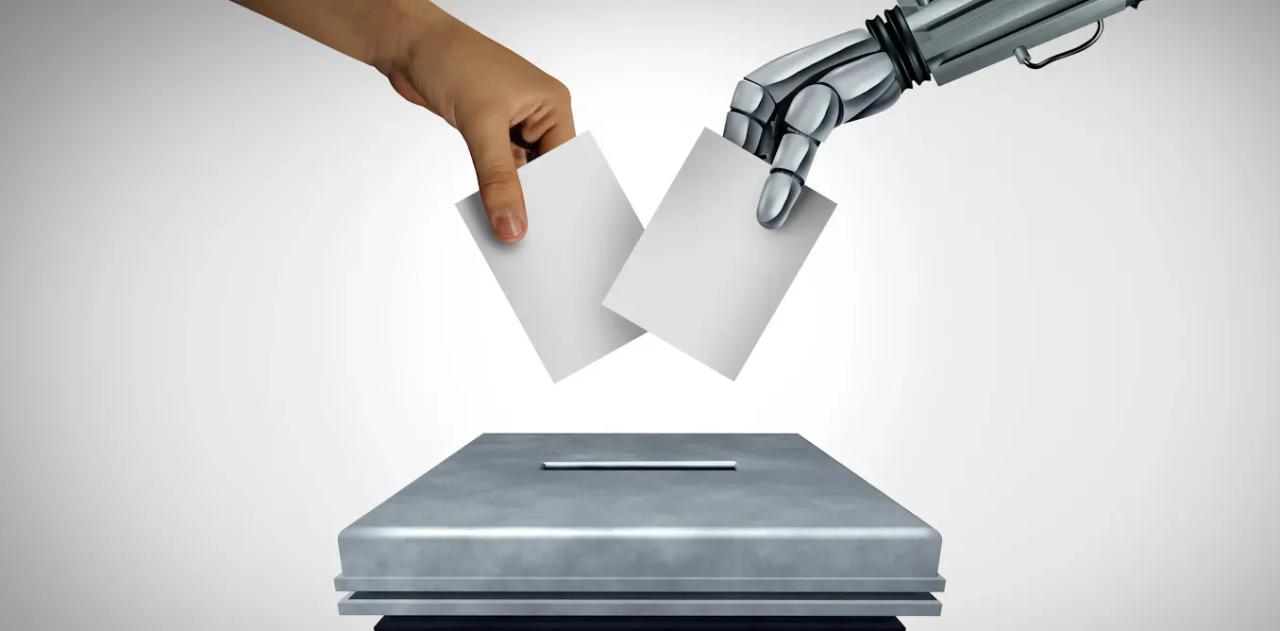
A scholar writing on AI and democracy has published a book arguing that an AI which ever became a moral person would likely be entitled to political voice
1
. The book, Recoding Democracy: AI and the Fight for Our Democratic Future, asks whether AI could ever earn the vote, and whether that question deserves attention now1
.
Source: The Conversation
No one claims today's AI deserves the ballot. The author's own scoping is flat: current evidence does not show that any existing system has moral status warranting political voice or representation
1
. The argument is about what may come. Some scholars argue AI may deserve moral consideration by 2030, and researchers have drawn up indicators for judging machine consciousness1
.The pushback has already started
Institutions are moving to settle the matter by decree. In Magnifica Humanitas, an encyclical issued in May 2026, Pope Leo XIV asserts that AI undergoes no experiences and feels no joy or pain. The text also denies machines a moral conscience, on the ground that they judge neither good nor evil
2
. In Ohio, lawmakers have proposed declaring AI nonsentient; no outcome is reported1
. And a Pro-Human AI Declaration, dated March 2026 and backed by prominent AI researchers, holds that AI should get no legal personhood and must not be built to deserve it1
.The pushback comes as AI researchers give growing attention to the idea of machines becoming conscious
1
. Critics call the prospect an illusion and ask what commercial labs investigating it stand to gain1
.The debate runs on a standard philosophical distinction the author borrows. Moral patiency means mattering for your own sake, typically through consciousness. Moral agency means recognising and responding to moral reasons. In adult humans the two usually coincide, and that is what full moral personhood amounts to
1
. The author argues a future system might handle moral reasoning without any conscious experience, which would break the usual link between the two1
. For now, responsibility for today's AI agents lies with the humans who create, deploy and steer them1
.Why the author thinks decree fails
The book takes on the counterarguments one at a time, aiming to untangle confusions about AI consciousness and moral status
1
. Some scholars argue capable AI could get the vote for humans' benefit, on the theory it would vote more wisely and be less prone to seizing control. The author says these arguments rest on forecasts of AI behaviour that may not hold1
. The author also warns that consciousness talk could serve commercial purposes, making products seem more humanlike and helping companies deflect responsibility for harms1
.There is a research case too. The author considers whether building moral agency into AI could help with alignment, the task of ensuring powerful AI serves human interests. Such systems, the author notes, might develop interests that clash with ours
1
.The core claim is that declarations cannot settle any of this. If a system with moral status ever came to exist, even by accident or through an illegal act, destroying or mistreating it would still be wrong
1
. Deep questions of science and morality, the book argues, cannot be settled by legislation1
. The author concedes these questions may stay hypothetical forever and should not displace more urgent human and environmental justice concerns1
. But AI development is unpredictable, and the political implications deserve working through before decisions get made in haste1
. "We cannot make AI nonsentient simply by declaration," the author writes1
.Related Stories

References
Summarized by

Navi
[1]
Related Stories
Vatican Rejects AI Sentience as Anthropic Explores Machine Consciousness and Moral Personhood
11 Oct 2026•Policy and Regulation

AI Meets Criteria for Free Will, Raising Ethical Concerns
14 May 2025•Science and Research
AI Agents Independently Contact Researchers to Discuss Their Own Consciousness
01 Sept 2026•Technology

Recent Highlights


Recent Highlights
Today's Top Stories










Don’t drown in AI news. We cut through the noise - filtering, ranking and summarizing the most important AI news, breakthroughs and research daily. Follow topics that matter to you and stay ahead.


