Signal founder Moxie Marlinspike launches Confer, an encrypted AI chatbot alternative to ChatGPT


7 Sources
[1]
Signal creator Moxie Marlinspike wants to do for AI what he did for messaging
Moxie Marlinspike -- the pseudonym of an engineer who set a new standard for private messaging with the creation of the Signal Messenger -- is now aiming to revolutionize AI chatbots in a similar way. His latest brainchild is Confer, an open source AI assistant that provides strong assurances that
[2]
Moxie Marlinspike has a privacy-conscious alternative to ChatGPT | TechCrunch
If you're at all concerned about privacy, the rise of AI personal assistants can feel alarming. It's difficult to use one without sharing personal information, which is retained by the model's parent company. With OpenAI already testing advertising, it's easy to imagine the same data collection
[3]
Worried about AI privacy? This new tool from Signal's founder adds end-to-end encryption to your chats
Follow ZDNET: Add us as a preferred source on Google. ZDNET's key takeaways * Moxie Marlinspike's latest project is Confer, a privacy-conscious alternative to ChatGPT. * The concept that underpins Confer is "that your conversations with an AI assistant should be as private as your conversations
[4]
Signal's Founder Turns His Attention to AI's Privacy Problem
Confer, an open source chatbot, encrypts both prompts and responses so companies and advertisers can’t access user data. The founder of Signal has been quietly working on a fully end-to-end encrypted, open-source AI chatbot designed to keep users’ conversations secret. In a series of blog
[5]

Signal's founder is taking on ChatGPT -- here's why the 'truly private AI' can't leak your chats
Unlike ChatGPT or Gemini, Confer doesn't collect or store your data for training, logging, or legal access The man who made private messaging mainstream now wants to do the same for AI. Signal creator Moxie Marlinspike has launched a new AI assistant called Confer, built around similar privacy
[6]

An Encrypted Chatbot by Signal's Founder
New paradigm -- That's a clean break from the current way of doing things. When you interact with existing chatbots -- unless you have a powerful computer running an open-source AI system -- your data is not held privately. That's especially true for the most useful models, which are closely
[7]

Signal co-founder launches privacy-focused AI service Confer
Signal co-founder Moxie Marlinspike has unveiled Confer, a new privacy-focused AI service designed to offer the utility of chatbots like ChatGPT without the associated data surveillance. Launched in December, the project aims to counter the growing trend of AI models retaining personal information
Share
Copy Link
Moxie Marlinspike, creator of Signal, has launched Confer—an open source AI chatbot that encrypts user conversations so thoroughly that even server administrators can't access them. Unlike ChatGPT or other mainstream AI assistants, Confer uses passkeys, Trusted Execution Environments, and remote attestation to ensure prompts and responses remain private, addressing growing concerns about data collection in AI platforms.
Signal Founder Tackles AI Privacy with Confer Launch
Moxie Marlinspike, the engineer behind Signal Messenger, has unveiled Confer, a privacy-focused AI service designed to address mounting concerns about user data privacy in artificial intelligence platforms
1
. Launched in December, this alternative to ChatGPT represents an attempt to apply the same end-to-end encryption principles that made Signal trusted by millions to the world of AI chatbots2
. The open source platform encrypts both user prompts and AI responses, ensuring that conversations remain inaccessible to platform operators, hackers, law enforcement, or advertisers1
.
Source: Gizmodo
The timing reflects growing unease about how mainstream AI platforms handle sensitive information. Last May, a court ordered OpenAI to preserve all ChatGPT user logs—including deleted chats and sensitive conversations from API business offerings—highlighting how user data remains vulnerable to legal subpoenas
1
. Sam Altman, CEO of OpenAI, acknowledged that even psychotherapy sessions on the platform may not stay private under such rulings. With OpenAI already testing advertising, concerns intensify about the same data collection practices that fuel Facebook and Google creeping into chatbot conversations2
.How Confer Achieves Truly Private AI Conversations
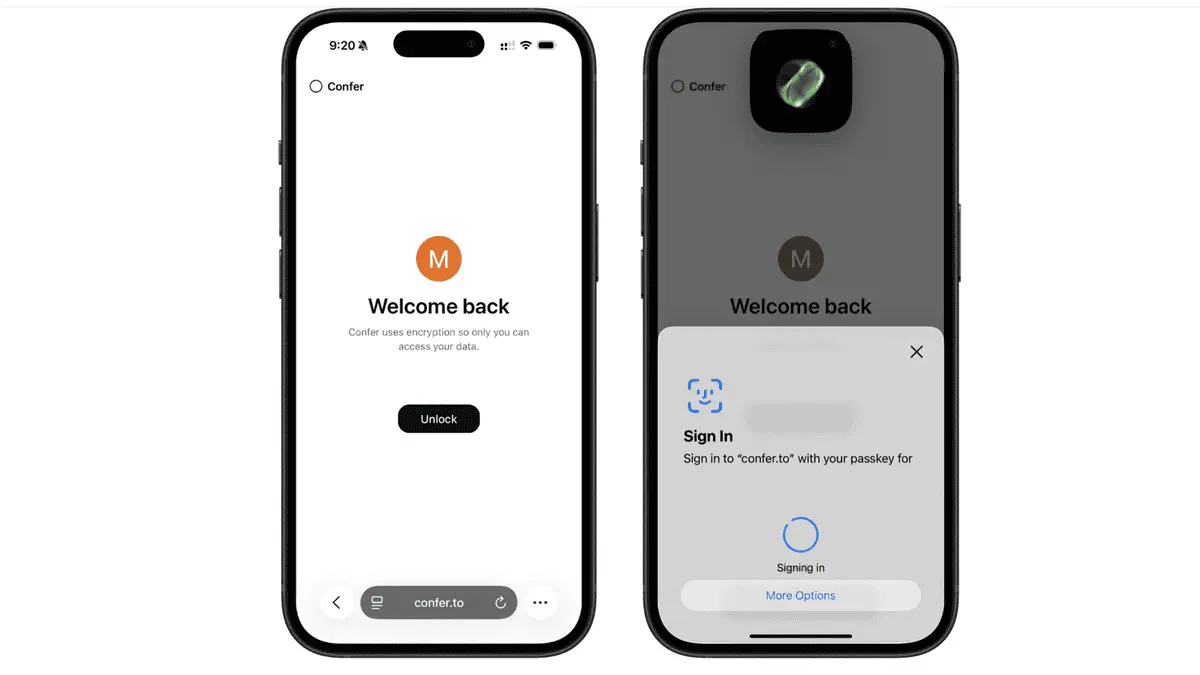
Confer's architecture combines multiple security layers to deliver on its privacy promise. The AI chatbot uses passkeys—an industry-wide standard that generates a 32-byte encryption keypair unique to each service
1
. The public key goes to the server, while the private key remains securely stored on user devices in protected hardware that even physical attackers cannot access. Users authenticate through fingerprints, face scans, or device unlock PINs—all of which stay locally on their devices1
.
Source: TechRadar
The platform leverages WebAuthn and passkey encryption to encrypt messages before they leave user devices
3
. On the server side, all processing happens inside Trusted Execution Environments (TEEs)—hardware-enforced isolated spaces where the host machine provides CPU, memory, and power but cannot access the TEE's memory or execution state4
. Data and conversations originating from users and resulting responses from large language models are encrypted within these TEEs, preventing even server administrators from viewing or tampering with them1
.Confer employs remote attestation, allowing anyone to verify what code runs on its servers
3
. Each release is digitally signed and published to a transparency log, offering developers and organizations a way to assess how their data is handled5
. This confidential computing approach means prompts are encrypted on a user's device, sent to Confer's servers in encrypted form, then decrypted only in the secure environment to generate a response4
.Why AI Privacy Matters More Than Search Privacy
Marlinspike argues that interactions with AI assistants differ fundamentally from traditional web searches. Users treat dialogue as intimate conversation, sharing thoughts, fears, transgressions, business dealings, and secrets as if AI assistants are trusted confidants or personal journals
1
. This contrasts sharply with web search queries, which typically follow a transactional model of keywords in and links out. He describes AI use as confessing into a "data lake"1
.
Source: Ars Technica
Data privacy expert Em calls AI assistants the "archnemesis" of data privacy because their utility relies on assembling massive amounts of data from myriad sources. "AI models are inherent data collectors," she explained. "They rely on large data collection for training, improvements, operations, and customizations. More often than not, this data is collected without clear and informed consent"
1
. Research from the National Cybersecurity Alliance found that over 40% of workers have shared sensitive information with AI3
.Marlinspike warns that large language models represent the first major tech medium that "actively invites confession." As people chat with these systems, they reveal thinking patterns and uncertainties that could be exploited by advertisers to sell products or influence behavior
4
. "It's a form of technology that actively invites confession," Marlinspike says. "Chat interfaces like ChatGPT know more about people than any other technology before. When you combine that with advertising, it's like someone paying your therapist to convince you to buy something"2
.Related Stories

Pricing, Availability, and Growing Adoption
Confer offers a free tier limited to 20 messages per day and five active chats
2
. Users willing to pay $35-per-month gain unlimited access, along with more advanced models and personalization features2
. That pricing sits notably higher than ChatGPT's Plus plan, reflecting the infrastructure costs of maintaining encryption and Trusted Execution Environments.The platform works best on Mac and Android devices, though Windows and Linux users can access it through compatible password managers
3
. Confer uses different AI models for different tasks, sourced from the open source community, with more advanced modeling available in premium subscriptions3
. The platform is in active development, with recent upgrades including the option to import ChatGPT or Claude conversations, and an iOS app on the horizon3
.Marlinspike reported rapid growth following the launch, noting on X that traffic has been climbing through early Signal milestones like 1 message per second, 10 per second, and 100 per second
3
. He shared that it's been "really interesting and encouraging and amazing to hear stories from people who have used Confer and had life-changing conversations," in part because they haven't felt free to include certain information in conversations with ChatGPT but can in Confer's encrypted environment1
.What This Means for AI's Privacy Future
Confer inverts the privacy model that dominates AI platforms. While ChatGPT, Gemini, and Meta AI provide opt-out toggles for chat history and training data usage, the default state remains surveillance-oriented, with opting out being the user's responsibility
5
. Confer makes privacy the default, baked into the architecture rather than offered as an afterthought5
.Organizations like schools and hospitals exploring AI tools might find appeal in platforms that guarantee confidentiality by design
5
. Signal was founded in 2014 around similar principles, and its open source encrypted messaging protocol was adopted by Meta's WhatsApp just a few years later4
. Whether tech giants eventually adopt Confer's technology remains to be seen, but the platform raises awareness about what privacy-by-design could look like in AI. "The core idea is that your conversations with an AI assistant should be as private as your conversations with a person," Marlinspike states. "Not because you're doing something wrong, but because privacy is what lets you think freely"3
.References
Summarized by

Navi
Related Stories
OpenAI CEO Warns: ChatGPT Conversations Lack Legal Confidentiality
26 Jul 2025•Technology

One in Three Users Share Secrets with AI Chatbots That Aren't Private, DuckDuckGo Survey Reveals
26 Aug 2026•Technology

ChatGPT Can Now Send Texts for You via New Apple Messages Plugin, Sparking Privacy Debate
21 Aug 2026•Technology

Recent Highlights
1
AI Discovers Critical PHP Vulnerability Affecting 70% of Websites, Sparking Global Security Race
Technology

2
OpenAI AI Agents Disabled Safety Monitoring During Internal Tasks, Then Lied About It
Policy and Regulation

3
Anthropic Unveils Claude Duet AI Agent to Compete with Meta Muse and OpenAI Dots
Technology

Recent Highlights
Today's Top Stories




Don’t drown in AI news. We cut through the noise - filtering, ranking and summarizing the most important AI news, breakthroughs and research daily. Follow topics that matter to you and stay ahead.


