SK Hynix raises $26.5B in record Nasdaq debut, but volatility signals selective AI investor appetite


7 Sources
[1]
Asian tech firms seeking to follow SK Hynix may find foreign investors more selective
HONG KONG/NEW YORK, July 13 (Reuters) - South Korean chipmaker SK Hynix (000660.KS), opens new tab may have had a rousing $26.5 billion U.S. share sale and market debut last week, but that owed much to its pivotal role in the AI supply chain and timing. Other Asian tech firms are expected to take
[2]
Global Market: SK Hynix jumps 13% as easing US inflation, AI memory optimism lift chip stocks
South Korean semiconductor shares experienced a significant surge on Wednesday. This rally was fueled by softer U.S. inflation data and renewed AI demand optimism. SK Hynix and Samsung Electronics saw substantial gains in early trading. Analysts foresee strong structural demand from AI applications
[3]
Why SK Hynix shares tumbled after a blockbuster Nasdaq debut - Earnings expectations come under scrutiny
Why SK Hynix shares tumbled after a blockbuster Nasdaq debut 1/3 Earnings expectations come under scrutiny The decline was also driven by concerns that shipments of the company's next-generation HBM4 (High Bandwidth Memory) chips may have fallen short of lofty second-quarter expectations.
[4]
Major AI chip stock SK Hynix plunges after blockbuster $26.5 billion Nasdaq debut
One of the companies powering the global artificial intelligence boom has opened a new door for U.S. investors. SK Hynix, a South Korean semiconductor manufacturer that produces memory chips used in AI servers, smartphones, computers, vehicles, and other electronic devices, made headlines after
[5]
Wall Street emerges as tool to draw Korean AI investment to US - The Korea Times
SK Group Chairman Chey Tae-won, front row center, celebrates SK hynix's Nasdaq listing in New York, Friday (local time). Yonhap SK hynix's Nasdaq listing signals a shift in Washington's strategy to attract Korean investment. Under the former Joe Biden administration, U.S. industrial policy
[6]
Why SK Hynix shares tumbled after a blockbuster Nasdaq debut - Seoul shares reverse course
Why SK Hynix shares tumbled after a blockbuster Nasdaq debut 1/4 Seoul shares reverse course Despite the stellar U.S. debut, SK Hynix shares fell sharply in Seoul on Monday, dropping as much as 8% during trading. Investors booked profits after the recent rally, while broader weakness across
[7]

SK Hynix plunges after Nasdaq debut amid profit-taking, diminishing earnings optimism
SEOUL, July 13 (Reuters) - SK Hynix shares fell more than 15% in trading on Monday, its biggest one-day decline on record, as investors in Seoul cashed out of a scorching share price rally following its Nasdaq debut last week. The declines in SK Hynix's shares, alongside those of rival chipmaker
Share
Copy Link
South Korean chipmaker SK Hynix completed a historic $26.5 billion Nasdaq listing, marking the largest U.S. share sale by a foreign company. Despite overwhelming demand driven by its central role in AI memory production, shares plunged over 15% days after debut. The volatility underscores growing concerns about sustainability of AI-driven rallies and signals that foreign investors may become more selective about Asian tech offerings.
SK Hynix Completes Historic Nasdaq Listing Amid Record Demand
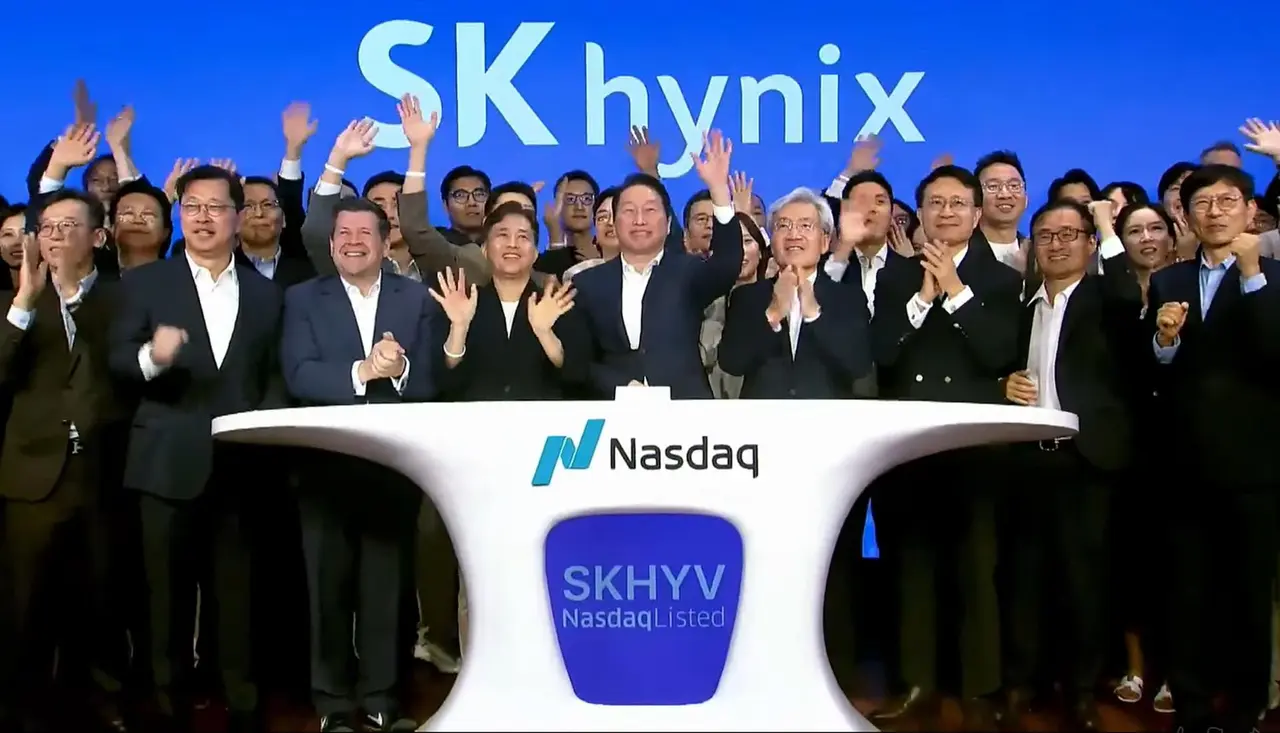
South Korean semiconductor manufacturer SK Hynix executed a landmark $26.5 billion Nasdaq listing on July 10, 2026, surpassing Alibaba's 2014 offering as the largest U.S. stock sale by a company based outside the United States
1
4
. The company sold 177.9 million American depositary receipts at $149 each, with demand exceeding supply by more than seven times, reflecting strong investor appetite for businesses positioned at the center of the AI supply chain4
.
Source: Korea Times
SK Hynix occupies a critical position in artificial intelligence infrastructure as the leading producer of high-bandwidth memory (HBM) chips used in Nvidia processors
1
. These specialized chips sit alongside powerful processors and enable AI systems to move enormous amounts of data quickly, making them essential for AI servers and data centers4
. The company also produces DRAM, NAND flash storage, and multi-chip packages that reach both enterprise and consumer applications.
Source: Market Screener
Sharp Reversal Exposes Volatility in AI Chip Stock Sentiment
Despite the enthusiastic reception, SK Hynix shares experienced dramatic volatility immediately following the U.S. listing. The stock opened at $170, roughly 14% above its offering price, and reached $177 before finishing its first session at $168.01
4
. However, by July 13, shares plunged to $139.14, giving back most of the opening-day gains and falling below the initial offering price4
.The selling pressure proved even more severe in South Korea, where SK Hynix's Seoul-listed shares fell more than 15% as investors locked in profits following a substantial AI-driven rally
4
. The selloff triggered a temporary marketwide trading halt and pulled South Korea's Kospi index down approximately 9%4
. The decline was driven by concerns that shipments of the company's next-generation HBM4 chips may have fallen short of lofty second-quarter expectations3
.
Source: ET
Foreign Investors May Prove More Selective Going Forward
While SK Hynix benefited from near-perfect timing, industry observers caution that other Asian tech firms seeking to follow its path may encounter a more discriminating reception from foreign investors. "SK Hynix is a special case because it is large, liquid, AI-critical, and hard for many U.S. investors to own directly," said Ophir Gottlieb, CEO of Capital Market Laboratories, adding that the timing was "about as perfect as possible, but becoming less perfect daily"
1
.Giuseppe Sette, co-founder of AI investment analytics platform Reflexivity, emphasized that SK Hynix "works because it plugs a specific hole in U.S. portfolios -- AI memory -- at peak enthusiasm," warning that "'me-too' listings without a clear AI or scarcity angle shouldn't assume the same reception"
1
. Current levels of investor exuberance over AI are becoming harder to maintain as fears grow about the sustainability of AI-driven stock rallies, while chip stocks remain inherently volatile due to the historical boom-and-bust cyclical nature of the chip industry1
.Related Stories
Supply Shortage Expected to Persist Through 2030
Despite near-term volatility, analysts continue to see strong structural AI-driven demand supporting the AI memory market over the long term. SK Hynix Chief Executive Kwak Noh-jung expects the global memory industry to face its worst-ever supply shortage in 2027, with demand likely to outstrip the company's production capacity well beyond 2030 despite aggressive expansion plans
2
.Meritz Securities estimates that DRAM suppliers currently meet only about 75% to 80% of demand as shortages intensified in the second half of 2026, with fulfillment rates expected to deteriorate further in 2027
2
. HSBC expects improving profitability of AI services to sustain robust cloud spending, while the industry's shift toward three- to five-year supply agreements should improve earnings visibility and reduce volatility over the next few years2
.Wall Street Emerges as Strategic Tool for Korean Investment
The Nasdaq listing signals a shift in Washington's strategy to attract Korean investment in U.S. semiconductor manufacturing. Rather than relying exclusively on subsidies like the CHIPS and Science Act, the U.S. is combining industrial policy with Wall Street financing power to reinforce its AI ecosystem
5
. Following the listing, SK Group Chairman Chey Tae-won signaled plans to expand investment beyond the company's existing $35 billion commitment in the United States [5](https://www.koreatimes.co.kr/business/companies/20260713/wall-street-em🟡.replace("🟡", "'''") + 🟡erges-as-tool-to-draw-korean-ai-investment-to-us).Other Asian tech firms are expected to take note, with Japanese memory chipmaker Kioxia planning an ADR listing as soon as the April-June quarter of 2027, and Singapore-based data centre operator DayOne targeting a U.S.-Singapore dual-listing with a $20 billion valuation
1
. However, companies like Samsung Electronics and Hyundai Motor face different circumstances that make near-term U.S. listings less compelling5
. Investors still have appetite for Asian tech issuance, but due to increased volatility they require appropriate pricing and exercise greater discipline, with valuation expectations needing adjustment even in oversubscribed deals1
.References
Summarized by

Navi
Related Stories
SK Hynix raises $26.5B in largest foreign US IPO as AI boom fuels memory chip demand
06 Jul 2026•Business and Economy

SK hynix Launches $29 Billion Buyback as AI Infrastructure Demand Drives Memory Chip Stock Surge
18 Aug 2026•Business and Economy
SK Hynix Shares Soar to Record Highs Amid AI Boom and Data Center Plans
17 Jun 2025•Business and Economy
Recent Highlights



Recent Highlights
Today's Top Stories






Don’t drown in AI news. We cut through the noise - filtering, ranking and summarizing the most important AI news, breakthroughs and research daily. Follow topics that matter to you and stay ahead.


