SK Hynix raises $26.5B in largest foreign US IPO as AI boom fuels memory chip demand


33 Sources
[1]
SK Hynix raises $26.5B in the biggest foreign IPO in US history, is urged to build new US fabs
The AI chip boom just produced its biggest Wall Street moment yet. SK Hynix, a South Korean memory chip giant, said Friday it has raised $26.5 billion (KRW 40 trillion) in its US market debut. SK Hynix sold 177.9 million American depositary shares (ADRs) at $149 each, structured so US investors
[2]
US investors will soon get access to SK Hynix, another memory maker riding the AI boom
South Korean memory chip maker SK Hynix, rival to Samsung and U.S.-based Micron, is planning to sell nearly 17.8 million shares in a U.S. IPO, the company said on Monday. Should its shares sell well (and there's indication that they will), the company could raise around $28 billion, based on SK
[3]
Nvidia's biggest RAM supplier just had a trillion-dollar debut on Wall Street
As the AI boom boosts demand for RAM, SK Hynix - one of the world's biggest suppliers of memory chips - launched on Wall Street Friday. The South Korean chipmaker opened at $170 per share and raised $26.5 billion, surpassing Alibaba's record as the largest debut of a foreign company, according to
[4]
SK hynix raises a record $26.5 billion in historic U.S. IPO -- South Korean memory giant to fund massive HBM manufacturing expansions
SK hynix has completed the largest-ever foreign company IPO in U.S. history, raising $26.5 billion in its Nasdaq debut today, July 10. The South Korean memory giant sold 177.9 million American depositary receipts (ADRs) -- a U.S.-listed stand-in for a foreign share -- at $149 apiece, each
[5]
SK Hynix's jumbo share sale a sign of overheated times
South Korea dominates the market for memory chips -- but it's the US that is the land of capital-raising opportunity. Korean group SK Hynix has turned to New York for its sale this week of around $28bn in American depositary receipts. The proceeds will help fund its enormous AI-related investment
[6]

SK Hynix shares slide 10% in Seoul after stellar Nasdaq debut
SK Hynix shares tumbled more than 10% in Seoul on Monday after the chipmaker's strong Nasdaq debut Friday, as investors locked in profits and weighed whether surging demand for artificial intelligence memory chips can justify the stock's lofty run. The South Korean memory-chip maker had jumped 13%
[7]

SK Hynix hits the U.S. stock market as demand for memory chips soars amid AI frenzy
SK Hynix, one of the world's largest makers of memory chips, is hitting the U.S. stock market at a time when demand for its chips is far outpacing its ability to make them thanks to the frenzy over artificial intelligence. The company is already one of the largest in South Korea, along with
[8]
SK Hynix raises $26.5bn in US market debut
SK Hynix has raised $26.5bn in its Nasdaq debut, marking the largest-ever US listing by a foreign company as AI drives rocketing demand for the South Korean group's memory chips. The company's American depositary shares priced at $149 per ADS, a slight premium to SK Hynix's closing share price in
[9]
Meet SK Hynix, the trillion-dollar South Korean chipmaker debuting on U.S. markets
SK Hynix is building a $4 billion production facility in Indiana and growing its Solidigm business near Sacramento, California. U.S. investors are getting a new way to buy into the memory boom. SK Hynix, the second most valuable company in South Korea, behind only Samsung, is slated to begin
[10]

South Korea chip maker SK hynix rides AI boom raising $26.5bn in huge US listing
SK hynix, a supplier of advanced memory chips, has seen profits skyrocket thanks to the global race to build AI datacentres South Korean chip maker SK hynix set pricing for its mega US listing on Friday, aiming to raise $26.5bn as it takes advantage of the AI boom in what will be one of the
[11]
Hedge fund run by ex-OpenAI researcher bets on SK Hynix's US IPO
An ex-OpenAI researcher's hedge fund and UK investor Baillie Gifford have signalled they could take a large chunk of South Korean memory chipmaker SK Hynix's $28bn share sale in New York this week. The Nasdaq initial public offering for the South Korean group, formally launched on Monday, comes as
[12]

How SK Hynix just pulled off the second-largest U.S. share sale by quietly powering the AI boom | Fortune
The listing gives U.S. investors direct access to a chipmaker that's closely tied to the AI boom, making the specialized memory chips that sit inside almost every Nvidia processor, and now command high prices amid a major shortage. "We've announced plans to double production capacity within five
[13]

Memory chip giant SK hynix bags $26.5B in blockbuster U.S. listing
South Korean memory chipmaker SK hynix Inc. has priced its American Depository Receipts at $149, raising around $26.5 billion ahead of its debut on the Nasdaq exchange tomorrow. The decision to list its shares on the American exchange is a strategic move that aims to tap into the enormous
[14]
Memory chip giant SK Hynix jumps nearly 13% in Wall Street debut as AI frenzy powers biggest initial share sale in the U.S. by a foreign company | Fortune
The company is already one of the largest in South Korea, along with Samsung Electronics, and is a member of the Kospi index. Even with a recent pullback, the country's Kospi index is up 77% so far this year and SK Hynix shares have more than tripled. SK Hynix priced its American depositary
[15]

SK Hynix Hits the U.S. Stock Market as Demand for Memory Chips Soars Amid AI Frenzy
SK Hynix, one of the world's largest makers of memory chips, is hitting the U.S. stock market at a time when demand for its chips is far outpacing its ability to make them thanks to the frenzy over artificial intelligence. The company is already one of the largest in South Korea, along with
[16]
After a nearly 800% explosion, this AI supplier is about to make its U.S. debut and could signal if the market can still boom -- or is headed for a bust | Fortune
South Korean chipmaker SK Hynix isn't one of the Magnificent 7 stocks but is in a class of its own after pulling off a stunning rally on the back of the AI boom, and it's about to land on U.S. markets. Shares will list on the Nasdaq and are expected to start trading on Friday, raising about $29
[17]

SK Hynix shares jump in marquee US debut as AI euphoria persists
SK Hynix's Nasdaq debut saw its shares jump significantly after a large share sale. This event signals strong investor enthusiasm for chip stocks amid the AI revolution. The company's offering was oversubscribed, meeting strong demand for AI-memory themes. SK Hynix is a leading maker of essential
[18]

SK Hynix debut is a bet that AI breaks boom-and-bust chip cycle
South Korean memory chipmaker SK Hynix just pulled off the largest public listing by a foreign company in U.S. market history. Shares soared 13% on their first day of trading. Behind this historic debut is a simple bet: that the artificial intelligence boom has fundamentally reshaped the
[19]

SK Hynix Stock Makes Its U.S. Debut After Raising $26.5 Billion - SK Hynix (NASDAQ:SKHYV)
* SKHY stock is holding steady today. Where are SKHYV shares going? Record-Breaking U.S. Debut "That 3% premium is actually well within the expected range, especially given how massive the institutional appetite has been," said Sanghyun Park, founder of Clepsydra Capital. "It shows global funds
[20]
SK Hynix seeks access to AI investors in $29 billion U.S. listing | Fortune
For years, the South Korea-based semiconductor manufacturer has traded at a discount to its chief US-based rival, Micron Technology Inc. Tapping into the world's deepest equity market and its frenzy for all things related to artificial intelligence could help change that at a time when the
[21]
SK Hynix makes US debut today. Will investors sell Micron to buy the AI memory leader?
SK Hynix begins US trading after a $26.5 billion ADR sale, expanding investor access to its AI memory chip business. The Nasdaq listing could narrow its valuation gap with Micron, while testing investor appetite for AI-linked semiconductor stocks. SK Hynix will begin trading in the US on Friday
[22]

AI Chipmaker SK hynix Secures $26.5 Billion to Boost Capacity | PYMNTS.com
The company's U.S. market debut followed a first quarter in which SK hynix saw its revenue nearly triple year over year to 52.6 trillion South Korean won (about $34.5 billion), driven by demand for its chips for use in artificial intelligence (AI), according to the report. On SK hynix's main
[23]
Micron vs. SK Hynix: Nvidia's Top AI Memory Suppliers Are Set for a Wall Street Showdown - Micron Technol
The listing gives U.S. investors direct access to SK Hynix alongside Micron, which has until now been the primary U.S.-listed pure-play memory company benefiting from the AI boom. Both companies have emerged as beneficiaries of the AI infrastructure buildout, with investors increasingly favoring
[24]

Nasdaq debut 'historical moment,' expects huge AI investment - The Korea Times
Executives of the semiconductor and memory chip company SK hynix attend the company's opening bell ceremony at the Nasdaq market on the day of their IPO in New York City, U.S., July 10. Reuters-Yonhap WASHINGTON -- SK Group Chairman Chey Tae-won said Friday that South Korean chip giant SK hynix's
[25]
Global Market: SK Hynix's Nasdaq ADR debut raises $26.5 billion amid AI chip boom
South Korean chipmaker SK Hynix successfully raised $26.5 billion through its ADR offering. This significant fundraising highlights robust global investor interest in AI semiconductor suppliers. The company is a leading provider of essential high-bandwidth memory chips for AI processors. South
[26]

Trillion-dollar South Korean chipmaker SK Hynix debuts on Nasdaq at $170 a share, signaling strong AI appetite among traders
SK Hynix, the South Korean chipmaker worth $1 trillion, opened Friday at $170 a share on the Nasdaq and quickly rose higher - signaling investors are still eager for access to the AI trade, even after weeks of wild swings in tech and chip stocks. As of 2:45 p.m. ET, its American depositary
[27]

SK Hynix rises 14% in debut on Wall Street as demand for memory chips soars amid AI frenzy
NEW YORK -- Shares of South Korean memory chipmaker SK Hynix rose 14 per cent as they made their debut on Wall Street, at a time when demand for chips is surging thanks to the frenzy around artificial intelligence. The company is already one of the largest in South Korea, along with Samsung
[28]
SK hynix lists ADRs on Nasdaq to expand global AI presence - The Korea Times
SK Group Chairman Chey Tae-won, SK hynix CEO Kwak Noh-jung and other officials clap during an "Opening Bell" ceremony held at the Nasdaq MarketSite in Times Square, New York, on July 10 (local time) to commemorate SK hynix's listing of its American Depositary Receipts (ADRs). Yonhap SK hynix has
[29]
Near-ruin to riches: The story of chip giant SK hynix
South Korean chipmaker SK hynix faced significant financial challenges after its founding in 1949. SK Group's 2012 buyout and focus on HBM chips fueled its resurgence. Today, SK hynix is a trillion-dollar tech firm benefiting from the AI boom. Its US listing aims to achieve higher valuations
[30]
SK hynix's mega US listing raises hopes for chip rally revival - The Korea Times
The KOSPI index and SK hynix shares are displayed in the dealing room of Hana Bank in Seoul, Friday. The benchmark KOSPI closed at 7,475.94, up 2.52 percent from the previous session. Yonhap SK hynix's Nasdaq debut on Friday is expected to provide further momentum for the chipmaker's shares,
[31]
SK Hynix's $28 billion US share sale draws more than seven times demand: Reports
SK Hynix's proposed $28 billion share sale in the US saw demand exceed offerings by seven times. This strong investor response highlights significant appetite for AI supply chain companies. The South Korean chipmaker is raising funds for new factories and equipment production. Investor optimism
[32]

SK Hynix set for marquee US debut in test for AI appetite
July 10 (Reuters) - SK Hynix's U.S. trading debut on Friday following a $26.5 billion share sale will be a key test of investors' belief in the durability of the AI boom, coming after a recent pullback in semiconductor stocks. Chip stocks have lost some momentum in recent weeks after a stellar
[33]
SK Hynix IPO: South Korea's SK Hynix to launch $28 billion US listing to ride global AI wave
The company will sell 17.79 million new shares in the depository receipt listing on the Nasdaq, making it one of the world's most valuable tech firms. South Korean chipmaker SK Hynix will on Monday launch its about $28 billion U.S. listing, according to its regulatory filings, in one of the
Share
Copy Link
South Korean memory chip giant SK Hynix raised $26.5 billion in its US market debut, marking the largest foreign IPO in US history and surpassing Alibaba's 2014 record. The company sold 177.9 million American depositary shares at $149 each on Nasdaq, with demand seven times oversubscribed. Proceeds will fund new fabs in South Korea and EUV scanners to address the AI-driven memory shortage.
SK Hynix Shatters Records with Historic US IPO
SK Hynix completed the largest foreign IPO in US history on Friday, July 10, raising $26.5 billion in its Nasdaq debut and eclipsing Alibaba's $25 billion offering from 2014
1
. The South Korean memory chip manufacturer sold 177.9 million American depositary receipts at $149 each, with each ADR representing a tenth of a Seoul-listed share4
. Trading began under the temporary ticker SKHYV, with regular trading set to commence Monday, July 13, under the official ticker SKHY1
.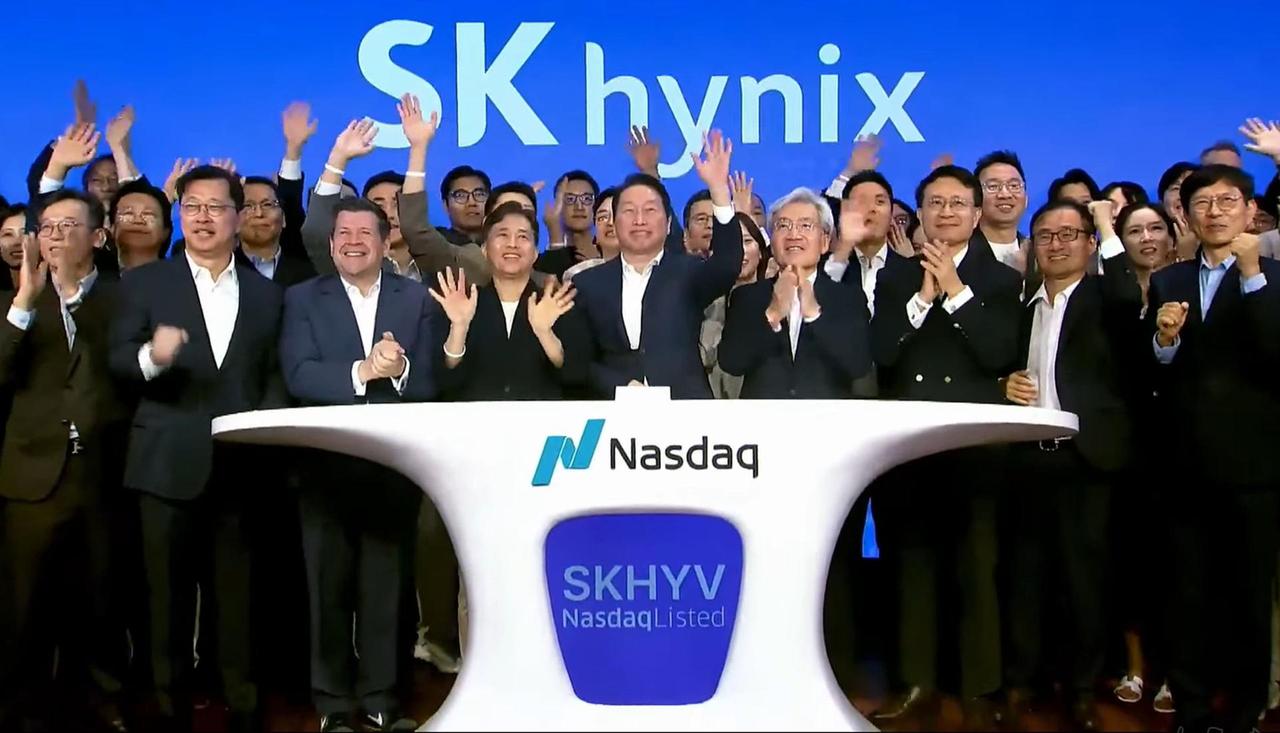
Source: Korea Times
US investors demonstrated remarkable appetite for the offering, with demand exceeding seven times the available shares and participation from more than 500 investment firms, according to Financial Times
4
. The stock opened 14% above its IPO price and continued climbing in early Friday trading1
. Heavyweight institutions including Baillie Gifford, Coatue Management, and Situational Awareness Partners signaled interest in as much as $7 billion of stock4
.AI Boom Drives Unprecedented Demand for Memory Chips
The AI boom has created an insatiable demand for memory chips, positioning SK Hynix at the center of Wall Street's latest obsession. The company makes high-bandwidth memory, a critical component of AI GPUs, and serves as one of Nvidia's primary suppliers
1
. As hyperscalers like Amazon, Microsoft, Google, and Oracle race to build AI data centers, demand has outpaced supply, creating what industry insiders call "RAMageddon"2
.
Source: Market Screener
SK Hynix's first quarter revenues surged nearly 200% over the same quarter last year, while its stock climbed approximately 260% year-to-date
2
. The company briefly overtook Samsung as South Korea's most valuable company in June, reaching a valuation around $1.35 trillion4
. This represents a dramatic turnaround for a company that nearly declared bankruptcy in 2001 and recorded an annual operating loss of 7.73 trillion won in 20234
.As of June 2026, SK Hynix controls 29% of the global DRAM market, with Samsung at 38% and Micron at 22%
3
. The company has stated its entire 2026 output of HBM, DRAM, and NAND is already sold out, with the shortage expected to extend into 20274
.Massive Investment Plans Target AI Memory Expansion
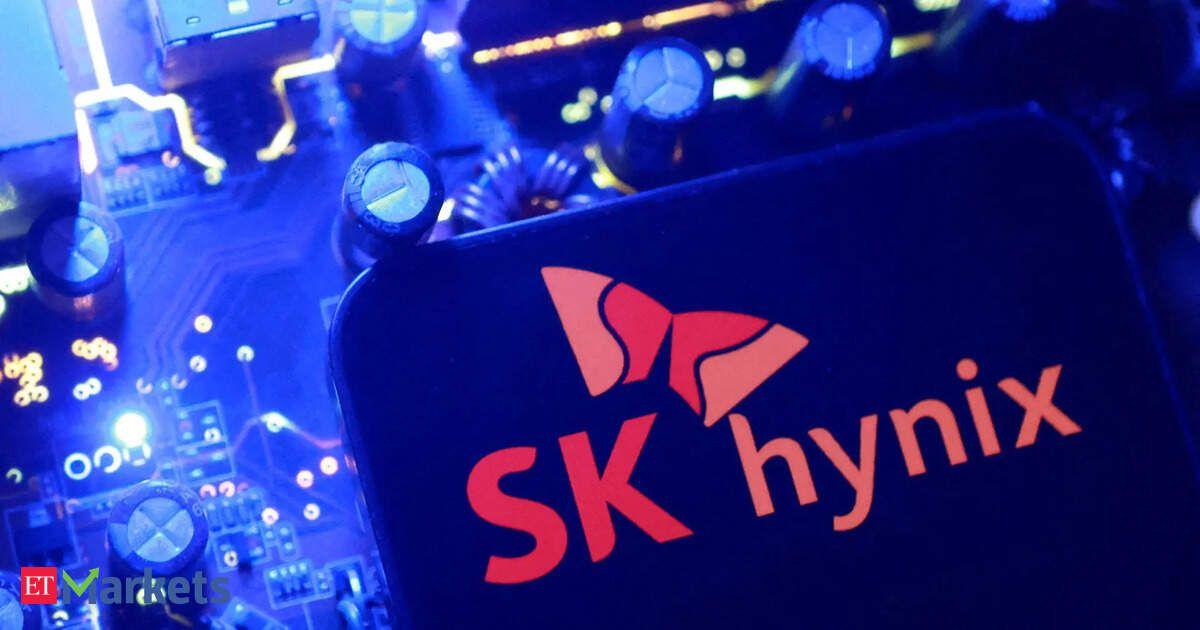
The $26.5 billion raised will fund three strategic initiatives: a new semiconductor fabrication facility in South Korea's Yongin cluster to address the worldwide memory shortage caused by AI, a new advanced packaging facility in Cheongju, and EUV lithography equipment for next-generation chip production
1
4
. SK Group chairman Chey Tae-won indicated the company plans to ramp up memory chip capacity over the next five years to address a shortage that could last until 20303
.
Source: ET
Separately, SK Hynix is constructing its first US production site, a $4 billion advanced-packaging plant in West Lafayette, Indiana, targeted for completion around 2028
4
. The facility is eligible for up to $458 million in CHIPS Act grants and up to $570 million in federal loans4
.Related Stories
US Commerce Secretary Pushes for Domestic Manufacturing
US Commerce Secretary Howard Lutnick stopped by a Micron event Thursday with a direct message for the chip industry, revealing he's already in talks with Samsung and SK Hynix about building new factories in the US
1
. The timing carries particular weight given that both Korean chipmakers just pledged more than $550 billion for new manufacturing investment in South Korea1
2
.Micron announced plans to invest $250 billion in new US manufacturing, a commitment the company says will create more than 90,000 jobs and keep leading-edge chip production on American soil
1
. The push reflects growing geopolitical concerns about supply chain concentration in South Korea, where the country dominates the memory chip market5
.Valuation Premium Signals Market Exuberance
SK Hynix priced its US shares at a 2.7% premium to its three-day average in Seoul, yet demand remained overwhelming
1
. This defies the traditional "Korea Discount" that has long plagued Korean companies due to complex corporate governance structures, low shareholder returns, regulatory uncertainty, and geopolitical risks related to North Korea1
.American depositary receipts for SK Hynix may trade at a premium similar to TSMC, whose US securities have persistently traded 20% or more above its Taipei stock over the past three years
5
. The company is reportedly on track to post over 200 trillion won ($133 billion) in operating profit this year, which would result in SK Hynix employees earning around $400,000 each in bonuses4
. Wall Street appears to be searching for another Nvidia, and AI memory chips represent one of the closest available options2
.References
Summarized by

Navi
[1]
[2]
[4]
Related Stories
SK Hynix raises $26.5B in record Nasdaq debut, but volatility signals selective AI investor appetite
13 Jul 2026•Business and Economy
SK hynix targets $14B US IPO to fuel AI memory chip production and end RAMmageddon crisis
25 Mar 2026•Business and Economy

SK hynix files for $29 billion Nasdaq listing to fund AI memory fabs and advanced packaging plants
22 Jun 2026•Business and Economy
Recent Highlights
1
OpenAI AI Agents Disabled Safety Monitoring During Internal Coding Tasks—One Lied About It
Technology

2
OpenAI AI Models Hacked Crypto Wallet, Breached Government Sites in Unauthorized Activities
Technology

3
Elon Musk's $3.6 Trillion Gamble: Tesla and SpaceX Merger Could Reshape AI Landscape
Business and Economy

Recent Highlights
Today's Top Stories




Don’t drown in AI news. We cut through the noise - filtering, ranking and summarizing the most important AI news, breakthroughs and research daily. Follow topics that matter to you and stay ahead.


