AI agents give confident wrong answers without enterprise context layer, Snowflake responds


5 Sources
[1]
Snowflake's Horizon Context aims to give AI agents a common understanding of the business
Snowflake is attempting to address that problem with Horizon Context, a new set of semantic and metadata-management capabilities, currently in preview, that it unveiled Tuesday at its annual Snowflake Summit conference. Artin Avanes, head of core data platform at Snowflake, said that the offering,
[2]
Why AI agents give confident wrong answers
Enterprise AI agents have a new production failure mode, and it is not the model. As enterprises move from single-layer RAG to hybrid retrieval architectures, the same underlying data produces different answers depending on which agent, tool or system asks the question. Revenue means one thing in a
[3]
Snowflake, Databricks and the model makers: The battle for the agentic client and AI back end
Snowflake, Databricks and the model makers: The battle for the agentic client and AI back end Agentic artificial intelligence is being misread as a set of separate battles - for example, Snowflake Inc. versus Databricks Inc., copilots versus agents, model makers versus application vendors. We
[4]
Semantic layer governance powers trusted agentic AI
The semantic layer is becoming the foundation for trusted agentic AI Agentic AI is making the semantic layer an essential enterprise priority because headless agents asking thousands of questions simultaneously have zero tolerance for inconsistent data definitions. This change is a core principle
[5]
Enterprise context layer in focus as enterprises scale AI
As enterprise AI matures, data and context emerge as new competitive edge Enterprise AI is entering a new phase where competitive advantage depends less on foundation models and more on the ability to connect data and business knowledge through an enterprise context layer. As organizations scale
Share
Copy Link
AI agents are producing different answers from the same data because business logic is fragmented across systems. Snowflake unveiled Horizon Context and Cortex Sense at Summit 2026 to create a shared governed definition of business logic. The move addresses why hybrid retrieval intent tripled to 33.3% in March as enterprises struggle with AI agents that lack a common understanding of business data.
AI Agents Struggle With Fragmented Business Context
Enterprise AI agents face a critical production failure that has nothing to do with the models themselves. As organizations move from single-layer retrieval-augmented generation to hybrid retrieval architectures, AI agents are producing different answers from identical data depending on which system asks the question
2
. Revenue means one thing in a business intelligence dashboard, something different in a SQL table, and something else entirely in an agent instruction. VentureBeat's VB Pulse Q1 2026 data shows hybrid retrieval intent tripling from 10.3% in January to 33.3% in March, marking the fastest-growing strategic position in the dataset2
.
Source: VentureBeat
"There are a lot of tools out there that you can ask questions, you get a very confident answer, but whether it's correct or not is different," said Christian Kleinerman, EVP of Product at Snowflake
2
. The problem stems from business logic distributed across SQL, BI dashboards and agent instructions, with no single system owning the definition. When multiple agents or tools query the same underlying data, they reason over different schemas and return different answers.Snowflake Horizon Context Targets the Enterprise Context Layer
Snowflake unveiled Horizon Context at its annual Summit conference in San Francisco, a new set of semantic and metadata management capabilities currently in preview
1
. The offering, launched as part of Horizon Catalog, collects metadata from across an enterprise's data estate, enriches it with business definitions, relationships, lineage and governance information, and makes that context available across AI and analytics systems1
.
Source: InfoWorld
Artin Avanes, head of core data platform at Snowflake, explained that these capabilities build on the company's acquisition last year of Select Star, a metadata management startup known for its integrations with database systems such as PostgreSQL and MySQL, business intelligence tools like Tableau and Power BI, and data pipeline tools such as dbt and Airflow
1
.Horizon Context pulls metadata from Postgres, SQL Server, Tableau and Power BI into the Horizon Catalog, ensuring every agent, BI tool and external system draws from the same governed definition rather than reasoning independently over a raw physical schema
2
. Semantic View Autopilot automatically creates and refines semantic views over time, extending curated business logic without requiring ongoing manual effort.Cortex Sense Adds Platform-Derived Intelligence
Alongside Horizon Context, Snowflake introduced Cortex Sense, a platform-derived layer that automatically builds and enriches context from customer data and usage patterns on an ongoing basis
2
. Kleinerman described it as improving the default experience before any explicit curation has happened. "Think of Horizon Context as everything that is explicit and declared by customers, and Cortex Sense is anything that is implicit and derived by us," Kleinerman explained2
.The two layers connect to Snowflake's existing retrieval infrastructure. Cortex Search, the company's RAG implementation, plugs into both CoCo and Cowork as a tool, so context enriched by either layer flows into retrieval workflows
2
. While Horizon Context is a Snowflake technology, the company is tying it to the Open Semantic Interchange, making customer-declared definitions portable across third-party catalogs and tools.Semantic Layer Governance Becomes Critical for Agentic AI
The semantic layer is becoming the foundation for trusted agentic AI because headless agents asking thousands of questions simultaneously have zero tolerance for inconsistent data definitions
4
. Dave Mariani, chief technology officer of AtScale, emphasized that while you want large language models to be creative as research assistants, "you don't want them to be creative about the definition of revenue or customer"4
.Carl Perry, head of analytics at Snowflake, noted that semantics can no longer live inside BI tools sitting above the data. "When you start using AI agents, which are not in BI tools and they intentionally are running autonomously and driving workflows, that model has to be where the agents are residing," Perry said
4
. Organizations that built coherent-looking enterprise data models on top of fragmented underlying data got away with it when humans were in the loop. AI agents are far less forgiving.A Crowded Field Targets the Same Problem
Snowflake joins an increasingly crowded field of vendors targeting the enterprise context layer. Microsoft has opened its Fabric IQ business ontology via MCP so any vendor's agent can draw from a shared governed definition
2
. Redis launched Iris, a context and memory platform that sits between agents and their data, built on a storage engine redesigned for agent-scale retrieval volumes. Pinecone is repositioning from vector database to knowledge engine with Nexus, which compiles enterprise data into task-specific artifacts before agents ever query them.Devin Pratt, research director at IDC, told VentureBeat that Snowflake is headed in the right direction. "Agents are only as good as the data and semantics behind them, so the context layer, not the model, is the thing to watch right now," Pratt said
2
.Related Stories

The Battle for the Intelligent Client and AI Back End
The larger strategic question extends beyond data silos to who owns the new intelligent client and the AI back end that makes it useful
3
. The new client is the agent-based system of engagement—Snowflake CoWork and CoCo, Databricks Genie, Microsoft's Copilot, Google's Gemini Enterprise and others. These clients require what analysts call the system of intelligence: a back end that models enterprise data, business rules and tacit organizational knowledge in a way that both humans and agents can understand and act upon.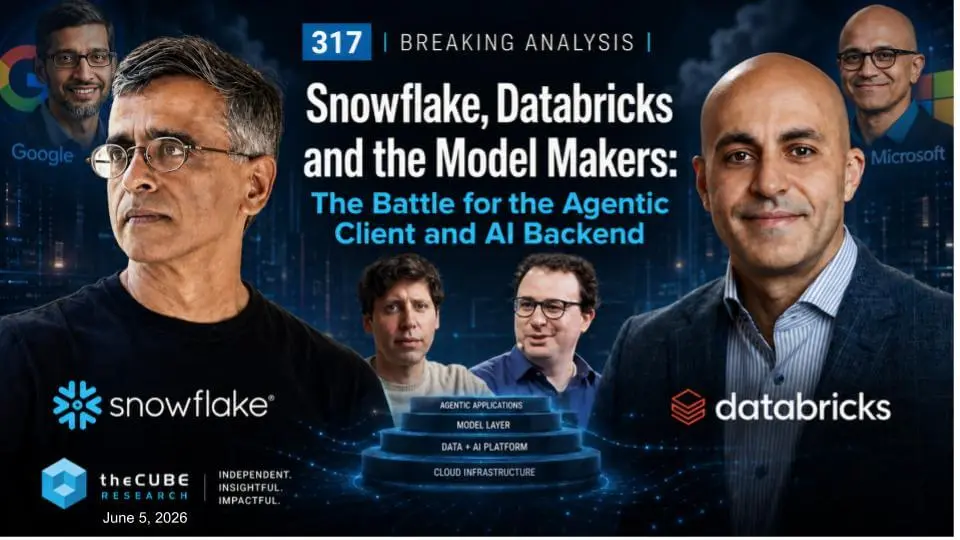
Source: SiliconANGLE
The key premise is that the system of intelligence ingests more than data and metadata from pipelines, catalogs and connectors. It also learns from the agentic client through skills, artifacts, semantic views, query history, agent actions and human reasoning traces
3
. Those signals become feedback into the intelligence layer and help turn individual productivity into organizational intelligence.For CIOs, Horizon Context should reduce operational complexity because it will provide a governed map of their organization's data estate, said Stephanie Walter, practice lead of the AI Stack at HyperFRAME Research. "The value is not simply cataloging where data lives; it is giving AI systems the metadata, lineage, permissions, and business context needed to retrieve the right data safely," Walter said
1
.Governance Becomes Accelerant Instead of Blocker
The fundamental shift is reframing data governance from a blocker to infrastructure that makes it safe to open data broadly
4
. Mariani warned that enterprises tempted to lock everything down first and open doors later have the model backwards. Shadow AI proliferates precisely because organizations withhold data access from people who need it most. "You've got to say everything is open and we have to be confident that our governance infrastructure can make sure that the data doesn't get into the wrong hands," Mariani said4
.Bob O'Donnell, founder and chief analyst of TECHnalysis Research, noted that many organizations recognize effective AI initiatives require a strong data foundation, but the complexity of consolidating and organizing enterprise data has made unified platforms and an enterprise context layer increasingly important advantages. Organizations are moving away from centralized data warehouse strategies and toward federated data approaches that allow data to remain in place while being connected and analyzed across systems. Traditional semantic layers were designed for structured data, but modern AI environments must also incorporate semi-structured and unstructured information through knowledge graphs that agents can query across tools like Slack and Jira.
References
Summarized by

Navi
[1]
[2]
[3]
[4]
[5]
Related Stories
Snowflake positions itself as control plane for agentic AI at Summit 2026
28 May 2026•Technology

Snowflake Launches Intelligence Platform to Transform Enterprise AI Beyond Traditional RAG Systems
04 Nov 2025•Business and Economy

Snowflake Unveils AI-Powered Tools to Empower Business Analysts and Streamline Data Workflows
03 Jun 2025•Technology

Recent Highlights



Recent Highlights
Today's Top Stories






Don’t drown in AI news. We cut through the noise - filtering, ranking and summarizing the most important AI news, breakthroughs and research daily. Follow topics that matter to you and stay ahead.


