Google Cloud rebuilds enterprise data infrastructure for AI agents with Agentic Data Cloud


3 Sources
[1]
The modern data stack was built for humans asking questions. Google just rebuilt its for agents taking action.
Enterprise data stacks were built for humans running scheduled queries. As AI agents increasingly act autonomously on behalf of businesses around the clock, that architecture is breaking down -- and vendors are racing to rebuild it. Google's answer, announced at Cloud Next on Wednesday, is the
[2]
Google Cloud databases power the agentic enterprise - SiliconANGLE
Google Cloud databases are being rebuilt for the age of AI agents AI agents depend on the quality and accessibility of the data behind them, placing Google Cloud databases at the center of that equation. The agentic data cloud introduced at Google Cloud Next 2026 underscores Google's push to
[3]
Google delivers connective tissue for autonomous AI agents to access data without restrictions - SiliconANGLE
Google delivers connective tissue for autonomous AI agents to access data without restrictions Google Cloud is turning the traditional enterprise data platform on its head, unveiling the Agentic Data Cloud infrastructure platform that aims to act as a kind of central nerve center for the era of
Share
Copy Link
Google Cloud announced Agentic Data Cloud at Cloud Next 2026, transforming enterprise data stacks from human-scale reporting systems into agent-scale systems of action. The platform features Knowledge Catalog for automated semantic metadata curation, a cross-cloud lakehouse that queries data across AWS and Azure without egress fees, and Data Agent Kit that enables developers to describe outcomes rather than write code.
Google Cloud Transforms Enterprise Data Stacks for Agent-Scale Operations
Google Cloud announced its Agentic Data Cloud at Cloud Next 2026 on Wednesday, marking a fundamental shift in how enterprise data stacks are architected
1
. The platform addresses a critical reality: traditional data infrastructure was built for humans running scheduled queries, but as AI agents increasingly act autonomously on behalf of businesses around the clock, that architecture is breaking down1
. "The data architecture has to change now," Andi Gutmans, VP and GM of Data Cloud at Google Cloud, told VentureBeat. "We're moving from human scale to agent scale."1
The Agentic Data Cloud represents Google's push to position its databases as the foundation of AI-driven enterprise architecture, transforming them from passive storage systems into intelligent context hubs that power agentic AI applications
2
. The platform is built on three core pillars designed to act as connective tissue for autonomous AI agents to access data without restrictions across any cloud environment3
.
Source: VentureBeat
Knowledge Catalog Automates Semantic Metadata Curation to Close the Context Gap
One of the biggest hurdles with deploying autonomous AI agents today is the context gap—if an agent doesn't understand a company's specific definition of metrics like "gross margin," it will likely make expensive mistakes
3
. The Knowledge Catalog, an evolution of Google's Dataplex governance product, automates semantic metadata curation by inferring business logic from query logs without manual data steward intervention1
.This automated approach scales to the full data estate, not just the curated subset that a small team of data stewards can maintain by hand
1
. The catalog scans all of a company's documents—including accounts, PDFs, PowerPoint presentations and images—extracting entities and studying relationships to build a navigable schema that agents can use3
. It covers BigQuery, Spanner, AlloyDB and Cloud SQL natively, and federates with third-party catalogs including Collibra, Atlan and Datahub1
.Cross-Cloud Lakehouse Eliminates Data Silos and Egress Fees
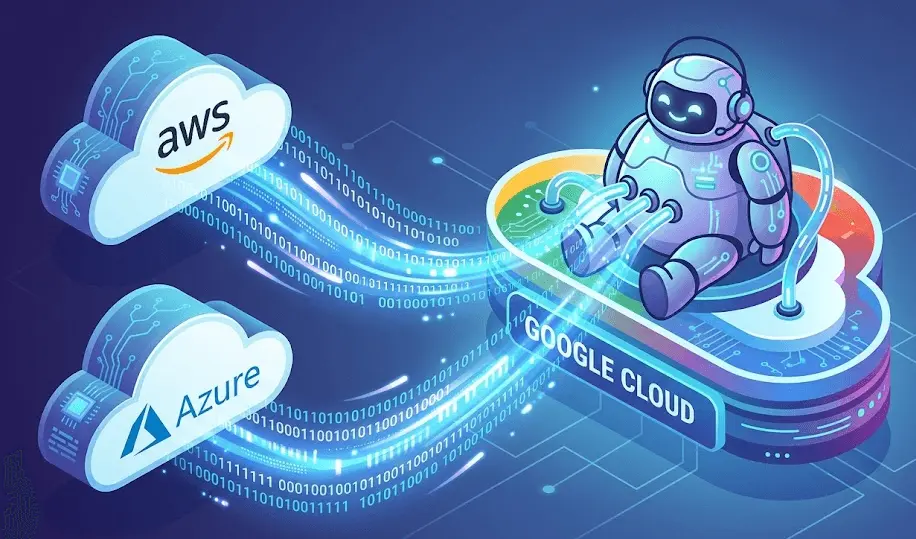
The cross-cloud lakehouse addresses what Google calls AI agent "gravity"—how agents lose autonomy when slowed by cross-cloud latency or prevented from accessing data trapped in other cloud platforms
3
. Using the open Apache Iceberg format, BigQuery can now query Iceberg tables sitting on Amazon S3 via Google's Cross-Cloud Interconnect with no egress fees and price-performance comparable to native AWS warehouses1
.
Source: SiliconANGLE
Gutmans explained that previous data federation worked through query APIs, which limited the features and optimizations BigQuery could apply to external data. The new storage-based sharing approach means "whether the data is in Amazon S3 or in Google Cloud, it doesn't make a difference"
1
. Bidirectional data federation in preview extends to Databricks Unity Catalog on S3, Snowflake Polaris and the AWS Glue Data Catalog using the open Iceberg REST Catalog standard1
.Related Stories

Data Agent Kit Shifts Developers from Writing Code to Describing Outcomes
The Data Agent Kit ships as a portable set of skills, MCP tools and IDE extensions that drop into VS Code, Claude Code, Gemini CLI and Codex
1
. Rather than writing a Spark pipeline to move data from source A to destination B, data engineers describe the outcome—a cleaned dataset ready for model training or a transformation that enforces a governance rule—and the agent selects whether to use BigQuery, the Lightning Engine for Apache Spark or Spanner to execute it, then generates production-ready code1
."Customers are kind of sick of building their own pipelines," Gutmans said. "They're truly more in the review kind of mode, than they are in the writing the code."
1
Three specialized AI agents were announced: a Data Engineering agent for building and governing complex data transformations, a Data Science agent for automating AI model lifecycles across BigQuery and Spark, and a Database Observability agent for diagnosing and repairing data infrastructure issues3
.Databases Evolve from Storage to Intelligent Context Hubs
For 50 years, databases had one job: store data and return exact results on demand, noted Sailesh Krishnamurthy, vice president of engineering for databases at Google Cloud
2
. AI agents break that contract entirely. Today's applications need the best results, not just exact ones, demanding that graph traversal, vector embeddings, full-text search and relational operations coexist in a single system2
.
Source: SiliconANGLE
"The models are amazing, but they don't have all the context," Krishnamurthy said. "The context is in the data. The heart of the data is actually stored in these systems of action."
2
Google also announced Spanner Omni, a downloadable edition of its globally distributed database that can run on-premises or across rival clouds2
. Agentic migration tooling powered by Gemini now handles not just schema and data but the application layer—including embedded SQL queries—dramatically compressing timelines that once required months of manual effort2
.The shift from human-scale to agent-scale operations demands infrastructure that enables semantic search, supports vector embeddings, and provides the governed context necessary for AI agents to take action rather than simply answer questions. By addressing data access, business context, and developer productivity simultaneously, Google Cloud is positioning the Agentic Data Cloud as the foundation for agent-centric action-oriented platforms that can operate autonomously across multi-cloud environments.
References
Summarized by

Navi
[1]
Related Stories
Google Unveils AI Agents to Revolutionize Enterprise Data Management and Analysis
06 Aug 2025•Technology

Google Cloud declares 'era of the agent is here' as it unveils full agentic enterprise stack
30 Apr 2026•Technology
Google unveils enterprise AI agents platform as Cloud reaches $70B revenue with 48% growth
22 Apr 2026•Technology

Recent Highlights



Recent Highlights
Today's Top Stories






Don’t drown in AI news. We cut through the noise - filtering, ranking and summarizing the most important AI news, breakthroughs and research daily. Follow topics that matter to you and stay ahead.


