5 Sources
5 Sources
[1]
Snowflake's ongoing pitch: bring AI to data, not vice versa
Snowflake is putting cash and kinetic energy behind the idea that AI works best in its platform. Whether it's the $200 million deal signed with OpenAI, its impdending acquisition of Observe, or its new Project SnowWork, Snowflake partner Gary McConnell said that the platform is constantly coming up in conversations, because of this effort. "What's compelling about Snowflake's recent moves isn't just the dollar amounts -- it's the consistency," he told The Register. "Snowflake has been aggressive on the feature roadmap. They're also making investments in observability which should play to enterprise support as complexity scales." McConnell, who's the CEO of solution provider VirtuIT, said Snowflake's recent moves have put a focus on helping customers achieve an actual return on investment for AI, an important topic among his enterprise customers. "The OpenAI partnership, the Observe acquisition intent, and Project SnowWork all point to the same thesis: your data platform should be the place where AI work actually happens, not just a source you export from," he told The Register. "For our customers, that's a meaningful shift. Historically, organizations had to stitch together a data warehouse, a feature store, and a separate AI/ML environment. Snowflake is collapsing that stack, and we're seeing real interest in that consolidation story." Snowflake has been aggressive with its feature roadmap and making investments in observability a critical component as the complexity of AI data scales, McConnell said. "Customers are excited about being able to bring AI workloads to the data rather than moving the data to the AI," he said. "The governance story of knowing where your data is and who touched it also resonates strongly in regulated industries such as pharma, legal, and finance to name a few." Snowflake is adding thousands of customers annually, growing from 7,800 in January 2023 to 13,330 this January, a 70 percent increase in its customer base in three years. In that same timeframe, it has also added more enterprise customers, growing those from 573 of the Forbes Global 2000 in 2023 to 790 as of January 2026. Those enterprises contributed 43 percent of the company's $4.7 billion in revenue during the most recent fiscal year. Snowflake kicked off the year by announcing a partnership with Google that brought the Chocolate Factory's Gemini model into Snowflake's Cortex AI, its application-to-inference service. It also announced plans to buy Observe AI which engineers can use to detect anomalies, identify root causes faster, and improve operational resilience. In February it announced a $200 million partnership with OpenAI to develop custom AI solutions for enterprise customers. It added Semantic View Autopilot, a service that gives AI agents a shared set of business metrics for more consistent and reliable data outcomes. Then came Snowflake Postgres which is powered by pg_lake, a set of open source PostgreSQL extensions that allow Postgres to work within an organization's data lakehouse. Last week the company announced that it was beta testing Project SnowWork, which uses role-based AI personas that understand common business workflows, terminology, and KPIs. The idea is to give business tasks to the business persona that it matches, with Snowflake providing pre-configured capabilities for finance, sales, marketing, operations. "We're not assuming every sales or marketing team works the same way, but there are clear patterns in how these functions operate -- how pipeline is tracked, how campaigns are measured, how forecasts are built," Snowflake's Bala Kasiviswanathan, VP of Developer and AI Experiences, told The Register. "Those patterns, observed across thousands of customers, give us a strong starting point." He said that Snowflake is using Project SnowWork internally with its sales teams, which can now generate data-backed QBRs, pitch decks, and customer emails all from one place. Executives get a personalized intelligence feed with the metrics that matter to them, tailored to their role. And Snowflake said it has begun to automate its earnings prep using SnowWork to ease the burden of a weeks-long, cross-team effort. "The system is grounded in each customer's own data, definitions, and workflows, and teams can layer in their own logic," Kasiviswanathan said. "Over time, it also improves through usage and feedback. So it's less a fixed "persona" and more a starting point that quickly becomes specific to how each company actually runs. This is also a key part of what we are trying to learn and codify during our research preview." In terms of security, he said that every action Project SnowWork takes inherits role-based access controls, data policies, and audit logging automatically. That means it can only act on data the user is allowed to see, and every step is fully traceable, he said. "Enterprises can inspect the steps, validate outputs, and maintain control over how and when actions are executed," he said. ®
[2]
Snowflake launches new AI platform
Why it matters: The product launch shows how enterprise software companies are aggressively responding to a workplace reshaped by AI. How it works: The new platform, Project SnowWork, essentially provides the "last mile" connecting enterprise data and work systems through AI agents on behalf of employees in sales, finance, operations, HR and other teams. * A user could ask SnowWork to build a pitch deck, and the platform would pull data from multiple sources, organize it, and draft an accompanying email -- no coding needed, CEO Sridhar Ramaswamy tells Axios. * And these "end-to-end" workflows can be automated through SnowWork. Zoom in: Snowflake says it's just starting to offer a limited set of customers a research preview of SnowWork. * It's different than other AI agents that typically function via documents, emails or online content, because it "is grounded in governed enterprise data and context that is embedded directly within the Snowflake platform," the company said in a statement. * "AI models can be very powerful orchestrators of work," Ramaswamy says. Zoom out: Snowflake was among the software companies whose stock prices got ensnared in a selloff earlier this year amid fears that AI could devastate such businesses -- the so-called SaaS-pocalypse.
[3]
Snowflake previews project to automate workflows with AI agents - SiliconANGLE
Snowflake previews project to automate workflows with AI agents Snowflake Inc. today is digging deeper into the emerging agentic enterprise model with the introduction of a research preview of an autonomous artificial intelligence platform designed to help business users automate complex tasks using Snowflake-governed data. The company said the platform, called Project SnowWork, is intended to move AI beyond queries and toward systems that can plan and execute multi-step workflows using enterprise data. While positioned as allowing users to "simply ask for what they need and have SnowWork securely complete the task," the platform works best with existing processes, said Bala Kasiviswanathan, vice president of developer and AI experiences at Snowflake. "Project SnowWork is most powerful when it's working with governed data, defined workflows and an understanding of how the business operates," he said. "Where it really adds value is not just automating tasks, but accelerating decision-making. It can synthesize data, surface insights and recommend next steps." SnowWork runs on governed enterprise data stored on Snowflake's platform and integrates business context, such as metrics, definitions and access policies. Snowflake executives said grounding AI agents in enterprise data is essential if companies want AI to move beyond experimentation and become a trusted operational tool. "The real issue enterprises are facing right now isn't just building agents," Kasiviswanathan said. "It's that most approaches aren't actually solving the business problem fast enough, or in a way that's grounded in real enterprise context." SnowWork orchestrates tasks such as querying datasets, analyzing results, generating reports and preparing presentations within a single interaction. The company said the system can handle workflows that span multiple enterprise systems while observing the same governance and security rules applied to the underlying data. Kasiviswanathan actions taken by the AI agent remain transparent and auditable. "Every action inherits role-based access controls, data policies and audit logging automatically," he said. "That means it can only act on data the user is allowed to see, and every step is fully traceable." The company also emphasized mechanisms it has put in place to reduce the risk of unreliable outputs or hallucinations when the system performs complex tasks. "Enterprises can inspect the steps, validate outputs and maintain control over how and when actions are executed," Kasiviswanathan said. Snowflake positions the new offering as the next stage in a long-running industry effort to democratize access to analytics. Previous waves of "self-service" data tools promised to eliminate the need for specialized data teams, but many organizations still rely heavily on analysts to create reports or interpret dashboards, it noted. Kasiviswanathan said SnowWork aims to go further by completing tasks rather than simply returning answers. "We're collapsing the entire chain from question to analysis to outcome into a single interaction," he said. "Project SnowWork doesn't just surface insights, it carries them through to a finished deliverable or recommended action." Another key point of differentiation is context, he said. "Project SnowWork understands how the business actually operates," he said. "This isn't just democratizing access to data, it's democratizing the ability to act on it." Snowflake didn't say when Project SnowWork will be generally available.
[4]
Snowflake launches autonomous AI platform to automate business workflows
SnowWork is positioned as an extension of Snowflake's AI Data Cloud, and is meant for employees across functions such as finance, sales, and operations. The tasks it assists with range from generating executive-ready reports and forecasting presentations to performing analyses that identify customer churn or operational bottlenecks. Cloud software company Snowflake has launched a new enterprise AI platform, called Project SnowWork, for business users to automate their workflows. The agentic platform is designed to act as an autonomous AI partner that can execute complex business tasks only through conversational prompts. The company has announced the project's research preview this week as part of its broader push into the "agentic enterprise" space. SnowWork is positioned as an extension of Snowflake's AI Data Cloud, and is meant for employees across functions such as finance, sales, and operations. The tasks it assists with range from generating executive-ready reports and forecasting presentations to performing analyses that identify customer churn or operational bottlenecks. The system aims to reduce the manual effort required in coordinating data analysis, reporting, and decision-making processes across business departments. Project SnowWork is built to autonomously plan and execute multi-step workflows tied to data in Snowflake's governed environment. It integrates AI capabilities directly into the enterprise data platform, offering a desktop-based experience for its clients. Users can initiate actions through simple language prompts, with the platform querying data, applying analysis, synthesising insights, and producing structured deliverables. Snowflake has emphasised that the platform operates within the company's existing data governance and security framework. Project SnowWork automatically enforces Snowflake's role-based access controls, masking policies, and audit logging, ensuring compliance and traceability as the AI executes workflows. The company is also offering pre-built, persona-specific AI profiles tailored to functional roles, reducing onboarding time for enterprise users. The launch is part of Snowflake's plan to expand capabilities beyond analytics to execution. For years, enterprises have invested heavily in data and AI technologies, but operationalising insights across teams has remained largely manual. Snowflake is aiming to make Project SnowWork a step toward closing that gap and embedding AI directly into day-to-day operations. Project SnowWork adds to Snowflake's AI product ecosystem, which includes Snowflake Intelligence, a conversational analysis agent for business insights, and Cortex Code, an AI-driven development assistant for engineering and data teams. Over the past few years, the startup has focussed on strengthening its core analytics layer. In an interview with ET, CEO Sridhar Ramaswamy said the company is building out its India team as well. "We've invested significantly in our India operations. We have a 500-plus person team in Pune and offices in Delhi and Bengaluru. Many of our partners are based in India as well -- about half our APJ (Asia Pacific and Japan) partners are here," Ramaswamy said. The company had announced that it will acquire Observe, an AI-powered platform, to deliver observability capabilities to enterprises building AI-driven applications. It has also signed a $200 million deal with artificial intelligence company Anthropic to deepen AI integration across its cloud data platform.
[5]
Snowflake launches desktop AI agent for enterprise workflows - The Korea Times
Christian Kleinerman, executive vice president of product at Snowflake, speaks during the company's media event in Seoul, Thursday. Courtesy of Snowflake U.S.-based software company Snowflake launched Project SnowWork, an artificial intelligence (AI) assistant designed to automate enterprise workflows, in a research preview on Thursday, marking the latest step in its push to bring agentic enterprise AI directly to business users' desktops. "The key insight (of the platform) is we will be introducing 'profiles' ... There is a profile for product managers, sales leaders and finance. And it personalizes every enterprise context to that specific role with the right data, right skills and right insights," Christian Kleinerman, the company's executive vice president of product, said during a media event in Seoul's Jung District. "We are incredibly excited to work with customers to shape what we think is the future of work and the future of the agentic enterprise." Project SnowWork allows business users to request tasks in natural language and have AI autonomously plan and execute multi-step workflows -- from data analysis to report writing and presentation generation. By combining multi-step task execution, persona-specific skills and built-in security and access controls, it is designed to act as a trusted agentic partner that can safely act on enterprise data rather than just summarize it. The launch reflects Snowflake's strategy for a broader enterprise AI stack, which already includes Snowflake Intelligence agent for natural-language analytics and Cortex services for building and deploying customized AI tools. The software company provides a single environment where enterprises can store, process, manage, analyze and share data, and even build applications and AI workloads on top of this data foundation. It currently serves more than 13,300 customers globally. With this new addition, users can move from intent to execution without filing tickets with data teams or waiting on static dashboards, while developers can use tools, such as Cortex Code, to productionize new AI workflows inside the same governed Snowflake environment. "Our goal is to help companies of all sizes, all industries, to make AI real and productive for all users," Kleinerman said. "It is for everyone in the company to leverage all the business logic they have and help them think through structured data, semi-structured data, unstructured data and streaming data." Since launching in 2021, Snowflake Korea has rapidly expanded its footprint, signing up around 80 percent of Korea's top 10 conglomerate groups and growing local platform consumption more than ninefold over the past four years. The company highlighted e-commerce operator Lotte ON, which used Snowflake's AI data platform to break down data silos and power AI-driven use cases such as customer segmentation and real-time product recommendations, delivering a 32-percent reduction in operating costs and a 40-percent improvement in overall performance.
Share
Share
Copy Link
Snowflake has launched Project SnowWork, an autonomous AI platform that uses AI agents to automate complex enterprise workflows. The system allows business users to request tasks in natural language and have AI autonomously plan and execute multi-step tasks—from data analysis to report generation—while maintaining data governance and security controls within Snowflake's platform.
Snowflake has unveiled Project SnowWork, an autonomous AI platform designed to help business users automate business workflows through conversational prompts
1
2
. The enterprise AI platform, currently in research preview, represents a significant shift in how companies can deploy AI agents to execute complex tasks rather than simply query data. According to CEO Sridhar Ramaswamy, users can ask SnowWork to build pitch decks, and the platform will pull data from multiple sources, organize it, and draft accompanying emails—no coding required2
. This approach aims to bring AI to data rather than forcing organizations to move data to separate AI environments, a strategy Snowflake has consistently pursued through recent partnerships including its $200 million deal with OpenAI and its acquisition of Observe1
.
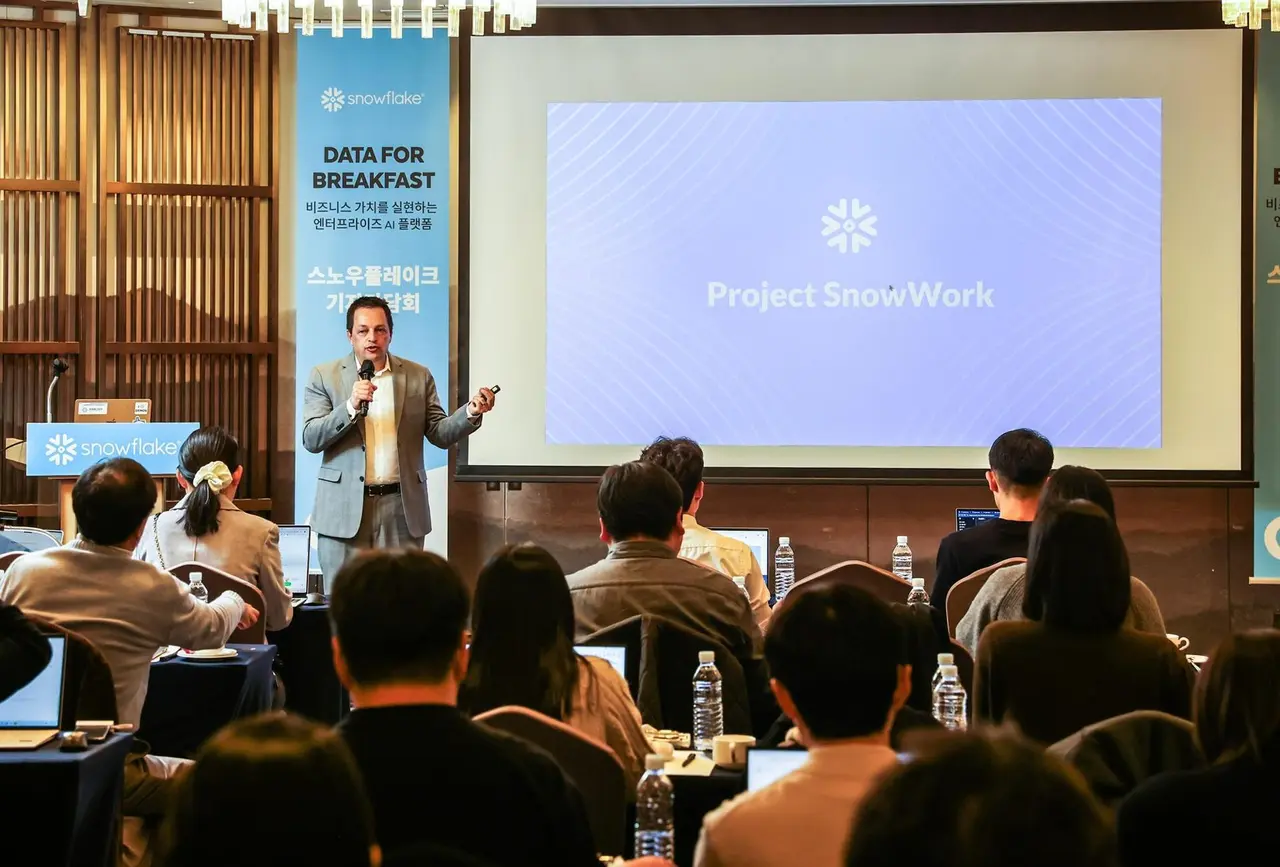
Source: Korea Times
Project SnowWork operates by orchestrating multi-step tasks such as querying datasets, analyzing results, generating reports, and preparing presentations within a single interaction
3
. The platform runs on governed enterprise data stored within Snowflake's AI Data Cloud and integrates business context including metrics, definitions, and access policies3
. Bala Kasiviswanathan, Snowflake's VP of Developer and AI Experiences, explained that the system is most powerful when working with governed data, defined workflows, and an understanding of how the business operates3
. The platform offers pre-built, persona-specific AI profiles tailored to functional roles in finance, sales, marketing, and operations, reducing onboarding time for enterprise users4
. Christian Kleinerman, Executive Vice President of Product at Snowflake, noted that these profiles personalize enterprise context to specific roles with the right data, skills, and insights5
.

Source: SiliconANGLE
Every action Project SnowWork takes inherits role-based access controls, data policies, and audit logging automatically, ensuring the AI assistant can only act on data users are permitted to see
1
3
. This security framework makes every step fully traceable, allowing enterprises to inspect actions, validate outputs, and maintain control over how and when tasks are executed3
. The platform automatically enforces Snowflake's role-based access controls, masking policies, and audit logging, ensuring compliance and traceability as AI workloads run4
. Snowflake has also implemented mechanisms to reduce the risk of hallucinations when the system performs complex operations3
. For regulated industries such as pharma, legal, and finance, the governance story of knowing where data resides and who accessed it resonates strongly, according to Gary McConnell, CEO of solution provider VirtuIT1
.The launch demonstrates how Snowflake is aggressively responding to a workplace reshaped by AI, providing the "last mile" to connect enterprise data and work systems through AI agents on behalf of employees
2
. McConnell noted that Snowflake's recent moves point to a consistent thesis: your data platform should be where AI work actually happens, not just a source you export from1
. This represents a meaningful shift for organizations that historically had to stitch together a data warehouse, a feature store, and a separate AI/ML environment1
. The company has been aggressive with its feature roadmap, recently partnering with Google to bring the Gemini model into Snowflake's Cortex AI, announcing plans to acquire Observe for observability capabilities, and signing a $200 million partnership with OpenAI to develop custom AI solutions1
4
.Related Stories

Snowflake is using Project SnowWork internally with its sales teams, which can now generate data-backed quarterly business reviews, pitch decks, and customer emails from one place
1
. Executives receive personalized intelligence feeds with metrics tailored to their roles, and the company has begun automating its earnings preparation using SnowWork to ease what was previously a weeks-long, cross-team effort1
. Kasiviswanathan emphasized that the system is grounded in each customer's own data, definitions, and workflows, with teams able to layer in their own logic1
. The platform improves through usage and feedback, functioning less as a fixed persona and more as a starting point that quickly becomes specific to how each company operates1
.Snowflake has added thousands of customers annually, growing from 7,800 in January 2023 to 13,330 this January—a 70 percent increase over three years
1
. Enterprise customers from the Forbes Global 2000 grew from 573 in 2023 to 790 as of January 2026, contributing 43 percent of the company's $4.7 billion in revenue during the most recent fiscal year1
. In Korea, Snowflake has signed approximately 80 percent of the country's top 10 conglomerate groups, with local platform consumption growing more than ninefold over four years5
. E-commerce operator Lotte ON used Snowflake's platform to break down data silos and power AI-driven use cases, delivering a 32-percent reduction in operating costs and a 40-percent improvement in overall performance5
. The company is also expanding its India operations with a 500-plus person team in Pune and offices in Delhi and Bengaluru, according to Ramaswamy4
.Summarized by
Navi
[1]
[2]
03 Jun 2025•Technology

02 Feb 2026•Technology

04 Nov 2025•Business and Economy