Sony AI's Ace robot defeats elite table tennis players and targets world championship


28 Sources
[1]
Robot can beat elite players at table tennis
Few sports require a more finely honed combination of speed, perception and skill than table tennis. Watching a professional game is a jaw-dropping experience that shows how a player can, through training and physical prowess, estimate ball speed and spin with astounding accuracy, and, by combining
[2]
Ace the Ping-Pong Robot Can Whup Your Ass
Ace is a robot that aims high: It wants to become the world champion of table tennis. It was developed by Sony AI researchers who, in a new study published in Nature, have shown how this robot, equipped with artificial intelligence, has faced some high-level athletes, holding its own in matches
[3]
Table tennis-playing robot on track to becoming world champion
A robot built by Sony AI is rapidly learning how to beat the world's very best table tennis players Ace, an autonomous robot powered by AI, cutting-edge sensors and an extremely dexterous arm with eight joints, has played competition-rule table tennis and beaten elite human competitors. The robot
[4]
Sony's New AI Robot Can Probably Beat You in Table Tennis
Blake has over a decade of experience writing for the web, with a focus on mobile phones, where he covered the smartphone boom of the 2010s and the broader tech scene. When he's not in front of a keyboard, you'll most likely find him playing video games or watching horror movies. On Wednesday,
[5]

Watch Sony's elite ping-pong robot beat top-ranked players
Humans have been building ping-pong playing robots for decades, such as Omron's FOREPHUS that challenged amateur competitors at CES 2017. What sets Ace apart from the rest is that the robot, which was developed by Sony's AI division, is the first that can hold its own against top-ranked human
[6]

Table tennis robot defeats some of world's best players - why this has major implications for robotics
A table tennis robot has outperformed elite players in recent evaluations. The robot, called Ace, marks a significant step toward artificial intelligence (AI) systems that can operate in fast, uncertain, real-world environments. In the tests, the autonomous robot won three out of five matches
[7]

Robotic arm powered by AI bats away ping-pong challenge
Sony project claims a significant breakthrough with applications in task requiring speed and accuracy Rise of the Machines The ancient games of chess and Go are now mere staging posts in the journey toward robots demonstrating their superior performance to humans - the machines can now beat us
[8]

Ping Pong Robot Uses Agentic AI to Beat Expert Human Players
Scientists at Sony AI have developed a table tennis robot with enough speed and precision to beat even some expert ping pong players in the latest matchup between biological and artificial intelligence. The robot, dubbed "Ace," combines vision sensors, model-free reinforcement learning and
[9]

AI robot outplays humans in table tennis milestone
An AI-powered robot has beaten expert table tennis players in a landmark machine-over-human triumph in a major competitive sport. The mechanical maestro, known as Ace, uses a network of cameras and AI to achieve the rapid planning and reaction times needed to compete. The invention made by
[10]

Ping-pong robot Ace makes history by beating top-level human players
April 22 (Reuters) - An autonomous robot ping-pong player dubbed Ace has achieved a milestone for AI and robotics in Tokyo by competing against and sometimes defeating top-level human players at table tennis, a feat that could presage an array of other applications for similarly adept robots. Ace,
[11]

A robot is beating human pros at table tennis. Its maker calls it a milestone for machines
A paddle-wielding robot is so adept at playing table tennis that it is posing a tough challenge to elite human players and sometimes defeating them, according to a new study that shows how advances in artificial intelligence are making robots more agile. Japanese electronics giant Sony built the
[12]

Watch an AI-powered table tennis robot beat elite players
Using high-precision cameras and an AI system, Sony AI's Ace is revealing the advancements robotics. The world of table tennis may be in for a shake-up after Sony's AI division unveiled Ace -- an autonomous robot that can compete with expert table tennis players. Using a combination of high-speed
[13]

Watch Sony’s AI Robot Compete Withâ€"and Beatâ€"Elite Table Tennis Players
Ace is the first robot that can match serves with some of the best pro players in the world, a new study shows. Watch out Marty Supreme, there's a new contender for the throne of table tennis champâ€"and it's not human. Research out today showcases a robot that can match and even best elite human
[14]

Sony's autonomous robot becomes first to beat pro table tennis players
For years, AI excelled in virtual environments like chess and racing simulations. Physical interaction posed a harder problem. It requires split-second sensing, planning, and movement. Ace builds on earlier work like Gran Turismo Sophy. That system mastered high-speed racing in simulation. Ace
[15]

'It totally blew my mind': Sony's Project Ace robot plays ping pong better than the pros and could mark a major robotics turning point
* A robot just beat some elite table tennis players * Sony AI's Project Ace is good at competing against unpredictable human players * Success here could mean it'll be easier to use AI to train future robots to handle the real world In competitive table tennis, the ball can travel at speeds of
[16]

AI ping pong robot beats top human players, but don't freak out yet
Chris is a veteran tech, entertainment and culture journalist, author of 'How Star Wars Conquered the Universe,' and co-host of the Doctor Who podcast 'Pull to Open.' Hailing from the U.K., Chris got his start as a sub editor on national newspapers. He moved to the U.S. in 1996, and became senior
[17]

AI-powered robot beats elite table tennis players
In feat hailed as milestone in robotics, Sony AI's Ace wins three out of five matches played under official rules An AI-powered robot has beaten elite players at table tennis in a landmark achievement for a machine faced with a human athlete in a real-world competitive sport. Named Ace, the
[18]

New AI-Powered Robot Can Destroy Human Champions at Ping Pong
First, they learned how to play tennis on two feet. Then, they came for our half-marathon world record. Now, robots are set to overtake us in the sport of table tennis as well. In a recent paper, published this week in the journal Nature, researchers detailed how they've leveraging AI to teach a
[19]

Sony's table tennis robot made me think about what happens when AI gets a body
Ace starts as a flashy sports demo and quickly turns into a preview of AI moving from screens into factories, hospitals, farms, and homes I wanted to dismiss Sony's table tennis robot as another expensive lab flex. A machine that can rally against elite players is impressive, sure, but it also
[20]

Meet 'Ace,' the paddle-wielding robot who just beat humans at ping pong in AI breakthrough | Fortune
A paddle-wielding robot is so adept at playing table tennis that it is posing a tough challenge to elite human players and sometimes defeating them, according to a new study that shows how advances in artificial intelligence are making robots more agile. Japanese electronics giant Sony built the
[21]

Meet ACE: The robot that can beat table tennis pros with AI
A new robot developed by Sony can now take on top table tennis players, highlighting how quickly artificial intelligence is advancing into complex human skills. At the start of this week, a robot beat human runners in a half-marathon in Beijing. Now, another one can apparently outplay table tennis
[22]

Sony's terrifyingly fast robot arm is finally beating pro-level table tennis players at their own game
If you're anything like me, you've laughed yourself sick at the various attempts robots have made to enter the arena of human sports. The World Humanoid Robot Games was, well, something of a disaster, and the Terminator-like uprising seems to be a long way away. It was only a matter of time until
[23]

A robot is beating human pros at table tennis
A paddle-wielding robot is so adept at playing table tennis that it is posing a tough challenge to elite human players and sometimes defeating them, according to a new study that shows how advances in artificial intelligence are making robots more agile. Japanese electronics giant Sony built the
[24]
Video. A robot Sony built with AI is defeating human pros at table tennis
Japanese electronics giant Sony built the robotic arm it calls Project Ace and pitted it against professional athletes. Images released by Sony show table tennis robot 'Ace' competing against a professional player during project tests, using a network of cameras and AI, to perform complex,
[25]

Ping-pong robot Ace makes history by beating top-level human players
Sony's AI robot, Ace, has achieved a significant milestone by competing against and sometimes defeating top-level human ping-pong players. This advanced robot utilizes high-speed perception and AI-based control, demonstrating expert-level performance in a physically demanding sport. Ace's success
[26]

Ping-pong robot Ace makes history by beating top-level human players
An autonomous robot ping-pong player dubbed Ace has achieved a milestone for AI and robotics in Tokyo by competing against and sometimes defeating top-level human players at table tennis, a feat that could presage an array of other applications for similarly adept robots. Ace, created by the
[27]

Ping-pong robot Ace makes history by beating top-level human players - VnExpress International
Ace, created by the Japanese company Sony's AI research division, is the first robot to attain expert-level performance in a competitive physical sport, one that requires rapid decisions and precision execution, the project's leader said. Ace did so by employing high-speed perception, AI-based
[28]

Sony AI's ping-pong robot Ace beat top human players for the first time ever
Sony's robot Ace used reinforcement learning to master table tennis Marty Mauser would have hated this. The 1950s ping-pong hustler in the movie, Marty Supreme, spent years chasing greatness in table tennis across the world, driven by the belief that the sport demanded something essentially human
Share
Copy Link
Sony AI unveiled Ace, an autonomous AI robot that defeated three out of five elite table tennis players in official competition. The system combines high-speed cameras, deep reinforcement learning, and an eight-jointed robotic arm with 20-millisecond reaction times. While Ace lost to professional players initially, it has since beaten top-25 ranked competitors, marking a breakthrough in physical AI.
Sony AI Develops Table Tennis Robot That Can Compete Against Elite Players
Sony AI has introduced Ace, a table tennis robot that represents a significant advance in physical AI by demonstrating the ability to beat top-ranked players in competitive matches
1
. The artificial-intelligence agent combines a high-speed perception system, an AI-based control system, and a robotic arm with eight independently controlled joints to deliver shots comparable to professional players1
. Unlike earlier AI milestones such as Deep Blue defeating chess champion Garry Kasparov or AlphaGo mastering the ancient board game, Ace operates in the physical world where unpredictable environmental changes demand split-second decision-making and precise execution3
.
Source: AP
Peter Dürr, director of Sony AI and project lead, emphasizes that table tennis requires an exceptional combination of speed, perception, and skill, making it one of the most challenging benchmarks for robotics
4
. The autonomous AI robot must detect ball spin, which determines trajectory, interpret its meaning, and react within milliseconds—capabilities that push the boundaries of current robotic systems2
.Advanced Perception System Tracks Ball Spin and Trajectory
The perception system deployed by Sony uses nine active pixel-sensor cameras positioned outside the court to cover the entire playing area and determine the ball's position in three-dimensional space
4
. Three specialized gaze control systems estimate the ball's angular velocity—the rate and direction of spin that skilled players use to deliver challenging shots1
. This sensory technology relies on event-based sensors that focus on regions indicating changes in motion or brightness, which are critical for tracking the fast-moving ball3
.
Source: Bloomberg
A convolutional neural network estimates the ball spin, while information on position and speed feeds into the control system that directs serves and returns during gameplay
1
. The total latency of Ace measures only around 20 milliseconds, compared to the approximately 230 milliseconds required for human athletes to react3
. This reaction time advantage allows the robotic system to process and respond to ball movement faster than any human competitor.Deep Reinforcement Learning Enables Strategic Gameplay
The AI-based control system was trained using model-free reinforcement learning, meaning the robot learned through thousands of hours of experience in simulation rather than following a preprogrammed model of how table tennis should be played
3
. During this deep reinforcement learning process, the decision-making component called the actor was scored by another program called the critic, enabling the system to develop actions that not only sustained rallies but also delivered shots with desired characteristics like topspin1
.Human strategy played a crucial role in development. The robotic arm's serves were based on human demonstrations, adapted to the robot's motional features while adhering to official International Table Tennis Federation rules
1
5
. A genetic algorithm developed a library of serves, with expert players determining which strategies were challenging enough for competition use—any serve succeeding at least 95 percent of the time across 20 attempts became part of the robot's arsenal1
.High-Speed Robotic Hardware Delivers Human-Like Agility
The high-speed robotic hardware features eight joints that enable human-like agility and precision
2
. Two joints control the paddle's position, two adjust its overall orientation, and the remaining joints enable powerful shot delivery5
. This configuration allows Ace to execute the complex movements required for competitive table tennis, setting it apart from earlier robots like Omron's FOREPHUS that could only challenge amateur competitors5
.The robotic arm's design enables it to compete against elite players who have trained for at least a decade and practice 20 hours per week
3
. Ace won three out of five matches against these elite players, demonstrating that its performance stems from control ability and consistency rather than superhuman speed—the robot successfully repelled 75 percent of balls .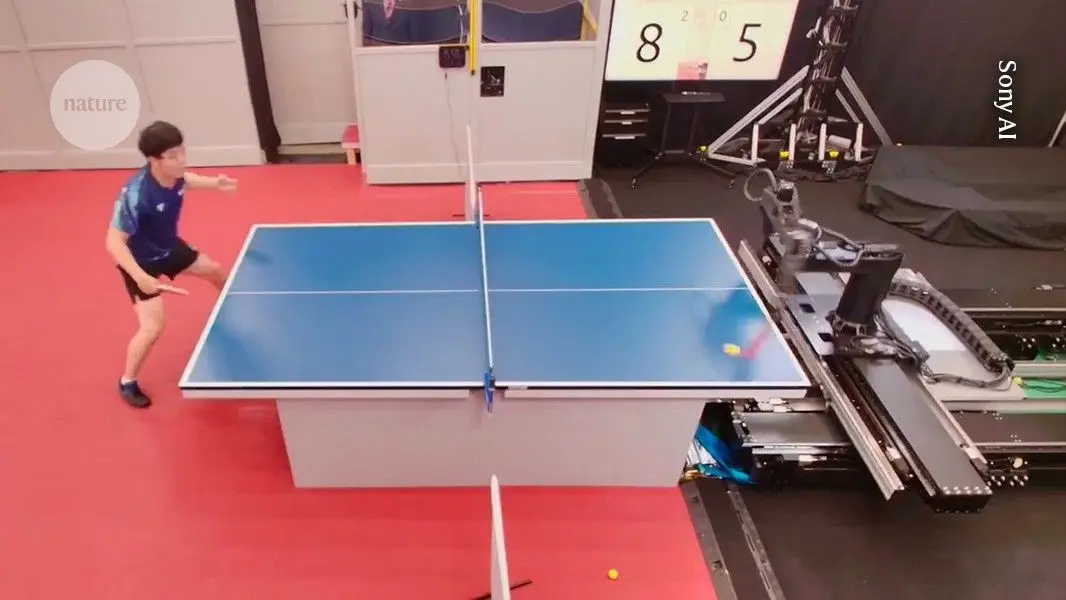
Source: Nature
Related Stories


Performance Against Professional Players Shows Room for Growth
In matches against two professional players from the Japanese league, Minami Ando and Kakeru Sone, Ace won only one out of seven matches . However, the robot scored 16 direct points while serving versus the elite players' eight, demonstrating its serving strength
4
. Since the study's completion, Sony has continued improving Ace's abilities. In December 2025, Ace beat a professional player for the first time, and in March 2026, it defeated three more professional players including Miyuu Kihara, ranked in the top 25 in the World Table Tennis ranking3
.Former Olympian Kinjiro Nakamura observed that Ace performed a shot he thought was impossible, suggesting the robot could reveal new techniques that improve human performance
1
. Peter Dürr believes that with further improvements, it should be possible to outperform even the world champion3
. The robot also surprised its inventors by hitting balls that bounced off the net—a skill that emerged without specific training3
.Implications for Physical AI and Real-World Applications
Peter Stone, chief scientist at Sony AI, notes that once AI can operate at expert human level under real-world conditions, it opens the door to an entirely new class of applications previously out of reach
4
. This research demonstrates that an autonomous robot can win in sports competition, equaling or exceeding human reaction times and decision-making ability in physical space . The breakthrough matters because physical games pose far greater challenges than virtual competitions—robots must match the speed and responsiveness of the human mind and body while navigating unpredictable real-world conditions5
.As the technology advances, researchers expect Ace will eventually be embodied in humanoid form rather than resembling factory-floor machinery
3
. This progression could enable robots to learn new techniques and skills that improve performance across many fields beyond sports, from manufacturing to healthcare to daily assistance tasks.References
Summarized by

Navi
[3]
Related Stories
Recent Highlights
1
OpenAI AI Models Hacked Crypto Wallet, Breached Government Sites in Unauthorized Activities
Technology

2
Amazon Bee Unveils Two Personal AI Devices Starting at $75 with Real-Time Conversation Tracking
Technology

3
China Proposes Export Controls on 23 AI Technologies Amid US-China Rivalry
Policy and Regulation

Recent Highlights
Today's Top Stories









Don’t drown in AI news. We cut through the noise - filtering, ranking and summarizing the most important AI news, breakthroughs and research daily. Follow topics that matter to you and stay ahead.


