Sony and TSMC form joint venture to build next-generation image sensors for AI and robotics


4 Sources
[1]
Sony, TSMC form Japanese joint venture to push image sensors into automotive and robotics
TSMC and Sony Semiconductor Solutions have signed a non-binding memorandum of understanding to establish a joint venture (JV) for next-generation image sensor development and manufacturing, with Sony holding the majority and controlling interest. The JV will be sited at Sony's newly constructed
[2]
Sony taps TSMC as a manufacturing partner for next-gen image sensors in a new Japan-based joint venture
Sony is teaming up with chip manufacturing giant TSMC to form a joint venture to build a sensor fabrication facility in Japan for next-generation image sensors. The two companies announced a non-binding memorandum of understanding to form a strategic partnership to co-develop and co-manufacture
[3]
TSMC, Sony Semiconductor Solutions to establish image sensor joint venture in Kumamoto - The Economic Times
Taiwan Semiconductor Manufacturing (TSMC) and Sony Semiconductor Solutions Corp., on Friday, announced plans to establish a joint venture in Kumamoto, Japan, to develop and produce next-generation image sensors. According to a report by Focus Taiwan, the two companies signed a non-binding
[4]
Sony and TSMC sign MoU for image sensor JV
Sony Semiconductor Solutions Corporation and Taiwan Semiconductor Manufacturing Company Limited (TSMC) have signed a non-binding memorandum of understanding (MOU) outlining a new strategic partnership. The agreement details plans to collaborate on the development and manufacturing of
Share
Copy Link
Sony Semiconductor Solutions and TSMC signed a non-binding memorandum of understanding to establish a joint venture in Kumamoto, Japan, focused on developing next-generation image sensors. With Sony as the majority shareholder, the partnership targets automotive and robotics markets where AI perception systems are becoming critical infrastructure.
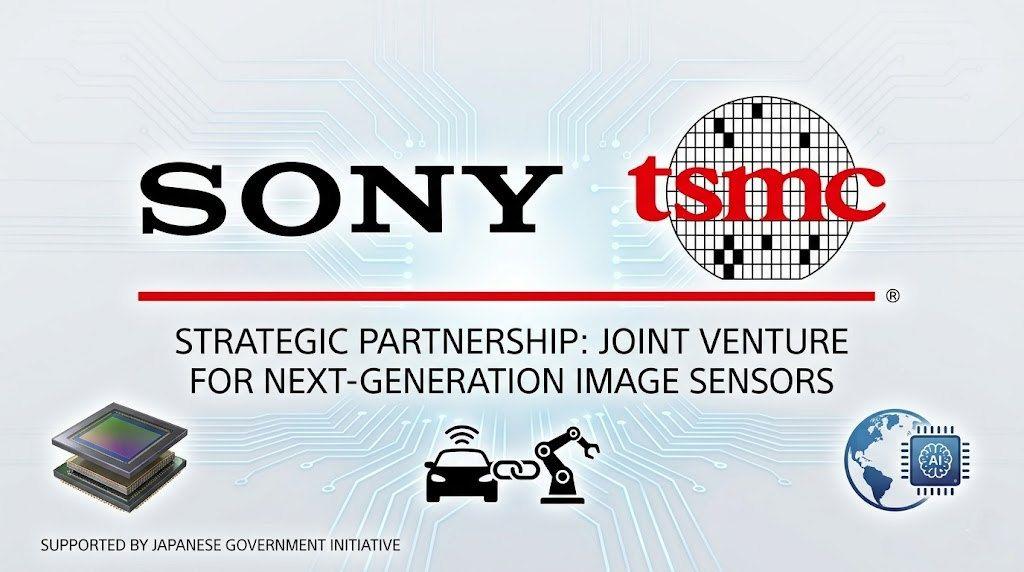
Sony TSMC Joint Venture Marks Strategic Shift in Image Sensor Manufacturing
Sony Semiconductor Solutions and Taiwan Semiconductor Manufacturing Company have signed a non-binding memorandum of understanding to establish a joint venture focused on developing and manufacturing next-generation image sensors
1
. Under the proposed terms, Sony will hold the majority and controlling interest as the majority shareholder, with the venture based at Sony's newly constructed fabrication facility in Koshi City, Kumamoto Prefecture3
. The partnership represents a significant strategic pivot for Sony, as CEO Hiroki Totoki described it as the "first step to becoming fab-light," signaling the company's intention to shift away from handling everything in-house toward a more collaborative manufacturing model2
.
Source: FoneArena
Physical AI Applications Drive Partnership Focus on Automotive and Robotics
The collaboration extends well beyond conventional imaging capabilities, explicitly targeting AI applications in automotive and robotics sectors where high-performance sensing is becoming increasingly critical
1
. These physical AI applications represent emerging opportunities where image sensors serve as core infrastructure for AI perception systems. TSMC Senior Vice President and Deputy Co-COO Dr. Kevin Zhang characterized the deal as "a key step forward in driving future sensing technology in the AI era," highlighting the partnership's commitment to delivering advanced sensing technology and products1
. The strategic focus on robotics and automotive markets positions both companies ahead of a potentially significant demand cycle in the AI hardware sector.Japanese Government Support and Competitive Pressures Shape Deal Structure
Japan's Ministry of Economy, Trade, and Industry has confirmed subsidies of up to ¥60 billion, approximately $380 million, for Sony's Kumamoto image sensor facility
2
. The investments, along with Sony's planned additional capital at its existing Nagasaki plant, will be implemented in phases based on market demand and are contingent on this government support3
. This arrangement continues the broader trend of state-backed semiconductor capacity building across allied nations. The timing proves particularly important as Samsung has been steadily gaining ground in supplying sensors for Apple, intensifying competition in the image sensor market where Sony currently maintains a dominant position, supplying sensors for the latest iPhones and much of the camera industry including Nikon and Fujifilm2
.
Source: ET
Related Stories


Technical Synergy and Manufacturing Expertise Drive Innovation
The partnership aims to combine Sony's established expertise in sensor design with TSMC's advanced manufacturing capabilities and process technology to enhance image sensor performance and meet evolving industry standards
3
. Sony Semiconductor Solutions President and CEO Shinji Sashida expressed that the joint venture "brings together the strengths of both companies" and emphasized Sony's intention to "create new markets through unprecedented ideas and distinctive technologies"1
. TSMC already operates an advanced wafer fab in Kumamoto through another joint venture with Japan Advanced Semiconductor Manufacturing Inc., which entered mass production in late 2024, supplying Sony Semiconductor Solutions and DENSO with chips built on 22/28nm and 12/16nm nodes2
. The new joint venture would push that relationship into more advanced territory. By taking a minority stake in a Sony-controlled venture on Sony's own turf in Japan, TSMC gains a stable long-term anchor customer in image sensors while limiting capital exposure, positioning both companies to capture demand from next-generation AI perception systems as they become standard infrastructure across industries.
Source: DIGITIMES
References
Summarized by

Navi
[1]
[2]
[4]
Related Stories
Recent Highlights
1
Meta Unveils Muse Wonder Frontier AI Models, Claims Performance Matching OpenAI and Anthropic
Technology

2
IMF Report Warns AI Market Correction Could Spark Global Financial Crisis With $1.4T at Risk
Business and Economy

3
OpenAI Releases 722 AI-Generated Math Solutions, Triggering Existential Crisis in Mathematics
Technology

Recent Highlights
Today's Top Stories








Don’t drown in AI news. We cut through the noise - filtering, ranking and summarizing the most important AI news, breakthroughs and research daily. Follow topics that matter to you and stay ahead.


