34 Sources
[1]
South Korea to spend $1T on more memory chip production and humanoid robots
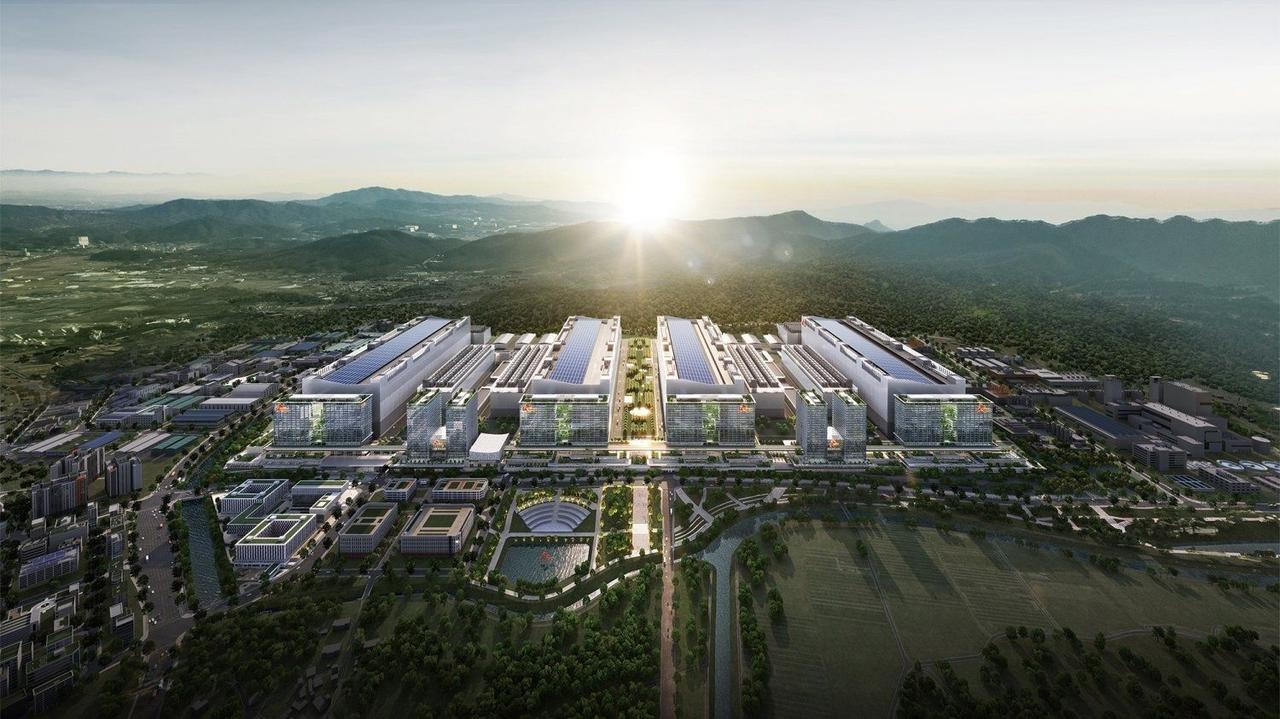
South Korea's government and top tech companies are committing $1 trillion to several flagship megaprojects that could bolster global memory chip supply, build new AI data centers and spur commercial deployment of humanoid robots by 2028. The announcement comes as South Korean companies such as Samsung and SK Hynix have enjoyed record profits and stock valuations due to the AI industry's demand for memory chips -- with the subsequent supply strain leading to memory chip shortages and higher prices for consumer electronics. Meanwhile, Hyundai Motor Company is racing to mass manufacture humanoid robots developed by its subsidiary, Boston Dynamics, so that the robotic workers can start taking over certain laborious tasks in automotive factories and other workplaces. "We must secure the core elements of AI faster than any other country," said South Korean President Lee Jae Myung in a televised speech on June 29, as reported by BBC News and other media outlets. "Semiconductors, physical AI, and AI data centers are the triple axis for a great leap forward." But the initiatives also coincide with public debates about South Korean chipmakers' huge profits during the AI boom and even policymaker proposals to distribute the excess wealth, along with South Korean labor unions pushing back against the prospect of humanoid robots entering the workforce. More memory chips and data centers The most costly of the megaprojects involves Samsung and SK Hynix committing $585 billion to building new chip fabrication plants in the southwest provinces of South Korea, along with boosting semiconductor fab construction in the Seoul capital region, according to Reuters. The government's goal is to double South Korea's production of dynamic random-access memory (DRAM) within five years. However, the new fabs in South Korea's southwestern region may need more time to get up and running, with SK Hynix Chairman Chey Tae-won commenting that it took nine years for the company to build a cluster of chip manufacturing facilities in Yongjin within the Seoul metropolitan area. So it's unclear how soon global consumers can expect relief from sky-high memory chip prices and elevated prices for Apple's Macs and Valve's Steam Machine -- especially if the AI boom continues and tech companies continue to buy up memory for AI data centers. The second flagship megaproject involves a $357 billion investment by the South Korean tech companies SK Group, GS Group, and Naver into building large-scale AI data centers in more outlying provinces, including South Chungcheong Province in the west, Gangwon Province in the east, and the North and South Jeolla Provinces in the southwest corner of South Korea. However, the new semiconductor chip fabs and the AI data centers require substantial electricity and water to operate. South Korea's Ministry of Climate, Energy and Environment said it was working to secure 6.3 gigawatts of electricity and 650,000 tons of water for the southwestern chip plants, along with an additional 8 gigawatts of power to support the new AI data centers, according to The Korea Times. Renewable power and nuclear power plants would help supply the electricity needed for chip fabs and AI data centers, alongside fossil fuels, government officials said. Nuclear power and coal power both accounted for more than 30 percent of South Korea's electricity generation in 2024, but the country's reliance on natural gas for nearly 25 percent of electricity generation has left it vulnerable to supply shortages and surging prices during the ongoing Strait of Hormuz crisis. Physical AI push and resistance to robots The third flagship megaproject revolves around the South Korean government assigning a "national strategic industry" designation to physical AI -- the AI systems that enable robots and self-driving vehicles to interact more autonomously with the real world. The government aims to develop a Korean "general-purpose foundation model" based on a world model to support robots within three years, according to The Chosun Daily. Hyundai Motor Company has also committed $5.8 billion to build a robot manufacturing facility and AI data center in the Saemangeum region of North Jeolla Province in the southwest, The Chosun Daily reported. The South Korean automaker has already been helping Boston Dynamics -- the US robotics company it acquired in 2021 -- use the South Korean supply chain in scaling up manufacturing to produce 30,000 Atlas humanoid robots each year by 2028. Similarly, the South Korean government announced it would aim to commercialize humanoid robots in 10 major industries by 2028, along with training 10,000 human workers as "AI robotics specialists" over the next five years, Reuters reported. However, South Korean workers are not feeling so optimistic about the prospect of competing with more robots. On June 25, Hyundai Motor's labor union overwhelmingly approved a potential strike as it negotiated with the South Korean automaker about profit-sharing and job protections to offset the company's planned deployment of Atlas humanoid robots, according to The Korea Times. A state labor mediation committee also granted the union the legal right to strike after suspending the arbitration process, with Hyundai Motor appealing to the union to return to the negotiating table. Other societal tensions have already arisen around South Korean chipmakers' burgeoning profits from the AI boom. South Korean government officials have encouraged tech companies to share some of their unprecedented profits with their workers and smaller supplier companies. In May, the South Korean presidential chief of staff for policy even offhandedly proposed a "national dividend" for citizens based on excess tax revenue from South Korean's companies' AI-driven profits -- though the government later described that as a personal view rather than an official proposal.
[2]
South Korean tech giants commit over $550B to ease ' RAMageddon'
The world's two largest memory chip companies plan to invest $518 billion (~800 trillion won) to build four new memory fabs in southwestern South Korea, a region that has historically attracted little semiconductor investment. The announcement is part of the country's sweeping national investment plan spanning semiconductors, AI data centers, and physical AI, which was unveiled at a presidential briefing on Monday, with the chairmen of Samsung and SK Hynix in attendance. The plan breaks down into three buckets. In the memory chip bucket is $518 billion for four new memory fabs in the southwest, plus $52 billion for an HBM (high bandwidth memory) packaging hub in the central region. Then there's another $356 billion (550 trillion won) for AI data centers to be built by Korean tech and energy behemoths such as SK, GS and Naver through 2035. All told, South Korean tech companies have committed to spend over $900 billion on AI and the demands for chips it is creating. With this, the nation hopes to catapult itself into becoming more of an AI power player than it already is. Currently, Samsung and SK Hynix (along with U.S. memory chip maker Micron) are all enjoying record demand from what's been called RAMageddon, a worldwide shortage of memory chips caused by the AI buildout. "Semiconductors, physical AI, and AI data centers are the triple axis for South Korea's next industrial era," President Jae Myung Lee said in a televised address Monday, calling 2026 the year South Korea must establish itself as an "irreplaceable" industrial power. Lee said existing chip facilities in Yongin and Pyeongtaek, the heart of South Korea's semiconductor belt just south of Seoul, have "already reached their limits," and urged companies to accelerate investment in the southwest, hoping to spreading the AI wealth beyond the nation's capital. "We must secure overwhelming production capacity in advance," he said. Yet, Lee pushed back against media reports that the government had pressured companies into the investments, reportedly saying the decisions reflected the companies' own judgment. "The government's role is to invest its capabilities so that companies can invest without losses and with better prospects," he was quoted as saying. Samsung separately published a press release Monday, announcing plans to invest 2,655 trillion won (~$1.7 trillion) over the next decade, with 425 trillion won earmarked for the Honam region, the southwestern corner of the Korean peninsula. The company cited expected incentives around power, water, workforce, and living conditions as key factors in selecting Gwangju, roughly 300 kilometers south of Seoul, for a new semiconductor fab, alongside an AI data center in Haenam, at the southern tip of the peninsula. That is not an outlandish sum compared to U.S. tech giants Alphabet, Amazon, Meta, and Microsoft, who will collectively spend $650 billion on AI infrastructure this year alone, according to Reuters. Meanwhile, SK Group announced a 2,100 trillion won (~$1.4 trillion) medium-to-long term investment roadmap, 1,100 trillion won to expand semiconductor production capacity and 1,000 trillion won for AI data centers nationwide. SK Hynix, the group's core semiconductor affiliate, is central to the chip expansion push, while SK Telecom will lead the buildout of 15 gigawatts of AI data center capacity across the country. Whether the ambition translates into execution is another question. Deep tech industries like semiconductors and AI don't move on political or even customer demand timelines. Fabs take years to build and the risk is that, by the time they are ready, the demand that caused them will have ebbed, leaving companies with oversupply and crashing prices. For now, the world's AI chip supply chain, especially those hungry for all things memory, will be watching to see if South Korea can pull it off.
[3]
South Korea's hot new sensation is 3S+1F - a quadrillion-Won AI plan, not a band
The government of South Korea and local tech giants yesterday announced over ₩1 quadrillion of investment related to AI - or about $900 billion - that it says will see the country emerge a "K-Semiconductor powerhouse" and a global leader in robotics and AI. The plan is called "3S+1F", shorthand for Speedily building fabs in regional hubs called "Strongholds", while aiming to Spearhead innovation in new forms of semiconductors that are needed by growing markets - and getting it done with Full support from government and industry. The nation also plans to grow a robotics industry ASAP, to give itself the chance of rivalling China as the world's unchallenged centre for clankers. Planned investments to make that happen include building Physical AI models - to do for movement what LLMs do for text. Underpinning it all will be datacenters with combined capacity of 18.4GW, all to be built by 2035 and made possible by massive investments in clean energy generation and a grid that moves electrons so efficiently it will literally and metaphorically electrify the South Korean economy. President Lee Jae-myung said the plan will see South Korea build the industrial base needed for AI faster than any other country and spread wealth beyond Seoul. He therefore pitched the plan as both social and economic policy. Local tech giants SK Hynix and Samsung are part of the plan, as both committed to spending vast sums on new fabs. LG and Hyundai will also invest. South Korea's announcement of the plan uses the rather Chinese phrase "great leap forward" several times. That's ironic given the Korean scheme is partly intended to ensure the country can compete with China - and to do so with local factories instead of the nation's tech giants investing in the Middle Kingdom. K-Chip Import Slayers, anyone? ®
[4]
Samsung and SK Hynix plan $590bn chipmaking expansion
Companies to invest alongside South Korean government in factories to meet surging demand for memory chips Samsung Electronics and SK Hynix, the world's largest makers of memory chips, and the South Korean government plan to invest $590bn in a vast manufacturing expansion as the AI boom exacerbates chip shortages. The companies and government will invest a combined Won911tn ($590bn) to build chipmaking facilities in under-developed parts of South Korea as part of President Lee Jae Myung's plan to promote more balanced regional economic development. The investment pledges are part of the "Three Mega Projects for the Great Leap Forward" initiative announced on Monday and aimed at developing the country's capabilities in semiconductors, AI data centres and robotics. "The AI revolution is reshaping the global economic and industrial landscape," the government said in a statement. "Our competitors are aggressively building semiconductor fabs to meet rapidly growing demand . . . we must respond swiftly to stay ahead." About Won800tn will be spent on building four chipmaking plants in the country's south-western region, while Won81tn will go towards constructing a chip packaging cluster in its central region. Over the next 15 years, South Korea plans to invest Won30tn to develop next-generation memory chips, on-device AI chips and semiconductors used in defence. South Korea's chipmakers are racing to meet surging demand from the data centres that power chatbots and other AI tools. The world's five largest AI companies are expected to spend more than $1tn in 2025 and 2026 on data centres. Their demand has raised memory chip prices for other customers, including consumer electronics makers. Last week, Apple raised MacBook and iPad prices, citing the "unsustainable" cost of memory and storage. Samsung and SK Hynix now have a combined market capitalisation of roughly $2tn. Together, the two companies account for nearly 80 per cent of the global market for high-bandwidth memory chips, which enable the rapid movement of the massive volumes of data required for AI applications.
[5]
South Korean President to unveil massive AI and chip investment drive
SEOUL, June 29 (Reuters) - South Korea is set to unveil three "mega-projects" to fuel its next growth phase, including a new semiconductor hub in the southwest that local media say could attract investments by Samsung and SK spanning hundreds of billions of dollars over several years. The announcement would mark President Lee Jae Myung's boldest push yet to align South Korea's AI and chip ambitions with his pledge to narrow regional disparities and revive economies beyond the Seoul metropolitan area. Lee will preside over the event, framed as a national "great leap" due to be unveiled around 0500 GMT, his office said, with ministries covering industry, science, climate and transport set to outline policy support. Samsung Electronics (005930.KS), opens new tab and SK are expected to present investment plans, and their chairmen, Jay Y. Lee and Chey Tae-won, are among business leaders tipped to attend by local media. Representatives of other firms including LG Electronics, HD Hyundai Robotics, Korea Electric Power Corp and Korea Water Resources Corp are also attending, Lee's office said. The package will span semiconductors, AI data centres and physical AI including robotics, Lee's office said, while the president's social media posts signalled a new chip cluster planned for the underdeveloped southwest, including Gwangju and South Jeolla province. Local media have reported the planned investments could exceed 1,000 trillion won ($651.41 billion) over coming years. Besides Samsung Electronics, South Korea is also home to SK Hynix (000660.KS), opens new tab, the world's two largest memory chipmakers, whose high-bandwidth memory (HBM) chips are pivotal in the global race to build advanced AI systems. Both companies already operate major semiconductor facilities in and around the Seoul metropolitan area. The government is also set to detail extensive support measures covering power, water, land, infrastructure, workforce training and housing. Lee has defended the proposed southwest chip hub in a series of X posts over the weekend, rejecting criticism that it favours a liberal stronghold. He framed it instead as a "national survival strategy" to ease regional imbalances and expand capacity for the AI era. "The creation of a semiconductor industrial ecosystem in (the southwest) is not a special favour for a particular region," Lee wrote in one post. "It is the additional creation of the most rational semiconductor industrial centre through the decisions of relevant companies under full government support." Industry experts say diversifying chip investment beyond Seoul could ease infrastructure bottlenecks, but warn that building cutting-edge fabs requires vast electricity and water, advanced logistics, deep supplier networks and highly skilled labour - elements that may not scale quickly enough in a new region to meet surging AI demand. Opposition politicians have sharply criticised the plan, questioning whether the proposal is politically motivated given that 85% of voters in the region backed Lee in last year's presidential election. The announcement comes as Lee's approval rating has slid for six weeks to 46.5%, according to pollster Realmeter. ($1 = 1,535.1300 won) Reporting by Joyce Lee Editing by Shri Navaratnam Our Standards: The Thomson Reuters Trust Principles., opens new tab
[6]
South Korea is betting $880 billion that the next AI race will be won in hardware, not software
Serving tech enthusiasts for over 25 years. TechSpot means tech analysis and advice you can trust. Bottom line: South Korea is moving aggressively to build the infrastructure behind artificial intelligence, committing vast sums to chips and data centers as it tries to maintain its position in a rapidly evolving tech economy. The government is coordinating roughly 1,350 trillion won (about $880 billion) in planned investments from major companies including Samsung Electronics and SK Hynix. The focus is not just on expanding capacity but on strengthening the broader AI ecosystem, from high-end memory chips to the data centers that power them. A significant portion of that spending is earmarked for semiconductor manufacturing. Samsung Group and SK Group plan to build two new chip fabrication plants each in the country's southwest, with a combined value of about 800 trillion won. The goal is to rapidly expand capacity as demand accelerates for memory chips that power AI systems, particularly high-bandwidth memory used in intensive computing applications. At the same time, South Korea is scaling up its data infrastructure. Companies, including Naver, are expected to invest about 550 trillion won to develop 8.4 gigawatts of AI data center capacity by 2029. That level of expansion would enable the country to handle large-scale AI workloads domestically rather than relying on overseas providers. President Lee Jae Myung has framed the effort in stark terms, tying it directly to the country's economic future. "We're entering an era where the page turns in the blink of an eye," he said during a briefing, where he also referred to Samsung and SK Hynix leaders as "national heroes." He added, "Speed is the only way to survive." The scale of the investment reflects how central memory technology has become to AI development. South Korea is a leading player in the global memory chip market, but maintaining that position requires continuous reinvestment as technology advances. The total planned spending amounts to roughly 5% of the country's 2024 GDP, based on World Bank data. Samsung alone has said it will spend more than $70 billion in 2026 to expand production and advance research. Over time, that could put the company in the same spending league as US hyperscalers such as Microsoft and China's planned AI investment initiative, which is reportedly valued at about $295 billion. Industry leaders say the timeline is tight. "It's a race against time," Samsung Electronics Executive Chairman Jay Y. Lee said at the briefing. The company is accelerating construction of fabs in the Seoul metropolitan area while also developing new regional hubs. Gwangju is being developed as a center for memory manufacturing, while Cheonan and Onyang will focus on high-bandwidth memory packaging, a critical step in improving chip performance for AI applications. Samsung is also planning to introduce humanoid robots into its fabrication facilities in Gumi as part of a broader push to automate chip production. The geographic distribution of these investments is deliberate. The government is trying to shift more high-value industry beyond Seoul, using AI infrastructure to stimulate regional economies and create higher-paying jobs. President Lee used a post on X to highlight what he sees as the need for a broad, collective effort to address regional imbalances. He described it as a shared national mission, calling on the public to cooperate and contribute ideas to reduce the concentration of economic activity in the capital region and promote more balanced growth nationwide. At its core, the strategy is a bet that the next phase of AI will be defined as much by access to hardware as by software. By investing simultaneously in chip manufacturing, packaging, and data centers, South Korea is seeking to establish a foothold across the entire AI infrastructure stack that underpins modern AI systems.
[7]
South Korea unveils $1tn chip and AI investment plan
South Korea has unveiled plans for about $1tn (£760bn) of investments to build out the country's chip manufacturing and artificial intelligence (AI) capabilities in the coming years. It is part of the country's so-called Three Mega Projects to develop new chip production hubs, data centres and robotics technology. The plan is aimed at rejuvenating the economies of areas outside the capital Seoul, President Lee Jae-myung said on Monday. It comes as regional rivals like Taiwan, China and Japan are investing heavily in chip factories and other technologies as the AI boom pushes up demand for semiconductors. "We must secure the core elements of AI faster than any other country," Lee said. "Semiconductors, physical AI, and AI data centres are the triple axis for a great leap forward." Lee announced the plans in a televised event alongside the leaders of Samsung and SK Hynix, the country's two largest chipmakers. The companies are expected to build a semiconductor manufacturing hub in the south west of the country. Lee also announced plans to build other AI infrastructure hubs outside of Seoul, where most of the country's advanced factories are currently concentrated. Earlier, Lee said in a statement that the project was a matter of "survival" for the country to address the decline in rural areas due to the concentration of industries in Seoul. "Now, we must break this long-standing cycle of discrimination and marginalisation - not only for the sake of justice and equity, but also to ensure sustainable and inclusive growth," he wrote. Samsung and SK Group, which count the likes of AI chip giant Nvidia among their customers, have been some of the biggest beneficiaries of the surge in spending on AI infrastructure. US tech giants - including Google, Amazon and Meta - said they will spend $650bn into the technology this year. SK Hynix's stock market valuation topped $1tn in May, driven by the boom in AI data centres. The surge in demand for chips to power AI has led to a global shortage of semiconductors, sending prices higher. Last week, Apple and Microsoft raised the prices of some of their devices, due to higher costs of components. But some investors have raised concerns about the huge amounts of money being poured into AI, which has triggered some shares to slide in recent days.
[8]
South Korea AI investment: $880bn for chips and robots
South Korea has unveiled its biggest tech bet yet: at least $880bn over a decade for chips, AI data centres and robots, with Samsung and SK Hynix building four new memory fabs. South Korea has placed its biggest bet yet on the AI era. The plan commits at least $880bn over a decade to chips, data centres and robots. It is the boldest South Korea AI investment to date, and the government says speed is now the only way to survive. President Lee Jae Myung unveiled the package on Monday in Seoul, flanked by the heads of Samsung and SK Hynix. He called the two business leaders "national heroes" and framed the spending as a matter of survival. Bloomberg put the total at 1,350 trillion won, or about $880bn. Lee branded the effort the "Three Mega Projects". The three pillars are semiconductors, AI data centres and physical AI. He called them the "triple axis for a great leap forward". "Speed is the only way to survive," he said. Four new chip fabs Samsung and SK Hynix will spend 800 trillion won, around $518bn, on memory chips. Each firm will build two fabs in the south-west, Yonhap reported. The Gwangju and Jeolla area becomes the country's second chip cluster, alongside the Seoul hub. It is the first real break from the capital region in years. Industry Minister Kim Jung-kwan said the old model had run out of room. "Relying on a single production base in the Seoul metropolitan area is no longer sufficient," he said, citing limits on power and water. The government will pull the new fabs forward by up to 12 years, from the late 2040s to the mid-2030s. It will fast-track permits and build out power and water supply. Seoul wants more than new ground, though. It also aims to double memory output near the capital within five years, and add 30 trillion won over 15 years for the whole chip value chain. Samsung will base its advanced packaging in the central region, where it makes the high-bandwidth memory that AI servers depend on. The map splits the work by region. The Chungcheong region becomes a packaging hub, with 81 trillion won for advanced lines. Daegu and North Gyeongsang will focus on materials, parts and equipment. Lee framed the spread as a way to end years of growth clustered around Seoul. A bigger grid for AI The second pillar targets compute. SK Group, GS Group and internet leader Naver will invest 550 trillion won in AI data centres. They aim to build 8.4 gigawatts by 2029, then add 10 more by 2035. Science Minister Bae Kyung-hoon called the next three years the "golden time" to lead physical AI, and said Seoul would name it a national strategic industry. Once the grid is ready, the science ministry wants to build a general-purpose "world model" for physical AI, a system that grasps how the real world behaves. SK chairman Chey Tae-won went further on his own books. He pledged 1,000 trillion won for data centres and 1,100 trillion won for chips through 2035, roughly 2,100 trillion won from a single group. He gave no firm timeline. Robots as the third pillar The third pillar is the robots themselves. South Korea wants to lift its share of the global humanoid market from 1% last year to 20% over time. Kim warned that China already mass-produces humanoids through regional hubs. "We must accelerate the foundation for mass production," Kim said. To seed demand, the government will buy humanoids for education, defence and disaster response. Samsung will site its own robot work, including humanoids and in-house data centres, in Gumi. Why Seoul is moving now The timing is no accident. An AI-driven boom in memory demand has reshaped the maths for both chipmakers. Orders are rising so fast that capacity once planned for the 2040s may now arrive a decade early. That same crunch is hitting shoppers. A global memory shortage has driven up component costs, and last week Apple and Microsoft raised prices on some devices. Chey has warned the squeeze could last several more years. There is a domestic angle too. Lee wants to steer investment away from Seoul and into poorer regions. He cast the plan as a fix for decades of imbalance, not just an industrial bet. The country has gained hugely from AI, yet the spoils have not spread evenly, and his approval rating has slipped. The risk in the numbers The sums are staggering. At about $880bn, the plan equals roughly 5% of South Korea's 2024 economic output. It dwarfs a $450bn chip blueprint from 2021 and a $400bn package from 2023. It also echoes earlier reporting on a second chip cluster, now confirmed at full scale. Markets were wary. The Kospi index pared steep losses after the news, but Samsung shares still fell nearly 5%, and SK Hynix slipped further. Analysts flagged the danger of future oversupply if memory demand cools. The wider race is fierce. The plan lands as the US pours money through its CHIPS Act and China drafts a $295bn AI buildout. Japan keeps lifting chip subsidies. Samsung's Jay Y. Lee, whose $647bn pledge trailed the wider package, called it "a race against time". One catch remains. Money alone does not build leading fabs, as one KAIST professor noted: the plan still needs power, water, talent and execution. The cash also follows a year in which SK Hynix overtook Samsung as Korea's most valuable firm. Seoul is betting that scale, and speed, will keep it ahead.
[9]
South Korea's government discussing major new chip investments with Samsung, SK Hynix
SEOUL, June 24 (Reuters) - South Korea's government is in talks with Samsung Electronics (005930.KS), opens new tab and SK Hynix (000660.KS), opens new tab over plans for the next phase of large-scale investments in semiconductor production facilities, an official said on Wednesday, adding an announcement on a new chip cluster would be made soon. "Exponential and explosive" growth in demand for chips driven by the AI industry could require the two companies to speed up ongoing construction of new chip facilities by more than 10 years to 2034-2035, presidential policy adviser Kim Yong-beom told a discussion panel. "The question is how we will support the AI revolution. Looking ahead to the next stage after seven or eight years, we are faced with the challenge of finding a massive new site for a second cluster," Kim said. Reporting by Jack Kim and Hyunjoo Jin Editing by Ed Davies Our Standards: The Thomson Reuters Trust Principles., opens new tab
[10]
South Korea is in talks with Samsung and SK Hynix over a second chip cluster
A presidential adviser says AI demand could pull forward the next phase of fab construction by more than a decade, and that the country needs somewhere to put it. South Korea's government is in talks with Samsung Electronics and SK Hynix about the next phase of large-scale investment in chip manufacturing, a presidential adviser said on Wednesday, adding that an announcement on a new chip cluster would follow soon. The remarks, from presidential policy adviser Kim Yong-beom, framed the conversation less as a negotiation than as a logistics problem the country has not yet solved. The pressure, Kim told a discussion panel, comes from demand. "Exponential and explosive" growth in orders driven by the AI industry could require the two companies to speed up construction of new facilities by more than 10 years, bringing forward to 2034 or 2035 capacity that had been planned for later. The schedule is being rewritten by how fast the chips are selling. That creates a question Kim was candid about. "Looking ahead to the next stage after seven or eight years, we are faced with the challenge of finding a massive new site for a second cluster," he said. The first cluster, the dense concentration of fabrication plants south of Seoul, is the spine of Korean memory production. A second one of comparable scale needs land, power, and water on a scale that does not assemble itself quickly. Beyond the timeline and the search for a site, the specifics remain thin. Kim did not attach a won or dollar figure to the discussions, and the talks were described as ongoing rather than concluded. Korean outlets have reported that Samsung and SK Hynix are weighing major investments in the country's south-western region, with figures potentially running into the hundreds of trillions of won, though those reports go further than the presidential office has confirmed and should be read as expectation rather than commitment. The political backdrop is President Lee Jae-myung's emphasis on balanced regional development, which has made the location of new industrial investment a matter of national policy rather than corporate preference. Steering a second chip cluster toward a region outside the existing Seoul-area corridor would serve that goal, which is part of why the government is in the room at all. The numbers underneath the conversation explain its urgency. Korea is on course for double-digit nominal growth for the first time in more than two decades, a pace driven almost entirely by the soaring profits of its chipmakers. The boom is narrow, concentrated in two companies, and the same officials now discussing where to build the next fabs have spent recent weeks worrying aloud about where the proceeds end up. Kim himself warned this month that the chip windfall risks pooling in real estate rather than wages or productive investment, and floated a "normalisation of property taxation" in response. The distributional question has already turned combustible once. Samsung's largest union came within days of an extended walkout this year before a government-mediated pay deal, and the wider debate over who captures the AI windfall has become, in Seoul's framing, a matter of national policy. The same chip surge that is pulling forward fab construction is pulling forward those arguments too. For the companies, the appeal of building with the state alongside them is straightforward. New fabs are among the most capital-intensive projects in industry, and government support on land, permitting, and infrastructure shortens the runway. Demand for the high-bandwidth memory that feeds AI accelerators has lifted both firms, with SK Hynix riding the HBM cycle hardest, and neither will want to be short of capacity when the next wave of orders lands. What was announced on Wednesday, in the end, was that an announcement is coming. The shape of the second cluster, its location, its cost, and how the bill is split between the companies and the state, are the things still to be settled. For now, Seoul has confirmed the talks are happening and the clock is running faster than the plans were drawn for.
[11]
South Korea to invest nearly $1.2 tn in chips, AI data centres
Seoul (AFP) - South Korea will invest nearly $1.2 trillion -- equivalent to more than two-thirds of its GDP -- in a new chip-building hub and AI data centres over several years, as it seeks to profit from soaring demand while developing previously neglected regions. The enormous cash injection comes as Asia's fourth-largest economy rides high on a global AI boom -- with South Korean memory chipmakers emerging as a crucial cog in the fast-moving industry. "Speed is the only path to survival. We must secure the core elements of artificial intelligence faster than any other nation," President Lee Jae Myung said in Seoul at an event to unveil the public-private collaboration. Samsung Electronics and SK hynix will make a record investment of 800 trillion won (around $520 billion) in a new semiconductor fabrication hub in the country's southwest, the government said. Both companies have seen profits and share prices skyrocket in recent months, as frenzied demand for AI infrastructure squeezes the global supply of memory chips. The government also announced a separate investment of a quadrillion won (around $650 billion) in AI data centres over the next 10 years. The plans are in line with Lee's agenda for industrial development in regions outside the capital, and Industry Minister Kim Jung-kwan said the Samsung-SK hynix project will comprise four fabrication plants. "We will develop the southwestern region into a second semiconductor production hub," he said. Samsung Electronics and SK hynix will each build two plants under the 800 trillion won project, according to Kim's presentation slide. Capacity expansion "Permit approvals and construction timelines will be dramatically shortened to rapidly expand production capacity," Kim said. "Through this, we will maintain an overwhelming market leadership and a decisive technological gap in the memory semiconductor sector." Science Minister Bae Kyung-hoon announced that the country will invest 550 trillion won on AI data centres by 2029. "By 2035, an additional 10-gigawatt AI data centre will be built, with a total investment exceeding 18.4 gigawatts and 1,000 trillion won." The new investment is by far South Korea's largest. The southwestern region of Honam -- a traditional liberal stronghold encompassing Gwangju and the Jeolla provinces -- has long lagged behind the more industrialised southeast. This disparity dates back to rapid economic development under former president Park Chung-hee in the 1960s and 70s. But without incentives for companies to voluntarily relocate, the massive investment could backfire, warned Kim Dae-jong, a professor of Business Administration at Sejong University. This could, in turn, hurt the nation's semiconductor competitiveness. "It is essential to minimise the financial burden, amounting to hundreds of trillions of won, as well as the time-related risks faced by companies," said Kim. Renewables Analysts say there are abundant renewable electricity resources in the southwest, making it possible for companies to meet their commitments to boosting green energy use. But they caution that building an entirely new semiconductor manufacturing ecosystem away from the existing industrial base around Seoul would require significant time and investment. "Establishing production lines from scratch could take more than five years," Lee Jong-hwan, a semiconductor engineering professor at Sangmyung University, told AFP. "The biggest challenge is that most skilled workers and suppliers remain concentrated around the Seoul metropolitan area." Concerns were also raised about heavy demand for water. President Lee wrote on X on Saturday that "assessments indicate it is possible to supply one million tons of industrial water per day" in the region. The announcement comes as South Korea debates how the enormous profits generated by the global AI-driven semiconductor boom should be shared more broadly across society. Kim Yong-beom, the president's chief policy secretary, in May suggested using excess AI-related tax revenue to fund startup support for young people, basic income programmes for rural and fishing communities, and assistance for artists. The boom has also fuelled worker demands over pay packages, with Samsung averting a major strike in May by agreeing a deal on bonuses with its largest union.
[12]
South Korea's president declares that it will invest over $580 billion in its AI chip industry, with Samsung and SK hynix coughing up most of the money
That's great and all that jazz, but can I have affordable DDR5 and SSDs again, please? When it comes to making bank off the currently insatiable demand for AI hardware, the companies with the biggest, ear-to-ear grins are those that make the processors, memory, and storage chips for such systems. In the case of the latter two, it's been so highly profitable that they have collectively agreed to substantially fund a drive by South Korea's government to "secure the core elements of AI faster than any other country." A report by Reuters has all the pertinent details, but the gist of it all is this: President Lee Jae Myung declared that around 900 trillion won ($583 billion) would be invested in new chip-making facilities, earmarked for sites in the southwest region of South Korea. According to industry minister Kim Jung-kwan, 800 trillion won would come from Samsung and SK hynix. These two companies hold around two-thirds of the global DRAM market share, and along with the US-based Micron, they're the only companies that produce HBM (high bandwidth memory) modules for Nvidia's AI processors. By any measure, $583 billion is a vast sum of money to stump up for AI chips, even if it's spread out over a decade or so (exact timelines for the investment weren't stated in the president's declaration), and it makes Taiwan's $250 billion promise look relatively small in comparison. It's worth noting that South Korea's 2025 GDP is estimated to be in the order of $1.8 trillion, so you're looking at a commitment that's around one-third that amount. It's not just for new chip foundries, of course, as Samsung and SK hynix will need to buy land and secure sufficient energy and water supplies, as well as human resources to build and operate it all. But one question remains unanswered, possibly because there is no answer for it right now. What happens if the demand for AI hardware suddenly collapses? While there's no doubt that the AI boom has been highly profitable on the hardware side of things, it's a different story for those who are using it to power their AI services, and even less so when one heads to the AI frontlines. There's an element of risk with any investment, but with AI, not only is the scale of the funding greater than anything seen before in the world of tech, its future is also very hard to predict with any degree of certainty. At the moment, many companies around the world are implementing AI into workflows, partly because of the potential productivity gains, but mostly because it's affordable. Unless the processing of tokens can be made substantially cheaper, sooner or later, companies such as OpenAI and Anthropic will have to increase their usage fees to balance their bank accounts. After all, Nvidia, Microsoft, Meta, et al. only have so much capital that they can fling at such AI model makers, and no business can maintain profit losses indefinitely. If the demand for AI hardware remains high over the next ten to 15 years (the minimum amount of time it will take Samsung and SK hynix's new facilities to come online and hit production targets), then South Korea's investment will likely secure it as the country that holds most of the cards in the AI profit wars. Should the alternate scenario transpire, then the consequences for the global economy could be severe. Nobody wants that to happen, but at the same time, the tech industry as a whole can ill afford to weather the global memory crisis for ten years. South Korea's massive investment plan is good news for somebody -- it's just not certain who exactly that is.
[13]
South Korea launches $584B chip manufacturing initiative with Samsung, SK hynix
South Korea launches $584B chip manufacturing initiative with Samsung, SK hynix The South Korean government today announced a 900 trillion won, or $584 billion, initiative to grow the country's chip manufacturing capacity. Officials also plan to build about $357 billion worth of artificial intelligence data centers. The chip manufacturing initiative will be led by Samsung Electronics Co. and SK hynix Inc., which intend to open two new fabs apiece. Most of South Korea's semiconductor production infrastructure is located near Seoul. By contrast, the new Samsung and SK hynix facilities are set to be built in South Korea's southwestern region. Samsung executives indicated that the company will likely construct its fabs in the southwestern city of Gwangju, which is about a four-hour drive from Seoul. SK hynix, for its part, is still in the process of finding a fab suite. Chey Tae-won, the company's chair, stated today that building its current flagship manufacturing campus took nine years. A sizable percentage of the upcoming fabs' capacity will likely be dedicated to RAM production. Samsung and SK hynix are the world's two largest memory manufacturers. The former company leads in the DRAM and flash segments, while SK hynix accounts for more than half of global HBM production. HBM is a high-speed memory variety that is widely used in AI chips. The upcoming fabs will likely use a mix of new and legacy nodes. The reason is that RAM cells, the basic building blocks of a memory chip, contain tiny energy storage devices called capacitors. Memory-grade capacitors can only be made using legacy nodes because shrinking them below 10 nanometers causes technical issues. An HBM chip contains not only memory cells but also a logic die, a component that helps coordinate the flow of data. It also performs certain related tasks including errors correction. Unlike capacitors, the logic die is usually produced using cutting-edge processes. SK hynix focuses exclusively on memory production, while Samsung also has a processor manufacturing business. The company debuted its first two-nanometer processor, the Exynos 2600, in December. It's a mobile system-on-chip that includes a central processing unit, an AI accelerator and a post-quantum cryptography module. Samsung and SK hynix are committing 800 trillion to South Korea's chip manufacturing effort. The city of Gwangju, where the former company plans to build its fabs, and South Jeolla Province will contribute up to 20 trillion won. Furthermore, industry players plan to spend 81 trillion won on upgrading the chip packaging infrastructure in central South Korea. Separately, government officials announced plans to invest more than 1,000 trillion won in AI data centers by 2035. The goal is to add 18.4 gigawatts of computing capacity. The initiative is set to include the participation of SK Group, SK hynix's parent company.
[14]
Samsung and SK Hynix announce a joint $518 billion investment in artificial intelligence
The tech giants are partnering on a chipmaking hub in South Korea's southwest region. South Korean tech giants Samsung Electronics and SK Hynix said Monday they will invest a combined 800 trillion won ($518 billion) in building a new computer chipmaking hub in the country's southwest region, capitalizing on surging artificial intelligence-driven demand. President Lee Jae Myung joined the companies' chairs Monday in announcing the plan, which dovetails with the government's efforts to expand investment beyond the greater Seoul metropolitan area, the country's economic center and heart of its semiconductor sector. The southwest has been a particular focus, as it lacks major industrial hubs and has historically trailed in economic development. The region has long been a political base for Lee's liberal Democratic Party. Samsung and SK Hynix, which together produce about two-thirds of the world's memory chips, said they will each build two fabrication plants in the southwest, expanding beyond their existing manufacturing complexes in Gyeonggi Province, south of Seoul. Samsung Chairman Lee Jae-yong said the company's new fabs will be built in the southwestern city of Gwangju, where experts have proposed several potential sites, including the grounds of a military air base slated for relocation. The companies didn't specify when the fabs in the southwest regions would be completed. SK Hynix's Chairman Chey Tae-won said the project would be a complex, large-scale effort requiring "vast sites, along with sufficient power, water and skilled workers." He said it took nine years for SK Hynix to establish its major manufacturing cluster in Gyeonggi Province. Still, a significant expansion of manufacturing facilities is needed for the company to keep up with global demand, Chey said. Government officials dismissed questions about whether the southwest has enough power and water to support major semiconductor fabs. They said the region's strength in renewable energy would give the chipmakers an edge as they face growing global pressure to use cleaner sources of electricity. Samsung and SK Hynix have reported record profits in recent months as soaring global investment in data centers and other AI infrastructure has fueled demand for memory chips. Government officials and business experts expect AI-driven demand to continue increasing as the technology spreads to AI-powered industrial robots and autonomous vehicles. The chipmakers' existing semiconductor complexes in Gyeonggi Province may reach capacity sooner than expected, they say. During Monday's event, government officials outlined plans to build what they called a nationwide semiconductor ecosystem, with existing manufacturing hubs in the southeast expanding production of chip components and materials, the central Chungcheong region specializing in chip packaging, while data centers are built across the country. "We must establish the core building blocks of artificial intelligence faster than any other country. Semiconductors, physical AI and AI data centers are the three pillars of our next great leap forward," the president said.
[15]
South Korea is investing $520 billion in Samsung and SK Hynix to build more HBM fabs for AI
As home to two of the world's largest memory makers, Samsung and SK Hynix, the South Korean economy is definitely benefiting from the current memory crisis, which has seen prices and profits hit unforeseen levels. Long story short, in the AI era of LLMs, agents, inference, and cloud-based computing, the demand for high-bandwidth memory (HBM) chips has reached a point where supply would take years to catch up. And with that, South Korean President Lee Jae Myung has announced a $520 billion USD public and private investment to expand the chipmaking capabilities of Samsung and SK Hynix so the country can remain a leader in the AI race and the memory market. And the announcement was made in a televised address with Samsung Electronics Chairman Lee Jae-yong and SK Group Chairman Chey Tae-won. According to the announcement, the majority of the $520 billion will be put toward the construction of four new fabs, two for Samsung and two for SK Hynix. The two plants will reportedly be built outside Seoul, in a mostly rural area. They will focus on producing lucrative HBM for the AI and data center markets rather than memory for the consumer technology market. "We will focus our investment on HBM fabs," Samsung Chairman Lee Jae-yong confirms. The inclusion of the South Korean government means these new facilities can be constructed on a much faster timeline, with the expectation that approvals, subsidies, and permits will be available more quickly. And with that, the expedited timeline would have these new fabs go online in the mid-2030s rather than the 2040s. According to the announcement, the new government investment will also accelerate the construction of existing Samsung and SK Hynix projects.
[16]
'One-time opportunity': South Korea bets big on AI boom
Seoul (AFP) - Huge demand for the components that power artificial intelligence presents South Korea with an opportunity to bolster its chip industry against rivals such as China, analysts say. Seoul announced Monday massive investments, including for new semiconductor factories and AI data centres, led by South Korean chipmakers. AFP looks at what has driven South Korea's AI boom, and where it could be heading: Sky-high profits Three companies dominate the global market for producing advanced memory chips that help power AI systems: US giant Micron, and South Korea's Samsung Electronics and SK hynix. Their profits and share prices have soared to dizzying heights, as governments and tech companies plough hundreds of billions of dollars into training and running AI tools. "AI has not only provided big demand, it has also created shortages, and that has driven price escalation," Jim Handy, semiconductor expert at Objective Analysis, told AFP. Spiralling prices for memory and storage chips are being passed on to consumers -- with Apple this month hiking the cost of MacBooks and iPads. The boom has also fuelled worker demands over pay packages, with Samsung averting a major strike in May by agreeing a deal on bonuses with its largest union. Chinese competition South Korea has pledged to triple spending on AI this year, aiming to join the United States and China as one of the world's top AI powers. With China in particular racing to develop its tech industry, Seoul sees the boom period as a "one-time opportunity" to close the gap, said Lian Jye Su, a chief analyst at Omdia. "Its the perfect time" for South Korea to leverage its strategic advantage and make investments as "the AI boom might die down" and demand could regress, he told AFP. The Financial Times reported Saturday that Apple is seeking to buy memory chips from Chinese manufacturer CXMT -- a company poised to benefit from shortages, along with Taiwanese rivals. AFP has approached Apple and CXMT for comment. Although Chinese firms benefit from lower labour costs and big domestic demand, there could be limits to the country's tech growth, Su said. "People are less keen to... (become) overly reliant" on Chinese silicon, a factor that Korean vendors like Samsung now want to "double down on". Innovation imperative Established Asian chipmakers can capitalise on the AI boom, partly because they remain innovative, Handy said. "This gives them profitability that helps to produce a moat between them and smaller firms" who cannot maintain the same level of spending and research investment, he said. With Monday's announcements, South Korean chipmakers want to use their current abundant cash to help diversify their offerings, Su added. That can help them avoid becoming too dependent on the current hot sector -- memory chips -- in what economists call a "Dutch disease", referring to the negative effect of a temporary upswing in the price of one commodity. Boom or bubble? The head-spinning speed of growth in the sector -- Samsung's share price has risen more than 430 percent over the past year, with SK hynix's up 770 percent -- has raised concern over how long the AI boom can last. Some analysts such as Su are optimistic that demand will stay buoyant, given the deepening integration of AI tools into business operations. For memory chips, "there's little to stop price rises until they impact end markets," Handy said. "If prices rise too high then markets move to another technology or disappear altogether," he explained.
[17]
South Korean Tech Giants to Build a $518 Billion Chipmaking Hub to Serve Soaring AI Demand
SEOUL, South Korea (AP) -- South Korean tech giants Samsung Electronics and SK Hynix said Monday they will invest a combined 800 trillion won ($518 billion) in building a new computer chipmaking hub in the country's southwest region, capitalizing on surging artificial intelligence -driven demand. President Lee Jae Myung joined the companies' chairs Monday in announcing the plan, which dovetails with the government's efforts to expand investment beyond the greater Seoul metropolitan area, the country's economic center and heart of its semiconductor sector. The southwest has been a particular focus, as it lacks major industrial hubs and has historically trailed in economic development. The region has long been a political base for Lee's liberal Democratic Party. Samsung and SK Hynix, which together produce about two-thirds of the world's memory chips, said they will each build two fabrication plants in the southwest, expanding beyond their existing manufacturing complexes in Gyeonggi Province, south of Seoul. Samsung Chairman Lee Jae-yong said the company's new fabs will be built in the southwestern city of Gwangju, where experts have proposed several potential sites, including the grounds of a military air base slated for relocation. The companies didn't specify when the fabs in the southwest regions would be completed. SK Hynix's Chairman Chey Tae-won said the project would be a complex, large-scale effort requiring "vast sites, along with sufficient power, water and skilled workers." He said it took nine years for SK Hynix to establish its major manufacturing cluster in Gyeonggi Province. Still, a significant expansion of manufacturing facilities is needed for the company to keep up with global demand, Chey said. Government officials dismissed questions about whether the southwest has enough power and water to support major semiconductor fabs. They said the region's strength in renewable energy would give the chipmakers an edge as they face growing global pressure to use cleaner sources of electricity. Samsung and SK Hynix have reported record profits in recent months as soaring global investment in data centers and other AI infrastructure has fueled demand for memory chips. Government officials and business experts expect AI-driven demand to continue increasing as the technology spreads to AI-powered industrial robots and autonomous vehicles. The chipmakers' existing semiconductor complexes in Gyeonggi Province may reach capacity sooner than expected, they say. During Monday's event, government officials outlined plans to build what they called a nationwide semiconductor ecosystem, with existing manufacturing hubs in the southeast expanding production of chip components and materials, the central Chungcheong region specializing in chip packaging, while data centers are built across the country. "We must establish the core building blocks of artificial intelligence faster than any other country. Semiconductors, physical AI and AI data centers are the three pillars of our next great leap forward," the president said.
[18]
Global Market: Samsung, SK Hynix double down on AI chip boom with massive investment push despite oversupply risks
South Korean chip giants Samsung and SK Hynix are investing trillions to boost memory chip production, fueled by soaring AI demand. This ambitious expansion, backed by the government, aims to solidify South Korea's global semiconductor leadership. While current shortages drive optimism, experts warn of potential oversupply if AI spending falters, echoing past industry cycles. The companies, however, signal flexibility in their long-term plans. Samsung Electronics and SK Hynix are embarking on one of the world's largest semiconductor investment drives, committing trillions of won to expand memory chip production as they seek to capitalise on surging artificial intelligence (AI) demand. However, industry experts caution that the aggressive capacity expansion could expose the sector to oversupply risks if AI-related spending slows in the coming years, as per a report by Reuters. The investment plans received strong backing from South Korean President Lee Jae Myung, who praised the country's leading chipmakers for supporting the government's ambition to strengthen South Korea's position in the global semiconductor industry. According to Reuters, the government aims to double the nation's memory chip production capacity over the next five years by accelerating approvals and construction timelines for new fabrication plants. US MarketsPowered By As on 01 Jul 2026, 01:30 AM IST S&P 500 Top Gainers Axon Enterprise560.61(9.79%) KLA301.71(8.38%) Air Products293.18(8.04%) Advanced Micro Devices580.91(7.68%) Gainers" S&P 500 Top Losers Coterra Energy32.56(-8.62%) Digital Realty Trust179.58(-5.77%) Hormel Foods24.82(-5.66%) Zimmer Biomet Holdings86.09(-5.64%) Losers" Samsung and SK Hynix have pledged a combined investment of around 3,200 trillion won ($2.07 trillion), covering a new semiconductor cluster in the country's southwest along with previously announced projects. The companies also plan to fast-track construction at the existing Yongin semiconductor cluster, reducing development timelines that typically span seven to twelve years. South Korea has emerged as one of the biggest beneficiaries of the AI investment wave, largely due to Samsung and SK Hynix's dominance in high-bandwidth memory (HBM) chips, a critical component used in advanced AI processors. Investor optimism surrounding the AI boom has also driven sharp gains in the companies' shares this year. The expansion comes amid robust demand from AI hyperscalers and technology companies seeking additional memory chips, resulting in a global supply shortage. However, analysts note that semiconductor fabrication plants require years to become operational, meaning much of the additional capacity is unlikely to come online until the next decade. Market observers have warned that memory chip prices remain highly sensitive to the balance between demand and supply. While current shortages continue to support prices, a slowdown in AI infrastructure spending could leave manufacturers with excess production capacity. Some industry experts also believe the scale and speed of the investments raise concerns. According to Reuters, analysts and academics argue that long-term demand remains uncertain, making capital allocation decisions particularly challenging despite today's favourable market conditions. The aggressive investment strategy marks a notable shift from the cautious approach both companies adopted after previous industry downturns. The memory chip business has historically experienced sharp boom-and-bust cycles, with falling prices contributing to significant financial losses for both Samsung and SK Hynix during earlier market slumps, as per a Reuters report. Recent profitability has been driven by the AI boom and a sharp rise in memory chip prices following supply shortages. Encouraged by the government's semiconductor strategy and growing global demand, both companies have now opted to accelerate capacity expansion. Nevertheless, analysts believe the manufacturers are unlikely to repeat mistakes from previous cycles. Samsung has indicated its long-term investment plans remain flexible and could be adjusted depending on market conditions, while SK Hynix has also suggested future spending will be guided by demand trends. South Korea's government has pledged to expedite regulatory approvals and infrastructure development to complete the country's new semiconductor cluster before President Lee's term ends in 2030, viewing the project as central to its ambition of becoming one of the world's leading AI and semiconductor powers.
[19]
Samsung and SK Hynix's mega South Korea chips gamble tests optimism of AI cycle
Seoul - Samsung Electronics and SK Hynix are making one of the biggest bets yet on the artificial intelligence boom with investments worth hundreds of billions of dollars, but the planned capacity buildout is stoking fears of a painful reckoning if AI spending cools. The tech giants won praise -- and a deep bow -- from President Lee Jae Myung after throwing their weight behind the government's semiconductor push, in an apparent departure from a previously restrained approach to capacity expansion shaped by decades of painful boom-and-bust cycles in the memory industry. Under the plan, the government hopes South Korea can double its memory chip production capacity within five years. Samsung and SK Hynix will also accelerate construction of fabs in the existing Yongin semiconductor cluster, shortening the 7-12 year timelines and bringing additional capacity online sooner. Together, the world's two biggest memory chipmakers pledged 3,200 trillion won ($2.07 trillion) of investment, encompassing a new 800 trillion won chip cluster in the country's southwest as well as previously announced projects. South Korea is emerging as a major winner from the surge in global AI investment, driven by Samsung Electronics and SK Hynix's commanding position in high-bandwidth memory (HBM) chips essential to advanced AI processors. Shares of SK Hynix and Samsung Electronics have gone up 307% and 179%, respectively, so far this year. The announcement comes as customers ranging from AI hyperscalers to electronics makers such as Apple press for more memory chips amid a global shortage. But analysts note that chip plants take years to build and ramp up, meaning much of the new capacity will not arrive until well into the next decade. "We see memory pricing remaining a function of demand and supply, and accelerating capex over the next decade further increases the risk of an oversupply longer term," said Morningstar analyst Jing Jie Yu. The memory chip boom remains reliant on whether AI hyperscalers would keep expanding at the current rate, he added. Lee Jong-ho, a professor at Seoul National University's Department of Electrical and Computer Engineering, said the investments appeared to have been pushed through too quickly. "It is the kind of investment that could determine a company's future," he said. "No one knows what the situation will look like three years from now. We need to respond quickly while demand is strong, but after that, demand is uncertain and decisions should be made cautiously." The soaring profitability of Samsung and SK Hynix's memory businesses is a relatively recent phenomenon, driven by the global AI boom and an acute memory-chip shortage that has nearly doubled chip prices in the first quarter alone. Past downturns in chip prices have badly hit the companies, causing SK Hynix to flirt with bankruptcy in 2001 and driving both firms to post big losses in 2023. But in recent months, as the AI wave swelled, ruling party lawmakers and government officials began floating the idea of relocating some of the chip factories to the country's southwest, their key support base largely bypassed during the country's industrial rise. As recently as two months ago, SK Hynix Chairman Chey Tae-won expressed scepticism when asked by a lawmaker about plans for chip factories in the southwest. "I'm not sure semiconductors are necessarily the field you have to go into," he said. Neither company explained what prompted the change of heart. Both Samsung and SK Hynix said they would now be able to speed up construction in Yongin as the government had pledged to accelerate approvals, as part of efforts to meet surging demand. "Investing in other regions could be a way of hedging the uncertainty surrounding the Yongin semiconductor cluster," said CW Chung, an analyst at Nomura. Still, analysts said they believed the companies would learn from past cycles. "A downturn in the memory industry is clearly a risk to the plan," CLSA senior analyst Sanjeev Rana said. But "memory producers retain the flexibility to adjust their investment pace if signs of excess capacity emerge." Samsung's plan envisages investing 2,100 trillion won in chip production through 2040, though it noted spending could be adjusted for market conditions and business needs. In 2024, Samsung halted construction of its P5 chip plant in Pyeongtaek, south of Seoul, for nearly two years amid a market downturn before resuming work late last year. During Monday's presentation attended by President Lee, SK Hynix's Chey said the company would monitor demand conditions as it determined the scale of investment but added that currently it was still difficult to fully address the supply shortage. For the government, however, maintaining momentum is a strategic priority. South Korean presidential chief of staff Kang Hoon-sik on Monday said the government would fast-track approvals and seek to complete the chip cluster before Lee's term ends in 2030. Koh Taebong, head of research at iM Securities, said he viewed the move as a bet in the right direction for South Korea as the world enters the era of AI-driven transformation. "Yesterday's message was that South Korea is serious about becoming one of the world's top three AI powers. This isn't just rhetoric -- the government is committing to spending real money to make it happen."
[20]
Samsung, SK Hynix Back South Korea's $520 Billion AI 'Mega Projects' With New Fabrication Plants - SAMSUN
Samsung Electronics Co., Ltd. (OTC:SSNLF) and SK Hynix plan to build two new semiconductor fabrication plants each in South Korea as part of a massive national chip manufacturing initiative. $520 Billion AI Push The South Korean government announced on Monday that Samsung and SK Hynix will each build the fabrication sites in the southwest region of the country. This move is a component of a national project aimed at creating a chip production "ecosystem" valued at 800 trillion won ($520 billion), reported Reuters. The announcement is part of three new "mega-projects" by the South Korean government and the global chip giants, designed to stimulate growth and establish a stronghold in the AI sector. Samsung Electronics' stock was down 3.87%, while SK Hynix was trading 1.35% lower in Seoul on Monday morning amid earlier reports that the tech giants would announce major investment plans of up to $1.3 trillion over the next 10 years. President Lee Jae-myung, who presided over the public briefing at Cheong Wa Dae, stressed the importance of securing core elements of artificial intelligence faster than other nations, identifying semiconductors, physical AI, and AI data centers as the "triangle axis for this great leap forward," reported KBS News. Lee Jae-myung said the Honam region is well-positioned for future development because its abundant electricity, water, renewable energy, and affordable land make it an ideal location for major investments. He added that, despite being historically overlooked, the region has become an attractive base for large-scale projects, with companies selecting it for three major mega-projects. Meanwhile, the Gwangju-Jeonnam government would contribute between 5 trillion ($3.23 billion) and 20 trillion won ($12.95 billion) towards the project, the South Korean President said. The President pledged to appoint a dedicated Blue House official to oversee the project and personally lead the three major mega-projects to ensure their rapid execution. AI Chip Race Heats Up in Korea Disclaimer: This content was partially produced with the help of AI tools and was reviewed and published by Benzinga editors. Photo courtesy: Arcansel via Shutterstock Market News and Data brought to you by Benzinga APIs To add Benzinga News as your preferred source on Google, click here.
[21]
South Korea to unveil $650 b. mega semiconductor, AI projects to drive new national growth
A view shows Samsung Electronics' chip production plant at Pyeongtaek, South Korea South Korea is set to unveil three "mega-projects" to fuel its next growth phase, including a new semiconductor hub in the southwest that local media say could attract investments by Samsung and SK Hynix spanning hundreds of billions of dollars over several years. The announcement would mark President Lee Jae Myung's boldest push yet to align South Korea's AI and chip ambitions with his pledge to narrow regional disparities and revive economies beyond the Seoul metropolitan area. Lee will preside over the event, framed as a national "great leap" due to be unveiled around 0500 GMT, his office said, with ministries covering industry, science, climate, and transport set to outline policy support. Samsung Electronics and SK are expected to present investment plans, and their chairmen, Jay Y. Lee and Chey Tae-won, are among business leaders tipped to attend by local media. Representatives of other firms, including LG Electronics, HD Hyundai Robotics, Korea Electric Power Corp, and Korea Water Resources Corp, are also attending, Lee's office said. Semiconductors, AI data centers, physical AI and robots The package will span semiconductors, AI data centers, and physical AI, including robotics, Lee's office said, while the president's social media posts signaled a new chip cluster planned for the underdeveloped southwest, including Gwangju and South Jeolla province. Local media have reported that the planned investments could exceed 1,000 trillion won ($651.41 billion) over the coming years. Besides Samsung Electronics, South Korea is also home to SK Hynix, the world's two largest memory chipmakers, whose high-bandwidth memory (HBM) chips are pivotal in the global race to build advanced AI systems. Both companies already operate major semiconductor facilities in and around the Seoul metropolitan area. The government is also set to detail extensive support measures covering power, water, land, infrastructure, workforce training, and housing. Lee has defended the proposed southwest chip hub in a series of X posts over the weekend, rejecting criticism that it favors a liberal stronghold. He framed it instead as a "national survival strategy" to ease regional imbalances and expand capacity for the AI era. "The creation of a semiconductor industrial ecosystem in (the southwest) is not a special favor for a particular region," Lee wrote in one post. Not scaling quickly enough to meet surging AI demand "It is the additional creation of the most rational semiconductor industrial center through the decisions of relevant companies under full government support." Industry experts say diversifying chip investment beyond Seoul could ease infrastructure bottlenecks, but warn that building cutting-edge fabs requires vast electricity and water, advanced logistics, deep supplier networks, and highly skilled labor - elements that may not scale quickly enough in a new region to meet surging AI demand. Opposition politicians have sharply criticized the plan, questioning whether the proposal is politically motivated, given that 85% of voters in the region backed Lee in last year's presidential election. The announcement comes as Lee's approval rating has slid for six weeks to 46.5%, according to pollster Realmeter.
[22]
Samsung, SK Hynix mega South Korea chips gamble tests optimism of AI cycle
South Korean tech giants Samsung and SK Hynix are investing billions in AI chip production, a move lauded by President Lee Jae Myung. While aiming to boost national capacity, analysts warn of potential oversupply risks if AI spending slows. The companies are accelerating fab construction, but much of the new capacity won't be available for years, raising concerns about market timing amidst past boom-and-bust cycles. Samsung Electronics and SK Hynix are making one of the biggest bets yet on the artificial intelligence boom with investments worth hundreds of billions of dollars, but the planned capacity buildout is stoking fears of a painful reckoning if AI spending cools. The tech giants won praise - and a deep bow - from President Lee Jae Myung after throwing their weight behind the government's semiconductor push, in an apparent departure from a previously restrained approach to capacity expansion shaped by decades of painful boom-and-bust cycles in the memory industry. Under the plan, the government hopes South Korea can double its memory chip production capacity within five years. Samsung and SK Hynix will also accelerate construction of fabs in the existing Yongin semiconductor cluster, shortening the 7-12 year timelines and bringing additional capacity online sooner. Together, the world's two biggest memory chipmakers pledged 3,200 trillion won($2.07 trillion) of investment, encompassing a new 800 trillion won chip cluster in the country's southwest as well as previously announced projects. South Korea is emerging as a major winner from the surge in global AI investment, driven by Samsung Electronics and SK Hynix's commanding position in high-bandwidth memory (HBM) chips essential to advanced AI processors. The announcement comes as customers ranging from AI hyperscalers to electronics makers such as Apple press for more memory chips amid a global shortage. But analysts note that chip plants take years to build and ramp up, meaning much of the new capacity will not arrive until well into the next decade. "We see memory pricing remaining a function of demand and supply, and accelerating capex over the next decade further increases the risk of an oversupply longer term," said Morningstar analyst Jing Jie Yu. The memory chip boom remains reliant on whether AI hyperscalers would keep expanding at the current rate, he added. Lee Jong-ho, a professor at Seoul National University's Department of Electrical and Computer Engineering, said the investments appeared to have been pushed through too quickly. "It is the kind of investment that could determine a company's future," he said. "No one knows what the situation will look like three years from now. We need to respond quickly while demand is strong, but after that, demand is uncertain and decisions should be made cautiously." FROM CAUTION TO EXPANSION The soaring profitability of Samsung and SK Hynix's memory businesses is a relatively recent phenomenon, driven by the global AI boom and an acute memory-chip shortage that has nearly doubled chip prices in the first quarter alone. Past downturns in chip prices have badly hit the companies, causing SK Hynix to flirt with bankruptcy in 2001 and driving both firms to post big losses in 2023. But in recent months, as the AI wave swelled, ruling party lawmakers and government officials began floating the idea of relocating some of the chip factories to the country's southwest, their key support base largely bypassed during the country's industrial rise. As recently as two months ago, SK Hynix Chairman Chey Tae-won expressed scepticism when asked by a lawmaker about plans for chip factories in the southwest. "I'm not sure semiconductors are necessarily the field you have to go into," he said. Neither company explained what prompted the change of heart. Both Samsung and SK Hynix said they would now be able to speed up construction in Yongin as the government had pledged to accelerate approvals, as part of efforts to meet surging demand. "Investing in other regions could be a way of hedging the uncertainty surrounding the Yongin semiconductor cluster," said CW Chung, an analyst at Nomura. PAST CYCLES Still, analysts said they believed the companies would learn from past cycles. "A downturn in the memory industry is clearly a risk to the plan," CLSA senior analyst Sanjeev Rana said. But "memory producers retain the flexibility to adjust their investment pace if signs of excess capacity emerge." Samsung's plan envisages investing 2,100 trillion won in chip production through 2040, though it noted spending could be adjusted for market conditions and business needs. In 2024, Samsung halted construction of its P5 chip plant in Pyeongtaek, south of Seoul, for nearly two years amid a market downturn before resuming work late last year. During Monday's presentation attended by President Lee, SK Hynix's Chey said the company would monitor demand conditions as it determined the scale of investment but added that currently it was still difficult to fully address the supply shortage. For the government, however, maintaining momentum is a strategic priority. South Korean presidential chief of staff Kang Hoon-sik on Monday said the government would fast-track approvals and seek to complete the chip cluster before Lee's term ends in 2030. Koh Taebong, head of research at iM Securities, said he viewed the move as a bet in the right direction for South Korea as the world enters the era of AI-driven transformation. "Yesterday's message was that South Korea is serious about becoming one of the world's top three AI powers. This isn't just rhetoric - the government is committing to spending real money to make it happen."
[23]
South Korea, Samsung and SK Hynix Launch AI Chip Push | PYMNTS.com
According to Reuters reporters Hyunjoo Jin and Jack Kim, President Lee Jae Myung announced a package of projects that includes more than $576 billion in planned semiconductor investment, alongside broader initiatives focused on AI infrastructure, robotics, and data centers. The announcement brings together commitments from South Korea's largest technology companies, including Samsung Electronics and SK Hynix, with government efforts to diversify economic development beyond the Seoul metropolitan area. Reuters reported that Samsung Electronics and SK Hynix plan to invest approximately 800 trillion won (about $518 billion) to construct new semiconductor fabrication facilities in the country's southwestern region. Government officials also announced plans for an additional chip-packaging cluster in the Chungcheong region valued at roughly 81 trillion won. President Lee described semiconductors, physical AI, and data centers as core pillars of South Korea's future industrial strategy, emphasizing the need to secure technologies viewed as essential to global AI development, according to Reuters. The initiative comes as worldwide demand for advanced memory chips continues to accelerate, driven by investment in generative AI systems, cloud computing infrastructure, and high-performance data centers. South Korea is home to Samsung Electronics and SK Hynix, the world's two largest producers of memory semiconductors, including high-bandwidth memory (HBM) chips that have become critical components for AI processors. Reuters separately reported that the government aims to increase domestic production of dynamic random-access memory (DRAM) while expanding support for advanced HBM development. The broader strategy also includes significant investment in AI data-center infrastructure and robotics, with officials outlining long-term targets extending into the next decade. The announcement reflects intensifying international competition over semiconductor manufacturing capacity. Governments in the United States, Japan, the European Union, China, and South Korea have all expanded industrial policies intended to secure domestic chip production and strengthen supply-chain resilience following years of geopolitical tensions and supply disruptions. Previous South Korean AI initiatives included government funding announced in 2024 to accelerate artificial intelligence research and support domestic AI semiconductor companies, according to Reuters. The latest investment program also illustrates the increasingly concentrated structure of the global AI hardware market. Samsung Electronics and SK Hynix together account for a dominant share of the worldwide memory-chip industry and are among the leading suppliers of high-bandwidth memory used alongside AI accelerators produced by companies such as Nvidia. While the South Korean government's announcement is focused on expanding domestic production capacity rather than addressing competition policy, the semiconductor industry has drawn sustained scrutiny from antitrust and competition authorities worldwide because of its strategic importance, high barriers to entry, and growing concentration across key segments of the AI supply chain. Regulators in multiple jurisdictions continue to examine competitive dynamics affecting semiconductor manufacturing, AI infrastructure, and digital markets as governments simultaneously pursue industrial policies designed to bolster domestic production. Market reaction was cautious despite the scale of the announcement. Reuters reported that shares of Samsung Electronics and SK Hynix declined following the presentation, with some investors expressing concern that rapid capacity expansion could eventually contribute to oversupply if AI-related demand moderates. The semiconductor initiative forms part of a broader economic development strategy that also seeks to channel more investment into regions outside the capital area. Reuters reported that the administration has argued the geographic expansion would help reduce concentration around existing manufacturing hubs while creating new industrial ecosystems in other parts of the country, although the regional emphasis has also attracted political criticism from some observers. Additional projects announced alongside the semiconductor investments include expanded AI data-center development and new robotics initiatives intended to support commercialization of physical AI technologies, according to Reuters' reporting on the government's broader industrial program.
[24]
South Korean president to unveil massive AI and chip investment drive
SEOUL - South Korea is set to unveil three "mega-projects" to fuel its next growth phase, including a new semiconductor hub in the southwest that local media say could attract investments by Samsung and SK spanning hundreds of billions of dollars over several years. The announcement would mark President Lee Jae Myung's boldest push yet to align South Korea's AI and chip ambitions with his pledge to narrow regional disparities and revive economies beyond the Seoul metropolitan area. Lee will preside over the event, framed as a national "great leap" due to be unveiled around 2 p.m., his office said, with ministries covering industry, science, climate and transport set to outline policy support.
[25]
Labor, infrastructure remain hurdles for Korea's AI megaprojects - The Korea Times
President Lee Jae Myung, Samsung Electronics Executive Chairman Lee Jae-yong, left, and SK Group Chairman Chey Tae-won, right, attend a public briefing at Cheong Wa Dae in Seoul, Monday, on the government's megaprojects for artificial intelligence industry development. Joint Press Corps Korea's ambitious plan to build a new semiconductor manufacturing hub in the country's southwestern region and expand artificial intelligence (AI) infrastructure faces growing practical questions over how to secure the workforce and industrial infrastructure needed to support these projects outside the Seoul metropolitan area. The government on Monday unveiled three flagship megaprojects -- semiconductors, physical AI and AI data centers -- as new growth engines, backed by more than 1,350 trillion won ($872 billion) in planned public and private investment. The initiative includes about 800 trillion won to build four memory fabs, two each for Samsung Electronics and SK hynix in the southwestern region, while strengthening existing manufacturing bases in Yongin, Gyeonggi Province, and other sites around the capital region. SK Group, GS Group and Naver are also expected to invest around 550 trillion won to develop AI data centers with a total capacity of 8.4 gigawatts in the initial phase and expand to 18.4 gigawatts by 2035. Samsung Group and SK Group separately pledged a combined 4,755 trillion won in long-term domestic investment, including new semiconductor fabrication plants and AI data center projects. However, despite the unprecedented investment commitments, labor and industrial infrastructure remain the biggest challenges, with experts raising concerns about reallocating experienced engineers from existing facilities in the capital region and building a sustainable recruitment pipeline in regional hubs. "Moving the existing (engineering) workforce is practically the only way to maintain the required level of expertise because these are new factories built by companies whose core manufacturing operations are already concentrated in the Seoul metropolitan area," said Lee Byung-hun, an electrical engineering professor at Pohang University of Science and Technology. "The conditions must be attractive enough for employees to relocate, and companies will have to establish a clear system that gives workers a compelling reason to move." Citing China's early 2000s hiring campaigns for Korean engineers, Yoo Hoi-jun, an electrical engineering professor at the Korea Advanced Institute of Science and Technology (KAIST), noted that companies should be prepared with compensation packages that include higher salaries and broader support for living conditions. "The conditions (the Chinese side) offered back then were salaries three times higher, company-provided housing and international schools for employees' children, and many engineers went," Yoo said. "I think the companies will need to offer those kinds of packages that will also include housing and children's education and should be prepared with them in advance." Lee Jong-hwan, a professor of system semiconductor engineering at Sangmyung University, noted that the longer-term challenge extends beyond relocating existing employees, citing the need for cultivating local workers. "This is an industry that requires a long-term commitment, and employees recruited from outside the region may leave after just a few years," he said. "That is why companies ultimately need to hire more locals and work closely with regional high schools, universities and graduate schools to secure production workers, engineers and R&D personnel in advance through industry-academia partnerships and dedicated training programs." Infrastructure and ecosystem risks add another layer of complexity. "You have to plan energy supply first for semiconductor plants. Water, electricity and whether there is an industrial ecosystem nearby all need to be examined before determining the appropriate location," said Cho Dong-keun, an economics professor at Myongji University. Lee of Sangmyung University also emphasized that building a regional semiconductor cluster would require supplier companies to relocate alongside chipmakers. "The key is the semiconductor ecosystem," he said. "Suppliers of semiconductor materials, parts and equipment, many of which are small and medium-sized companies, also need to be in the region to complete the ecosystem. Providing incentives for those partner companies is also a critical task." Despite the hurdles, the experts expressed cautious optimism that the regional push could ultimately strengthen Korea's chip industry. Yoo said dispersing fabs beyond the capital region, as seen with TSMC's sites spread across Taiwan, can ease pressure on power and water while supporting more balanced regional growth. "Even in countries like Japan and the United States, you don't see semiconductor plants being crammed into the capital region. If they are in the capital, the factories inevitably end up competing with large numbers of citizens for electricity," he said. "If there's a power shortage, policymakers will side with the voting public, and you could see situations where factories are temporarily shut down ... And those problems can arise if everything is concentrated in the capital." Sangmyung University professor Lee stressed that execution should take priority over dwelling on potential obstacles. "The semiconductor industry is too important for Korea and the country needs to become a global powerhouse. What matters is making early investments and how to execute them," he said. "Now is the right time ... So the focus should be on moving ahead now and solving problems as they arise."
[26]
Korea to invest more than $1 trillion into AI, chips in regions outside Seoul
The Korean government on Monday announced plans for investments of 1.588 quadrillion won in the central, southeast and southwestern regions of the country as part of its three "megaprojects," including 800 trillion won for the construction of memory chip fabs in Gwangju and other areas in the southwest. "In my second year in office, I will make sure that 2026 becomes the year Korea becomes so invaluable that it cannot be substituted by any other country in the world," President Lee Jae Myung declared from the Blue House during a televised address on the ventures that day. The president called the pursuit of "absolute competitiveness" a critical task that the country must undertake. Corporate investment plans and government support measures related to three major sectors -- semiconductors, artificial intelligence data centers, and physical AI -- were unveiled at the briefing. The administration has designated the southwestern Honam region as the country's second semiconductor production hub, alongside the primary hub of the Seoul metropolitan area. Samsung Electronics and SK Hynix will invest 800 trillion won in the region to build four semiconductor fabs and establish an ecosystem of partner companies and human resources. When the construction of AI data centers and other projects are added, around 896 trillion won is to be invested in Honam. "We are planning to select Gwangju, where we are expected to receive significant initiatives, such as support for securing power, water, and workers, as a new site," said Samsung Electronics CEO Lee Jae-yong at the briefing. Kang Hoon-sik, the Blue House chief of staff, remarked that the plan is to complete the initiative in the Honam region before Lee leaves office. The timelines for the completion of the final fabs at the Yongin semiconductor cluster and general industrial complex will be shortened by seven years (2047 to 2040) and 12 years (2045 to 2033), respectively, with the goal of doubling memory production capacity within five years. In the central Chungcheong region, 392 trillion won will be invested to establish the area as a semiconductor packaging hub. The plan is to provide support to ensure that projects, including the construction of new high-bandwidth memory (HBM) fabs in Onyang and Cheonan, and investments in HBM packaging in Cheongju, are carried out in a timely manner. A provisional 270 trillion won is slated to be invested in the country's southeastern Yeongnam region, going toward the construction of AI data centers and the physical AI industry. The government said it would support automotive and home appliance parts companies in the Daegu and North Gyeongsang regions as they transition into robotics parts manufacturers. "Along with the AI data center for Samsung's internal use, we will concentrate our robotics-related investments in Gumi, North Gyeongsang Province," said Lee Jae-yong, the chairman of Samsung Electronics. The government additionally plans to build an 8.4 gigawatt AI data center in partnership with SK, GS and Naver. The three companies plan to invest approximately 550 trillion won. Science and ICT Minister Bae Kyung-hoon announced plans for "an additional 10 gigawatts by 2035, bringing the total to 18.4 gigawatts, with investments exceeding 1 quadrillion won." Samsung Electronics and SK Group issued press releases following the briefing, announcing their plans to invest 2.655 quadrillion won and 2.10 quadrillion won, respectively, in Korea, including investments in existing projects such as the Yongin chip cluster. By Seo Young-ji, staff reporter
[27]
Korea taps Samsung, SK Hynix in $576 billion AI-chip drive to cement global leadership
The plan, anchored by Samsung Electronics and SK Hynix, marks Lee's boldest push yet to align South Korea's AI and chip ambitions with his pledge to narrow domestic regional disparities and revive economies beyond the Seoul metropolitan area. South Korea on Monday laid out a sweeping industrial strategy centred on semiconductors and artificial intelligence, as President Lee Jae Myung unveiled over $576 billion in chip investment to secure global dominance and rebalance growth. The plan, anchored by Samsung Electronics and SK Hynix, marks Lee's boldest push yet to align South Korea's AI and chip ambitions with his pledge to narrow domestic regional disparities and revive economies beyond the Seoul metropolitan area. Flanked by the chiefs of the world's two biggest memory chipmakers, Lee cast the initiative as a "great leap forward," centred on the "triple axis" of semiconductors, physical AI and data centres. "We must secure the core elements of AI faster than any other country," the president said in a televised address. Samsung and SK Hynix will invest 800 trillion won ($518.30 billion) to build two new chip fabrication sites each in South Korea's southwest region, industry minister Kim Jung-kwan said. Lee said the country's southwestern city of Gwangju and South Jeolla province will also invest 5-20 trillion won in the projects. A further 81 trillion won is expected for a chip packaging cluster in the Chungcheong area near Seoul. "To meet the rapidly increasing demand for semiconductors, we need to quickly complete the production hubs that are currently under construction," Lee said. "At the same time, we must secure overwhelming production capacity in advance through large-scale new investments, including in the southwestern region. Existing sites centred around Yongin and Pyeongtaek have already reached their limits." Lee said the southwest will host major chip production clusters, drawing on abundant, underused power. Industry experts say diversifying chip investment beyond Seoul could ease infrastructure bottlenecks, but warn that building cutting-edge fabs requires vast electricity and water, advanced logistics, deep supplier networks and highly skilled labour - elements that may not scale quickly enough in a new region to meet surging AI demand. "To execute something of this magnitude properly requires an extraordinary amount of deliberation. I am sure there has been extensive internal review, but from the outside, it still appears to be moving too fast," said Lee Jong-ho, a professor at Seoul National University's Department of Electrical and Computer Engineering. "It would be ideal if demand remained strong for the next 20 or 30 years, but no one can know that with certainty...If demand were to decline, the consequences would be severe." HBM chips give pole position in AI race South Korea is emerging as a major winner from the surge in global AI investment, driven by Samsung Electronics and SK Hynix's commanding position in high-bandwidth memory (HBM) chips essential to advanced AI processors. Their grip on HBM supply has made them central to the global push to develop more powerful AI systems. Both companies operate large semiconductor hubs in the Seoul metropolitan area. Industry minister Kim also said the country will double dynamic random-access memory (DRAM) output within five years by bringing forward construction of fabs in the Seoul metropolitan area to the mid-2030s. DRAM is a type of memory that is used to power electronics such as laptops and smartphones and HBM is produced by stacking multiple layers of DRAM. Samsung Electronics Chairman Jay Y. Lee said at the event the company had selected Gwangju as a site for its new chip cluster, while SK Hynix's Chairman Chey Tae-won said the firm needed more time to finalise a site and secure infrastructure in the southwestern region. "It took us nine years for us to create a cluster in Yongin. Also, a chip factory requires massive land, power, water and talent," Chey said. Shares of Samsung and SK Hynix closed down 4.86% and 1.68%, respectively, on Monday with some analysts warning that the surge in investments could lead to a supply glut. Lee defends plan Opposition politicians have sharply criticised Lee's southwest chip hub, questioning whether the proposal is politically motivated given that 85% of voters in the region backed Lee in last year's presidential election. The announcement comes as Lee's approval rating has slid for six weeks to 46.5%, according to pollster Realmeter. The president defended the proposed southwest chip hub in a series of X posts over the weekend, rejecting criticism that it favours a liberal stronghold. In addition to chips, science minister Bae Kyung-hoon said South Korea is aiming to invest 550 trillion won in AI data centres by 2029 and more than 1,000 trillion won by 2035, while decentralising infrastructure to support regional growth beyond the capital. Seoul also plans a robotics and parts cluster in Saemangeum on the west coast, where Hyundai Motor has invested, to rival humanoid robotics advances in countries including China.
[28]
Samsung, SK hynix to invest $585 bil. to build semiconductor complex in southwestern region - The Korea Times
President Lee Jae Myung speaks during a public briefing on the government's three flagship megaprojects on artificial intelligence (AI) industries at Cheong Wa Dae in Seoul, Monday. Yonhap Samsung Electronics and SK hynix will invest 800 trillion won ($585 billion) to establish a semiconductor complex in the country's southwestern region, as part of government-private sector plans to develop Korea into one of the world's top semiconductor powerhouses amid a boom in artificial intelligence (AI) industries. SK Group, GS Group and Naver will also spend 550 trillion won to set up AI data centers to increase the total capacity to 18.4 gigawatts by 2035. The government and Samsung and SK groups announced the massive investment plans Monday as part of the government's three flagship megaprojects focusing on semiconductors, physical AI and AI data centers, designed to meet surging demand for AI infrastructure as AI reshapes the global industrial landscape. The projects are also intended to promote high-tech investment across the country's southwestern, central and southeastern regions as part of a broader push for balanced regional development, while relevant plants and infrastructure are currently concentrated around the capital region, such as in Icheon, Pyeongtaek and Yongin of Gyeonggi Province. "Today's AI race is not only a county-to-country competition but also a global battle across multiple fronts," President Lee Jae Myung said during a public briefing at Cheong Wa Dae, in the presence of ministers from corresponding sectors and business leaders. He explained that the competition extends far beyond AI models themselves to the semiconductors that power computing and inference, AI data centers that process enormous volumes of data, physical AI that brings AI into the real world and even foundational infrastructure, such as electricity and water, which makes these technologies possible. Calling the three priorities of semiconductors, physical AI and AI data centers as the "three pillars of our next great leap" for Korea's AI ecosystem, Lee said, "The results of the megaprojects will decide on Korea's fate for the next 20 to 30 years." As for semiconductor, a new production hub will be built in the southwestern region with an 800 trillion won investment from the two chipmakers, each building two memory chip fabs, while the central Chungcheong region will become a semiconductor packaging hub and the southeastern regions will focus on materials, parts and equipment. Samsung Electronics Executive Chairman Lee Jae-yong said Gwangju is the leading candidate for its next semiconductor investment site. "As investment in our existing semiconductor hubs has accelerated, we need to move up the timeline for preparing a new production base," the Samsung chairman said, citing Gwangju's advantages in electricity, water supply, workforce availability and infrastructure incentives. For advanced chip packaging, he said Samsung Electronics will concentrate investment in the central region, including South Chungcheong Province's Cheonan and Onyang, where it plans to expand production of high-bandwidth memory (HBM) chips that require state-of-the-art packaging technology. The government also said it would help the two companies accelerate the ongoing construction of semiconductor clusters in Yongin and other sites throughout the capital region, in order to double memory chip production capacity within five years. Additionally, the government will invest over 30 trillion won over 15 years in next-generation chips and establish a comprehensive support system involving government, industry and academia. For AI data centers, SK Group, GS Group and Naver will invest 550 trillion won. They aim to establish centers with 8.4 gigawatts of capacity in the initial phase, and expand it to 15 gigawatts by 2035. Including the memory fabs and the data centers, SK Group Chairman Chey Tae-won said the group will invest a total of 1,100 trillion won. Alongside the infrastructure buildout, the government will foster an AI data center ecosystem by supporting domestically developed AI chips, power and cooling solutions, and AI data center clusters with large-scale testbeds. It also aims to strengthen cloud technologies and AI semiconductor capabilities to boost exports and expand public access to AI services. Concerning physical AI, Korea is aimed at becoming one of the the world's top three AI robot powers while positioning physical AI as a national strategic industry by 2030. The plan will accelerate AI use in manufacturing, nurture key technologies such as robot components, train skilled workers and establish regional mass production hubs led by private investment. Over the next three years, the government aims to develop a world-class domestic physical AI foundation model and expand its use across manufacturing, health care, agriculture, safety and defense, with the goal of commercializing physical AI services and exporting full-stack AI platforms. The Samsung chairman said Samsung Electronics will focus its investments in physical AI, including humanoid robots and AI data centers for internal use, in Gumi, North Gyeongsang Province.
[29]
South Korea AI investment: South Korean president to unveil massive AI and chip investment drive
Lee will preside over the event, framed as a national "great leap" due to be unveiled around 0500 GMT, his office said, with ministries covering industry, science, climate and transport set to outline policy support. South Korea is set to unveil three "mega-projects" to fuel its next growth phase, including a new semiconductor hub in the southwest that local media say could attract investments by Samsung and SK spanning hundreds of billions of dollars over several years. The announcement would mark President Lee Jae Myung's boldest push yet to align South Korea's AI and chip ambitions with his pledge to narrow regional disparities and revive economies beyond the Seoul metropolitan area. Lee will preside over the event, framed as a national "great leap" due to be unveiled around 0500 GMT, his office said, with ministries covering industry, science, climate and transport set to outline policy support. Samsung Electronics and SK are expected to present investment plans, and their chairmen, Jay Y. Lee and Chey Tae-won, are among business leaders tipped to attend by local media. Representatives of other firms including LG Electronics, HD Hyundai Robotics, Korea Electric Power Corp and Korea Water Resources Corp are also attending, Lee's office said. The package will span semiconductors, AI data centres and physical AI including robotics, Lee's office said, while the president's social media posts signalled a new chip cluster planned for the underdeveloped southwest, including Gwangju and South Jeolla province. Local media have reported the planned investments could exceed 1,000 trillion won ($651.41 billion) over coming years. South Korean construction and engineering shares surged in early trade ahead of the announcement on expectations the investments could drive massive regional infrastructure development. Major cement producers Asia Cement and Hanil Cement jumped 15% and 7%. The KOSPI fell more than 2%, with both chipmakers Samsung Electronics and SK Hynix down over 4% and 3% respectively, as global tech stocks took a breather from their recent sharp rally. PRESIDENT DEFENDS THE PLAN Besides Samsung Electronics, South Korea is also home to SK Hynix, the world's two largest memory chipmakers, whose high-bandwidth memory (HBM) chips are pivotal in the global race to build advanced AI systems. Both companies already operate major semiconductor facilities in and around the Seoul metropolitan area. The government is also set to detail extensive support measures covering power, water, land, infrastructure, workforce training and housing. Lee has defended the proposed southwest chip hub in a series of X posts over the weekend, rejecting criticism that it favours a liberal stronghold. He framed it instead as a "national survival strategy" to ease regional imbalances and expand capacity for the AI era. "The creation of a semiconductor industrial ecosystem in (the southwest) is not a special favour for a particular region," Lee wrote in one post. "It is the additional creation of the most rational semiconductor industrial centre through the decisions of relevant companies under full government support." Industry experts say diversifying chip investment beyond Seoul could ease infrastructure bottlenecks, but warn that building cutting-edge fabs requires vast electricity and water, advanced logistics, deep supplier networks and highly skilled labour - elements that may not scale quickly enough in a new region to meet surging AI demand. Opposition politicians have sharply criticised the plan, questioning whether the proposal is politically motivated given that 85% of voters in the region backed Lee in last year's presidential election. The announcement comes as Lee's approval rating has slid for six weeks to 46.5%, according to pollster Realmeter.
[30]
Lee set to unveil large-scale investment plans in advanced tech, including chip cluster - The Korea Times
President Lee Jae Myung, left, shakes hands with Samsung Electronics Chairman Lee Jae-yong during an event held in Rome, Italy, June 13. Yonhap President Lee Jae Myung on Monday was set to unveil large-scale investment plans designed to nurture the country's semiconductor, physical artificial intelligence (AI) and AI data center sectors, including the creation of a new chip cluster. The "tripolar mega projects for a great leap" comes as Korea seeks to secure what Lee has called "absolute competitiveness" in advanced technologies to become an industrial powerhouse in the emerging AI era. The plans are expected to involve investment commitments from Samsung Electronics and SK Group, the parent group of SK hynix Inc., among other firms, with their respective chairmen, Lee Jae-yong and Chey Tae-won, set to announce large-scale investments. The plans may, in particular, include the creation of a massive semiconductor production cluster in the southwestern Honam region, reportedly involving up to 1 quadrillion won ($650 billion) in investment over a 10-year period. The central Chungcheong and southeastern Yeongnam regions may also host investment projects, as the Lee administration seeks to align the technology investment plans with its vision for balanced regional development. As part of the announcement, the industry, science, land and energy ministries also plan to unveil their respective projects to back up the broader investment plan, including measures to secure the power and water supplies needed to operate the envisioned technology facilities.
[31]
South Korea unveils $576 billion AI-chip investment
STORY: South Korea rolled out sweeping chip and AI mega-projects on Monday. President Lee Jae Myung pledged investments worth more than $576 billion over several years. :: SK Hynix It's a move that aims to cement the nation's overwhelming industry leadership. Lee was joined for the announcement by the leaders of Samsung Electronics and SK Hynix. :: Samsung High-bandwidth memory (HBM) chips produced by both tech giants have become pivotal in the global race to build advanced AI systems. Lee said the world's two largest memory chipmakers will invest around $518 billion with suppliers to build two new chip fabrication sites each in South Korea's southwest region. He announced plans for the southwest to host major chip production clusters, drawing on abundant, underused power. :: SK Hynix Lee defended this proposed new hub over the weekend as a "national survival strategy" to ease regional imbalances and expand capacity for the AI era. Representatives of other firms including LG Electronics and HD Hyundai Robotics also attended.
[32]
Samsung to unveil record $650B South Korea investment amid AI boom
South Korea's Samsung Electronics is expected to announce a record domestic investment plan next week, according to local media reports, in a massive bet on AI-driven semiconductor demand. The 1,000 trillion won (US$650 billion) package, to be announced by the chip giant and the government, is in line with President Lee Jae Myung's agenda for development in regions outside of the capital Seoul. Lee will host a "National Mega Project" briefing on Monday, where Samsung will unveil major long-term investment plans, the reports said. Rival chipmaker SK hynix is also expected to announce spending plans at the same event. Both companies are top producers of advanced memory chips used in the data centers that train and run artificial intelligence tools like chatbots and image generators. The AI boom has sent the firms' profits and share prices skyrocketing, with Samsung recently agreeing a bonus deal with its workers' union to avert a major strike. The Samsung investment package is expected to include about 300 trillion won for a new semiconductor complex in southwest South Korea -- one of the regions that has fallen behind the capital in tech investment. Some 60 trillion won would likely be earmarked for six chip manufacturing plants at Yongin in the south, and more than 350 trillion won for AI infrastructure including data centers, according to Maeil Business Newspaper. The proposed 10-year spending package would be the largest investment commitment ever announced by a South Korean company. Lee met Samsung chairman Lee Jae-yong in Seoul this week to discuss semiconductor investments, according to news reports. The president also reportedly met SK Group Chairman Chey Tae-won last week. Samsung Electronics last year posted an operating profit of 43.6 trillion won -- a 33% increase year-on-year. The company is projected to achieve an operating profit in the mid-to-high 300 trillion won range this year, and 550 trillion won next year. Kim Yong-beom, the presidential chief of staff for policy, said Wednesday that discussions on the planned semiconductor project in Yongin were in their final stages. "Once everything is confirmed, we plan to bring together the companies and relevant ministries to explain the plan to the public at once," Kim said.
[33]
South Korea Announces Massive New Chip, AI Investment Plan
South Korea's government has laid out plans for massive outlays in semiconductor industries and artificial-intelligence infrastructure, with memory-chip leaders Samsung Electronics and SK Hynix committing to substantial new investments. More than 3 quadrillion won, equivalent to nearly $2 trillion, will be spent in the years to come in creating fresh chip and AI industry hubs in South Korea. The country's industry minister said at a televised government briefing on Monday that he expects the government and companies to invest around 800 trillion won to build new chip-making hubs in southwest Korea, 81 trillion won to build chip-packaging facilities in central Korea and 30 trillion won to secure an early foothold in emerging chip markets over the next 15 years. Meanwhile, the nation's science minister said he expects more than 1 quadrillion won to be invested by both the government and companies in building AI data centers by 2035. The briefing was chaired by President Lee Jae Myung, who has called for large-scale investment in South Korea's semiconductor and AI industries, including robotics and AI data centers, while pledging strong government support for relevant businesses. SK Group Chairman Chey Tae-won said mobile carrier SK Telecom plans to build 15 gigawatts of AI data center capacity in Korea. Chey also said Nvidia supplier SK Hynix plans to invest 1.100 quadrillion won to expand its chip production in Korea in the future, and of the total, 400 trillion won has been earmarked for investment in a new facility in southwest Korea. Samsung Chairman Lee Jae-yong said that he has picked Gwangju in southwest Korea as a strong candidate to host a new Samsung chip production hub. Samsung Electronics said in a separate statement that it and other AI-related Samsung affiliates are also expanding their investments across the country, worth 2.655 quadrillion won in total. SK Hynix and Samsung--alongside Micron Technology of the U.S.--are the world's leading suppliers of high bandwidth memory chips, which are crucial parts of Nvidia's AI accelerators and other advanced memory products for AI applications.
[34]
South Korea unveils $576 billion AI-chip investment powered by Samsung, SK Hynix
SEOUL, June 29 (Reuters) - South Korea rolled out sweeping chip and AI mega-projects on Monday, as President Lee Jae Myung pledged to cement overwhelming industry leadership with investments worth more than $576 billion over several years. The announcement marks Lee's boldest push yet to align South Korea's AI and chip ambitions with his pledge to narrow regional disparities and revive economies beyond the Seoul metropolitan area. Lee was joined by the leaders of Samsung Electronics and SK Hynix, the world's two largest memory chipmakers, for the televised announcement. "We must secure the core elements of AI faster than any other country," the president said. "Semiconductors, physical AI, and AI data centres are the triple axis for our great leap forward." Samsung and SK Hynix will invest 800 trillion won ($517.87 billion) with suppliers to build two new chip fabrication sites each in South Korea's southwest region, he said. Lee said the country's southwestern city of Gwangju and South Jeolla province will also invest 5-20 trillion won in the projects, with a further 81 trillion won expected for a chip packaging cluster in the Chungcheong area near Seoul. Lee said the southwest will host major chip production clusters, drawing on abundant, underused power. "To meet the rapidly increasing demand for semiconductors, we need to quickly complete the production hubs that are currently under construction," he said. "At the same time, we must secure overwhelming production capacity in advance through large-scale new investments, including in the southwestern region. Existing sites centred around Yongin and Pyeongtaek have already reached their limits." Representatives of other firms including LG Electronics, HD Hyundai Robotics, Korea Electric Power Corp and Korea Water Resources Corp also attended, Lee's office said. PRESIDENT DEFENDS THE PLAN High-bandwidth memory (HBM) chips produced by Samsung Electronics and SK Hynix have become pivotal in the global race to build advanced AI systems. Both companies already operate major semiconductor facilities in and around the Seoul metropolitan area. South Korean industry minister Kim Jung-kwan said at the event the country will double dynamic random-access memory (DRAM) output within five years by bringing forward construction of fabs in the Seoul metropolitan area to the mid 2030s. DRAM is a type of memory that is used to power electronics such as laptops and smartphones and HBM is produced by stacking multiple layers of DRAM. Lee defended the proposed southwest chip hub in a series of X posts over the weekend, rejecting criticism that it favours a liberal stronghold. He framed it instead as a "national survival strategy" to ease regional imbalances and expand capacity for the AI era. "The creation of a semiconductor industrial ecosystem in (the southwest) is not a special favour for a particular region," Lee wrote in one post. "It is the additional creation of the most rational semiconductor industrial centre through the decisions of relevant companies under full government support." Industry experts say diversifying chip investment beyond Seoul could ease infrastructure bottlenecks, but warn that building cutting-edge fabs requires vast electricity and water, advanced logistics, deep supplier networks and highly skilled labour - elements that may not scale quickly enough in a new region to meet surging AI demand. Opposition politicians have sharply criticised the plan, questioning whether the proposal is politically motivated given that 85% of voters in the region backed Lee in last year's presidential election. The announcement comes as Lee's approval rating has slid for six weeks to 46.5%, according to pollster Realmeter. ($1 = 1,544.3800 won) ($1 = 1,538.0000 won) (Reporting by Joyce Lee, Heejin Kim, Brenda Goh, Hyunjoo Jin, Heekyong Yang; Additional reporting by Cynthia Kim, Jihoon Lee, Jack Kim; Editing by Shri Navaratnam)
Share
Copy Link
South Korea's government and tech giants including Samsung and SK Hynix are committing $1 trillion to expand memory chip production, build AI data centers, and deploy humanoid robots by 2028. The initiative aims to double DRAM production within five years as the AI boom drives global memory chip shortages and higher consumer electronics prices.
South Korea's government and leading tech companies are committing over $1 trillion to three flagship megaprojects designed to secure the country's position as an AI industrial power. President Lee Jae Myung unveiled the "Three Mega Projects for the Great Leap Forward" initiative on June 29, calling semiconductors, physical AI, and AI data centers the "triple axis" for South Korea's next industrial era
1
. The South Korea AI investment plan, dubbed "3S+1F" for Speedily building fabs in regional Strongholds while aiming to Spearhead innovation with Full government support, represents one of the most ambitious national technology initiatives globally3
.
Source: Japan Times
The most substantial component involves Samsung and SK Hynix committing $585 billion to build new chip fabrication plants in South Korea's southwest provinces, alongside boosting semiconductor manufacturing in the Seoul capital region
1
. The Samsung and SK Hynix investment specifically allocates $518 billion for four new memory fabs in the historically underdeveloped southwestern region, plus $52 billion for a high-bandwidth memory chips packaging hub in the central region2
. Samsung separately announced plans to invest $1.7 trillion over the next decade, with $275 billion earmarked for the Honam region in the southwest2
. The government aims to double DRAM production within five years to address what's been called RAMageddon—a worldwide shortage of memory chips caused by the AI buildout2
.
Source: Fast Company
The semiconductor industry expansion comes as Samsung and SK Hynix enjoy record profits and stock valuations, with both companies now holding a combined market capitalization of roughly $2 trillion
4
. Together, the two South Korean tech giants account for nearly 80 percent of the global market for high-bandwidth memory chips, which enable rapid data movement required for AI applications4
. The AI boom has created supply strain leading to global memory chip shortages and higher prices for consumer electronics, with Apple recently raising MacBook and iPad prices citing "unsustainable" memory and storage costs1
4
. However, SK Hynix Chairman Chey Tae-won noted it took nine years to build the company's chip manufacturing cluster in Yongjin, raising questions about how quickly the new fabs can provide relief from elevated prices1
.
Source: SiliconANGLE
The second pillar of the AI and chip investment involves $357 billion from South Korean tech giants SK Group, GS Group, and Naver to build large-scale AI data centers across outlying provinces through 2035
1
. SK Group announced a $1.4 trillion medium-to-long term investment roadmap, with $650 billion for AI data centers nationwide, aiming to build 15 gigawatts of capacity2
. The plan calls for datacenters with combined capacity of 18.4 gigawatts by 20353
. South Korea's Ministry of Climate, Energy and Environment is working to secure 6.3 gigawatts of electricity and 650,000 tons of water for the southwestern chip plants, plus an additional 8 gigawatts of power for the new AI data centers1
. Renewable power and nuclear plants will help supply electricity alongside fossil fuels, though South Korea's reliance on natural gas for nearly 25 percent of electricity generation creates vulnerability1
.Related Stories
The third megaproject centers on establishing the robotics industry as a "national strategic industry," with the government aiming to develop a Korean general-purpose foundation model based on a world model to support robots within three years
1
. Hyundai Motor has committed $5.8 billion to build a robot manufacturing facility and AI data center in North Jeolla Province1
. The automaker is helping Boston Dynamics, which it acquired in 2021, scale up manufacturing to produce 30,000 Atlas humanoid robots annually by 2028 for deployment in automotive factories and other workplaces1
. The government plans to commercialize humanoid robots in 10 major industries by 2028 and train 10,000 workers as "AI robotics specialists" over five years1
. However, South Korean labor unions are pushing back against robots entering the workforce, with Hyundai Motor's union overwhelmingly approving a potential strike in late June1
.President Lee Jae Myung has framed the initiative as both social and economic policy, aiming to spread wealth beyond Seoul and promote balanced regional development
3
. Lee defended the southwest chip hub as a "national survival strategy" to ease regional imbalances, rejecting criticism that it favors a liberal stronghold where 85 percent of voters backed him in the presidential election5
. The president pushed back against reports that the government pressured companies into the investments, stating the decisions reflected companies' own judgment and that "the government's role is to invest its capabilities so that companies can invest without losses and with better prospects"2
. Industry experts warn that building cutting-edge chip fabrication plants requires vast electricity, water, advanced logistics, deep supplier networks and highly skilled labor—elements that may not scale quickly enough in a new region to meet surging AI demand5
. The announcement comes as Lee's approval rating has declined for six weeks to 46.5 percent5
.🟡 injurious_photos=🟡Summarized by
Navi
Today•Business and Economy

18 Nov 2025•Business and Economy

17 Mar 2026•Technology

1
Policy and Regulation

2
Policy and Regulation

3
Policy and Regulation