6 Sources
[1]
SK Hynix will spend $51bn on a new NAND factory to catch the AI memory wave
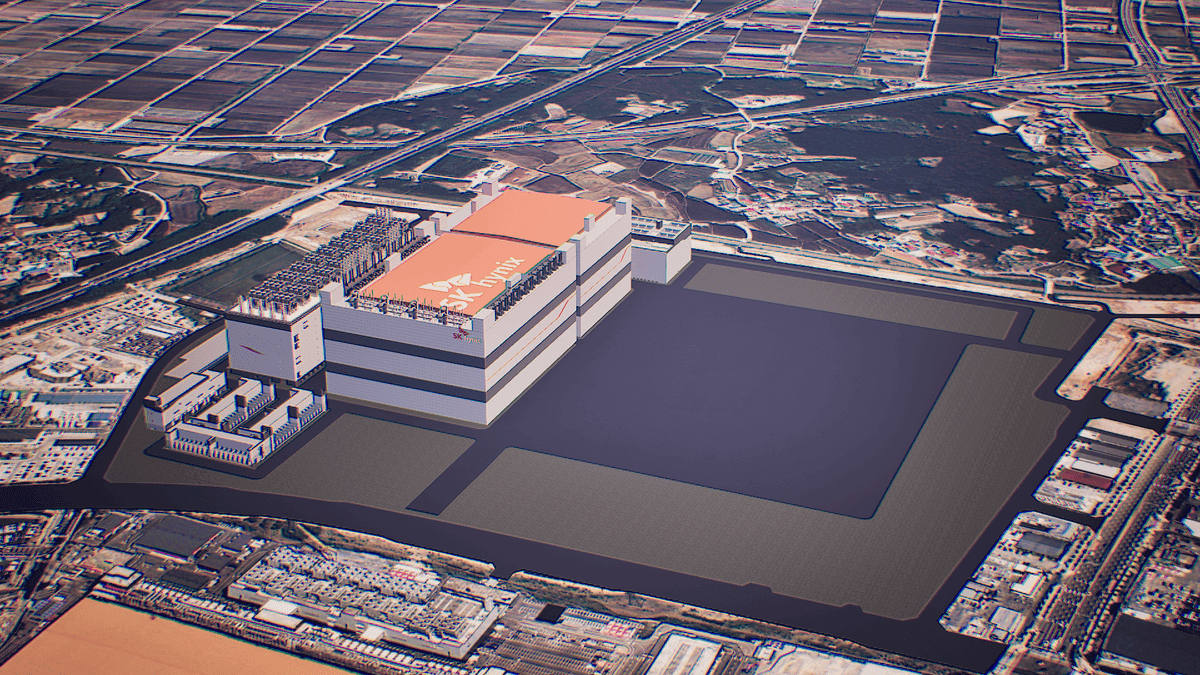
The Cheongju fab, due online in 2029, sits inside a wider $64bn package as chipmakers scramble to keep pace with AI-driven memory demand SK Hynix will spend 80 trillion won, or roughly $51.46 billion, building a new NAND flash memory factory in Cheongju, South Korea, with production targeted to begin in the first half of 2029. Chief executive Kwak Noh-jung announced the plan at an event attended by President Lee Jae Myung, folding the new fab, called M17, into a broader push by South Korea's two memory giants to keep up with demand the industry is struggling to satisfy. The announcement follows Samsung's own $647bn domestic investment plan, unveiled days earlier for the same chip-starved corner of the country. The $51.46 billion figure covers the NAND fab alone. SK Hynix's total spending commitment, once a separate advanced packaging plant is included, rises to 100 trillion won, or about $64 billion. That second facility, known as P&T7 and also sited in Cheongju, is intended for wafer-level packaging and is targeted for completion by 2027, two years ahead of the main fab. Reuters reported both figures, and Korean outlets corroborated the split between the two projects. M17 will be SK Hynix's fourth NAND fab and represents a bet that flash storage, long the less glamorous half of the memory business compared with the high-bandwidth memory (HBM) chips that feed AI accelerators, still needs serious new capacity. NAND chips handle long-term data storage in solid-state drives, distinct from the DRAM and HBM used as working memory inside AI servers. Industry trackers including TrendForce and DigiTimes have flagged tightening NAND supply as datacentre operators buy up storage alongside compute, even as most attention around SK Hynix's stock rally has centred on HBM. President Lee's government unveiled an investment plan worth somewhere between $520 billion and $576 billion, depending on which outlet's tally you use, on June 29, with Samsung and SK Hynix both committing to new fabs and packaging lines across the Chungcheong region. Reuters and Nikkei Asia have linked the spending spree to warnings that the global memory shortage, driven largely by AI datacentre buildouts, could persist into 2027 rather than easing this year. That shortage has already rippled into consumer electronics. Memory prices have climbed sharply enough this year that Apple discontinued its entry-level Mac Mini, and DRAM buyers elsewhere have turned to alternative suppliers, including a reported shift by Corsair toward Chinese-made DRAM in some of its kits. The scale of the response from SK Hynix and Samsung suggests both expect the squeeze to last well beyond the next product cycle. Construction on M17 is expected to begin next year, giving SK Hynix roughly three years to bring the fab from groundbreaking to output, a typical timeline for a facility of this scale. Neither SK Hynix nor the South Korean government has detailed how the investment will be financed beyond the company's own capital plans. Cheongju, already home to SK Hynix's existing NAND operations, is becoming the centre of gravity for the company's storage ambitions well into the next decade. SK Hynix overtook Samsung last year as South Korea's most valuable listed company, a shift driven almost entirely by the HBM boom rather than NAND, which makes this fresh bet on flash storage notable in its own right. NAND capacity additions rarely draw the same headlines as HBM supply deals, but the two product lines increasingly compete for the same wafer starts and packaging capacity inside SK Hynix's Korean plants. Executives at both companies have been candid that memory has become the bottleneck constraining how fast the wider AI industry can build. South Korea's government has framed the combined spending as a matter of national strategy, treating the country's memory dominance as an asset worth defending through direct policy support. Whether that translates into tax incentives or faster permitting for the Chungcheong region's fabs has not yet been detailed publicly. For now, the concrete commitment is SK Hynix's own: two plants, one region, and a 2029 deadline.
[2]
SK Hynix investment: SK Hynix to spend $64 billion on chip plants under broader AI-driven investment plan
The projects in the country's central city of Cheongju outlined on Thursday come under a $2.1 trillion plan unveiled by the chipmaker and its local rival Samsung Electronics on Monday that also included a new chip cluster in the southwest and existing projects. SK Hynix said on Thursday it planned to invest 100 trillion won ($64.38 billion) to build new NAND memory chip and packaging factories as part of a massive investment programme aimed at addressing a shortage driven by the AI boom. The projects in the country's central city of Cheongju outlined on Thursday come under a $2.1 trillion plan unveiled by the chipmaker and its local rival Samsung Electronics on Monday that also included a new chip cluster in the southwest and existing projects. South Korea is hoping the investments will double the country's memory chip production capacity within five years. At an event on Thursday attended by South Korea's president, SK Hynix CEO Kwak Noh-jung said the company would spend 80 trillion won to build a new factory for NAND memory chip production by 2029 and 20 trillion won for a chip packaging plant by late 2027 in Cheongju. The plan to invest 100 trillion won in Cheongju was announced on Monday, but details of the investment were not provided at the time. The huge capacity buildout by the South Korean chipmakers is a major political win for the country's President Lee Jae Myung, though it is stoking fears of a painful reckoning if AI spending cools. SK Hynix shares slumped 7.1% and Samsung shares were down 8.6% on Thursday, hit by a global selloff in chipmakers as Meta Platforms' plan to sell computing power raised questions over excess AI computing capacity. But at the SK Hynix event, Kwak expressed confidence in the market for NAND, a storage chip that retains data even when a device is turned off, unlike a DRAM chip. "While demand for NAND has been increasing and is expected to continue growing in the future, NAND supply is constrained," he said. SK Hynix said it planned to start construction of the new Cheongju NAND factory, known as M17, next year. ($1 = 1,553.2400 won)
[3]
SK Hynix to invest $64 billion in new AI memory chip facilities, Reuters reports By Investing.com
Investing.com -- SK Hynix Inc (KS:000660) plans to invest 100 trillion won ($64.4 billion) to expand its memory chip manufacturing footprint in South Korea, including new NAND flash and advanced chip packaging facilities, Reuters reported on Thursday, citing comments from Chief Executive Kwak Noh-jung. The investment includes 80 trillion won for a new NAND flash fabrication plant in Cheongju by 2029 and 20 trillion won for a chip packaging facility scheduled for completion by late 2027. Construction of the NAND plant, known as M17, is expected to begin next year. South Korea is targeting a doubling of the country's memory chip production capacity over the next five years through the investment programme. Unlock premium semiconductor insights and Fair Value analysis with InvestingPro The projects form part of a broader 2.1 quadrillion won investment programme announced earlier this week by SK Hynix and Samsung Electronics Co Ltd (KS:005930), aimed at significantly expanding South Korea's semiconductor production capacity to meet growing demand from artificial intelligence applications. Speaking at an event attended by South Korean President Lee Jae Myung, Kwak said the company remains confident in the long-term outlook for NAND memory despite recent volatility in AI-related stocks, noting that supply remains constrained even as demand continues to grow, according to Reuters. The announcement came as semiconductor shares remained under pressure globally. SK Hynix shares fell about 7% on Thursday, while Samsung Electronics dropped roughly 8%, amid a broader selloff sparked by concerns that AI infrastructure spending could moderate after reports surrounding Meta Platforms Inc' (NASDAQ:META) cloud computing plans. The broader KOSPI was last down 7.2%.
[4]
SK Hynix to spend $64 billion on flash memory chip plants under broader AI investment plan
SEOUL, July 2 (Reuters) - SK Hynix said it would invest 100 trillion won ($64.38 billion) to build new chip plants, including one for NAND flash memory, as part of a massive South Korean investment drive aimed at spreading returns from the AI boom beyond Seoul. The projects in the central city of Cheongju outlined on Thursday are included in a broader $2.1 trillion plan unveiled by the chipmaker and its local rival Samsung Electronics this week that also included a new chip cluster in the southwest and existing projects. The huge capacity buildout by the South Korean chipmakers is a major political win for the country's President Lee Jae Myung, who wants the AI windfall to help revive economies beyond the Seoul metropolitan area, though it is stoking fears of a painful reckoning if AI spending cools. At an event on Thursday attended by Lee, SK Hynix CEO Kwak Noh-jung said the company would spend 80 trillion won to build a new factory for NAND memory chip production by 2029 and 20 trillion won for a chip packaging plant by late 2027 in Cheongju. The plan to invest 100 trillion won in Cheongju was announced on Monday, but details of the investment were not provided at the time. South Korea is hoping the investments will double the country's memory chip production capacity within five years. Samsung and SK Hynix are the world's largest manufacturers of memory chips alongside U.S. rival Micron. The investments come as demand from AI hyperscalers has caused a global shortage of all types of memory chips. Prices for both NAND flash memory, a storage chip that retains data even when a device is turned off, and DRAM have soared to historical highs. CHIP SELLOFF SK Hynix shares ended down 15% and Samsung shares closed 9% lower on Thursday, hit by a global selloff in chipmakers as Meta Platforms' plan to sell computing power raised questions over excess AI computing capacity. Michael Burry, the investor whose successful bets against the U.S. housing market in 2008 were recounted in the movie "The Big Short," expressed caution about the massive South Korean investment plan in a subscriber-only Substack newsletter on Tuesday, the Wall Street Journal reported. The investment drive set off alarm bells for Burry over whether the massive sums of money being poured into AI could ever generate appropriate returns, according to the report, which added that he had made more bearish bets against AI-related stocks. "I see that as the beginning of the end," he told subscribers. At the SK Hynix event, Kwak expressed confidence in AI-driven demand for chips. "While demand for NAND has been increasing and is expected to continue growing in the future, NAND supply is constrained," he said. SK Hynix said it planned to start construction of the new Cheongju NAND factory, known as M17, next year. In April, SK Hynix broke ground on the P&T7 fab at Cheongju, a dedicated advanced packaging facility for AI memory, including high-bandwidth memory. However, the company cautioned in a filing this week that the long-term investment plans could change depending on global chip demand and spending by major customers. Factors such as delays in selecting and securing construction sites could also cause it to postpone plans, it added. (Reporting by Hyunjoo Jin and Heejin Kim; Editing by Brenda Goh and Jamie Freed)
[5]
SK Hynix to spend $64 billion on chip plants under broader AI-driven investment plan
SEOUL, July 2 (Reuters) - SK Hynix said on Thursday it planned to invest 100 trillion won ($64.38 billion) to build new NAND memory chip and packaging factories as part of a massive investment programme aimed at addressing a shortage driven by the AI boom. The projects in the country's central city of Cheongju outlined on Thursday come under a $2.1 trillion plan unveiled by the chipmaker and its local rival Samsung Electronics on Monday that also included a new chip cluster in the southwest and existing projects. South Korea is hoping the investments will double the country's memory chip production capacity within five years. At an event on Thursday attended by South Korea's president, SK Hynix CEO Kwak Noh-jung said the company would spend 80 trillion won to build a new factory for NAND memory chip production by 2029 and 20 trillion won for a chip packaging plant by late 2027 in Cheongju. The plan to invest 100 trillion won in Cheongju was announced on Monday, but details of the investment were not provided at the time. The huge capacity buildout by the South Korean chipmakers is a major political win for the country's President Lee Jae Myung, though it is stoking fears of a painful reckoning if AI spending cools. SK Hynix shares slumped 7.1% and Samsung shares were down 8.6% on Thursday, hit by a global selloff in chipmakers as Meta Platforms' plan to sell computing power raised questions over excess AI computing capacity. But at the SK Hynix event, Kwak expressed confidence in the market for NAND, a storage chip that retains data even when a device is turned off, unlike a DRAM chip. "While demand for NAND has been increasing and is expected to continue growing in the future, NAND supply is constrained," he said. SK Hynix said it planned to start construction of the new Cheongju NAND factory, known as M17, next year. ($1 = 1,553.2400 won) (Reporting by Hyunjoo Jin and Heejin Kim; Editing by Jamie Freed) By Hyunjoo Jin and Heejin Kim
[6]
SK Hynix to build $51 billion NAND memory chip factory by 2029
SEOUL, July 2 (Reuters) - SK Hynix said on Thursday that it plans to invest 80 trillion won ($51.46 billion) to build a new factory for NAND memory chip production by 2029 to address a shortage driven by the AI boom. SK Hynix plans to start construction of the new fab, called M17, in the South Korean city of Cheongju next year, according to its plan laid out at an event attended by its CEO Kwak Noh-jung and South Korean President Lee Jae Myung. The chipmaker also plans to spend another 20 trillion won to build a new chip packaging factory in Cheongju by late 2027. ($1 = 1,554.6000 won) (Reporting by Hyunjoo Jin and Heejin Kim; Editing by Jacqueline Wong and Jamie Freed)
Share
Copy Link
SK Hynix announced a $64 billion investment to build new NAND flash memory and chip packaging facilities in South Korea by 2029. The move addresses a global memory shortage driven by AI datacentre demand, with the company spending $51 billion on a NAND factory and $13 billion on advanced packaging. The investment comes amid concerns about whether massive AI infrastructure spending can deliver returns.
SK Hynix plans to invest 100 trillion won, approximately $64 billion, to construct new facilities for AI memory chips and NAND flash memory production in Cheongju, South Korea
1
2
. CEO Kwak Noh-jung announced the plan at an event attended by President Lee Jae Myung, breaking down the spending into two major projects. The company will allocate 80 trillion won, or roughly $51.46 billion, to build a new NAND factory called M17, with production targeted to begin in the first half of 20291
. An additional 20 trillion won will fund a chip packaging plant known as P&T7, scheduled for completion by late 20272
.Source: Market Screener
This SK Hynix investment forms part of a broader $2.1 trillion plan unveiled alongside Samsung Electronics, aimed at doubling South Korea semiconductor production capacity within five years
3
. Construction on the M17 factory is expected to begin next year, giving the company roughly three years to bring the facility from groundbreaking to output1
.The massive capacity buildout addresses a global shortage of memory chips driven by AI datacentre buildouts and hyperscalers demanding more storage alongside compute power
1
. Industry trackers including TrendForce and DigiTimes have flagged tightening NAND supply as operators buy up storage, even as most attention around SK Hynix's stock rally has centered on HBM memory1
. At the Thursday event, Kwak expressed confidence in the market, stating that "while demand for NAND has been increasing and is expected to continue growing in the future, NAND supply is constrained"5
.NAND flash memory, which retains data even when devices are turned off, handles long-term data storage in solid-state drives, distinct from DRAM and HBM used as working memory inside AI servers
1
. Reuters and Nikkei Asia have linked the spending spree to warnings that the global memory shortage could persist into 2027 rather than easing this year1
. The shortage has already rippled into consumer electronics, with memory prices climbing sharply enough that Apple discontinued its entry-level Mac Mini1
.The P&T7 facility in Cheongju will focus on wafer-level packaging and advanced packaging for AI memory, including high-bandwidth memory
4
. This represents a critical component of the company's strategy, as NAND capacity additions and HBM supply increasingly compete for the same wafer starts and packaging capacity inside SK Hynix's Korean plants1
. The M17 factory will be SK Hynix's fourth NAND fab and represents a bet that flash storage still needs serious new capacity despite being the less glamorous half of memory chip manufacturing compared to HBM chips that feed AI accelerators1
.Cheongju, already home to SK Hynix's existing NAND operations, is becoming the center of gravity for the company's storage ambitions well into the next decade
1
. SK Hynix overtook Samsung Electronics last year as South Korea's most valuable listed company, driven almost entirely by the HBM boom, making this fresh bet on NAND flash memory notable1
.Related Stories
Despite the confident outlook from executives, semiconductor shares faced significant pressure following the announcement. SK Hynix shares slumped 7.1% and Samsung shares dropped 8.6% on Thursday, hit by a global selloff in chipmakers as Meta Platforms' plan to sell computing power raised questions over excess AI computing capacity
2
5
. The massive capacity buildout is a major political win for President Lee Jae Myung, though it is stoking fears of a painful reckoning if AI infrastructure spending cools4
.Investor Michael Burry, known for his successful bets against the U.S. housing market in 2008, expressed caution about the massive South Korean investment plan, with the Wall Street Journal reporting he sees it as "the beginning of the end" and has made bearish bets against AI-related stocks
4
. SK Hynix cautioned in a filing that long-term investment plans could change depending on global chip demand and spending by major customers, with factors such as delays in selecting and securing construction sites potentially causing postponements4
. The scale of response from SK Hynix and Samsung Electronics suggests both expect the squeeze to last well beyond the next product cycle, treating memory chip manufacturing dominance as a national strategic asset worth defending1
.Summarized by
Navi
[3]
[4]
18 Nov 2025•Business and Economy

24 Jun 2026•Technology

13 Jan 2026•Business and Economy

1
Policy and Regulation

2
Policy and Regulation

3
Policy and Regulation