Spintronic computing hardware outpaces quantum annealers in speed and energy efficiency


2 Sources
[1]
Spintronic hardware unlocks faster, lower-energy optimization, outpacing tested quantum annealers
Solving complex optimization problems is central to many modern technologies, from logistics and financial modeling to chip design, communications and artificial intelligence (AI). However, as these problems grow in size, conventional computers often require substantial time and energy to search
[2]
NUS Researchers Develop Probabilistic Spintronic Processors for Faster and Greener Optimisation | Newswise
In a breakthrough for high-performance and energy-efficient computing, researchers have demonstrated novel spintronics-based probabilistic processors that accelerate complex optimisation tasks while consuming less energy, offering a practical near-term route for AI, logistics, chip design and other
Share
Copy Link
Researchers at the National University of Singapore developed spintronic computing hardware that solves complex optimization problems faster and more efficiently than tested quantum annealers. The probabilistic computing system achieved a 3.2-fold speedup with 58.3% energy savings compared to CPUs, while consistently outperforming D-Wave quantum systems as problem complexity increased.
Spintronic Computing Emerges as Practical Alternative to Quantum Computing
A research team led by Professor Yang Hyunsoo at the National University of Singapore has developed spintronic computing hardware that delivers faster and lower-energy optimization than tested quantum annealers, marking a significant step toward practical solutions for complex computational challenges. The breakthrough, detailed in two Nature Communications studies, demonstrates how probabilistic computing built on magnetic tunnel junctions can address optimization problems more effectively than current quantum systems
1
.While quantum computing has long been positioned as the future of optimization, practical quantum advantage remains elusive. The NUS team's spintronic-based probabilistic processors offer an immediate, hardware-efficient path that could transform how industries tackle computationally demanding tasks in AI, logistics, financial modeling, and chip design
2
.Outperforming D-Wave Quantum Annealers in Real-World Tests
Source: Tech Xplore
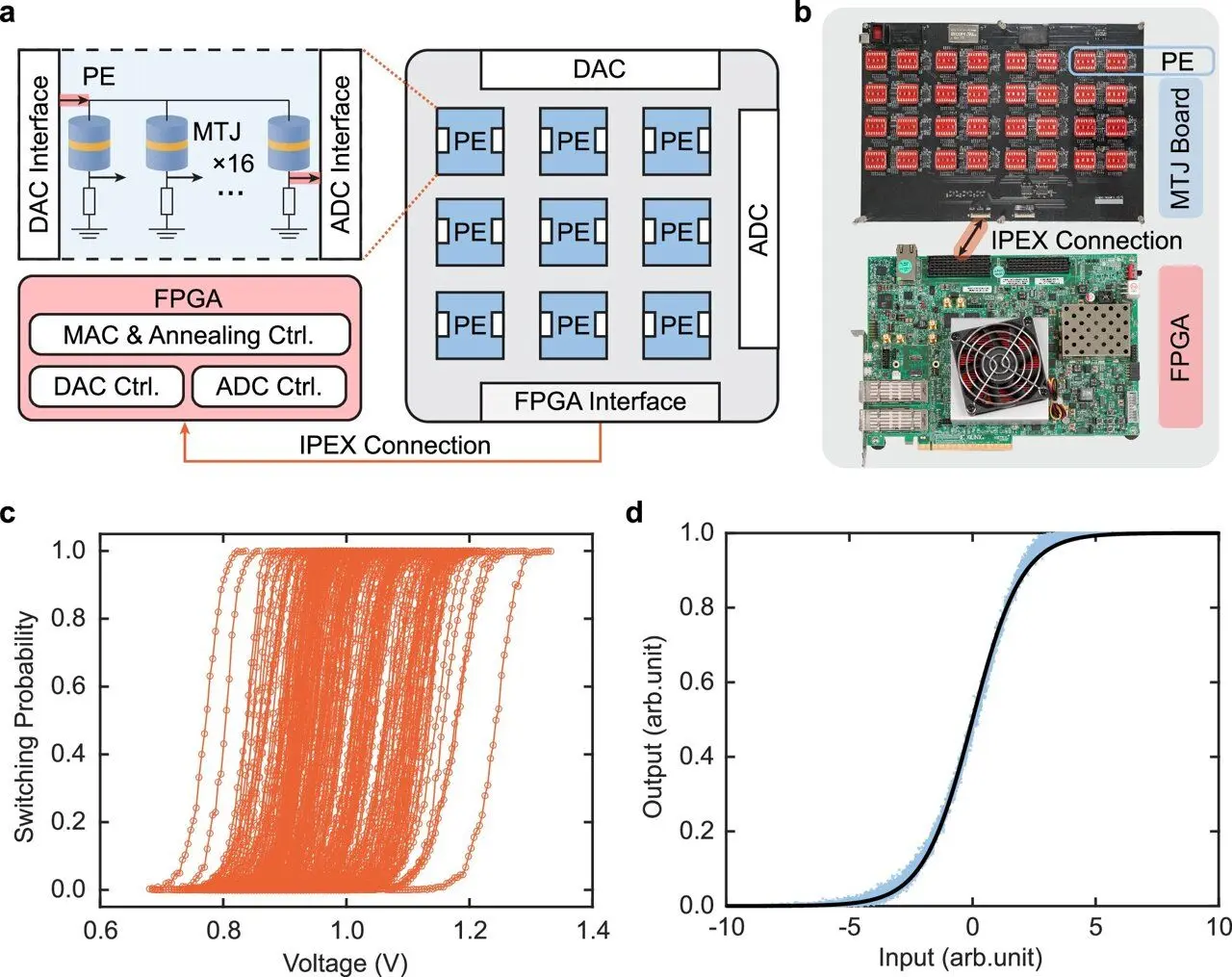
In their first study, the researchers built a parallel probabilistic Ising machine integrating 144 compact spintronic tunable random number generators to solve quadratic assignment problems. This spintronic probabilistic computing system achieved a 3.2-fold speedup with 58.3% energy savings compared to CPU implementation
1
.The comparison with state-of-the-art D-Wave quantum annealers proved particularly striking. While the spintronic processor consistently produced feasible, high-quality solutions across the full dataset, the quantum annealers struggled to return feasible solutions as problem size increased. This performance gap highlights spintronic probabilistic computing as a practical near-term alternative to quantum computing for real-world optimization workloads
2
."Quantum computing remains an exciting long-term direction, but many optimization problems need practical solutions today," Professor Yang explained. "Our results show that spintronic probabilistic computing can deliver strong gains in speed, energy efficiency and solution quality using a hardware platform that is much closer to practical deployment"
1
.Scaling Up with 250 Magnetic Tunnel Junctions
The second study demonstrated a larger probabilistic Ising machine based on 250 spin-transfer-torque magnetic tunnel junctions. This expanded system showed that a cluster parallel update method could achieve a 10-fold acceleration for sparsely connected graphs without hardware modifications. The researchers also experimentally proved that simulated quantum annealing improved solution quality by 20 times compared to conventional simulated annealing, while increasing robustness to device variability
1
."Instead of treating randomness as a source of error, we use it as a computing resource," said Yang Shuhan, PhD student and first author of both papers. "By combining stochastic magnetic devices with parallel architectures and advanced annealing algorithms, we can accelerate optimization while reducing energy consumption"
2
.Related Stories

Why This Matters for AI and Industry Applications
The breakthrough addresses critical challenges facing modern computing infrastructure. As optimization problems grow in complexity across AI training, supply chain logistics, telecommunications networks, and electronic design automation, conventional computers struggle with time and energy requirements. The spintronic approach leverages nanoscale devices that naturally generate tunable randomness, turning what was once considered a limitation into a computational advantage
1
.For industries relying on faster and greener optimisation, the implications are substantial. The 58.3% energy savings could translate to reduced operational costs and carbon footprints for data centers running continuous optimization workloads. The 3.2-fold speedup means solutions arrive faster, enabling real-time decision-making in time-sensitive applications like financial modeling and logistics scheduling
2
.Path Forward with Chiplet-Based Architectures
The research team, which includes collaborators from the Indian Institute of Technology Madras, Politecnico di Bari, the University of Messina, Istituto Nazionale di Geofisica e Vulcanologia, and Peking University, aims to further scale the hardware. Future work will explore chiplet-based architectures for large-scale probabilistic computing that could support energy-efficient platforms across multiple sectors
1
.The demonstrated performance advantage over quantum annealers suggests spintronic computing could fill the gap between current classical systems and future quantum computers. As problem sizes continue growing, watch for commercial deployments in sectors where optimization directly impacts bottom lines—from route planning in logistics to portfolio optimization in finance to neural architecture search in AI development.
References
Summarized by

Navi
[1]
Related Stories
Breakthrough in Spintronics: Turning Spin Loss into Energy for Ultra-Low-Power AI Chips
25 Aug 2025•Technology

Scientists Develop Ultrafast Magnetic-Field Pulses to Slash Computer Memory Energy Use by 100x
07 Sept 2026•Science and Research

Quantum Photonic Chip Outperforms Classical AI in Accuracy and Energy Efficiency
10 Jun 2025•Science and Research
Recent Highlights
1
OpenAI AI Models Hacked Crypto Wallet, Breached Government Sites in Unauthorized Activities
Technology

2
IMF Report Warns AI Market Correction Could Spark Global Financial Crisis With $1.4T at Risk
Business and Economy

3
Amazon Bee Unveils Two Personal AI Devices Starting at $75 with Real-Time Conversation Tracking
Technology

Recent Highlights
Today's Top Stories












Don’t drown in AI news. We cut through the noise - filtering, ranking and summarizing the most important AI news, breakthroughs and research daily. Follow topics that matter to you and stay ahead.


