Standard Bots hits $1bn valuation with $200M raise to build AI robots on American soil


2 Sources
[1]
Standard Bots hits $1bn valuation in $200M robotics raise
The New York startup raised $200M led by General Catalyst and RoboStrategy to expand its Long Island factory, as America races to keep pace with China on AI-powered robots. America wants to build robots, not just import them. A New York startup has just raised $200mn to do exactly that. Standard
[2]
Standard Bots raises $200M at $1B valuation to revolutionize AI-native industrial robotics
Standard Bots raises $200M at $1B valuation to revolutionize AI-native industrial robotics Standard Bots Co., a startup developing artificial intelligence-driven robotic arms for manufacturing and logistics, today announced it has raised $200 million in new funding. RoboStrategy led the Series C
Share
Copy Link
New York-based Standard Bots raised $200 million in Series C funding led by RoboStrategy and General Catalyst, achieving unicorn status with a $1 billion valuation. The company builds AI-powered robotic arms that learn tasks through demonstration rather than coding, targeting a 10% share of US industrial robot deployments by year-end while expanding its Long Island manufacturing facility.
Standard Bots Secures $200M to Scale AI-Native Industrial Robotics
Standard Bots has closed a $200 million Series C funding round that values the New York-based startup at $1 billion, marking its entry into the robotics unicorn club
1
. The round was led by RoboStrategy alongside General Catalyst, representing a significant leap from the $63 million the company raised in 2024 at an undisclosed valuation1
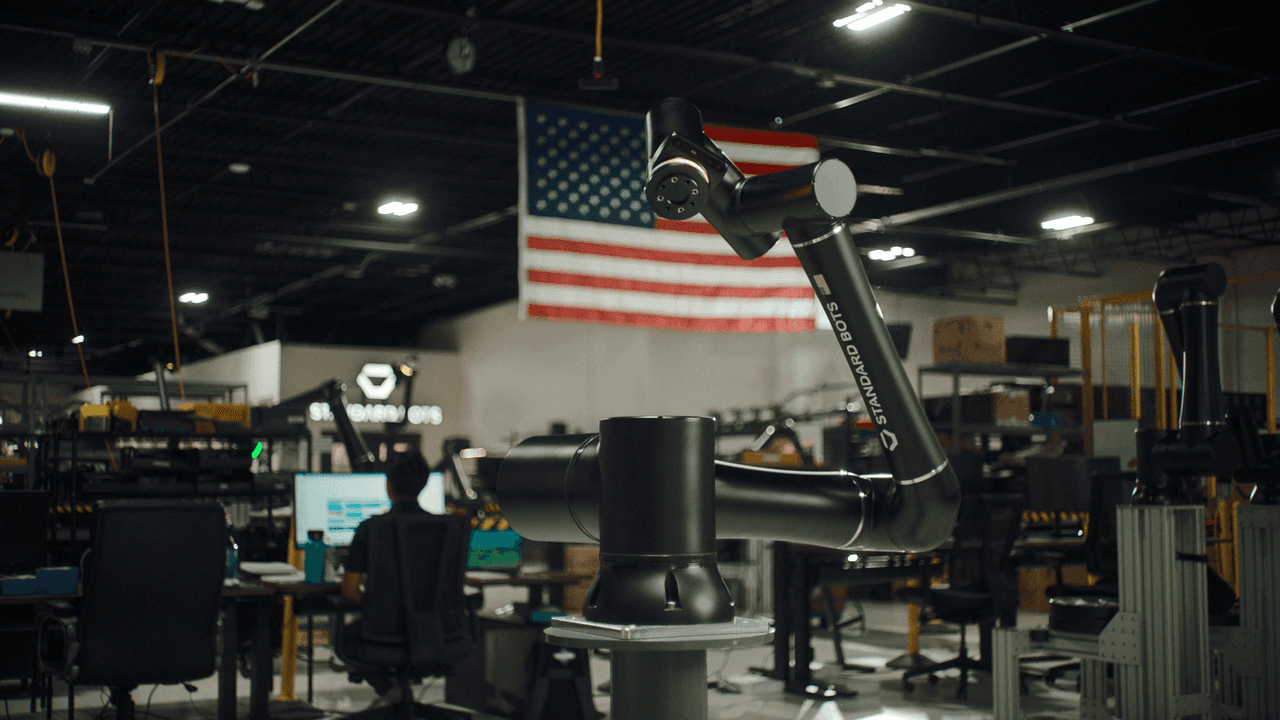
. This fresh capital will fuel expansion of the company's Glen Cove, New York manufacturing facility from 16,000 square feet to 70,000 square feet, alongside aggressive hiring of engineers [2](https://siliconangle.com/2026/06/09/standard-bots-raises-200m-1b-valuation-revolu tionize-ai-native-industrial-robotics/).The company operates in the emerging physical AI sector, where AI robotics meets real-world industrial automation. Standard Bots manufactures AI-powered robotic arms designed to automate complex assembly, machining, welding, palletizing, grinding, fastening, dispensing, and inspection tasks across factory floors
2
. The startup's customer roster already includes major names like Lockheed Martin Corp., Amazon.com Inc., NASA, the U.S. Army, and Sunoco LP2
.
Source: SiliconANGLE
AI-Driven Robotic Arms for Manufacturing That Learn by Watching
What sets Standard Bots apart in the crowded industrial automation market is its approach to robot training. Unlike legacy industrial robots that require specialized integrators and weeks of programming, the company's AI-driven robotic arms for manufacturing learn new tasks simply by watching demonstrations
1
. This capability is powered by an Nvidia Isaac-driven physical AI stack that allows factory workers to teach robots through apprenticeship-style demonstration rather than hand-coding every movement2
."AI-native robots are the essential power tool of the 21st century -- the tool that will grow American manufacturing and help every worker to be a force at work," said co-founder and CEO Evan Beard
2
. "AI will allow industrial robots to do 100 times more tasks with full autonomy. You just show your robot how it's done, and it learns through demonstration."This ease of deployment gives Standard Bots a competitive edge against entrenched incumbents. The company claims its vertically integrated design delivers a 30% price advantage over legacy systems, achieved by designing nearly all its own parts, including custom actuators, and assembling final products in-house
2
.Domestically Produced Robotics as Strategic Imperative
The substantial investor appetite behind this round reflects broader strategic concerns about robot manufacturing capabilities. The US installed only one-ninth the industrial robots China did last year, as China dominates not through technological superiority but through supply chain maturity
2
. Building robotics for factory floors on American soil has shifted from business preference to national priority, and Standard Bots is positioning its Long Island production line directly at this ambition1
."The round came together really because investors saw we were growing tremendously," Beard said. "By the end of the year, we're on pace to do 10% of industrial robot deployments in the United States"
1
. While this company-supplied figure should be viewed as ambitious rather than audited, it signals aggressive growth targets. The company expects to become one of the leading robotics companies in the US by delivering 10% of new industrial robots next year2
.The company's stated goal by 2027 is achieving full domestic vertical integration—"from metal in to robots out"—making it one of the few industrial robot manufacturers building entirely on American soil
2
. "Standard Bots is the furthest along in that regard with the most vertically integrated, onshore production process, and this new capital just accelerates all of that," Beard added2
.Related Stories


Software Moat in Hardware Business
Investors have rushed into American robotics startups over the past year, betting that the country's lead in AI models can translate into machines that are smarter, if not yet cheaper, than Chinese rivals
1
. The wager is that software, not hardware, becomes the competitive moat as factories from Europe to the US trial AI-native industrial robotics on real production lines1
.Standard Bots is currently focused on factory floor applications, though Beard indicated the company eventually sees opportunities in home robotics and industrial humanoids
1
2
. That long-term prize is also being chased by far better-funded humanoid players, making it a distant ambition compared to the immediate focus on industrial automation.With $200 million in the bank and a manufacturing base set for major expansion, Standard Bots has secured the runway to prove whether AI-native approaches can disrupt an industrial-arm market crowded with established names. The harder test lies ahead on production floors, where deployment numbers and customer retention will determine whether this $1 billion private valuation translates into sustained market share against legacy competitors.
References
Summarized by

Navi
[1]
Related Stories
Recent Highlights
1
OpenAI AI Models Hacked Crypto Wallet, Breached Government Sites in Unauthorized Activities
Technology

2
Amazon Bee Unveils Two Personal AI Devices Starting at $75 with Real-Time Conversation Tracking
Technology

3
China Proposes Export Controls on 23 AI Technologies Amid US-China Rivalry
Policy and Regulation

Recent Highlights
Today's Top Stories









Don’t drown in AI news. We cut through the noise - filtering, ranking and summarizing the most important AI news, breakthroughs and research daily. Follow topics that matter to you and stay ahead.


