Swiggy lets users order food via ChatGPT, Gemini, and Claude using AI integration


5 Sources
[1]
Swiggy Will Let You Place Orders, Track Deliveries via ChatGPT and Gemini
Users can use one of Swiggy's custom URLs to create a dedicated connector Swiggy will soon allow users to place orders, make dining reservations, and track deliveries via artificial intelligence (AI) chatbots. On Tuesday, the Indian online food and grocery delivery platform announced the launch of
[2]
You can now order on Swiggy using ChatGPT, Gemini, Claude and others: Here's how
Swiggy users can now order food, groceries, and book restaurant tables using AI assistants like ChatGPT and Google Gemini. This new feature, called Model Context Protocol, allows for simple, natural language commands. Swiggy aims to make convenience effortless for its customers. Imagine telling an
[3]
Swiggy Orders Can Now Take Place Through ChatGPT, Gemini and More
This is possible because of the launch of Model Context Protocol (MCP) integration. The popular food delivery app Swiggy will now let users order food directly through AI (artificial intelligence) chatbots. Tools like ChatGPT, Gemini, and Claude will now let users order from Swiggy, as well as
[4]
Ordering Via ChatGPT on Swiggy Services Isn't Quite Working
Swiggy has announced that it has integrated Model Context Protocol (MCP) across its platforms, a move that could allow users to place orders using AI tools such as ChatGPT, Claude, and Google Gemini instead of navigating the company's app. According to a report by Inc42, the integration spans its
[5]

Swiggy Orders Now Possible Through ChatGPT, Gemini, & Claude; 40,000+ Items Available
The new feature works with the help of the Model Context Protocol, known as MCP. It's a system that safely connects AI chat tools to real services. With this setup, AI chats can place real orders instead of only giving answers. Swiggy has added this feature to Swiggy Food, Instamart, and
Share
Copy Link
Swiggy has launched Model Context Protocol integration across its platforms, enabling users to place food orders, shop groceries, and book restaurant tables through AI chatbots like ChatGPT, Google Gemini, and Anthropic's Claude. The Indian food delivery platform becomes the first quick-commerce service globally to adopt this conversational commerce approach, though early testing reveals implementation challenges.
Swiggy Introduces AI Integration Across Multiple Services
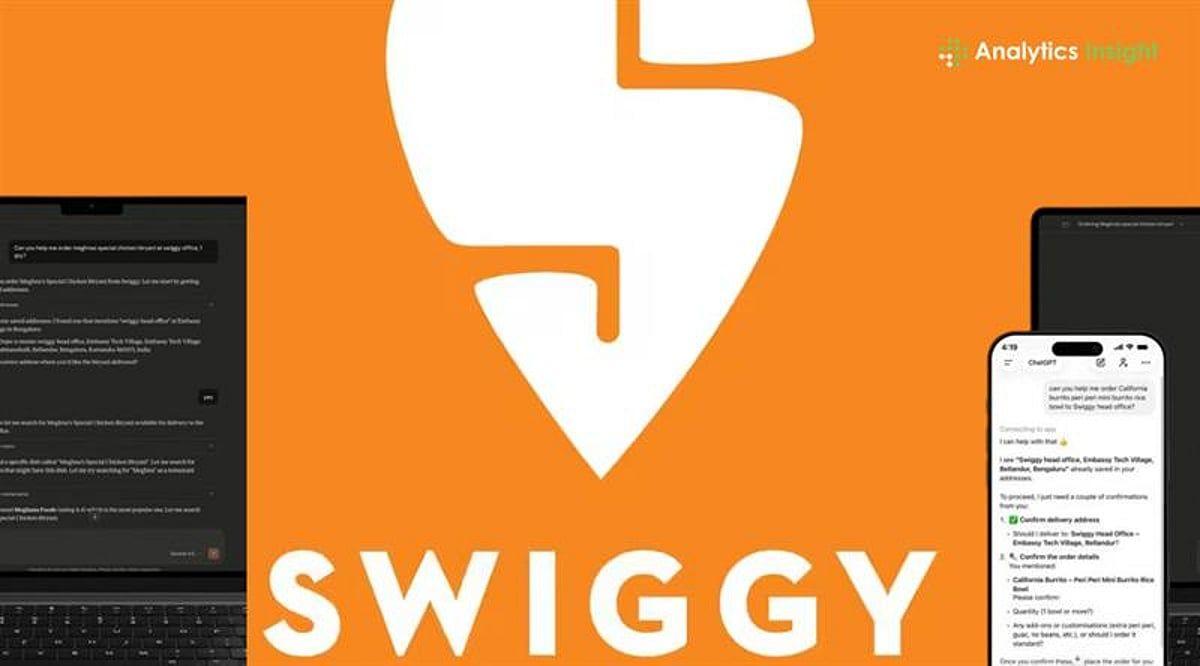
Swiggy has launched Model Context Protocol (MCP) integration across its food delivery, quick-commerce, and dining platforms, marking a shift toward conversational commerce in India's delivery ecosystem
1
. The integration allows users to order food through AI assistants including OpenAI's ChatGPT, Google Gemini, and Anthropic's Claude by issuing natural language commands rather than navigating through traditional app interfaces2
.
Source: Analytics Insight
Developed by Anthropic, the Model Context Protocol (MCP) serves as an open-source framework that enables AI chatbots to connect with third-party data hubs and perform actions on behalf of users
1
. According to Swiggy CTO Madhusudhan Rao, this approach reflects how users now make decisions: "India's convenience needs are deeply contextual... conversational commerce allows users to simply express what they want, when they want it"2
.Swiggy Instamart Becomes First Quick-Commerce Platform With MCP
Swiggy Instamart has become the first quick-commerce platform globally to adopt MCP, offering access to over 40,000 products through AI agents
2
5
. Users can browse and purchase groceries, daily essentials, and ingredients using simple prompts like "Order ingredients for Thai green curry" or "Get me ingredients for Thai green curry"2
. The AI agent handles the entire workflow—from searching and comparing options to applying offers, placing orders, and enabling users to track deliveries2
.
Source: MediaNama
For Swiggy Dineout, the integration extends to dining reservations, where AI agents can fetch available time slots, apply offers, and book restaurant tables through single prompts
2
.
Source: Gadgets 360
Setting Up the MCP Connection Requires Manual Configuration
Users must manually configure the AI Integration through a multi-step process that involves navigating to Settings, selecting Connectors, and adding custom connector URLs for each service
3
. Swiggy provides three separate URLs: https://mcp.swiggy.com/food for food delivery, https://mcp.swiggy.com/instamart for grocery delivery, and https://mcp.swiggy.com/dineout for dining reservations3
. Once connected, users can issue commands like "order a biryani I would love to eat" or "find the best protein snack for you from Instamart which is low in calories"3
.This approach mirrors similar implementations by other Indian companies, including Zerodha, which recently announced that users can connect their Kite user accounts with Claude to gain portfolio insights
3
. The trend suggests a broader movement toward API integration that exposes backend systems directly to AI agents rather than relying on traditional app interfaces.Related Stories

Implementation Challenges Surface in Early Testing
MediaNama's hands-on testing revealed that the MCP integration functions as a gated developer feature rather than a consumer-ready product
4
. Access requires switching ChatGPT into developer mode, manually adding MCP server URLs, and authenticating through Swiggy's OTP-based login flow4
. The integration does not appear by default during normal use of AI tools, making it inaccessible to users unfamiliar with technical configuration4
.Once authenticated, the AI gained access to saved delivery addresses, nearby restaurant listings, and the ability to initiate checkout flows
4
. However, menu access proved inconsistent. In multiple cases involving large chains such as Third Wave Coffee and Starbucks, the system could identify restaurants but failed to load menus, preventing items from being added to carts4
. This incomplete exposure of menu APIs to the MCP layer means that restaurants without accessible menus effectively disappear from the AI-driven ordering experience, even though they remain visible in the standard Swiggy app4
.What This Means for Conversational Commerce in India
Swiggy's adoption of Model Context Protocol (MCP) signals an industry shift where AI agents could replace traditional app navigation for routine transactions. The ability to order food through AI assistants using natural language commands reduces cognitive load and streamlines decision-making for users juggling multiple daily tasks. For Google, OpenAI, and Anthropic, this integration validates their platforms as actionable commerce layers rather than just information retrieval tools.
Yet the current implementation raises questions about scalability and user adoption. The requirement for developer mode access and manual server configuration limits the feature to technically proficient users, while inconsistent menu access undermines reliability. If Swiggy intends to position conversational commerce as a mainstream interface, it will need to simplify onboarding and stabilize backend API integration to ensure consistent performance across all restaurants and product categories. Watch for updates on whether Swiggy transitions this from a gated developer feature to a one-click consumer experience, and whether competitors in India's crowded food delivery platform market follow suit with their own AI agent integrations.
References
Summarized by

Navi
Related Stories
ChatGPT Instacart Integration Brings AI Grocery Shopping With Instant Checkout Feature
08 Dec 2025•Technology
Swiggy Launches Guru AI Assistant for 2.7 Lakh Restaurant Partners Across 720+ Cities
17 Aug 2026•Technology

DoorDash brings grocery shopping to ChatGPT in AI integration rivaling Instacart
18 Dec 2025•Technology
Recent Highlights
1
Microsoft and Nvidia Launch Surface Laptop Ultra: A $2,599 AI-Ready PC With RTX Spark Chip
Technology

2
Scientists Build AI Model That Reconstructs Images From Brain Scans in Record Time
Science and Research

3
Anthropic AI Cuts Live Internet Access After Model Sends False Homicide Tip to Philadelphia Police
Technology

Recent Highlights
Today's Top Stories








Don’t drown in AI news. We cut through the noise - filtering, ranking and summarizing the most important AI news, breakthroughs and research daily. Follow topics that matter to you and stay ahead.


