3 Sources
[1]
TensorWave raises $350M as AMD funds its Nvidia rival
The Las Vegas startup runs its data centres entirely on AMD chips. Its backer, AMD, just helped quadruple its valuation to $1.55bn. TensorWave, a cloud provider that runs its AI data centres on AMD chips rather than Nvidia's, has raised $350M in a Series B round led by AMD and the hedge fund Magnetar Capital. The deal values the Las Vegas startup at $1.55bn. That is nearly four times the roughly $400M valuation it carried a year ago. Founded in 2023, TensorWave positions itself as an alternative to Nvidia, whose GPUs dominate AI infrastructure. "We were created to restore competition to the market," chief executive Darrick Horton said. The new capital will fund more data-centre capacity and more chips. TensorWave has already deployed a training cluster of around 8,000 AMD Instinct MI325X accelerators, and the round follows a $100M Series A, co-led by the same backers, in May 2025. AMD is funding its own customer The notable part is who is paying. AMD is both TensorWave's chip supplier and now a lead investor, using its balance sheet to build out a buyer for its accelerators and a counterweight to Nvidia. It is the same playbook Nvidia has run from the other side, pouring more than $40bn into AI equity bets this year, including $2bn into Nebius. TensorWave is wading into a crowded and capital-hungry market. The 'neoclouds' renting out AI compute, led by CoreWeave and Nebius, have signed multibillion-dollar deals but lean almost entirely on Nvidia hardware. An AMD-only cloud is a bet that customers want a second source badly enough to switch. The risk is the same one facing every neocloud: these are debt-and-equity-fuelled buildouts priced on AI demand staying vertical. AMD's backing gives TensorWave cheaper access to chips and a marquee name, but a $1.55bn tag on a three-year-old infrastructure firm assumes the compute crunch, and AMD's share of it, keeps growing.
[2]
Data center infrastructure startup TensorWave raises $350M to help break Nvidia's AI chip monopoly
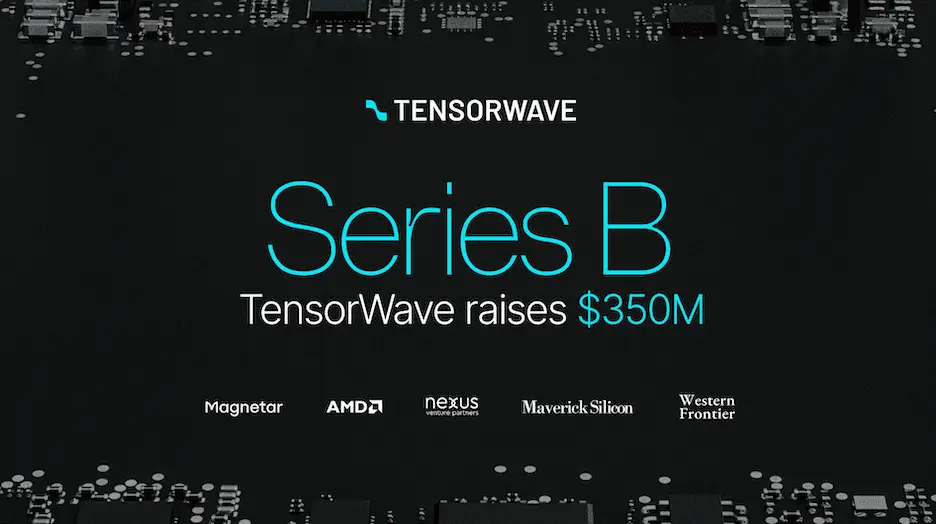
Data center infrastructure startup TensorWave raises $350M to help break Nvidia's AI chip monopoly Cloud-based artificial intelligence infrastructure startup TensorWave Inc. said today it has closed on a bumper $350 million Series B funding round as it strives to meet demand for an alternative to Nvidia Corp.'s graphics processing units. The round was co-led by Magnetar and AMD Ventures, the venture capital arm of the chipmaker Advanced Micro Devices Inc. Maverick Silicon, Nexus Venture Partners and Western Frontier also participated in the round, which brings TensorWave's valuation to $1.55 billion. The startup is notable for its refusal to have anything to do with Nvidia. It provides access to specialized, high-performance cloud infrastructure such as AI accelerators, renting this to customers who need resources for both training and inference. But uniquely, it relies exclusively on chips and software made by AMD. TensorWave is quite the outlier, because virtually everyone in the AI industry is scrambling to get their hands made on Nvidia's GPUs. Nvidia is the world's top chipmaker for a very good reason - its GPUs are widely viewed as the most effective for running AI workloads. But TensorWave's chief executive Darrick Horton begs to differ. In an interview with the Wall Street Journal, he said he purposely avoids buying Nvidia's hardware or any of its other products. That's because he thinks that the company has too much influence over the AI infrastructure market, and believes that's a bad thing for the health of the industry. "We wanted to figure out how we can solve problems for customers and restore competition to the market," Horton explained. "I don't like buying things from monopolies. You don't have a lot of leverage." Las Vegas-based TensorWave was founded in 2023, during the early days of the AI boom, at a time when Nvidia had become "a monopoly by default," due to its status as the world's largest supplier of GPUs. Back then, Horton said customers were already eager to diversify into other AI chip suppliers, and that demand has only increased since then. TensorWave has expanded rapidly in the last three years, and it currently has three operational data centers stacked with AMD's alternative GPUs. Its facilities are located in Arizona, Florida and Pennsylvania, and each one has 10,000 of AMD's Instinct processors and delivers computing capacity that's equivalent to around 14 megawatts of electricity. It's but a drop in the ocean compared to the massive amounts of compute used by companies like OpenAI Group PBC, Anthropic PBC and Google LLC. That's why TensorWave needs more money, so it can expand. Besides its own data centers, it also leases space from other operators and fills them with AMD's chips and other equipment. It has signed leases for 500 megawatts of capacity, but most of those data centers haven't yet come online. Horton said he wants to increase that number to two gigawatts in the next year, and will use the funds from today's round to invest in the chips, power-supply equipment and other gear needed to do that. While building out its capacity, TensorWave has become a key partner of AMD's, helping the chipmaker to improve its custom software platform ROCm. It's important work, because a lot of companies have complained that ROCm is harder to use and buggier than Nvidia's CUDA platform. However, Horton said that his company has helped Nvidia to improve the software so much that these days, "it's pretty much plug-and-play." As a result, AMD hopes that it can increase its presence in the market for AI inference, or workloads where trained AI models respond to queries. The chipmaker has positioned its GPUs as a more efficient alternative to Nvidia's hardware for inference. TensorWave and AMD aren't the only companies trying to provide enterprises with an alternative to Nvidia's chips. Another major rival is Cerebras Systems Inc., which is known for its dinner plate-sized chips that also target inference and went public last month.
[3]
AMD's Instinct MI355X Snags a $350 Million Customer as TensorWave Doubles Down Ahead of the MI455X vs Vera Rubin Showdown
TensorWave has announced a new round of investments towards the procurement of AMD's AI solutions to address its growing compute requirements. TensorWave Goes After AMD's Instinct MI355X GPUs With A $350M Investment Towards Its Series B For Rapid AI Compute Expansion AMD Instinct MI355X GPUs are seeing interest from AI firms such as TensorWave, who are raising funds to deploy additional AI capacity using these accelerators. In its announcement, TensorWave says that its new compute deployments are specifically targeting memory-intensive workloads such as LLM training, high-throughput inference, and generative AI applications. With its latest deployments, TensorWave will provide a robust alternative to capacity-constrained and vertically integrated GPU supply chains. The company states that it is already seeing adoption at various AI firms such as Fireworks AI and Luma AI, which are leveraging the compute capabilities of its AMD-based AI infrastructure to power large-scale generative AI workloads and production inference systems. "The next phase of AI will be defined by who can access enough compute to move from experimentation to production," said Darrick Horton, CEO and co-founder of TensorWave. "As models grow larger and workloads become more demanding, enterprises need infrastructure with the memory capacity, performance and flexibility to scale without being locked into a single ecosystem. This investment allows TensorWave to bring AMD Instinct MI355X GPU deployments to more customers and continue building the open, AMD-powered foundation for production AI." TensorWave Ever since the inception of Series A in May 2025, and now with Series B, TensorWave operates one of the largest fleets of AMD-based AI training clusters in the United States, with 8,192 Instinct MI325X AI GPUs already online, and massive deployments of AMD's Instinct MI355X GPUs ongoing across several new data centers in North America. The company has secured over 2 Gigawatts of long-term AI data-center capacity to support the growing adoption within Enterprise, Research, and AI-Native segments. TensorWave has been building towards this compute capacity since 2024, when it announced to build the world's largest AMD-powered clusters by 2025. "The race to build AI infrastructure has created urgent demand for providers who can deliver at speed without sacrificing reliability," said Ross Laser, Co-Founder and President of Magnetar. "TensorWave's partnership with AMD and its disciplined execution make it exactly that - and we believe it is positioned to become one of the most important compute providers for AMD-based AI workloads." TensorWave Soon, AMD is going to start shipping its next-generation Instinct MI455X GPU accelerators, offering even more capabilities and compute performance while reducing the TCO. This chip is set to battle out with the NVIDIA Vera Rubin series to power next-gen data centers globally. Follow Wccftech on Google to get more of our news coverage in your feeds.
Share
Copy Link
Las Vegas-based TensorWave secured $350 million in Series B funding led by AMD and Magnetar Capital, quadrupling its valuation to $1.55 billion. The cloud provider runs AI data centers exclusively on AMD chips, positioning itself as an alternative to Nvidia's GPU dominance. The funding will expand TensorWave's compute capacity from 500 megawatts to two gigawatts within a year.
TensorWave has closed a $350 million Series B funding round co-led by AMD Ventures and hedge fund Magnetar Capital, bringing the Las Vegas startup's valuation to $1.55 billion
1
. This represents nearly four times the roughly $400 million valuation the company carried just a year ago1
. Founded in 2023, TensorWave operates cloud-based AI infrastructure entirely on AMD chips rather than Nvidia's GPUs, making it a notable outlier in an industry where virtually everyone scrambles for Nvidia hardware2
.
Source: SiliconANGLE
The most striking aspect of this Series B funding is AMD's dual role as both TensorWave's chip supplier and lead investor
1
. AMD is using its balance sheet to build out a buyer for its accelerators and create a counterweight to Nvidia, mirroring the playbook Nvidia has run from the other side by pouring more than $40 billion into AI equity bets this year, including $2 billion into Nebius1
. CEO Darrick Horton explained the company's mission clearly: "We were created to restore competition to the market"1
. Horton told the Wall Street Journal he purposely avoids buying Nvidia's hardware because "I don't like buying things from monopolies. You don't have a lot of leverage"2
.TensorWave currently operates three AI data centers in Arizona, Florida, and Pennsylvania, each equipped with 10,000 AMD Instinct processors delivering computing capacity equivalent to around 14 megawatts of electricity
2
. The startup has already deployed a training cluster of around 8,192 AMD Instinct MI325X accelerators3
. The new capital will fund more AI compute capacity and additional chips, with TensorWave having signed leases for 500 megawatts of capacity, though most haven't yet come online2
. Horton plans to increase that number to two gigawatts in the next year2
. The company has secured over two gigawatts of long-term AI data center capacity to support growing adoption within Enterprise, Research, and AI-Native segments3
.TensorWave's new compute deployments specifically target memory-intensive workloads such as LLM training, high-throughput inference, and generative AI applications
3
. The company is already seeing adoption at AI firms including Fireworks AI and Luma AI, which are leveraging its AMD-based infrastructure to power large-scale generative AI workloads and production inference systems3
. "The next phase of AI will be defined by who can access enough compute to move from experimentation to production," Horton stated3
.Related Stories
TensorWave has become a key partner in helping AMD improve its custom software platform ROCm, which many companies have complained is harder to use and buggier than Nvidia's CUDA platform
2
. Horton said his company has helped AMD improve the software so much that these days, "it's pretty much plug-and-play"2
. This partnership positions AMD to increase its presence in the market for AI inference, where the chipmaker has positioned its GPUs as a more efficient alternative to Nvidia's hardware2
.
Source: Wccftech
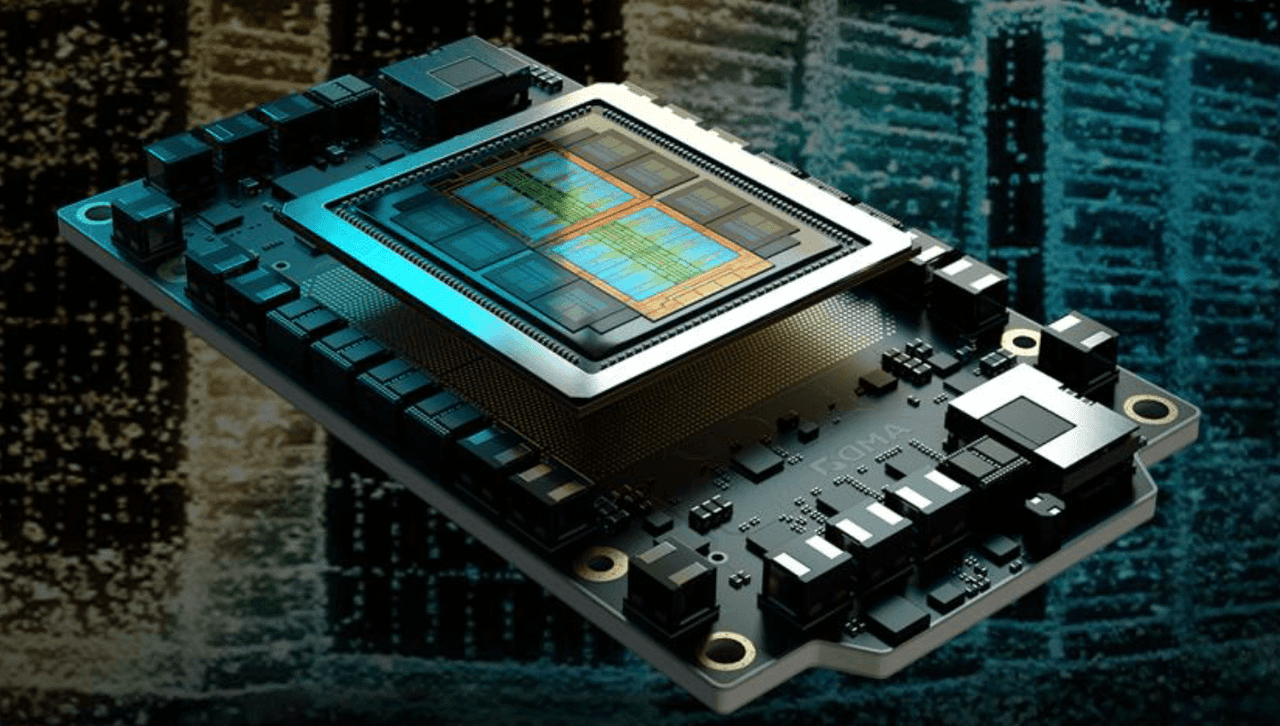
Massive deployments of AMD's Instinct MI355X GPUs are ongoing across several new data centers in North America
3
. AMD will soon start shipping its next-generation Instinct MI455X GPU accelerators, offering enhanced capabilities and compute performance while reducing total cost of ownership, setting up a battle with Nvidia's Vera Rubin series to power next-gen data centers globally3
. TensorWave is wading into a crowded and capital-hungry market where neoclouds like CoreWeave and Nebius have signed multibillion-dollar deals but lean almost entirely on Nvidia hardware1
. The risk is that these are debt-and-equity-fuelled buildouts priced on AI demand staying vertical, and a $1.55 billion valuation on a three-year-old infrastructure firm assumes the compute crunch and AMD's share of it keeps growing1
.Summarized by
Navi
[1]
[2]
08 Oct 2024•Technology

14 May 2025•Technology

13 Jun 2025•Technology

1
Policy and Regulation

2
Technology

3
Health