The Fed held rates steady, and its minutes are full of AI worry


6 Sources
[1]
Fed policymakers concerned about financial system risks, minutes show
NEW YORK, Nov 18 (Reuters) - Financial stability risks tied to aggressive artificial intelligence investment and elevated asset prices are on the US central bank's radar, the minutes from the Federal Reserve's policy meeting last month showed on Wednesday. The concern was raised as part of a broad
[2]
Fed officials expect more rate hikes, worry about AI impact on inflation, minutes show
Federal Reserve officials expressed confidence in October that further interest rate increases will be needed to stem inflation, though they decided to hold off while gathering more information, according to meeting minutes released Wednesday. Policymakers put artificial intelligence at the core
[3]
Fed officials worry an AI bust could shake the financial system
Minutes of the Fed's October meeting opened with an unusual warning about AI-related debt, as doubts about the boom spread on Wall Street. Almost every Federal Reserve official raised concerns last month about what could happen to the financial system if the artificial intelligence boom
[4]
Fed minutes show officials want more rate hikes, see AI inflation risk
Two Fed members voted against holding rates at 3.75% to 4% in October, preferring a quarter-point increase Federal Reserve officials concluded in October that additional rate hikes would be warranted to bring inflation back to 2%, according to minutes the central bank released Wednesday. Nearly
[5]

Fed flags financial stability risks from AI investment boom, elevated asset valuations
The US Federal Reserve has flagged financial stability risks from the AI investment boom, elevated asset valuations and rising hedge fund leverage. Policymakers warned that disappointing returns on AI investments, heavy borrowing and concentrated market exposure could trigger broader financial
[6]

Fed policymakers concerned about financial system risks, minutes show
NEW YORK, Nov 18 (Reuters) - Financial stability risks tied to aggressive artificial intelligence investment and elevated asset prices are on the US central bank's radar, the minutes from the Federal Reserve's policy meeting last month showed on Wednesday. The concern was raised as part of a broad
Share
Copy Link
The Federal Reserve held interest rates steady in October, but minutes of the meeting show almost all its officials worrying that returns on the AI boom could disappoint
2
3
.
Source: Quartz
The October 27-28 meeting ended with a 10-2 vote to keep the benchmark rate at 3.75-4%. Governor Lisa Cook and Cleveland Fed President Beth Hammack dissented, preferring a quarter-point hike
2
4
. Those voting to wait said the benefit of gathering more information justified holding the rate where it is2
. Nearly all participants said further hikes would likely be appropriate on their baseline outlooks, aimed at returning inflation to the Fed's 2% goal2
4
1
. A couple said a bigger-than-quarter-point move could be considered at the December 8-9 meeting if inflation data came in badly2
4
1
.The minutes described inflation pressures as broad-based, and some officials had pushed for a quarter-point hike at the October meeting itself
2
4
. October's consumer price report, released after the meeting, came in a tenth of a point above expectations on both measures2
4
. Economists read the figures as consistent with inflation running well above 3%2
4
. Underneath the debate sits one open question: whether inflation from the Iran war and Trump tariffs, potentially temporary shocks, is becoming entrenched in the economy2
.The AI warning
The AI discussion ran on two tracks. On inflation, many participants saw AI-driven demand as a material source of price risk, straining supply and pushing up the cost of tech-related consumer goods and skilled construction labor
2
4
3
.On financial stability, almost all participants flagged the risk of a scenario in which returns on AI investment disappoint investors. Most noted that AI-related debt had grown fast through complex, opaque financing structures, and a few said exposure was increasingly concentrated in a handful of firms
2
6
3
. Fed staff pointed to specific mechanics: arrangements "that off-balance-sheet leasing commitments and circular financing arrangements among AI-related firms could amplify losses if returns on AI investment were to disappoint"2
. In plain terms, suppliers are lending to and investing in their own customers, so a disappointment at one firm spreads to the firms backing it.AI-driven market-drop risk has appeared in Fed minutes since late 2025, per the Post, but never before with nearly every official weighing in. This time the document even opened with an unusual section on financial-system risks
3
.The worry was not abstract. Per the Fed's markets desk, two prominent AI firms had just reported revenue below expectations, and a giant tech company had unveiled data-center spending needing more financing than anticipated
3
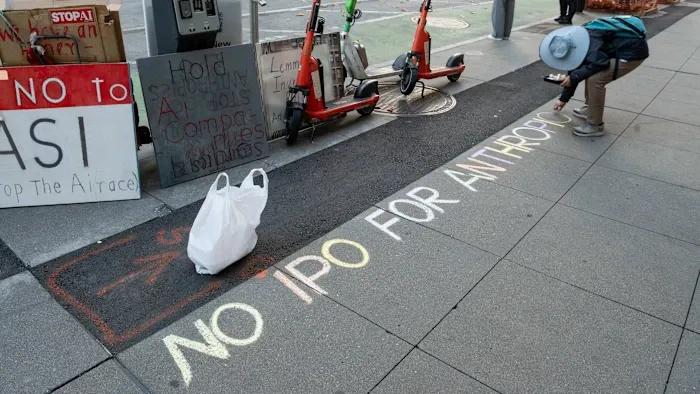
. In October, Google lost half a trillion dollars of market value in a single day. Meta said the day before the meeting that it planned to sell as much as $95 billion in new stock. Anthropic began the process for an IPO that is expected to set a record3
. Markets have been strained in recent weeks as questions grow about the buildout's reliance on debt6
1
.Getting ready for trouble
The alarm has limits. Fed staff judged that today's vulnerabilities could magnify shocks somewhat more than usual, with elevated asset valuations and hedge fund leverage the most salient
6
1
5
. The overall assessment was still resilience, with banks holding ample liquidity6
1
5
. Most participants also named hedge fund leverage and limited dealer capacity as potential amplifiers in a market selloff6
5
. Some officials cautioned that banking vulnerabilities can emerge rapidly even after reassuring assessments, and that Fed data may not capture banks' full exposure to private credit funds6
3
.A few policymakers mulled responses: higher bank capital requirements, better preparation for the Fed's discount window, and a dedicated asset-purchase facility aimed at financial stability
6
3
. History shapes the debate. Pandemic-era bond purchases that began in 2020 as market stabilization turned into outright stimulus, and officials do not want a repeat without a planned exit6
5
. Hammack wants any such program clearly defined and temporary, with holdings "sold in a timely way once market financial stability is restored"6
. Several policymakers cautioned that monetary policy is not the right tool for market trouble, though AI's role in growth could complicate that view6
3
.Related Stories
The December split
The hold bought time, and officials are using it to argue about the next move. Governor Christopher Waller said this week the Fed should consider a half-point hike in December and may have to shock markets. He is the only central banker publicly arguing for a half-point December hike
2
4
. St. Louis Fed President Alberto Musalem anticipates as much as a full percentage point of increases by spring 2027, though he does not vote until 20284
. New York Fed President John Williams said, "I don't think the situation calls for dramatic action"4
. Markets, for now, fully price a quarter-point hike at that meeting, per the CME FedWatch gauge, with a solid chance of two more increases in 20272
.
Source: Reuters
Warsh, for his part, said nothing about AI debt at his post-meeting news conference, saying only that credit had tightened about as expected. At an AI conference this week he described a staff-studied scenario of AI disappointment, falling stock prices and a slowing economy
3
. Per the Post's reading, Warsh has not appeared to embrace the view that the AI buildout is an inflation risk3
.
Source: Washington Post
References
Summarized by

Navi
[3]
Related Stories
Fed Officials Clash Over AI Investment Risks as Spending Reaches $2.4 Trillion
05 Aug 2026•Policy and Regulation

AI tops the Fed's list of financial-system worries, and the worry has a number behind it
14 Nov 2026•Business and Economy
Central banks warn AI bubble could trigger global recession as Big Tech spending hits $1 trillion
25 Jun 2026•Policy and Regulation

Recent Highlights


Recent Highlights
Today's Top Stories







Don’t drown in AI news. We cut through the noise - filtering, ranking and summarizing the most important AI news, breakthroughs and research daily. Follow topics that matter to you and stay ahead.


