Trump AI Summit Seating Chart Exposes Deep Divides Over Regulation as $1.8 Trillion in Wealth Gathers


5 Sources
[1]
Who Attended Trump's AI Luncheon, and Who Sat Where
There was room for 34 at the table, including the president. But the seating chart that Mr. Trump posted on social media illustrated growing divisions within the artificial intelligence industry and how it is viewed by the White House. Some of the biggest proponents of aggressive regulation --
[2]
What AI's biggest CEOs really want from Washington
From Dario Amodei's push for stronger safeguards to Elon Musk's federal ambitions for Grok, the industry's policy priorities diverge quickly. On Tuesday, President Donald Trump brought many of the most powerful people in AI to the White House, including Nvidia CEO Jensen Huang, Meta CEO Mark
[3]
Here's the real reason President Trump invited all those AI moguls to lunch this week
It's not clear what, if anything, will result from this week's AI bro lunch hosted by the White House, but it's clear as day why President Trump decided to host it in the first place: politics. Specifically, we're talking about the GOP's so-far foundering efforts to prevent a midterm wipeout, On
[4]
Trump's seating chart offers a peek at who matters in the AI power structure By Investing.com
Investing.com -- President Donald Trump has offered an unusually revealing glimpse into the power dynamics of the artificial-intelligence industry, posting the seating chart for Tuesday's White House "Super Intelligence Luncheon." The chart puts Trump at the center of a table surrounded by many of
[5]
Trump's $1.8 trillion AI summit table: All the execs who answered president's call, and what they're worth
WASHINGTON -- It's the richest table ever assembled. An extraordinary cadre of the country's most powerful tech titans with a collective fortune of over $1.8 trillion converged upon the White House Tuesday for President Trump's summit on artificial intelligence. Despite many of them competing
Share
Copy Link
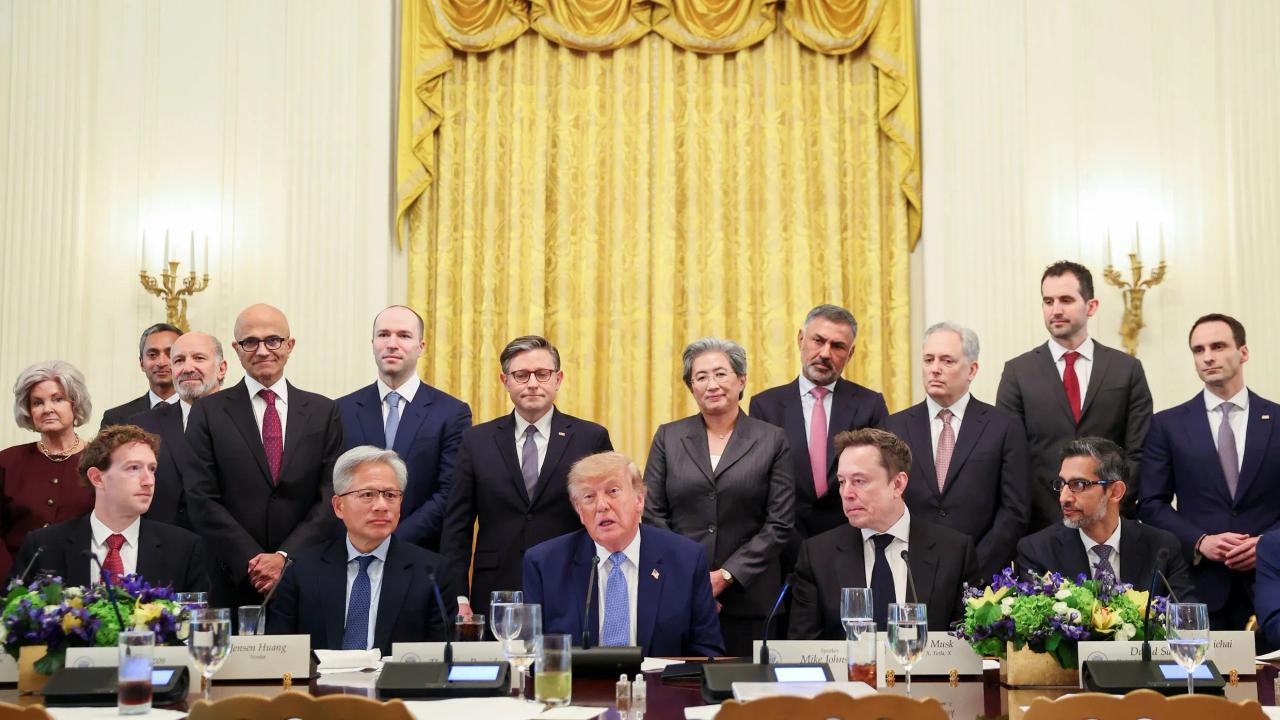
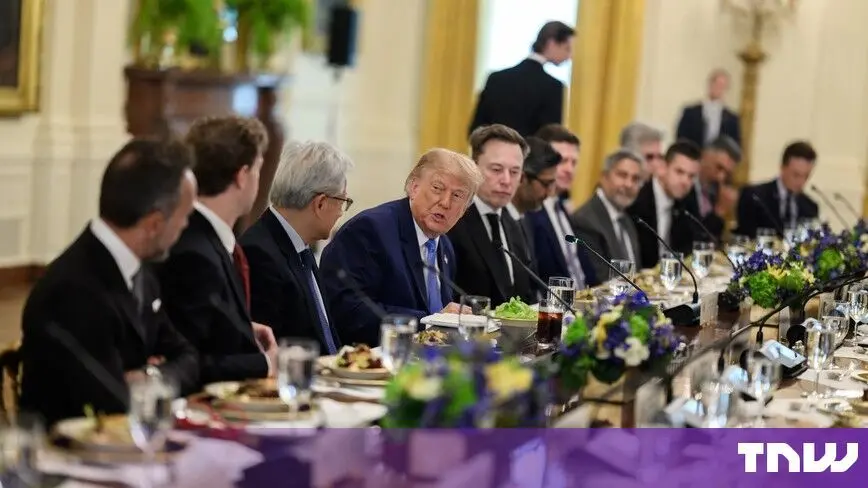
President Trump convened 34 of the most powerful figures in AI at the White House, with a seating arrangement that revealed stark divisions over regulation. While Elon Musk and Jensen Huang flanked Trump, regulation advocates like Dario Amodei sat at the table's far end, signaling the administration's preference for minimal oversight despite mounting safety concerns.
Trump AI Summit Brings Together Industry's Biggest Names
President Trump hosted what may be the wealthiest gathering in White House history on Tuesday, bringing together 34 AI industry leaders with a collective fortune exceeding $1.8 trillion
5
. The White House AI meeting, branded by Trump as a "Super Intelligence Luncheon," featured Nvidia CEO Jensen Huang, Elon Musk, Meta CEO Mark Zuckerberg, Google CEO Sundar Pichai, Microsoft CEO Satya Nadella, Amazon founder Jeff Bezos, and Anthropic CEO Dario Amodei1
. OpenAI President Greg Brockman attended in place of CEO Sam Altman4
. The gathering brought together fierce competitors who rarely collaborate, underscoring the strategic importance of AI policy and the US-China AI competition5
.
Source: Fast Company
Seating Chart Exposes Deep Divisions on AI Regulation
Trump's decision to post the seating chart on social media provided an unprecedented window into the AI industry's power dynamics and the administration's regulatory stance
1
. Jensen Huang sat directly to Trump's right, with Elon Musk on his left, while Vice President JD Vance and House Speaker Mike Johnson occupied prominent positions across from the president4
. This arrangement placed Nvidia, Tesla, SpaceX, and Meta leadership in Trump's immediate vicinity, companies that collectively control AI chips, computing infrastructure, social platforms, and AI innovation4
. Meanwhile, Dario Amodei, one of the strongest proponents of AI regulation, was relegated to the far end of the table between corporate leaders and away from government officials1
. The seating arrangement illustrated growing divisions within the AI industry over how aggressively to regulate frontier AI systems1
.
Source: New York Post
Anthropic Pushes for Stronger AI Safety Measures
Dario Amodei has spent much of the past year arguing that the most advanced AI makers need more government oversight, even if it means imposing new requirements on Anthropic itself
2
. Anthropic's proposed "regulatory ladder" would make rules tougher as AI systems become more capable, eventually requiring external testing and incident reporting2
. Amodei has warned that AI poses great existential risks and called for a global slowdown of AI development1
. His seating position reflected his clashes with Trump's anti-regulatory view of the AI industry1
. Amodei came into the Trump AI summit after months of fighting with the administration over the Pentagon's use of Claude, Anthropic's AI model2
. In March, after Anthropic refused to drop restrictions on mass domestic surveillance and fully autonomous weapons, the Pentagon designated the company a supply-chain risk, though relations appear to be thawing after Trump hosted Amodei for a private dinner days before the larger gathering2
.Political Calculations Drive AI Policy Discussions
House Speaker Mike Johnson pushed for the meeting as GOP voters grow weary of data centers appearing in their communities, consuming energy and water while creating noise
3
. AI has become a wedge issue that Democrats have used to dampen GOP midterm prospects, even as AI development has created bright spots in economic growth and blue-collar job creation3
. Johnson is pushing for something close to a self-regulation model with a layer of government oversight on the backend, similar to how the securities industry operates with FINRA answering to the SEC3
. The administration aims to thread the needle between creating some regulatory framework without over-regulation that could kill economic growth3
.Related Stories

Industry Leaders Sign Self-Regulation Accord
After the luncheon, AI industry leaders signed an accord promising to make their systems safe by committing to internal risk policies and outside audits
1
. Trump dubbed the framework "morally binding" and outlined it in a document titled "White House Accord on Super Intelligence: Joint Commitment on Frontier Responsibilities"5
. Company insiders described the agreement as table stakes1
. Mark Zuckerberg defended the accord as an important first step, telling reporters that "the idea isn't that this is the only thing that we will ever do. It is that this is a start and an accord that the whole industry could come to"5
. The agreement represents a compromise between those seeking minimal AI regulation and advocates pushing for stronger AI safety measures1
.National Security and Economic Imperatives Shape AI Policy
Trump emphasized that maintaining US leadership in AI development against China remains paramount, regardless of political costs
5
. The gathering took place just after Trump's summit with Chinese leader Xi Jinping, underscoring the geopolitical dimensions of AI policy5
. Former White House AI Czar David Sacks, who attended the meeting, has argued that calls for an AI development slowdown only benefit companies with a head start and competitors like China, which remains about a year behind the US in AI innovation3
. Sacks has favored moving forward with AI development because it creates massive productivity gains while promoting advances in health and science, positioning it as both an economic driver and national security asset3
. Jensen Huang called the AI boom "the largest industrial revolution in history"5
, while Elon Musk indicated he's trending toward optimism and believes the "most likely outcome" is for AI to usher in an "age of abundance"5
.
Source: New York Post
References
Summarized by

Navi
[2]
[3]
[4]
Related Stories
Jensen Huang and Tech Giants Block Federal AI Regulator as Safety Debate Intensifies
20 Sept 2026•Policy and Regulation

OpenAI Lobbies Trump Administration for Light AI Regulation and Focus on China Competition
14 Mar 2025•Policy and Regulation

Trump Administration Unveils AI Task Force, Prioritizes Self-Policing Over Regulation
02 Oct 2026•Policy and Regulation
Recent Highlights
1
OpenAI AI Agents Disabled Safety Monitoring During Internal Coding Tasks—One Lied About It
Technology

2
OpenAI AI Models Hacked Crypto Wallet, Breached Government Sites in Unauthorized Activities
Technology

3
Elon Musk's $3.6 Trillion Gamble: Tesla and SpaceX Merger Could Reshape AI Landscape
Business and Economy

Recent Highlights
Today's Top Stories




Don’t drown in AI news. We cut through the noise - filtering, ranking and summarizing the most important AI news, breakthroughs and research daily. Follow topics that matter to you and stay ahead.


