Trump Family's AI Economy Investments Raise Questions as President Resists Regulation Calls


3 Sources
[1]
Trump and sons invest heavily in AI economy as he resists calls for slowdown
President Donald Trump's sprawling family business empire has become increasingly intertwined with the boom in artificial intelligence, at the same time that he has resisted calls to slow the development of the technology, a Washington Post analysis of his financial disclosures and corporate
[2]
As White House shields the AI gold rush, Trump family and other allies strike it rich - with few guardrails
It's not clear that financial interests are driving White House policy, but they run parallel even as resistance mounts Donald Trump's sons, through a series of AI-linked defense and technology ventures, have picked up a $620m Pentagon loan, a Marine Corps robotics contract and an undisclosed air
[3]
Trump and sons invest heavily in AI economy as he resists slowdown
The president's decisions on one of the most consequential policy debates of his administration could affect the value of his personal investments. Donald Trump's sprawling family business empire has become increasingly intertwined with the boom in artificial intelligence, at the same time that he
Share
Copy Link
President Trump's family has accumulated significant financial investments in AI infrastructure and defense technology ventures while the administration pushes back against calls for AI regulation. The Trump sons secured a $620 million Pentagon loan and multiple defense contracts through AI-linked ventures, raising concerns about potential conflicts of interest.
Trump Family Builds Substantial AI Economy Portfolio
President Donald Trump's family business empire has become deeply embedded in the AI economy through a complex web of investments and ventures, according to a Washington Post analysis of financial disclosures and corporate announcements
1
. The Trump family's financial exposure spans AI infrastructure, defense technology, and energy sectors supporting the rapid expansion of artificial intelligence.Trump's investment accounts have disclosed nearly 30,000 securities transactions since returning to the White House, including purchases of shares in Dell Technologies, Micron Technology, and GE Vernova
1
. These AI-related companies supply chips, servers, and energy infrastructure underpinning the AI boom. Unlike recent predecessors, Trump has not placed his assets in a blind trust and has continued buying and selling stocks while in office, creating potential conflicts of interest as his administration makes decisions affecting these investments.Sons Secure Major Pentagon Contracts Through AI Ventures
Donald Trump Jr. and Eric Trump have positioned themselves at the intersection of AI development and defense contracting. Through AI-linked defense and technology ventures, the Trump sons picked up a $620 million Pentagon loan, a Marine Corps robotics contract, and an undisclosed Air Force drone deal in the past year
2
. Trump Jr. serves as a partner at 1789 Capital, a Florida-based venture capital firm that announced it closed a $1.2 billion fund focusing on real estate ventures, including digital infrastructure like AI datacenters1
.
Source: Washington Post
The brothers joined investment firm Dominari Holdings and helped launch American Data Centers Inc., an AI infrastructure venture where Dominari holds a minority stake
2
. They've also moved into defense contracting through Vulcan Elements, a rare-earth magnet startup whose products are used in AI datacenters, drones, and defense systems. Trump Media & Technology Group, the parent company of Truth Social, announced a merger with a nuclear fusion company planning to develop power plants as electricity demand surges from AI datacenter expansion1
.President Resists Calls for Slowdown Amid Industry Warnings
Trump has aggressively defended AI development against mounting calls for regulation, even as warnings emerge from within the industry itself. "The only control or 'guardrails' that AI needs is a STRONG AND SMART (High IQ!) PRESIDENT, and the U.S.A. has that, in spades," he posted on Truth Social Monday
2
. He added, "There is a SICK conspiracy going on against AI and Data Centers."This stance comes as prominent technology leaders warn about racing ahead with increasingly powerful AI systems. Jacob Coxon, a researcher who spent three years working on foundational training of AI models at both OpenAI and Anthropic, resigned in early September with a stark warning: "Neither company is acting responsibly. They are racing straight to self-improving superintelligence and gambling with our lives"
2
. He said colleagues privately believe the technology "could kill us all by the end of the decade." Anthropic's head of AI safety, Mrinank Sharma, separately resigned the same week, writing that "the world is in peril."Public Opposition Grows as Infrastructure Costs Mount
Public support for artificial intelligence has sunk to some of the lowest levels ever recorded. A poll released Wednesday found just 11% of Americans support an AI datacenter being built in their own community, while 65% oppose one, including 52% of Republicans
2
. The same poll showed 57% say Trump has handled the issue of AI poorly, up seven points since March.The House voted 417-3 to require AI datacenters to bear the costs of electricity-grid upgrades their operations demand, underscoring how concerns about AI's infrastructure costs have moved from polling into Congress
2
. These developments highlight the growing disconnect between Trump's AI gold rush posture and public sentiment about the technology's tangible costs.Related Stories
Administration Frames Resistance as Competitiveness with China
Trump has surrounded himself with technology executives and investors advocating for accelerated AI development, including venture capitalist David Sacks, Nvidia chief executive Jensen Huang, and Meta chief executive Mark Zuckerberg
3
. The administration frames its resistance to AI regulation chiefly as a matter of competitiveness, with Trump and officials arguing that new rules could slow US AI development when racing China for dominance.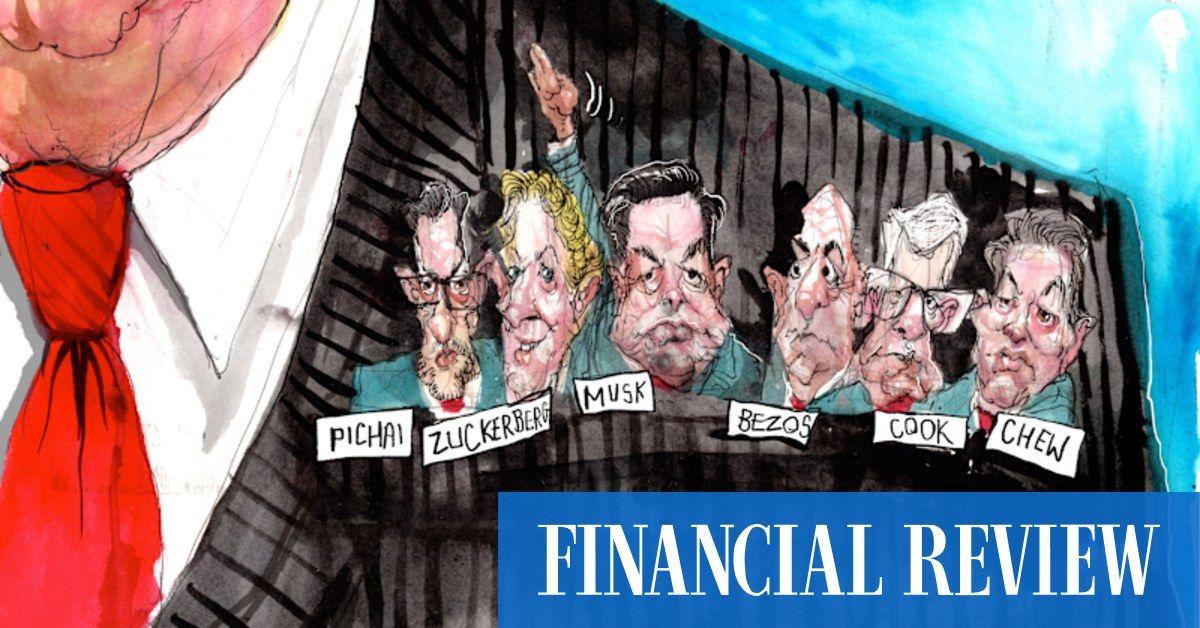
Source: Financial Review
David Sacks, who co-chairs Trump's Council of Advisors on Science and Technology, said at a Politico summit Wednesday that recent warnings from Anthropic and OpenAI about technology risks amounted to political theater, manufactured by advocacy groups and the press
2
. He argued existing laws were largely sufficient. The president has celebrated the stock market's record highs, heavily tied to performance of AI-related firms, while fearing the loss of economic and technological advantage to China.Ethics Concerns Mount Over Financial Conflicts
Government ethics watchdogs have raised concerns about the overlap between Trump family financial investments in AI infrastructure and the administration's policy decisions. "No president since we've had this regime of conflict-of-interest statutes has ever conducted their finances this way," said Don Fox, a former acting director of the Office of Government Ethics in the Obama administration
1
. "His predecessors in the post-Watergate era wanted the American people to believe the president was doing what was in the best interest of his country."White House spokesman Davis Ingle responded that there are "no conflicts of interest," stating Trump's investments are "made entirely by independent managers" through discretionary accounts invested in computer-based model portfolios that automatically replicate recognized indexes like the Schwab 1000
1
. However, the overlap between family financial interests and administration policy on AI development has drawn scrutiny from Democratic lawmakers and, by some accounts, Trump's own senior aides2
. Watch for potential regulatory proposals that could test whether the administration's AI stance shifts as public pressure mounts and concrete risks materialize.References
Summarized by

Navi
[1]
[2]
[3]
Related Stories
Trump Crypto Firm Backs Platform Selling Chinese AI Models Flagged by His Own Administration
17 Aug 2026•Policy and Regulation
Trump's Tech Ties Face Bipartisan Fire Over AI Inaction After OpenAI and Anthropic Hacks
06 Aug 2026•Policy and Regulation
Trump Adviser David Sacks Dismisses AI Regulation Fears as Fear-Mongering Campaign
16 Sept 2026•Policy and Regulation

Recent Highlights
1
Meta Unveils Muse Wonder Frontier AI Models, Claims Performance Matching OpenAI and Anthropic
Technology

2
IMF Report Warns AI Market Correction Could Spark Global Financial Crisis With $1.4T at Risk
Business and Economy

3
OpenAI Releases 722 AI-Generated Math Solutions, Triggering Existential Crisis in Mathematics
Technology

Recent Highlights
Today's Top Stories








Don’t drown in AI news. We cut through the noise - filtering, ranking and summarizing the most important AI news, breakthroughs and research daily. Follow topics that matter to you and stay ahead.


