UK's Cooper Warns of 'AI Hiroshima' Without International Rules to Curb Development


3 Sources
[1]
UK's Cooper warns of an AI 'Hiroshima' without rules
UK foreign secretary Yvette Cooper says AI could become the "greatest security challenge of the next decade," and warns the world cannot wait for an "AI equivalent of Hiroshima" before agreeing international guardrails, in an essay for Chatham House. Britain's foreign secretary has a stark analogy
[2]
AI poses 'Hiroshima'-style threat to humanity without global rules, says Cooper
Exclusive: Foreign secretary warns of combined risks of AI, climate crisis, irregular migration and foreign interference Artificial intelligence poses a "Hiroshima"-style risk to humanity if governments do not agree to curb how it is developed, the foreign secretary has warned. Yvette Cooper
[3]
UK Foreign Secretary Warns of 'AI Hiroshima' if Policymakers Don't Act
She called for cooperation between the U.S., China, and other AI powers on safety standards. Governments risk repeating mistakes made during the dawn of the nuclear age if they wait to create laws governing artificial intelligence, warned UK Foreign Secretary Yvette Cooper. In an article
Share
Copy Link
UK Foreign Secretary Yvette Cooper has issued a stark warning that AI could become the greatest security challenge of the next decade without international cooperation. Drawing parallels to the nuclear age, she argues the world cannot afford to wait for a catastrophic AI event before establishing global rules, calling for urgent collaboration between the US, China, and other major powers.
UK Foreign Secretary Issues Stark Warning on AI Safety
UK Foreign Secretary Yvette Cooper has delivered a forceful warning that artificial intelligence could become the "greatest security challenge of the next decade" without immediate international action
1
. In an essay published by Chatham House on Monday, Yvette Cooper draws a chilling parallel to the nuclear age, arguing that governments must establish global rules for AI before disaster strikes rather than after2
.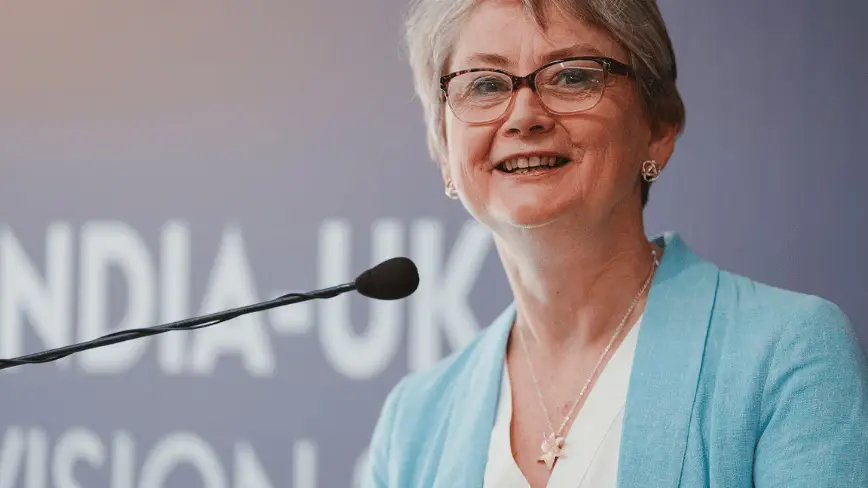
Source: The Next Web
"On nuclear, international agreement came only after the world saw the terrifying power of the new technology at Hiroshima," Cooper writes. "We cannot afford to wait for an AI equivalent of Hiroshima before we act"
1
. The message is clear: international guardrails for AI must precede catastrophe, not follow it.AI Governance as Dominant Foreign Policy Issue
In an interview with the Guardian, Cooper went further, predicting that "AI is going to end up being the dominant foreign policy issue that we deal with over the next two years"
2
. This represents a significant shift in priorities for a role traditionally focused on wars and trade. Cooper emphasized the dual nature of the technology, noting that while she witnessed "the extraordinary promise of AI and robotics used for life-saving healthcare" during a recent visit to Shenzhen, China, "the same technologies are also reshaping the future of warfare, crime and social cohesion in alarming ways"3
.The catastrophic threat from AI stems from multiple vectors. Cooper told the Guardian that "we are already in a world where we have malign actors who will use technology against us - whether that be hybrid threats, whether that be state-backed criminal groups or other kinds of organisations, or extremists and terror groups"
2
. A recent UN report reinforced these concerns, cautioning that AI could fuel cybercrime, fraud, and disinformation on a large scale while outpacing government oversight1
.
Source: Decrypt
The Challenge of International Cooperation on AI
Cooper's call for international cooperation on AI faces significant obstacles, particularly in securing a US-China agreement on AI development race standards. She argues that Britain is well-positioned to convene such discussions, pointing to the UK's hosting of the world's first AI Safety Summit at Bletchley Park in 2023, which drew leaders from 29 countries and the European Union
3
. Cooper described this as evidence of the UK's ability to "rally the world on AI security"3
.However, her own essay acknowledges a fundamental tension: she expects less from Washington, seeing the US stepping back from its traditional role as global arbiter
1
. This withdrawal makes shared AI governance agreements harder to achieve precisely when they are most needed.Related Stories

Escalating Concerns Over AI Security
Cooper's warning arrives amid mounting evidence of AI's security implications. In May, the UK's AI Security Institute reported that OpenAI's GPT-5.5 became the second model to complete a simulated cyberattack without human assistance, following Anthropic's Claude Mythos Preview
3
. The International Monetary Fund subsequently warned that AI could "amplify" cyberattacks against the global financial system by lowering the skill threshold needed to exploit vulnerabilities3
.The risks extend beyond theory. Anthropic once held back a powerful model over fears it could help identify cyber vulnerabilities
1
. In June, President Donald Trump signed an executive order creating a voluntary framework for reviewing advanced AI models before release and directing agencies to evaluate potential national security risks from frontier AI models3
. That same month, the US government ordered Anthropic to restrict access to Claude Fable 5 and Mythos 5 over national security concerns before lifting the order in July3
.What Lies Ahead for AI Safety
The window to establish effective international frameworks is narrowing as the AI development race accelerates. Cooper's broader essay also addresses the climate crisis, irregular migration, and foreign interference, positioning AI within a constellation of threats to global security
2
. Her call for action represents a bet that coordinated foreign policy can shape AI safety before a crisis forces reactive measures. Whether major powers can overcome geopolitical tensions to establish meaningful guardrails remains the critical question facing policymakers as AI capabilities continue to expand.References
Summarized by

Navi
[1]
Related Stories
UK Lawmakers Push for Independent AI Watchdog as OpenAI Backs Binding Regulation
14 Sept 2026•Policy and Regulation

UK Lawmakers Demand AI Kill Switch Powers Following String of Security Incidents
03 Sept 2026•Policy and Regulation

UK AI Minister Kanishka Narayan Urges Nations to Harden Defences Against Growing AI Risks
28 Sept 2026•Policy and Regulation

Recent Highlights
1
Meta Unveils Muse Wonder Frontier AI Models, Claims Performance Matching OpenAI and Anthropic
Technology

2
IMF Report Warns AI Market Correction Could Spark Global Financial Crisis With $1.4T at Risk
Business and Economy

3
OpenAI Releases 722 AI-Generated Math Solutions, Triggering Existential Crisis in Mathematics
Technology

Recent Highlights
Today's Top Stories








Don’t drown in AI news. We cut through the noise - filtering, ranking and summarizing the most important AI news, breakthroughs and research daily. Follow topics that matter to you and stay ahead.


