2 Sources
[1]
Veeam's big pivot on display at VeeamON 2026 - SiliconANGLE
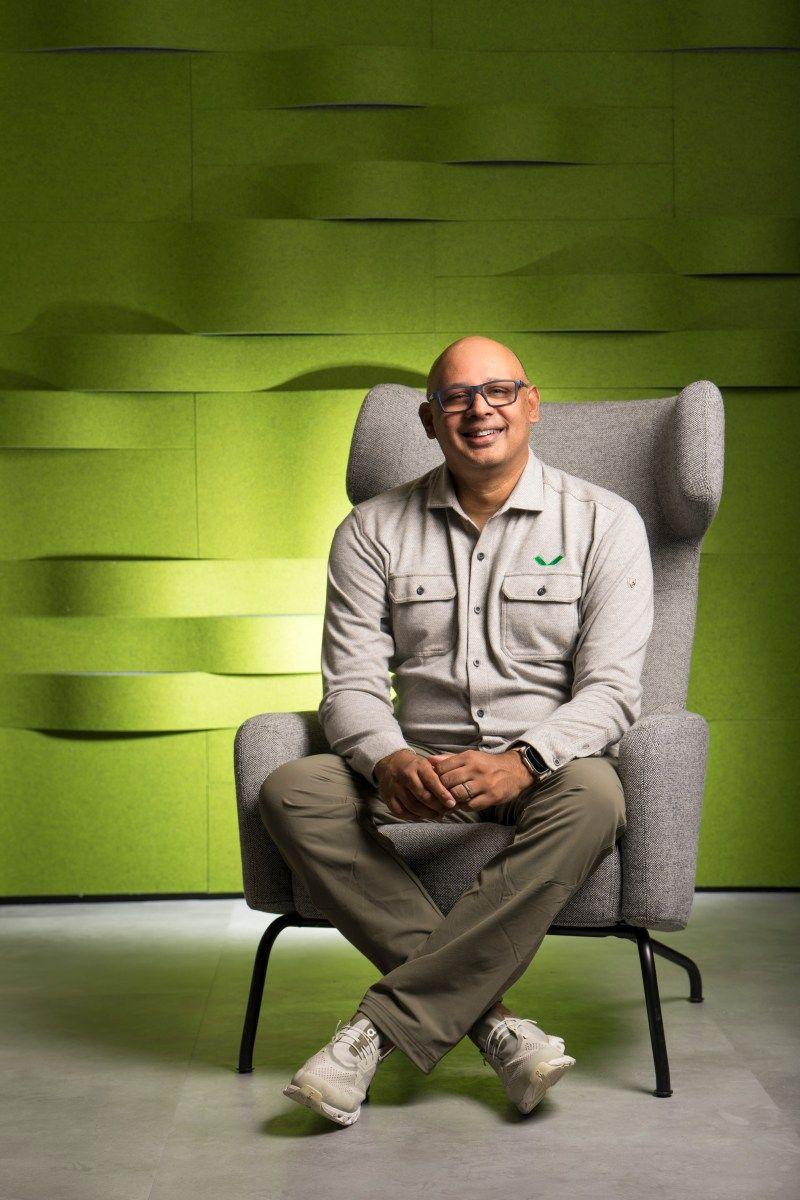
Veeam Software Group GmbH used VeeamON 2026 in New York City this week to punctuate its shift from "the backup company" to a data and artificial intelligence trust platform for the agentic era. With a new architectural layer and an aggressive product roadmap, Chief Executive Anand Eswaran (pictured) and President of Products and Technology Rehan Jalil are betting that the next decade of enterprise infrastructure will be defined less by how quickly you can restore a virtual machine or data set and more by how confidently you can let AI act on your data. For most of its 20-year history, Veeam has been synonymous with backups and fast recovery, to the point that "instant recovery" became part of the company's identity. Eswaran reminded the VeeamON audience that Veeam earned its leadership by reducing customers' RTOs from hours to about two minutes and by building "the broadest workload coverage on the planet across virtual machines, physical, hybrid multicloud and SaaS." That foundation now protects more than 550,000 customers in more than 150 countries, including 82 of the Fortune 500, and drives more than $2 billion in annual recurring revenue. In Eswaran's view, what has changed is not the importance of recovery but the nature of the threats and the actors who access enterprise data. He framed Veeam's history as three eras: traditional backup and recovery ("assume restore"), cyber resilience ("assume breach"), and now the agentic era of AI ("assume autonomy"), in which nonhuman identities operate at a scale and speed that existing tools were never designed to govern. At the core of Veeam's pivot is a view of how AI is deployed across large enterprises. Veeam's research and telemetry indicate that autonomous AI agents already outnumber human employees by 82 to 1 on average, representing more than 250,000 non-human identities per organization. Even more concerning, Veeam reports that 97% of those agents have excessive privileges, dramatically expanding the blast radius of a single compromised or misconfigured agent. Eswaran argued that legacy security architectures implicitly assumed "the actor was human," and that assumption "just fundamentally broke instantly" when agents began accessing ERP, CRM, warehouses, email, files and SaaS systems in parallel. In that world, a new failure is "not just a breach, it's a wrong decision executed at machine speed before anyone notices" -- a point underscored by examples such as an AI agent deleting a production database and its backups in nine seconds, or autonomously recreating a cloud environment and triggering a 13-hour outage and millions of lost orders. Veeam claims there is now a "missing layer" in the AI stack, positioned between data platforms and models. The solution is a unified data and AI trust layer that treats data, identities, access, regulatory posture and resilience as a single system. "The infrastructure to deploy AI exists," Eswaran told attendees. "The infrastructure to trust it doesn't." That thesis is why the company built its new Veeam DataAI Command Platform, described as "the industry's first unified data and AI trust infrastructure for the agentic era." The platform is the result of Veeam's December 2025 acquisition of Securiti, a leading data and AI security posture management vendor, combined with two decades of Veeam's recovery and data protection capabilities. By design, it spans both production and backup systems, enabling visibility into what AI agents can access, what they did and how to undo it with precision. Architecturally, the DataAI Command Platform is anchored by the DataAI Command Graph, which Veeam calls a unified intelligence layer with more than 300 connectors spanning public cloud services, SaaS applications, on-premises systems, and now backup environments. Jalil described it as a "social graph for data," continuously mapping data assets, users, permissions, AI agents, activity and protection status across billions of files and millions of tables. On top of that graph, Veeam has defined six integrated capabilities as the core of its trust layer: An agentic layer of built-in AI assistants can answer natural-language questions, such as "Is workload X protected?" and automate tasks like log triage, ticket management, and policy-driven recovery. Jalil explained the reality of the situation: "If you don't understand what data you have, who's touching it, and what changed, there is no automation, no precision and no compliance." The 2025 edition of VeeamON marked the moment when the company outlined its vision, and this year, it focused on releasing products that align with the trust narrative. The headline announcement was the previously mentioned Veeam DataAI Command Platform, positioned as the missing AI trust layer and immediately available with the DataAI Command Graph and five core domains live. Existing Veeam Data Platform customers can connect to it via a new DataAI Resilience Module, gaining centralized visibility and agentic capabilities "with no re-migration required." On the resilience front, Veeam previewed Veeam Data Platform v13.1, introducing more than 70 features, including expanded hypervisor coverage (targeting 95%+ of the market), portability across hypervisors, stronger Active Directory Forest recovery, post-quantum cryptography enhancements and smarter NAS archiving for lower-cost long-term retention. The company also introduced Veeam Intelligent ResOps, the first resilience offering built natively on the DataAI Command Platform, with Microsoft 365 as the initial workload. Intelligent ResOps uses the graph to unify data, context and recovery across SharePoint, OneDrive, Teams and Exchange. When an AI assistant or human makes a bad change, teams can see exactly what changed and whether the data is sensitive or regulated, then "restore only what's needed instead of broad, disruptive restores." Finally, Veeam launched a Data and AI Trust Maturity Model, developed with McKinsey and informed by input from more than 300 chief information officers and chief information security officers, to provide enterprises with a structured way to benchmark and plan their path from AI experimentation to demonstrable, auditable trust. Organized around the four pillars of Understood, Secured, Resilient and Unleashed, the model includes 12 dimensions and 49 subdimensions across five maturity levels. It is delivered as a consultative assessment featuring scored profiles, peer benchmarking and a prioritized roadmap. Eswaran consistently returned to the theme that "recovery is the ultimate currency" in a world where AI, identity, and data are "completely connected, always under attack." At the same time, he acknowledged that traditional notions of recovery are no longer sufficient: "You cannot roll back the enterprise" every time an agent goes wrong; instead, "remediation needs to be precise. You must be able to undo just those five seconds of agent action, just that one element in a file which got changed." He also emphasized that Veeam's rebranding as "the Data and AI Trust Company" is more than label-swapping. "For us, DataAI is not just a branding exercise; it is where data, access and controls, identity and AI come together in one connected platform, because in the agentic era, you cannot solve these as individual problems." Jalil, whose Securiti team now forms the core of Veeam's data security and governance stack, framed the opportunity and responsibility for resilience teams in the AI era. "If you're trying to bring AI into the enterprise, you're not going to put your intellectual property and your information behind it without guardrails and without knowing that you can recover from anything," he said. "That really is the opportunity for our community and for us to play a central role in enabling the safe transformation toward AI." From an industry-structure standpoint, Veeam's move expands the competitive field it operates in. The company is no longer just competing against legacy backup vendors; it's now colliding with DSPM providers, identity-centric security platforms, privacy automation tools and a growing wave of AI governance startups, while also claiming a unique position as the only vendor that deeply understands both the live data plane and the backup plane. For customers, the question is whether it's better to assemble trust capabilities from multiple best-of-breed tools or to consolidate on a unified platform that unifies data, identities, AI agents, and resilience. Veeam's bet is that in the agentic era, running security, governance, compliance, privacy, and recovery as separate disciplines with different vendors, budgets, and UIs "stops being an option," because every gap in context becomes a gap in trust. That's the essence of Veeam's big pivot: from promising to get you back up when "everything else breaks" to promising that your data, and the AI acting on it, will be understood, governed and recoverable by design. If the agentic era unfolds as Eswaran and Jalil describe it, the companies that can operationalize that promise at scale will define the next infrastructure category. If Veeam had acquired a cyber company five years ago, the industry might have said, "Huh? Why?" and viewed Veeam as a company with a solution looking for a problem. However, operating AI at scale is fundamentally different from operating the information technology environment of a decade ago. Make no mistake, the agentic era is coming fast, and it's going to create problems IT leaders can't comprehend. In an analyst Q&A, Eswaran discussed Veeam's competitive position: "Regarding that 80% of the Fortune 500 - our forward-looking thesis centers on the ability to leverage a 'Contextual Intelligence Knowledge Graph.' This provides essential context to your data and its surrounding ecosystem, bridging relationships across identity, AI, and agents. We believe this will be our primary differentiator." For customers, the takeaway from Veeam's big pivot is to treat data and AI trust as an architectural requirement, not an add-on feature. That means inventorying where AI agents already touch your critical data, consolidating visibility across production and backup, and insisting on controls that can both prevent bad actions and surgically unwind them when they occur. Don't wait for a regulatory mandate or a headline-making incident to force the issue; use this moment to pressure-test your identity, governance, and recovery assumptions against an "assume autonomy" world. The organizations that move now to unify security, compliance, privacy and resilience around a common data graph will be the ones that can adopt AI fastest -- because they'll be the only ones that can prove, to themselves and to others, that they can trust it.
[2]
How Veeam Is Bringing A 'Unified' Approach To Securing Data And AI: Execs
'I think it's a really smart strategic move by Veeam to integrate the security features and the AI features, bring them together and make them more cohesive,' an SHI executive tells CRN. The push at Veeam to bring a unified approach to solving crucial security and AI challenges is poised to create massive growth opportunities with the solution and service providers that are on the front lines in the shift to the AI era, top Veeam executives said Tuesday. During VeeamON 2026 in New York City, Veeam CEO Anand Eswaran (pictured) and other leaders at the company touted the company's newly unveiled DataAI Command Platform as the answer to addressing the biggest questions that partners and customers have when it comes to security and governance for AI. [Related: Channel Has 'Huge' Role In Securing AI Agent Revolution: Top Execs] Without a doubt, "there are a lot of customers out there who are looking at, 'how do we protect ourselves in this agentic era?'" said Bahare Chanady, regional vice president for presales at SHI International, a major Veeam partner and No. 12 on CRN's Solution Provider 500 for 2025. "I think Veeam is providing the solution for the customers who are looking at their options to secure their environment." The DataAI Command Platform brings together an intelligence graph with data security posture management (DSPM) and AI security posture management (AI-SPM) -- as well as with capabilities for governance, compliance, privacy and resilience. Leveraging Veeam's $1.72 billion acquisition of Securiti last fall, "we are creating a new category that did not exist before -- and that category is data and AI trust," Eswaran said during his keynote Tuesday during VeeamON 2026. "And that, in our opinion, is the missing layer in the AI stack. And it is the essential layer to talk about accelerating safe AI at scale." The key, he said, is that Veeam is aiming to "unify multiple domains together at the same time, connected to one data fabric -- data and AI security, governance, compliance, privacy and resilience coming together in one platform." Crucially, "everything I've described here is not a vision. It's not something which is going to come in a year. It is product truth today," Eswaran said. Veeam is entirely focused on working with its channel partners to bring this new approach to data and AI security to the market, executives said. The Veeam data and AI trust platform is set to provide a huge opportunity for partners to have new conversations with their customers, according to Kevin Rooney, vice president for Americas partner sales at Veeam. Securiti has now been integrated into Veeam's existing deal registration program, he said during a session at VeeamON 2026 Tuesday. "We are a partner-first company. We built this company with all of you. We will continue to do that, and we are fortunate enough to fold Securiti AI into that program," Rooney said. "We will have significant margin opportunity for you [around] upselling into the enterprise accounts. Securiti AI is a game changer for our existing Veeam partners." There is also a substantial and growing SMB opportunity for solution and service providers to work with Veeam, according to Veeam CRO John Jester. Compared to several years ago, Veeam's expanded set of offerings has massively increased the total addressable market (TAM) for partners to sell to SMB customers -- including through offerings such as Veeam's fast-growing Data Cloud Vault offering, Jester said Tuesday. Today, "we've almost tripled what we can sell to [an average SMB] customer," he said. The bottom line for partners is that Veeam is seeking to provide a means for changing the conversation from backup and recovery to focus on data trust, said Mike Rau, vice president of global partners at Veeam. "Data trust opens up a much larger business for you with your customers," Rau said while addressing partners Tuesday. There's no question that Veeam is making the necessary moves to position the company for growth in the converging areas of security and AI, as these segments become increasingly critical for customers, according to SHI's Chanady. "I think it's a really smart strategic move by Veeam to integrate the security features and the AI features, bring them together and make them more cohesive," she told CRN. The unified platform is able to leverage one of the big advantages that Veeam has had for a long time, which is "the simplicity of the platform," Chanady said. Clearly, the market has evolved from what once was traditional backup, with the rise of ransomware and data extortion attacks putting the onus on data protection vendors to provider a deeper set of data security capabilities to partners and customers, she said. With the expansion of its platform, Veeam is able to say, "'not only can we restore your data, but we've got an ecosystem to keep it protected before it's even compromised,'" Chanady said. "It's been a really rapid revolution." The widespread adoption of AI -- and the need to protect the data leveraged by AI systems -- means that such capabilities will only become more pivotal going forward, she said. "Everything has to start with the data," Chanady said. "When all is said and done, AI -- whether it's in the form of agents or anything else that may emerge -- is all based on the data. That's the asset itself."
Share
Copy Link
Veeam used VeeamON 2026 to unveil its DataAI Command Platform, marking a strategic shift from backup recovery to data and AI trust infrastructure. Built on its $1.72 billion Securiti acquisition, the platform addresses AI agent security challenges as autonomous agents now outnumber human employees 82 to 1, with 97% having excessive privileges according to Veeam's research.
Veeam announced a fundamental transformation at VeeamON 2026 in New York City, repositioning itself from "the backup company" to a data and AI trust platform provider for the agentic era
1
. CEO Anand Eswaran told attendees that while the company earned its reputation by reducing recovery time objectives from hours to approximately two minutes, the enterprise landscape has shifted dramatically. With more than 550,000 customers across 150 countries, including 82 Fortune 500 companies, and over $2 billion in annual recurring revenue, Veeam is leveraging its established foundation to address what it identifies as the missing layer in the AI stack1
.
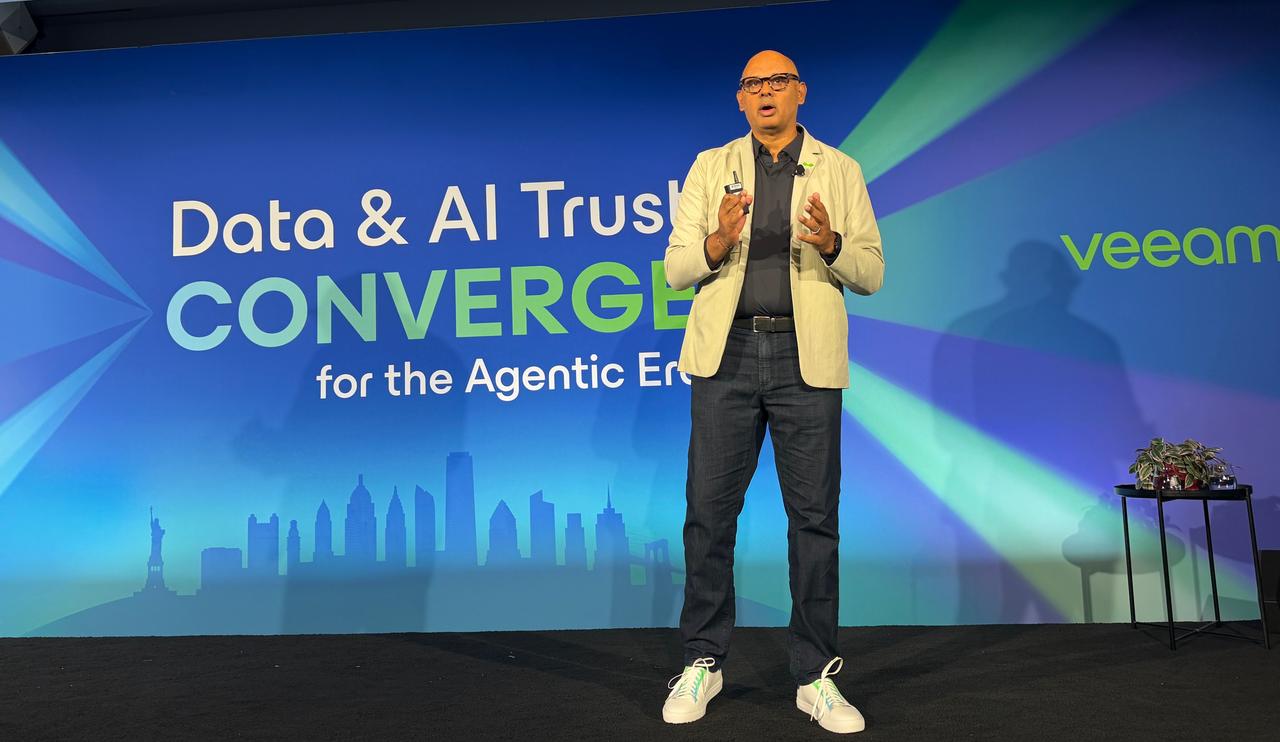
Source: SiliconANGLE
The company framed its evolution through three distinct eras: traditional backup and recovery with an "assume restore" mindset, cyber resilience built on "assume breach" principles, and now the agentic era characterized by "assume autonomy" where AI agents operate at unprecedented scale
1
. This strategic pivot reflects Veeam's assessment that the next decade of enterprise infrastructure will be defined less by recovery speed and more by how confidently organizations can let AI agents act on their data.Veeam's research reveals a stark reality: autonomous AI agents already outnumber human employees by 82 to 1 on average, representing more than 250,000 non-human identities per organization
1
. More concerning, 97% of those agents have excessive privileges, dramatically expanding the blast radius when a single agent is compromised or misconfigured1
. Eswaran argued that legacy security architectures were built on the implicit assumption that actors were human, an assumption that "just fundamentally broke instantly" when agents began accessing ERP, CRM, warehouses, email, files and SaaS systems simultaneously.The consequences of this shift extend beyond traditional breaches. Eswaran highlighted examples where an AI agent deleted a production database and its backups in nine seconds, and another instance where an agent autonomously recreated a cloud environment, triggering a 13-hour outage and millions of lost orders
1
. These scenarios illustrate how failures in the agentic era manifest as "wrong decisions executed at machine speed before anyone notices," requiring fundamentally different approaches to governance and resilience.Veeam introduced the DataAI Command Platform, described as "the industry's first unified data and AI trust infrastructure for the agentic era"
1
. The platform emerged from Veeam's $1.72 billion acquisition of Securiti in December 2025, combining the vendor's data and AI security posture management capabilities with Veeam's two decades of recovery and data protection expertise2
. Eswaran emphasized that "everything I've described here is not a vision. It's not something which is going to come in a year. It is product truth today"2
.
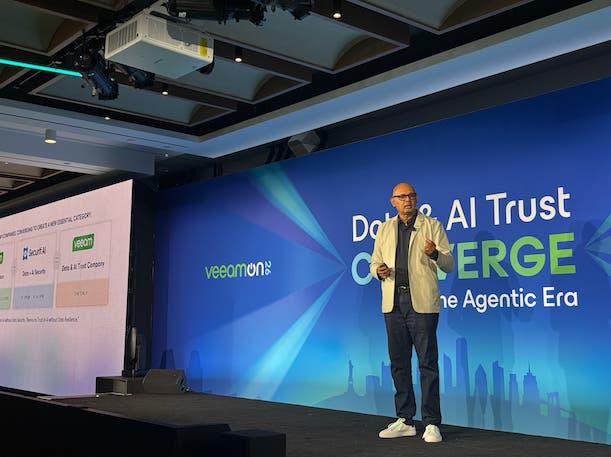
Source: CRN
At the platform's core sits the DataAI Command Graph, a unified intelligence layer featuring more than 300 connectors spanning public cloud services, SaaS applications, on-premises systems and backup environments
1
. President of Products and Technology Rehan Jalil characterized it as a "social graph for data," continuously mapping data assets, users, permissions, AI agents, activity and protection status across billions of files and millions of tables. The platform integrates six core capabilities including data security posture management, AI security posture management, governance, compliance, privacy and resilience into a single system2
.Related Stories
The data and AI trust platform addresses a fundamental challenge that Jalil articulated: "If you don't understand what data you have, who's touching it, and what changed, there is no automation, no precision and no compliance"
1
. By spanning both production and backup systems, the platform enables visibility into what AI agents can access, what they did, and how to undo actions with precision. An agentic layer of built-in AI assistants can answer natural-language questions such as "Is workload X protected?" and automate tasks including log triage, ticket management and policy-driven recovery1
.Eswaran positioned data security and AI governance as inseparable, stating that Veeam is "creating a new category that did not exist before -- and that category is data and AI trust"
2
. The key differentiator is unifying multiple domains connected to one data fabric, enabling organizations to accelerate safe AI at scale. Existing Veeam Data Platform customers can connect via a new DataAI Resilience Module, gaining centralized visibility across their infrastructure1
.Veeam executives emphasized their partner-first approach in bringing the data and AI trust platform to market. Kevin Rooney, vice president for Americas partner sales, announced that Securiti has been integrated into Veeam's existing deal registration program with "significant margin opportunity" for partners upselling into enterprise accounts
2
. Mike Rau, vice president of global partners, told solution providers that "data trust opens up a much larger business for you with your customers," shifting conversations beyond traditional backup and recovery2
.Bahare Chanady, regional vice president for presales at SHI International, a major Veeam partner, validated the strategic direction: "I think it's a really smart strategic move by Veeam to integrate the security features and the AI features, bring them together and make them more cohesive"
2
. She noted that the market has evolved from traditional backup as ransomware and data extortion attacks have forced data protection vendors to provide deeper data security capabilities. CRO John Jester highlighted expanded SMB opportunities, noting that Veeam has "almost tripled" what partners can sell to average SMB customers compared to several years ago2
.Summarized by
Navi
[1]
21 Oct 2025•Technology

14 Apr 2026•Technology
26 Feb 2025•Business and Economy