Women in AI Secure Just 26% of High-Paying Jobs as Gender Gap Widens in Booming Sector


4 Sources
[1]
Women are missing out on the AI jobs boom
Why it matters: These jobs are some of the fastest-growing and highest-paying in the country right now -- at a time when the overall labor market is pretty sluggish -- and the report shows women are getting left behind. By the numbers: Men landed 74%, and women 26%, of the new hires for AI roles
[2]
Women are being left behind in high-paying AI jobs boom, LinkedIn study finds
Megan Cerullo is a New York-based reporter for CBS MoneyWatch covering small business, workplace, health care, consumer spending and personal finance topics. She regularly appears on CBS News 24/7 to discuss her reporting. The artificial intelligence jobs boom is exacerbating the gender gap women
[3]
OpenAI is losing female execs. But data shows women in AI don't even make it to the C-suite
A new analysis from LinkedIn found that across 27 countries and tens of millions of workers, women only accounted for about 31% of AI leadership roles and under 13% of C-suite positions. Multiple executives have decamped from OpenAI ahead of its forthcoming IPO, including some of the most
[4]
LinkedIn Says Women Hold Just 13 Percent of Top AI Roles. That's Becoming a Business Risk
Artificial intelligence is reshaping nearly every corner of the workplace. Companies are experimenting with tools like ChatGPT, Claude, Copilot, Gemini, Perplexity, and others. Leaders are trying to understand which jobs AI will change, which skills employees will need, and where the technology can
Share
Copy Link
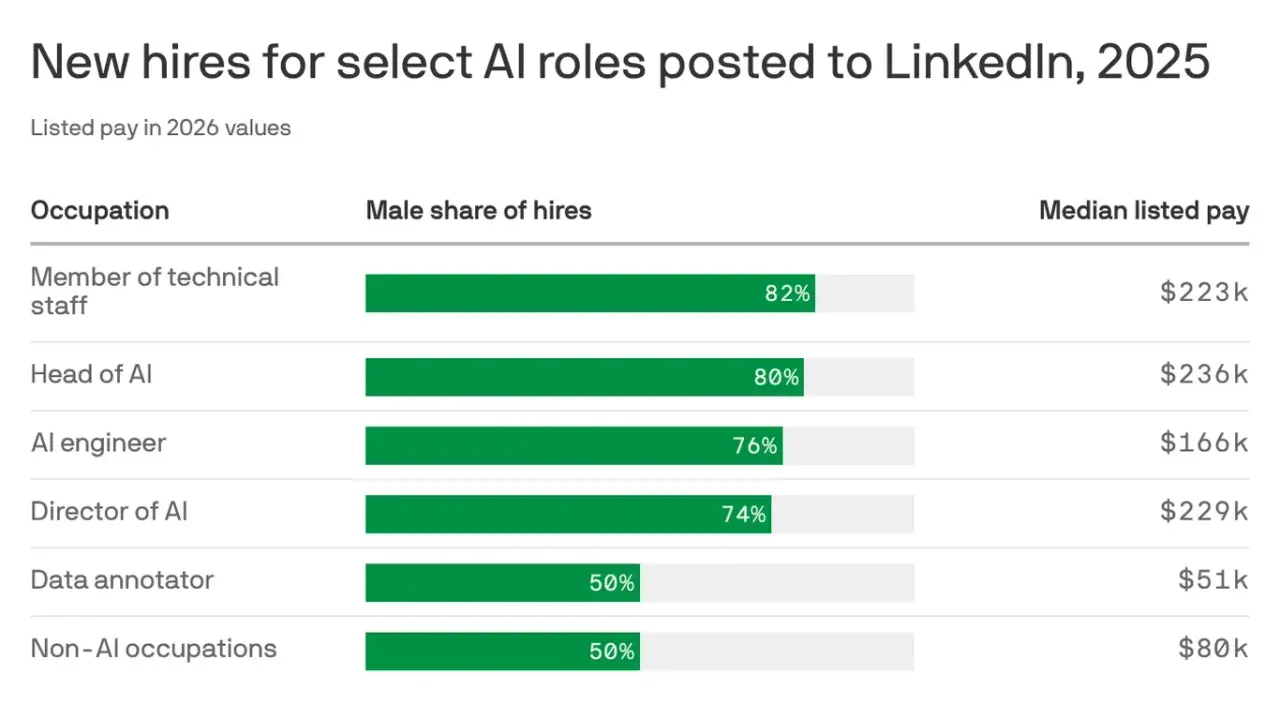
Women captured only 26% of AI job hires in 2025 compared to 50% in non-AI roles, according to LinkedIn's Triple Penalty report. The underrepresentation of women in AI worsens at senior levels, with women holding just 13% of C-suite positions at AI companies. As AI jobs offer median salaries of $177,000 versus $80,000 for non-AI roles, this widening gender gap threatens to deepen economic inequalities.
Women in AI Jobs Face Alarming Hiring Disparity
Women are being systematically left behind in the AI jobs boom, capturing just 26% of new hires in 2025 while representing 50% of hires in non-AI positions
1
2
. This widening gender gap comes at a critical moment when AI jobs command a significant pay premium, with typical listings advertising salaries around $177,000 compared to roughly $80,000 for non-AI roles2
. The disparity becomes even more pronounced in technical roles, where 82% of new hires for "member of technical staff" positions—a role common in AI labs sitting at the intersection of advanced research and full-stack engineering—went to men in 2025, with median listed pay reaching $223,0001
. Meanwhile, lower-paying positions like data annotators, offering median pay of $51,000, show a roughly equal 50/50 split between men and women1
.
Source: Axios
Women in AI Leadership Roles Hit Historic Lows
LinkedIn's Triple Penalty report examined 27 countries and tens of millions of workers, revealing that women hold just 13% of C-suite positions at AI companies
3
4
. This represents a stark contrast to the broader tech industry, where women account for approximately 20% of leadership roles3
. The underrepresentation of women in AI extends across all leadership levels: women make up only 20% of "head of AI" hires and 26% of "director of AI" hires4
. At AI companies specifically, women hold 29% of entry-level positions, but that representation shrinks to 21% at the vice president level before collapsing to just 13% in the C-suite4
. Sarah Steinberg, LinkedIn's head of global public policy partnerships, emphasized that "the steepest drop-off happens at the final step into the C-suite," but warned that focusing only on that last rung misses the larger systemic issue4
.
Source: Inc.
High-Paying AI Jobs Deepen Economic Divide
The gender disparities in tech are becoming a business risk as AI job postings have doubled since 2023
2
. Women face what LinkedIn researchers call a "triple penalty": they are underrepresented in AI job hiring, miss out on the substantial pay premium these roles offer, and have minimal influence in leading the development and deployment of this transformative technology2
. This creates a troubling economic reality where women are more likely to have their jobs disrupted by AI while simultaneously being excluded from the benefits of AI innovation. Research from The Brookings Institution shows that 86% of the 6.1 million workers in clerical and administrative roles vulnerable to AI takeover are women2
. "We have a world in which women are more likely to have their jobs changed or disrupted by AI, and they are also not benefiting from AI pay premiums, or moving into jobs that are created by AI," Steinberg noted2
.Related Stories
OpenAI Exodus Reflects Broader Industry Pattern
Recent departures from OpenAI underscore the challenges women face in AI leadership. Chief revenue officer Denise Dresser stepped away to "pursue other opportunities" barely a month after top executive Fidji Simo dropped to a part-time role for health reasons
3
. In preceding months, the company lost former chief marketing officer Kate Rouch, ethics chief Chloé Bakalar, and hardware lead Caitlin Kalinowski3
. While some exits involved extenuating circumstances, the overall pattern reflects the broader talent shortages and retention challenges for women in AI companies. At smaller companies with 200 or fewer employees, the lack of female representation becomes even more acute3
.
Source: Fast Company
Skills-Based Hiring Emerges as Potential Solution
Experts suggest that shifting toward skills-based hiring rather than credential-based recruitment could help address the career pipeline problem. If employers focus on applicable skills rather than degrees earned or previous jobs held, more women could enter AI roles
2
. This approach holds promise because workers can relatively easily acquire AI skills through online courses, training programs, or experience with publicly available AI tools2
. "Someone can have AI skills without having a related diploma or having held a previous job in AI," Steinberg explained2
. However, the current hiring practices continue to favor traditional pathways that have historically excluded women, perpetuating the cycle of underrepresentation from entry-level positions through the C-suite4
.References
Summarized by

Navi
[3]
Related Stories
AI Adoption in the Workplace: Widening Gender Gaps and Potential Consequences
09 May 2025•Business and Economy

The AI Gender Gap: Women's Underrepresentation in AI Usage and Its Implications
30 Jul 2025•Technology

Women Recognize the Importance of AI for Career Advancement, Despite Lower Interest
11 Aug 2024

Recent Highlights



Recent Highlights
Today's Top Stories









Don’t drown in AI news. We cut through the noise - filtering, ranking and summarizing the most important AI news, breakthroughs and research daily. Follow topics that matter to you and stay ahead.


