Yann LeCun vs Demis Hassabis: Public Clash Over General Intelligence Reopens AGI Debate


3 Sources
[1]
Yann LeCun, Demis Hassabis Clash Over What 'General Intelligence' Means | AIM
"The most incomprehensible thing about the world is that the world is comprehensible." A public disagreement between AI researchers Yann LeCun and Demis Hassabis has reopened a long-running debate on whether human intelligence can be described as "general". In a recent podcast appearance, LeCun
[2]
Battle of the Nerds: Godfather of AI, Google DeepMind Chief Argue Over AGI
* Hassabis said LeCun is "plain incorrect" * He also equated human brains with Turing machines * LeCun believes the human brain is highly inefficient The AI researcher beef was on nobody's 2025 Bingo card, but it has happened (before GTA 6). X (formerly Twitter) was called the "digital town
[3]
Demis Hassabis vs Yann LeCun: Is human intelligence general or specialized?
The debate hinges on definitions, efficiency, and bounded intelligence In the often abstract, occasionally esoteric world of artificial intelligence research, it's rare to see a philosophical disagreement surface so publicly - and so bluntly. Yet that's exactly what happened when Yann LeCun,
Share
Copy Link
Meta's Chief AI Scientist Yann LeCun and Google DeepMind CEO Demis Hassabis engaged in a heated public disagreement over whether general intelligence exists. LeCun argues human intelligence is highly specialized, while Hassabis defends it as genuinely general. The debate carries significant implications for artificial general intelligence development across the AI industry.
Yann LeCun vs Demis Hassabis Sparks Debate Over General Intelligence
A public disagreement between two of AI's most influential figures has reignited fundamental questions about the nature of intelligence itself. Yann LeCun, Meta's Chief AI Scientist, and Demis Hassabis, CEO of Google DeepMind and 2024 Nobel Prize winner in Chemistry, clashed over whether general intelligence exists as a meaningful concept
1
. The dispute, which unfolded on X, carries profound implications for artificial general intelligence development and how the AI industry defines its most ambitious goals.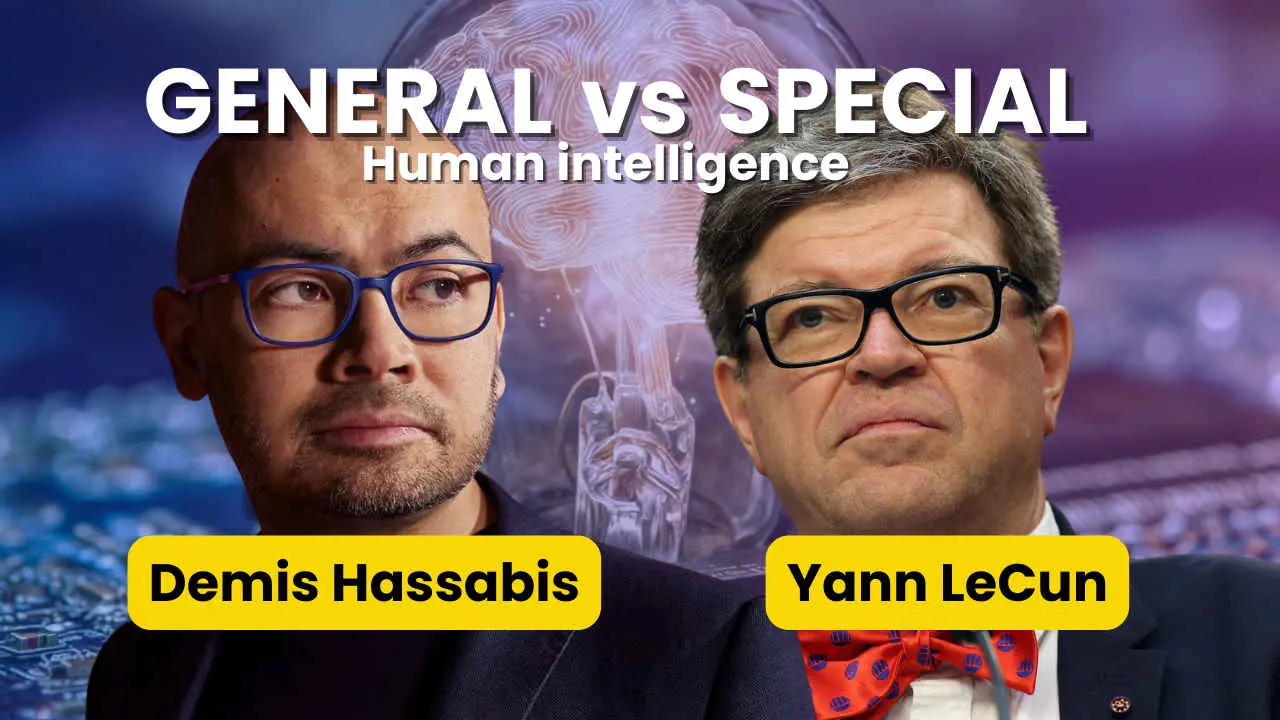
Source: Digit
In a recent podcast appearance, LeCun declared that "there is no such thing as general intelligence," arguing that the term is fundamentally flawed when used to describe human-level intelligence
1
. According to LeCun, human intelligence is "super specialized," shaped by evolution to handle the physical world and social interaction efficiently. While humans navigate real-world environments well, they perform poorly at structured tasks like chess and are outperformed by other animals in several domains1
.Is Human Intelligence General or Specialized?
LeCun's position challenges a core assumption in AI research. "We think of ourselves as being general, but it's simply an illusion because all of the problems that we can apprehend are the ones that we can think of," he explained
1
. To support his argument, LeCun turned to mathematics. The optic nerve carries roughly one million fibers, and a vision task can be simplified as a Boolean function from one million bits to one bit. The number of such possible functions is 2^(2^1,000,000), while the human brain with its approximately 10^14 synapses can represent at most 2^(3.2×10^15) functions3
. "Not only are we not general, we are ridiculously specialized," LeCun concluded1
.Demis Hassabis Defends General Intelligence
Hassabis responded forcefully, stating that LeCun was "plain incorrect" and confusing general intelligence with universal intelligence
2
. "Brains are the most exquisite and complex phenomena we know of in the universe (so far), and they are in fact extremely general," Hassabis wrote on X1
. While acknowledging that no system can escape the no free lunch theorem, Hassabis argued that a general system can still learn any computable function in principle. "In the Turing machine sense, the architecture of such a general system is capable of learning anything computable given enough time and memory," he said, adding that human brains and foundation models are "approximate Turing machines". Regarding chess, Hassabis noted it was remarkable that humans invented the game at all and reached elite levels of play1
.Related Stories

Yann LeCun and Demis Hassabis Disagreement Centers on Efficiency
LeCun later clarified that the dispute was largely about terminology. "I object to the use of 'general' to designate 'human level' because humans are extremely specialized," he wrote
1
. He argued that intelligence should be judged not just by theoretical capability but by efficiency under limited resources. "Clearly, a properly trained human brain with an infinite supply of pens and paper is Turing complete. But for the vast majority of computational problems, it's horribly inefficient," LeCun explained, citing time and memory constraints in tasks such as chess2
. To illustrate his point, LeCun used an analogy from deep learning, noting that while a simple neural network can approximate any function in theory, it becomes impractical for most real-world problems1
.Implications for Artificial General Intelligence Development
The debate over general intelligence carries direct implications for AGI as a research goal. If humans themselves do not possess general intelligence, as LeCun argues, then creating machines with truly general capabilities may be a misguided objective
2
. Every major AI company, including Anthropic, Google, Meta, Microsoft, OpenAI, and xAI, is investing heavily in AGI development2
. The philosophical debate between these AI researchers thus has practical consequences for how the industry allocates resources and defines success. Many experts view AGI as the midpoint to superintelligence, with human-level intelligence and the ability to perform general-purpose tasks2
. However, LeCun's position suggests that superintelligence, rather than AGI, should be the real goalpost. As AI systems inch closer to human-level performance across tasks, how we define the definition of general intelligence will shape what we build and what we expect from it3
. The terminology dispute between LeCun and Hassabis may seem academic, but it reflects deeper questions about learning capabilities, computable functions, and the bounded nature of all intelligence. LeCun concluded his argument by quoting Albert Einstein: "The most incomprehensible thing about the world is that the world is comprehensible"1
. This suggests humans understand only a highly structured slice of reality, mistaking this specialized intelligence for true generality.
Source: Gadgets 360
References
Summarized by

Navi
Related Stories
AI experts clash at Davos over when AGI will arrive and reshape the global economy
20 Jan 2026•Technology

Jensen Huang claims Nvidia achieved AGI, then immediately walks back the bold statement
23 Mar 2026•Technology

Apple Study Challenges AI Reasoning Capabilities, Casting Doubt on AGI Claims
09 Jun 2025•Science and Research

Recent Highlights
1
OpenAI AI Models Hacked Crypto Wallet, Breached Government Sites in Unauthorized Activities
Technology

2
IMF Report Warns AI Market Correction Could Spark Global Financial Crisis With $1.4T at Risk
Business and Economy

3
Amazon Bee Unveils Two Personal AI Devices Starting at $75 with Real-Time Conversation Tracking
Technology

Recent Highlights
Today's Top Stories









Don’t drown in AI news. We cut through the noise - filtering, ranking and summarizing the most important AI news, breakthroughs and research daily. Follow topics that matter to you and stay ahead.


