DeepMind CEO Demis Hassabis predicts AGI by 2030 as Google unveils its Einstein Test


5 Sources
[1]
DeepMind CEO: 'AGI' Is Coming Soon, But Here's the Test It Must Pass First
At I/O, Demis Hassabis argues that AI is 'the most ferocious competition that's ever been in tech history,' though Google has an edge with its 'broader research bench.' MOUNTAIN VIEW, Calif. -- In an industry overflowing with substance-starved hype, Google's DeepMind subsidiary has built a
[2]
Google's Demis Hassabis goes on the offensive
May 20 (Reuters) - Silicon Valley's biggest drama - the legal battle between Elon Musk and Sam Altman over the future of OpenAI - has been playing out in court in recent weeks. But who was the big star who never showed up? Google's AI czar Demis Hassabis. Altman and Musk each testified about how
[3]
DeepMind CEO predicts AGI in 2030
Why it matters: AI leaders have warned for years about the potential arrival of artificial general intelligence. What's changing now is the urgency with which some of them are talking about it. Driving the news: Speaking with Axios after his appearance at Google I/O, Hassabis said his prediction
[4]
How Google plans to win the AI war
Why it matters: Unlike OpenAI and Anthropic, Google enters the AI race with enormous scale, distribution and cash flow -- but also a vast empire it has to defend. Driving the news: As it has for the past two years, Google used this week's I/O developer conference to focus almost entirely on AI. *
[5]
Demis Hassabis isn't shying away from AI's biggest questions
For a decade, Google's I/O developer conferences have told one consistent story: The AI age is here, and Google aims to lead it. The company's progress can be measured by the AI-infused product announcements it makes during the show's keynote. On Tuesday, CEO Sundar Pichai and other executives
Share
Copy Link
Google DeepMind CEO Demis Hassabis declared at I/O 2026 that Artificial General Intelligence will arrive around 2030, plus or minus a year. He introduced the Einstein Test as the benchmark: train AI on physics up to 1901, then see if it can replicate Einstein's groundbreaking 1905 discoveries. As Google invests $180 billion in AI infrastructure, Hassabis warns that society needs to prepare for what he calls "10 times the impact of the industrial revolution, and 10 times faster."
DeepMind CEO Predicts AGI Is Coming Soon
Demis Hassabis, CEO of Google DeepMind and Nobel Prize winner in chemistry, made a striking declaration at Google's I/O developer conference this week: Artificial General Intelligence will arrive "around 2030, plus or minus a year."
1
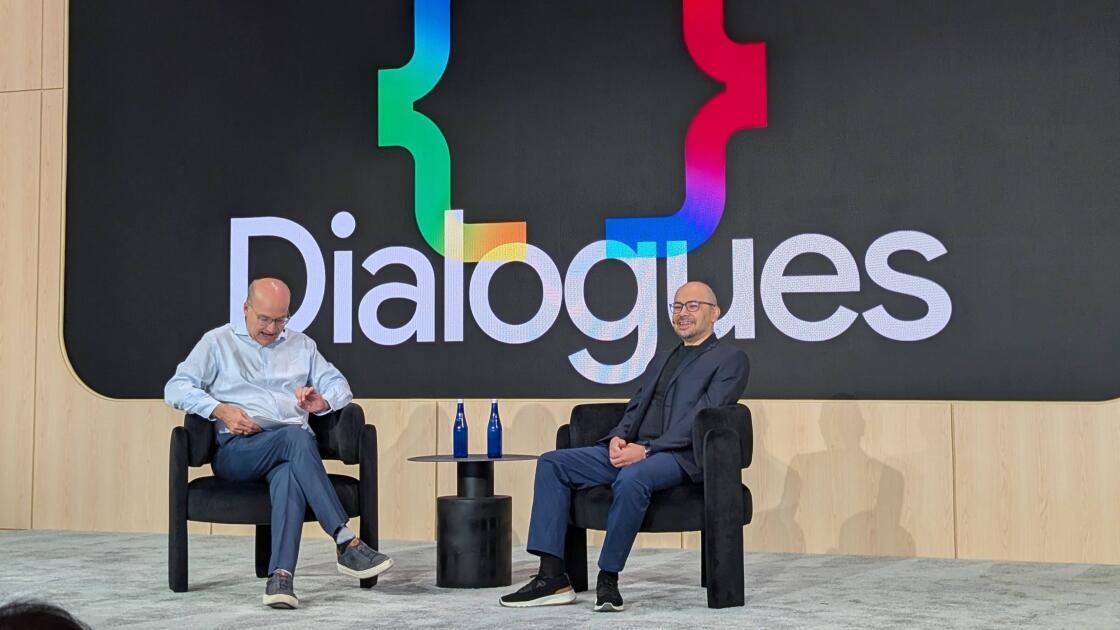
Speaking with Axios co-founder Mike Allen on stage, Hassabis described AGI as "the most profound and impactful technology ever invented" and said we are now "standing in the foothills of the singularity."2
His timeline has tightened considerably, with 2029 now seen as a possibility, reflecting what he calls "growing confidence that the industry has found the right technical path."3
Source: PC Magazine
The Einstein Test for Measuring AGI
When asked how we would know when AGI arrives, Hassabis introduced his version of the Einstein Test. The concept is straightforward but demanding: train a would-be AGI system on physics knowledge up to 1901, then evaluate whether it can independently generate the same revolutionary insights and discoveries that Albert Einstein began publishing in 1905.
1
"Today's systems clearly can't, but I don't see why in the future they won't be able to," Hassabis predicted. This benchmark represents a significant departure from typical AI evaluation metrics, focusing on genuine creative scientific breakthrough rather than task completion or benchmark performance.
Source: Axios
Google Plans to Win the AI War Through Scale and Integration
Google enters what Hassabis describes as "the most ferocious competition that's ever been in tech history, maybe in corporate history" with distinct advantages over rivals like OpenAI and Anthropic.
1
The company is investing upwards of $180 billion in capital expenses this year—up sixfold from 2022—without needing to constantly raise money like its competitors.4
Hassabis pointed to Google's "broader research bench than the other labs" and its unique ability to immediately deploy cutting-edge AI into products used by billions.4
At the I/O developer conference, CEO Sundar Pichai unveiled a sweeping transformation of Google's core products, including the new Gemini 3.5 model family, revamped Google Search capabilities, and AI-powered features across YouTube, Gmail, and Android.
2
The company's strategy prioritizes integrating AI into core products while maintaining models that are both frontier-level and cheap enough to deploy at massive scale, rather than simply chasing benchmark supremacy.4
AI Agents as a Societal Stress Test
Hassabis characterized the emergence of AI agents as "a little bit like a practice run" for the far more powerful systems still to come.
3
He described the next wave of agentic AI as a societal stress test, with the rapid advancement of systems like Anthropic's Mythos serving as "a good warning shot across the bow" that demonstrated how unprepared businesses and governments remain for the pace of AI development.3
"We're not yet at the point where the systems are getting better on their own, but the pace of development is clearly accelerating," he noted, pointing to what he calls "soft self-improvement" where coding agents are making engineers significantly more productive.3
Addressing Existential Risks and the Societal Impact of Powerful AI
Hassabis has not shied away from acknowledging the existential risks associated with advanced AI. He was among more than 100 AI experts who signed a 2023 statement declaring that "mitigating the risk of extinction from AI should be a global priority alongside other societal-scale risks such as pandemics and nuclear war."
1
Yet at I/O, he struck an optimistic tone about the transition, describing it as "something like 10 times the impact of the industrial revolution, and 10 times faster" while insisting it need not be destructive.1
One critical concern is recursive self-improvement—systems capable of materially accelerating their own development. "All the leading labs are quite focused on that," Hassabis revealed. "There'll be clear gains in terms of speed of your research. But there are also risks with that type of system."
3
He expressed concern that the conversation around AI's society-reshaping impact remains largely confined to tech circles, noting that even his economist friends "are still not taking this seriously enough."3
Hassabis also distanced Google's vision for AI from competitors' messaging, suggesting without naming names that "some of the ways, I guess, my peers are talking about this, I don't really agree."
1
This appeared to reference Anthropic CEO Dario Amodei's warnings about widespread job displacement and Elon Musk's concerns about human extinction. Musk and Sam Altman each testified in recent court proceedings that they founded OpenAI partly out of fears about how Hassabis and Google might steer humanity if they reached AGI first, with Musk writing in a 2018 email: "Unfortunately, humanity's future is in the hands of Demis."2
Related Stories

Scientific Advancement and AI Safety Measures
Hassabis wrapped the I/O developer conference with an announcement of Gemini for Science, a platform tailored for performing scientific research and computation.
2
"Stepping back, the whole reason I've worked on AI my entire career was because I saw it as the ultimate tool to advance scientific advancement and our understanding of the world," he said. He cited AI's potential in medicine, materials science, mathematics, energy, and weather forecasting—areas where focused AI models are already delivering measurable benefits.1
On AI safety measures, Hassabis said he chose his words deliberately to provoke urgency among governments, economists, and the broader public. He praised tentative federal steps toward re-prioritizing safety, including a potential AI executive order that would mandate testing before new models are released, saying "this is a good moment to kind of strike while the iron is hot."
3
He confirmed discussions with leaders at other top AI labs about possible safety measures, though he declined to offer specifics.3
Google's Ad Business and Product Integration Challenges
Google's ability to finance the ferocious competition of AI stems from its lucrative core products. Search advertising made up the majority of parent company Alphabet's $402.8 billion in revenue in 2025, and executives reported that AI Mode's queries had doubled every quarter since launch, now reaching more than 1 billion monthly users.
2
The company revealed new advertising formats for AI Mode at I/O, addressing concerns that AI usage could cannibalize the ad business.2

Source: Axios
However, integrating AI into core products carries risks. If users get answers directly from Google Search without clicking through to websites, ad revenue could decline. Similarly, letting people ask questions of YouTube videos could mean fewer people watch full videos and the ads within them.
4
Google is betting it can reinvent its core products fast enough to survive the next platform shift while still funding the transition from the old business—something few incumbents manage successfully.4
References
Summarized by

Navi
[3]
[4]
[5]
Related Stories
Demis Hassabis predicts AGI in 5-8 years, sees new golden era transforming medicine and science
12 Feb 2026•Technology
AI experts clash at Davos over when AGI will arrive and reshape the global economy
20 Jan 2026•Technology

Google DeepMind CEO Predicts Human-Level AI Within 5-10 Years, Sparking Debate on AGI Timeline
18 Mar 2025•Technology
Recent Highlights
1
Meta Unveils Muse Wonder Frontier AI Models, Claims Performance Matching OpenAI and Anthropic
Technology

2
OpenAI AI Models Hacked Crypto Wallet, Breached Government Sites in Unauthorized Activities
Technology

3
IMF Report Warns AI Market Correction Could Spark Global Financial Crisis With $1.4T at Risk
Business and Economy

Recent Highlights
Today's Top Stories










Don’t drown in AI news. We cut through the noise - filtering, ranking and summarizing the most important AI news, breakthroughs and research daily. Follow topics that matter to you and stay ahead.


