Category
Year
Month
Yesterday
Apollo Global Management's chief economist Torsten Slok reveals AI has delivered zero financial payoff to most S&P 500 companies outside the tech sector. While the Magnificent Seven sees soaring profits, the S&P 493 shows flat revenue per worker and profit margins, raising questions about AI's true economic impact.
8 Sources
Nvidia CEO Jensen Huang disclosed a proposed $2,000-per-GPU annual software fee for running AI agents at GTC Berlin, signaling a major shift toward recurring revenue. The pricing remains unconfirmed and sits below the company's existing $4,500 AI Enterprise platform cost, raising questions about product scope and implementation timeline.
3 Sources
25 Oct 2026
Organizations worldwide are discovering that consuming AI tokens doesn't automatically translate into revenue. Industry experts warn that technology debt, infrastructure gaps, and accountability issues are preventing companies from capturing measurable business outcomes from their AI investments.
2 Sources
23 Oct 2026
Peter Steinberger, creator of OpenClaw and now at OpenAI, revealed he spent approximately $10 million on AI tokens last month during Cloudflare Connect conference. His comments about unlimited token budgets and infrastructure challenges have sparked debate about the real costs of AI agent development and corporate AI strategies.
Anthropic is partnering with London-based private equity firm Hg to launch an AI consultancy in Europe by the end of 2026. The venture will embed AI engineers inside businesses to help deploy Claude AI model and build AI-powered products, with offices in London and Berlin targeting software companies and white-collar industries.
Major corporations including Meta, Microsoft, Barclays, and Kroger are implementing significant workforce reductions while redirecting billions toward AI infrastructure. Meta plans to cut 8,000 workers while its 2026 expenses could reach $169 billion for AI investments. The trend reflects a fundamental shift in resource reallocation across industries.
American Express announced a 5% workforce reduction affecting approximately 3,840 employees as part of a $336 million restructuring plan. CEO Stephen Squeri and CFO Christophe Le Caillec say the move aims to make the company leaner and more agile while preparing for AI integration across operations.
6 Sources
RingCentral reported third-quarter earnings that beat expectations, with AI products surpassing $400 million in annual recurring revenue. The cloud communications company raised its fiscal 2026 guidance and saw analysts boost stock price targets, citing accelerating AI product adoption among customers and improved margin expansion.
Oracle announced a $1 billion investment over four years to strengthen its partner ecosystem at AI World conference in Las Vegas. The funding covers training, certification, cloud migration, and Oracle Marketplace support to help partners build and sell AI-powered solutions. The move comes as Oracle redirects resources toward AI infrastructure after spending $50 billion on capital projects.
Nvidia's role as AI financier faces scrutiny as neoclouds CoreWeave, Nebius and IREN plunge over 30% this month. Credit default swaps for CoreWeave surge past 11% while the chip giant holds $36 billion in off-balance-sheet guarantees, raising questions about the sustainability of AI spending and debt-fueled expansion.
Sterlite Technologies delivered its strongest quarter ever with net profit surging 12,817% year-on-year to Rs 517 crore in Q2 FY27. Revenue jumped 145% to Rs 2,529 crore as AI-driven demand from hyperscalers and telecom operators pushed the company's order book to a record Rs 35,274 crore, securing multi-year revenue visibility.
Pathos AI secured $237 million in Series E funding at a $3 billion valuation, led by Bristol Myers Squibb. The company is expanding beyond oncology into neuroscience drug development through strategic partnerships with Bristol Myers Squibb and Tempus AI, focusing on Alzheimer's disease research using its AI-driven Foundry platform.
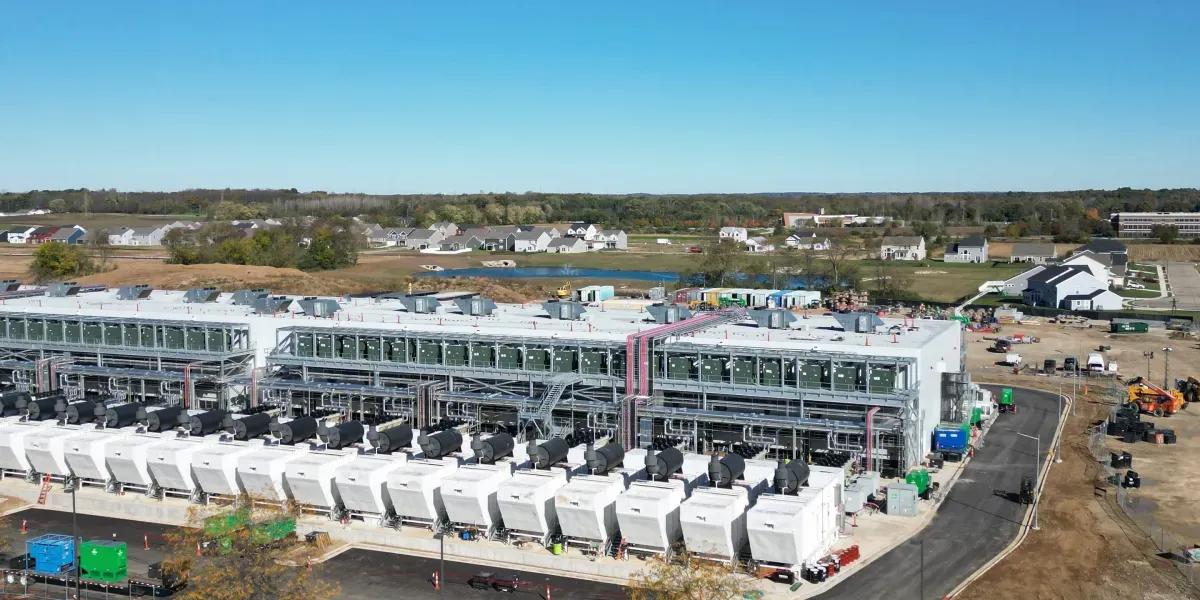
US hyperscalers racing to build AI data centers are turning to fuel cells as grid constraints delay power access by up to six years. Rystad Energy projects fuel-cell investments will surge from $2.8 billion in 2025 to $30 billion by 2030, with 40% of data-center capacity pursuing on-site power solutions.
Infosys reported 29% sequential growth in AI revenues, reaching 10.5% of total revenue in Q2 FY27, while securing $5.2 billion in large deal contract value including a $2 billion mega deal. Despite strong AI performance, the company revised its FY27 revenue growth guidance downward to 1%-2% in constant currency.
4 Sources
India's Global Capability Centres are evolving from delivery hubs into AI-powered innovation centers, projected to add 1-1.4 million jobs by 2031. With 44% of GCCs now owning platforms and AI-driven business outcomes, the transformation is driving unprecedented salary premiums and reshaping workforce composition across the ecosystem.
Get all updates into your inbox 💌, Stay Up-to-date for Free 🥳
Subscribe to our newsletter
Get the latest updates delivered to your inbox every day, and stay up-to-date for free 🧠📈
Don’t drown in AI news. We cut through the noise - filtering, ranking and summarizing the most important AI news, breakthroughs and research daily. Follow topics that matter to you and stay ahead.