AI Boom Propels Global Trade Growth to 3.9% Despite Geopolitical Disruptions, WTO Reports


4 Sources
[1]
Global Trade Proved More Resilient Than Expected This Year, W.T.O. Says
Ana Swanson covers international trade and reported from Washington The World Trade Organization said Thursday that it expected the global trade in goods to grow by 3.9 percent this year, almost double the rate it had forecast in March, as spending on expensive chips and other equipment needed to
[2]
WTO hikes 2026 trade growth forecast on AI boom
Geneva (AFP) - The WTO on Thursday sharply raised its global trade growth forecast for 2026, with merchandise trade riding the AI boom and proving more resilient than expected amid the Middle East crisis. Thanks to supply chain adaptations and the surge in artificial intelligence investments, the
[3]
AI drives global goods trade facing Trump tariffs, war headwinds
Global goods trade is projected to grow significantly this year, driven primarily by demand for artificial intelligence products. Despite tariffs and geopolitical tensions, merchandise trade growth is expected to reach 4.6% this year. The DHL-Stern report indicates a positive outlook, as many
[4]
AI Investment Boom to Drive Fastest Global Trade Growth Since Financial Crisis, WTO Forecasts
The AI investment boom is driving an expansion in global goods trade volumes at a pace last seen during the period of rapid globalization that was ended by the global financial crisis, according to new forecasts released Thursday by the World Trade Organization. However, that expansion is being
Share
Copy Link
The World Trade Organization doubled its 2026 global trade growth forecast to 3.9%, driven by a 67% surge in AI-enabling goods trade. Despite Middle East conflict reducing regional oil exports by 24%, supply chains adapted while semiconductors and data center equipment accounted for nearly half of all merchandise trade growth.
World Trade Organization Doubles 2026 Growth Forecast
The World Trade Organization announced Thursday that global trade growth will reach 3.9% in 2026, nearly double its March forecast of 1.9%
1
. The dramatic revision reflects how the AI investment boom has reshaped merchandise trade patterns, with AI-enabling goods accounting for approximately half of all global goods trade expansion in the first six months of 20262
. Trade in semiconductors, servers, and equipment essential to artificial intelligence infrastructure surged 67% year-over-year during this period2
.
Source: France 24
Johanna Hill, deputy director-general at the organization, described trade resilience as "a striking feature of the past six months"
1
. The World Trade Organization projects global trade growth will accelerate further to 4.1% in 2027, with global GDP expected to grow 2.6% this year and 2.9% next year2
.AI-Related Products Reshape Global Commerce Patterns
The AI boom has fundamentally altered merchandise trade dynamics. Trade in AI-related equipment represented 42% of all merchandise trade growth in 2025, but that share jumped to nearly 76% during the first quarter of 2026
3
. Robert Staiger, the World Trade Organization's chief economist, noted that "AI is very trade intensive, and the AI investment boom is bringing us back to a ratio of trade growth to GDP growth that is closer to what we used to have"4
.Global spending on AI infrastructure is expected to rise at least 30% this year, with market forecasts indicating investment spending will grow another 10% to 20% in 2027
2
. This multi-year expansion represents the fastest pace since the period of rapid globalization before the 2008 financial crisis4
. Following 4.2% growth in 2025, the projected increases would leave trade volumes more than 12% higher in 2027 than in 20244
.Asian Economies Lead AI-Driven Trade Expansion
Asian economies dominate AI-enabling goods exports, with the top 10 exporters accounting for 85% of total overseas sales in 2025
4
. The World Trade Organization expects Asian exports to rise 9% in 2026 and 5.2% in 20274
. American imports increased 57% from Taiwan through August 2026, 44% from Vietnam, and 28% from South Korea3
.Shares of A.P. Moller-Maersk, the largest publicly traded container carrier, climbed to a record this week, while shipping gateways in China struggled with congestion
3
. The Port of Los Angeles recorded its busiest June-to-August stretch on record3
.Related Stories

Supply Chains Adapt to Middle East Conflict Impact
Despite the AI boom offsetting geopolitical disruptions, the Middle East conflict created significant regional challenges. The quantity of crude oil exported by the Middle East fell 24% in the first half of 2026 compared to 2025, while liquefied natural gas exports dropped 47%
1
. The World Trade Organization estimates Middle East exports will tumble 17.2% this year before rebounding 23.3% in 20274
.However, supply chains demonstrated remarkable adaptability. While Middle East crude oil exports declined 24%, global exports fell just 6% as countries outside the region increased production
4
. Similarly, global liquefied natural gas shipments declined only 1% as Malaysia, Norway, and Angola expanded output4
. Countries outside the region increased production and exports of energy and fertilizer to compensate for supply losses1
.Tariffs and Services Trade Face Headwinds
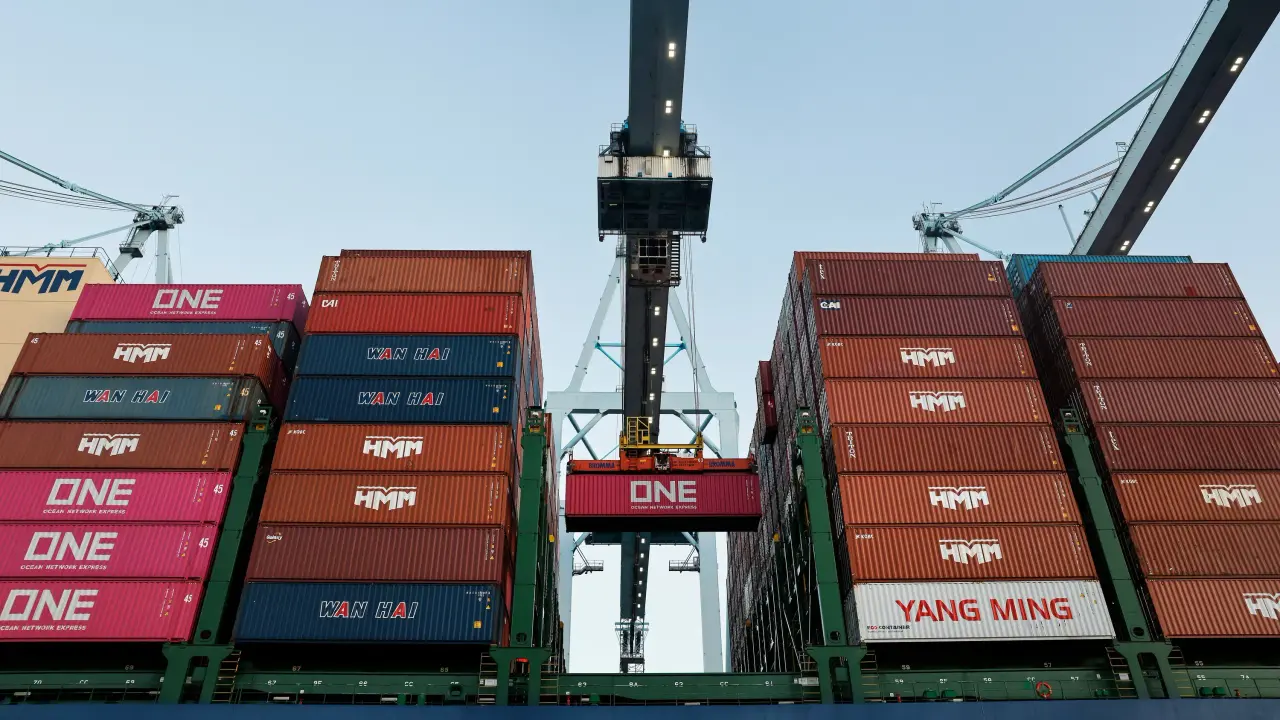
Despite Trump administration tariffs representing the largest increase in U.S. tariffs for a century, global goods trade remained robust
4
. Almost three-quarters of cross-border commerce still operates under the World Trade Organization's low-tariff terms3
. The U.S. share of global imports was 13% in 2025, with about half of American imports exempted from higher tariffs3
.
Source: NYT
Trade in services faces a different trajectory. The World Trade Organization lowered its services trade growth forecast to 3.3% for 2026, down from 4.8% projected in March and 5.3% recorded in 2025
4
. Services trade remains less impacted by AI-driven opportunities while facing significant disruptions from the Middle East conflict affecting tourism and transport4
. Europe will account for more than half of world services trade growth in 2026, demonstrating regional resilience4
.WTO chief Ngozi Okonjo-Iweala emphasized that "an integrated world economy and a rules-based trading system provide economies flexibility to keep essential products flowing," while acknowledging that "not everyone can access emerging opportunities like AI"
2
. The concentration of AI-driven growth in a small number of economies raises questions about equitable participation in this technological transformation.References
Summarized by

Navi
[2]
Related Stories
AI-Related Goods Drive Unexpected Surge in Global Trade, WTO Reports
07 Oct 2025•Business and Economy

AI Set to Revolutionize Global Trade, WTO Report Predicts 40% Growth by 2040
17 Sept 2025•Business and Economy

China exports jump 27% in June as AI boom fuels semiconductor demand amid domestic struggles
14 Jul 2026•Business and Economy
Recent Highlights
1
Microsoft and Nvidia Launch Surface Laptop Ultra: A $2,599 AI-Ready PC With RTX Spark Chip
Technology

2
Google Unveils Gemini 4 Argon AI Model, Restricts Access to Trusted Cyber Defenders
Technology

3
OpenAI Releases 722 AI-Generated Math Papers on GitHub, Igniting Fury Among Mathematicians
Science and Research

Recent Highlights
Today's Top Stories










Don’t drown in AI news. We cut through the noise - filtering, ranking and summarizing the most important AI news, breakthroughs and research daily. Follow topics that matter to you and stay ahead.


