NicheCompass: AI Tool Revolutionizes Cancer Treatment by Visualizing Cellular 'Social Networks'


3 Sources
[1]
New AI tool visualizes a cell's 'social network' to help treat cancer
A first-of-its-kind artificial intelligence (AI)-based neural network can rapidly analyse and interpret millions of cells from a patient sample, predicting molecular changes in the tissue. It can potentially pinpoint where personalised treatments could be most effective for conditions such as
[2]
AI-based neural network revolutionizes cancer treatment predictions
Wellcome Trust Sanger InstituteMar 18 2025 A first-of-its-kind artificial intelligence (AI)-based neural network can rapidly analyze and interpret millions of cells from a patient sample, predicting molecular changes in the tissue. It can potentially pinpoint where personalized treatments could be
[3]
New AI tool visualizes a cell's 'social network' to help treat cancer
A first-of-its-kind artificial intelligence (AI)-based neural network can rapidly analyze and interpret millions of cells from a patient sample, predicting molecular changes in the tissue. It can potentially pinpoint where personalized treatments could be most effective for conditions such as
Share
Copy Link
Researchers have developed NicheCompass, an AI-based neural network that analyzes cellular interactions to predict molecular changes in cancer tissues, potentially leading to personalized treatment strategies.

Breakthrough in AI-Powered Cancer Research
Researchers from the Wellcome Sanger Institute, Helmholtz Munich, and the University of Würzburg have developed a groundbreaking artificial intelligence tool called NicheCompass. This innovative technology has the potential to revolutionize cancer treatment by visualizing and interpreting cellular 'social networks' within patient samples
1
2
3
.How NicheCompass Works
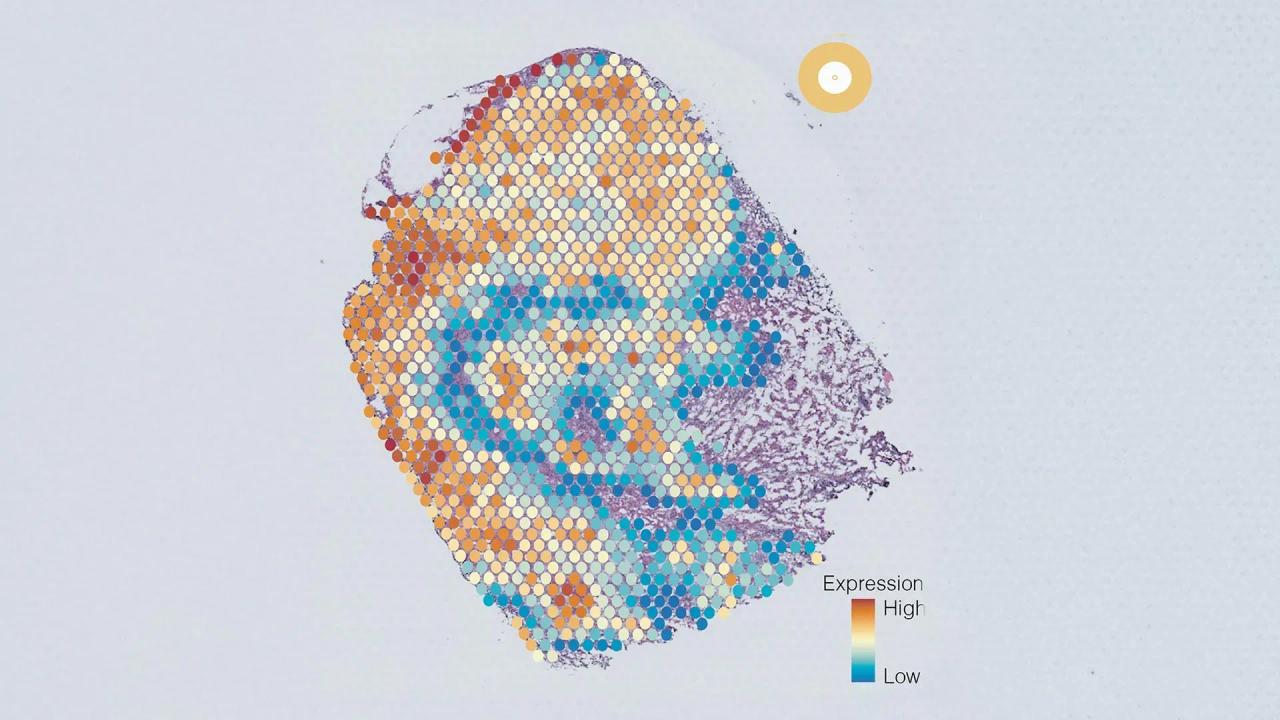
NicheCompass leverages generative AI to create a visual database that combines spatial genomic data on cell types, their locations, and communication patterns. The deep-learning model is based on cell-to-cell communication, learning how different cells interact through their networks and aligning them with similar cellular networks
1
2
.Key features of NicheCompass include:
- Rapid analysis of millions of cells from patient samples
- Prediction of molecular changes in tissue
- Interpretation of cell-to-cell communication patterns
- Creation of visual resources for entire organs
Applications in Cancer Research
The tool has demonstrated significant potential in cancer research, particularly in breast and lung cancer studies. Researchers used NicheCompass to analyze data from 10 lung cancer patients, revealing both similarities and differences between individuals
1
2
3
.Dr. Carlos Talavera-López, co-senior author, explained: "Using NicheCompass, we were able to see the differences in how immune cells interact with lung cancer tumours in patients. This real-world application not only uncovered new information that adds to our collective understanding about cancer, it also highlighted one patient whose cancer interacted with the immune system differently."
1
Implications for Personalized Medicine
NicheCompass's ability to rapidly process and interpret cellular data has significant implications for personalized medicine:
- Identification of specific changes that could be targeted in cancer treatment
- Development of personalized therapy plans
- Potential for harnessing the immune system in cancer treatment
Sebastian Birk, first author of the study, emphasized the tool's importance: "NicheCompass is a significant leap in this field, leveraging the power of AI but also offering interpretability, allowing researchers and clinicians to ask questions about their data and better understand and treat diseases."
2
Related Stories

Broader Applications
Beyond cancer research, NicheCompass has shown promise in other areas:
- Applied to a mouse brain spatial atlas with 8 million cells, correctly identifying brain sections
- Potential application to spatial atlases of whole organs generated by researchers worldwide
The Future of NicheCompass
As NicheCompass continues to develop, it could play a crucial role in uncovering new ways to harness the immune system in various cancers. This may lead to the creation of personalized treatments that empower a patient's immune system to target cancer mechanisms directly
1
2
3
.Dr. Mohammad Lotfollahi, co-senior author, drew an analogy between cell communication and human social networks: "Cell-to-cell communication is similar, cells might use different features to communicate with their social network, creating communities or networks in their local area."
3
With its ability to process vast amounts of cellular data and provide interpretable results within an hour, NicheCompass represents a significant advancement in the field of AI-powered medical research, offering new hope for more effective and personalized cancer treatments.
References
Summarized by

Navi
[3]
Related Stories
AI Tool Uncovers Five Distinct Cancer Cell Groups, Revolutionizing Tumor Characterization and Treatment
25 Jun 2025•Health
AI-Powered scNET System Revolutionizes Understanding of Cellular Responses to Drug Treatments
02 Apr 2025•Science and Research

AI Breakthrough Enhances Personalized Cancer Treatment with Multi-Modal Data Analysis
01 Feb 2025•Health

Recent Highlights



Recent Highlights
Today's Top Stories









Don’t drown in AI news. We cut through the noise - filtering, ranking and summarizing the most important AI news, breakthroughs and research daily. Follow topics that matter to you and stay ahead.


