AI Use Linked to Worst Student Test Scores in 25 Years, OECD PISA 2025 Results Reveal


4 Sources
[1]
15-year-olds are reading, calculating and reasoning worse than ever, thanks to AI, OECD finds
Global 15-year-olds show weakest performance in reading, math, and science tests. Reading scores declined significantly, with students now performing at a lower level. Mathematics also saw a sharp drop, while science remained relatively stable. Digital distractions and AI use present complex
[2]
AI has taken a toll on kids' brains -- removing technology from the classroom will fix that
Is it the end of the Flynn effect? Decades ago, the researcher James Flynn recognized a secular increase in IQ scores around the world that amounted to humanity getting smarter all the time. Now, technology appears to be pushing the other way. The new results are in from a 2025 Organization for
[3]
Global high school test scores plummet to 20 year low as AI and social media rot student brains
It's a brain rot pandemic! Students worldwide are getting dumber, with scores from a sweeping exam issued to teens around the globe tanking to 20-year lows -- and tech like AI and social media may be behind the brain-rotting culprits. Reading and mathematics scores plummeted nearly 20 points on
[4]
AI Use Contributes to Global Decline in Student Reading Skills, OECD Says
The widespread use of AI tools and social media platforms has contributed to a sharp deterioration in the reading skills of high-school students around the world, according to the OECD, with potential implications for the long-term economic outlook. The Organization for Economic Cooperation and
Share
Copy Link
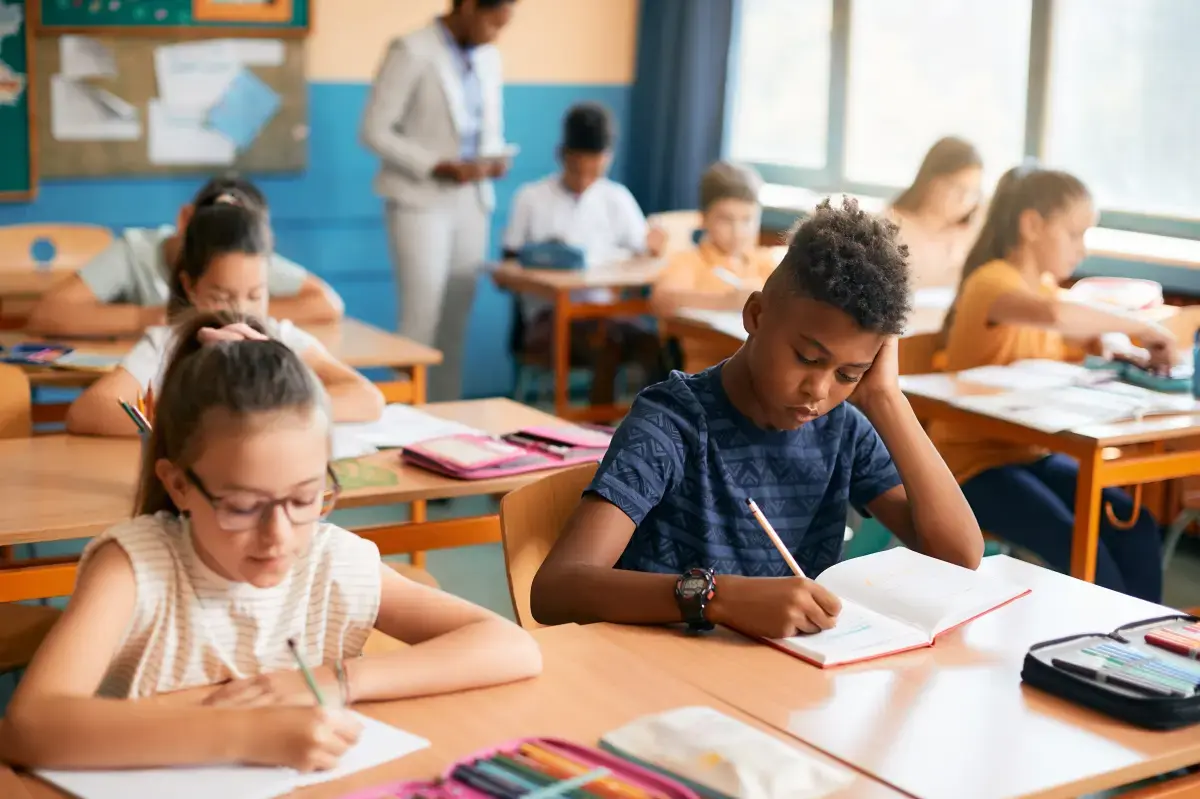
OECD's PISA 2025 results show global decline in student reading skills, with 15-year-olds scoring at levels a year behind expectations. The study of 760,000 students across 91 countries links AI and social media use to declining performance in reading, math, and science—the weakest results in 25 years.
Global Student Performance Hits 25-Year Low
The world's 15-year-olds are demonstrating the weakest cognitive skills recorded since global testing began, according to the OECD's PISA 2025 results released Tuesday
1
. The Programme for International Student Assessment tested more than 760,000 students representing approximately 33 million 15-year-olds across 91 countries and economies, revealing average performance across OECD countries at the lowest recorded levels in science, reading, and mathematics1
. This student performance decline signals a troubling reversal of what researcher James Flynn once identified as humanity's steady increase in IQ scores—now appearing to move in the opposite direction2
.Reading Scores Show Steepest Drop
The global decline in student reading skills proved most severe among the three core subjects tested. Average reading scores across OECD countries fell 28 points between 2015 and 2025, with 25 points of that decline occurring between 2018 and 2025 alone
1
. Since 20 points roughly equals one year of schooling for a 15-year-old, today's students are reading at levels once expected of students a year younger1
. The decline in reading and math extended beyond OECD members, with non-OECD participants showing reading scores down 16 points and mathematics down 8 points over the same decade1
. Mathematics fell 22 points over ten years among OECD countries, dropping especially sharply after 2018, while science proved comparatively resilient with a 7-point slip over the decade1
.AI and Social Media Emerge as Key Culprits
The OECD data pointed directly to AI and social media as primary drivers behind declining high school test scores. Students who regularly use AI performed far worse on tests than those who don't, with rare AI users scoring approximately 30 points better than regular users
3
. Only three countries where AI was widely accessible saw reading scores increase, along with just four in mathematics and five in science3
. OECD director for education and skills Andreas Schleicher warned that AI may be creating a paradoxical effect: "If AI makes things easy, it's not great for you in the long run. It gives you better results, but it doesn't enhance learning"3
. The organization found that 46% of students use AI chatbots weekly or more to help them learn, though often in ways that do more harm than good4
. A recent study of 26,811 students in grades 7 to 12 in central China found that while AI use boosted homework grades, subsequent performance in closed-book exams declined sharply4
.The Rise of 'Hasty Readers'
PISA identified a specific behavioral shift behind the reading decline. The share of hasty readers—students who rush through texts and give quick but incorrect answers—nearly doubled between 2018 and 2025, rising from approximately 7% to 11%
1
. Meanwhile, the share of accurate, fluent readers fell by about 7 percentage points over the same period1
. Performance dropped most sharply on tasks built around longer texts and higher-order processes such as evaluating information, connecting material across multiple sources, and thinking critically1
. OECD secretary-general Mathias Cormann noted that "more screen time and less reading for pleasure have gone hand in hand with weaker results," with students increasingly engaging in rapid, superficial reading patterns shaped by digitalization4
.Digital Distractions in the Classroom
On average across OECD countries, 28% of students reported that classmates are distracted by digital devices in most or every science lesson
1
. In Beijing-Shanghai-Jiangsu-Zhejiang (China), Japan, and Korea, fewer than 10% reported such distraction, with higher distraction linked to lower science scores in most participating systems1
. Students who excessively used social media at school performed about 44 points worse in mathematics than those who barely did3
. Schools that ban cell phones on premises or set subject-specific guidelines for device use recorded lower distraction levels, with nearly half of students across OECD countries now attending schools where phones are barred, up from 34% in 20221
. Schleicher emphasized that removing technology from the classroom through cell-phone bans represents "the only thing that works" to halt the deterioration in learning4
.Screen Time Reaches Alarming Levels
Students reported spending approximately 1.7 hours daily on digital devices for learning at school and 1.1 hours for leisure while at school
1
. Outside the classroom, screen time reaches even more concerning levels. A study from Common Sense Media found 8- to 12-year-olds are on screens for more than 5 hours daily, while 13- to 18-year-olds exceed 8.5 hours2
. Limited to moderate use for learning was associated with stronger science performance than either no use or very heavy use1
. The new technology may deliver a one-two punch: screens and social media diminish attention spans while AI makes it easier to avoid critical thinking by doing the work for students2
.Related Stories

Foundational Skills Crisis
Across OECD countries, 20% of 15-year-olds are now low performers in all three subjects, up from 16% in 2022
1
. These students lack the foundational skills needed for further education, employment, and everyday life—they struggle to interpret simple data or identify evidence in graphs, find it hard to understand straightforward texts, and have trouble working out relationships between units and price1
. The report emphasizes these are not students in conflict zones or countries without infrastructure, but rather live in high- and middle-income OECD countries and have had nine or ten years of formal schooling1
.Socio-Economic Gaps Narrow Through Decline
Socio-economic gaps in performance narrowed between 2022 and 2025, but the report attributes this to declining scores among advantaged students rather than gains among disadvantaged ones
1
. In science, disadvantaged students' performance held steady while advantaged students' scores fell 8 points1
. In reading, disadvantaged students slipped 4 points against a 20-point drop among advantaged students, while in mathematics, advantaged students fell 14 points1
4
. Schleicher called this "a new phenomenon, with the biggest factor in the overall drop in scores being advantaged students who are performing below what one would expect given their background"4
. Socio-economic background nonetheless remains a strong predictor of achievement, accounting for 12% of within-country variation in science performance, with 37% of disadvantaged students classified as low performers in science against 12% of advantaged students1
.Global Rankings and Regional Variations
Asian students dominated the top 10 rankings in all three categories, with students from four Chinese provinces continuing as top performers in science and math, while students from Singapore topped the rankings for reading
3
4
. The US didn't scratch the top 10 in any categories, ranking 27th for math, 13th for science, and 13th for reading3
. While the US followed most global decline trends, it still fared better than the worldwide reading score by 24 points and showed improvements in science scores—up 3 points from 2022 and up 13 points since 20003
. England fared relatively well in the PISA 2025 results, probably because it has been relatively immune to faddish theories of instruction, recording improvements across all three subjects and moving into the top 10 in each2
4
.Economic Implications and Future Outlook
The decline in student performance raises serious concerns for long-term economic growth, since most economists believe growth is partly driven by improvements in education levels
4
. While new AI tools promise to raise productivity levels among existing workers, the PISA 2025 results suggest they could already be lowering productivity levels among future workers4
. Education writer Daisy Christodoulou suggests that AI may lessen the need for brainpower in ways that parallel how widely available, inexpensive calories made obesity more common—representing a radical change from millennia when scarcity demanded constant effort2
. She proposes that schools might need to become "gymnasia for the mind"—places that allow students to practice and acquire basic cognitive skills that are no longer directly rewarded in daily life but remain vital2
. Watch for increased policy debates around technology use in education, potential expansion of smartphone bans, and efforts to redesign curricula that build critical thinking skills in an AI-saturated world.References
Summarized by

Navi
[2]
[3]
[4]
Related Stories
MIT Study Reveals Cognitive Costs of Using ChatGPT for Writing Tasks
18 Jun 2025•Science and Research

AI in Education Surges as Experts Warn of Critical Thinking Decline and Learning Risks
14 Mar 2026•Policy and Regulation

The Cognitive Cost of AI: How Generative Tools May Be Dulling Our Thinking Skills
10 Nov 2025•Science and Research

Recent Highlights
1
OpenAI's AI Math Breakthrough on Navier-Stokes Equations Ignites Fierce Controversy Over Credit
Science and Research

2
Nvidia CEO Jensen Huang Declares AGI Has Arrived With OpenAI's GPT-6 Astra Release
Technology

3
Apple debuts $1,999 iPhone Duo foldable and A20 Pro chip as new CEO John Ternus takes the stage
Technology

Recent Highlights
Today's Top Stories








Don’t drown in AI news. We cut through the noise - filtering, ranking and summarizing the most important AI news, breakthroughs and research daily. Follow topics that matter to you and stay ahead.


