AMD EPYC Processors Power Google Cloud TPU 8tx for Confidential AI Computing


6 Sources
[1]
AMD Joins Google AI Chip Push Against Nvidia - Advanced Micro Devices (NASDAQ:AMD)
AMD Lands Key Role in Google's New AI Chip System as Nvidia Rivalry Intensifies AMD (NASDAQ:AMD) is supplying processors for a new AI computing system unveiled Monday by Google (NASDAQ:GOOGL), as the search giant expands its challenge to Nvidia (NASDAQ:NVDA). Google's new TPU 8tx combines its own
[2]
AMD EPYC Powers Google Cloud TPU 8tx Infrastructure for Confidential AI Computing
AMD announced that 5th Gen AMD EPYC™ processors are powering the host infrastructure for Google Cloud TPU 8tx, the first cloud Tensor Processing Unit (TPU) system to deliver hardware-enforced confidential computing. The expanded collaboration between the companies combines AMD EPYC™ CPU
[3]
Google just handed AMD a job its own chip already does
On Monday, November 9, 2026, Alphabet (GOOGL) unit Google introduced TPU 8tx, a TPU system built for confidential inference, according to Google. The host processors running alongside it come from Advanced Micro Devices (AMD). That choice stands out because Google already designs and uses its own
[4]
AMD EPYC Expands Its Leadership at the Foundation of AI
5th Gen AMD EPYC processors power Google Cloud TPU 8tx host infrastructure, helping enterprises protect sensitive AI models. AMD today announced that 5th Gen AMD EPYC™ processors are powering the host infrastructure for Google Cloud TPU 8tx, the first cloud Tensor Processing Unit (TPU) system to
[5]

AMD Expands Work With Google to Power Host Infrastructure for Cloud TPU
Advanced Micro Devices says its processors are powering the host infrastructure for one of Google's cloud tensor processing unit systems under an expanded collaboration between the two companies. AMD said Monday its fifth-generation Epyc processors manage workload orchestration, data preparation
[6]
AMD supplies 5th-generation EPYC processors for Google's TPU 8tx
AMD announced that its 5th-generation EPYC processors power the host infrastructure for Google Cloud's TPU 8tx, the first cloud tensor processing unit (TPU) systems to feature hardware-backed confidential computing capabilities. The expanded collaboration between the companies combines the
Share
Copy Link
Google Cloud selected AMD's 5th Gen EPYC processors to power its new TPU 8tx system, marking the first cloud TPU platform with hardware-enforced confidential computing. The partnership combines AMD's security capabilities with Google's AI acceleration to help enterprises run sensitive workloads while maintaining data protection, even as Google uses its own Axion processors for other TPU systems.
AMD EPYC Secures Role in Google's Confidential AI Push
Google Cloud unveiled its TPU 8tx system on Monday, November 9, 2026, powered by AMD's 5th Gen EPYC processors in a strategic partnership that brings hardware-enforced confidential computing to cloud-based AI infrastructure for the first time
1
. The collaboration pairs AMD EPYC CPU performance, AMD Infinity Guard security capabilities, and x86 software compatibility with Google Cloud TPU AI acceleration to help enterprises deploy inference, fine-tuning, and reinforcement learning workloads2
. This expanded AMD and Google collaboration addresses a critical requirement for production AI: protecting sensitive data while it remains in active use by processing systems.
Source: Market Screener
Why Google Chose AMD Over Its Own Silicon
The processor selection stands out because Google already designs and uses its own Axion processors for host infrastructure. When Google introduced TPU 8t and TPU 8i systems in April 2026, both ran on Axion chips, replacing the x86 processors used in earlier generations
3
. TPU 8tx is built on the same silicon as TPU 8t, yet Google specifically chose AMD's fifth-generation EPYC processors for this confidential computing variant. Google built the system for regulated enterprises and governments running frontier or proprietary models, noting that highly regulated customers are requesting specialized encryption capabilities for unique workloads3
. AMD's advantage lies in its established security track record within Google's infrastructure—AMD SEV technologies already help protect workloads across Google Cloud's Confidential VMs, Confidential GKE, Confidential Space, Confidential Managed Service for Apache Spark, and Confidential Dataflow4
.Hardware-Level Data Protection for Sensitive AI Workloads
In TPU 8tx systems, 5th Gen AMD EPYC processors manage workload orchestration, data preparation, and high-throughput communication with TPU accelerators
5
. The system utilizes AMD Secure Encrypted Virtualization (SEV) capabilities, which extend confidential computing protection beyond the CPU to connected accelerators, helping protect sensitive data as it moves among components2
. The architecture verifies an accelerator's identity and security configuration before granting direct access to protected memory, ensuring customer prompts, model weights, and intermediate data remain encrypted in CPU memory and in transit among the host and accelerators, with hardware isolation during accelerator execution4
. Mark Lohmeyer, vice president and general manager for AI and Computing Infrastructure at Google Cloud, explained that teams moving AI agents into production need confidence that their data and intellectual property stay private, even from the underlying infrastructure, noting that customers get silicon-level data protection alongside the low-latency performance needed for modern reasoning models2
.Related Stories

AMD's Dual Revenue Path in AI Infrastructure
AMD competes with Nvidia in the AI chip market through its Instinct GPUs, but the company also sells processors that run AI systems built by other companies, creating a dual revenue opportunity
1
. Dan McNamara, senior vice president and general manager of Compute and Enterprise AI at AMD, stated that the most capable AI systems need a CPU foundation that can match the demands of the accelerators they host, emphasizing that AMD has built leadership capabilities in performance, memory bandwidth, and I/O that keep accelerated systems productive4
. AMD EPYC processors serve as the host CPU of choice for more than 10 leading hyperscalers and frontier AI labs, spanning GPUs and custom AI accelerator ASICs2
. This breadth gives customers a proven CPU platform across accelerator choices, supported by the established x86 software ecosystem, meaning AMD benefits even when customers select Nvidia chips or Google's own technology over its competing GPU products1
.Market Response and Future Implications
AMD shares climbed 13.26% on Monday, November 9, 2026, closing at $508.58, recovering from a volatile week that saw a 17.26% drop on November 5 followed by an 11.04% rebound on November 6
3
. The rally was amplified by Oppenheimer analyst Rick Schafer upgrading AMD to Outperform from Perform with a $600 price target1
. As of November 6, 2026, 53 analysts tracked by StockAnalysis rated AMD a consensus Strong Buy with an average price target of $658.533
. Bloomberg Intelligence estimates Google's TPU-related annual sales could grow from $12 billion in 2026 to more than $135 billion by 2028, though most new TPU systems use Google's own Axion CPUs, meaning AMD won't necessarily benefit from all that growth1
. Google expects the new TPU 8tx systems to become available in 20271
. The development signals that data privacy and compliance are becoming critical factors in AI chip selection, potentially favoring suppliers with established security records that take years to build3
.References
Summarized by

Navi
[3]
[5]
Related Stories
Google Teams with AMD on 10th-Generation TPU Project for Reinforcement Learning Workloads
17 Aug 2026•Technology
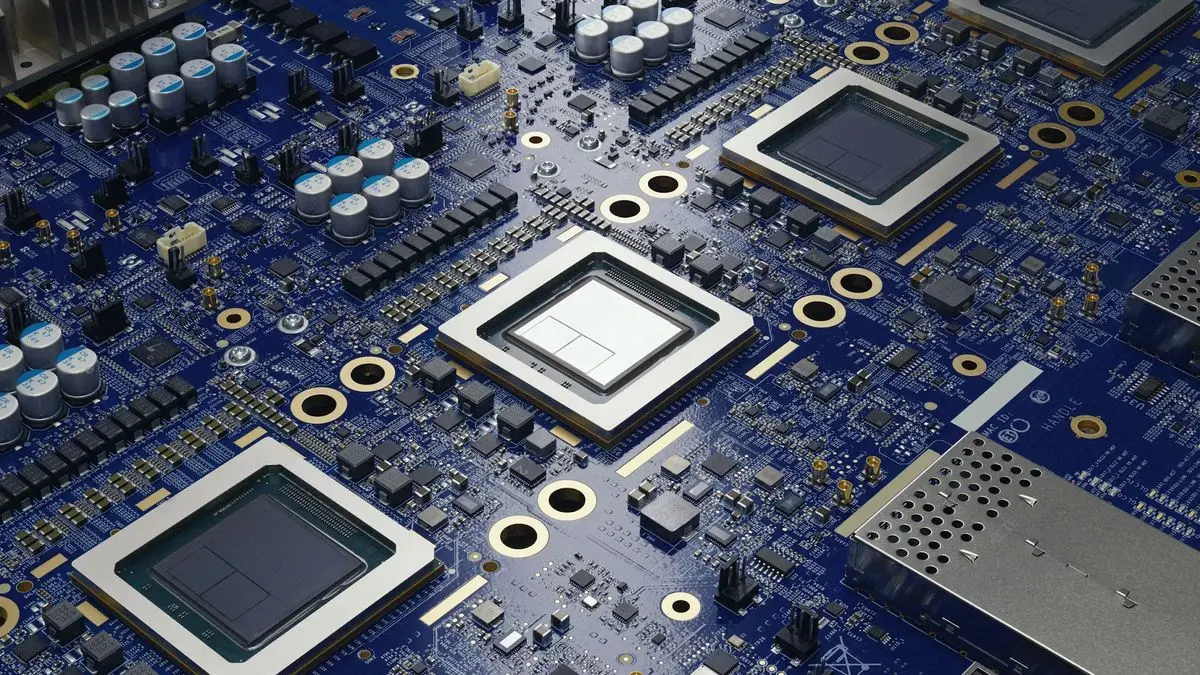
AMD Unveils MI325X AI Chip to Challenge Nvidia's Dominance
05 Oct 2024•Technology

Google Unveils Two Specialized AI Chips to Compete with Nvidia in Secure and Memory-Intensive Workloads
Yesterday•Technology

Recent Highlights
1
Anthropic AI Development Doubles Speed as Self-Improving Systems Near Breakthrough
Technology

2
Google's AI Policy Forces Schools to Accept AI Overviews or Lose Search Access Entirely
Technology

3
Jensen Huang Scandal: Nvidia CEO's Affair with Suspected Chinese Spy Raises National Security Concerns
Policy and Regulation
Recent Highlights
Today's Top Stories





Don’t drown in AI news. We cut through the noise - filtering, ranking and summarizing the most important AI news, breakthroughs and research daily. Follow topics that matter to you and stay ahead.


