AMD Launches Zen 6 EPYC Processors With 256 Cores, Challenges Nvidia's Agentic AI CPU Claims


5 Sources
[1]
AMD VP and chief Zen architect rebuke claims that Nvidia and Arm made CPUs for agentic AI -- 'We didn't magically know four years ago that agentic was going to be a thing'
AMD's new Venice chips aren't agentic CPUs, but they're the best CPUs for agentic AI, says AMD. Two prominent voices within AMD agree that the company didn't design its new Zen 6 family, codenamed Venice, explicitly for agentic AI in a clear shot at Nvidia and Arm, who've both described their
[2]
AMD launches Zen 6 Epyc 9006 series with up to 256 cores, 512 threads, and TSMC N2
Serving tech enthusiasts for over 25 years. TechSpot means tech analysis and advice you can trust. Highly anticipated: AMD has fully pulled back the curtain on its first Zen 6 CPU lineup. Debuting with Epyc server chips, the new architecture offers up to 256 cores and 512 threads at the top end,
[3]
AMD introduces Epyc 6 processors for AI agent workloads
Advanced Micro Devices Inc. today debuted a new line of central processing units for servers. The Epyc 6 series, which is also known as Venice, comprises 10 CPUs that are organized into two groups. The first set includes chips with a large number of relatively slow cores. The remaining CPUs
[4]
AMD Verano "EPYC 9006 LP" CPUs Are Architected For The Agentic AI Era: Up To 192 Cores With LPDDR5X SOCAMM2 Memory Support
AMD is unveiling more details of its Verano "EPYC 9006 LP" CPUs, which feature up to 192 cores, LPDDR5X memory support & made for Agentic AI. AMD Verano CPU Architecture Disclosed: Up To 6 "Zen 6" CCDs With Up To 192 Cores, & Perf/$ Optimized LPDDR5X SOCAMM2 Support The AMD EPYC Verano CPUs are
[5]

AMD Showcases 6th Gen AMD EPYC Processors to Lead Next Era of AI and Enterprise Computing
6th Gen AMD EPYC SP7 CPU-based platforms are now shipping from leading server OEMs and ODMs. AMD today announced the general availability of the 6th Gen AMD EPYC™ server SP7 processors, based on the new "Zen 6" architecture, extending its historical server CPU performance leadership as AI creates
Share
Copy Link
AMD unveiled its 6th Gen AMD EPYC processors featuring Zen 6 architecture with up to 256 cores and 512 threads, targeting agentic AI workloads. Chief Zen architect Mike Clark and VP Madhu Rangarajan dismissed competitor claims that Nvidia Vera and Arm CPUs were purpose-built for agentic AI, arguing CPU development cycles make such claims unrealistic.
AMD Zen 6 EPYC Processors Challenge Agentic AI CPU Narrative
AMD has launched its 6th Gen AMD EPYC processors based on the Zen 6 architecture, directly challenging claims from Nvidia and Arm about purpose-built CPUs for agentic AI. Chief Zen architect Mike Clark and corporate VP Madhu Rangarajan explicitly rebuked assertions that any company designed silicon specifically for agentic AI workloads, noting that CPU development cycles span years while the agentic AI trend emerged only around March this year
1
. Rangarajan stated, "We didn't magically know four years ago that agentic was going to be a thing and purpose-built something for agentic"1
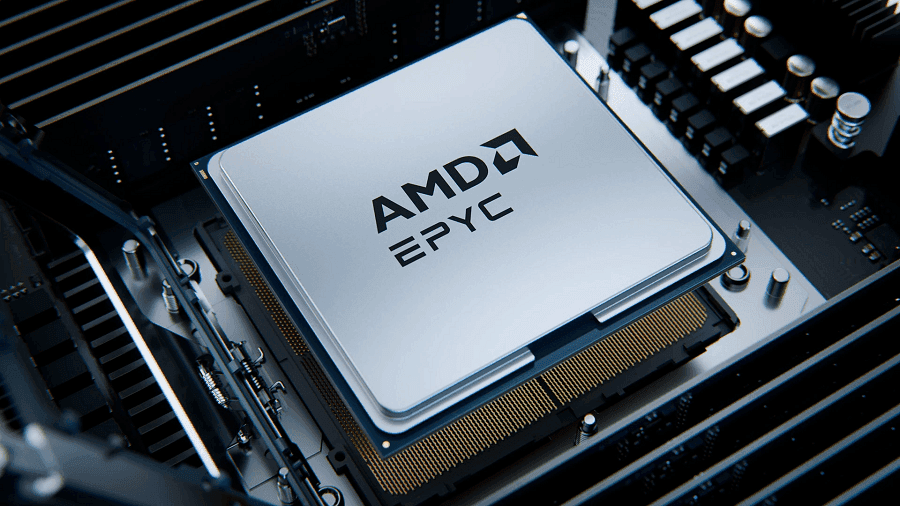
. The AMD EPYC 9006 series, codenamed Venice, is now shipping to server clients with systems arriving through leading OEMs and ODMs2
.
Source: Tom's Hardware
Flagship EPYC 9996 Delivers 256 Cores and Massive Performance Gains
The flagship EPYC 9996 raises the maximum core count to 256 cores with 512 threads, clocked at up to 4.1GHz with 1GB of L3 cache
2
. Operating at a 2.55GHz base clock, the chip defaults to 600W but can be configured down to 400W2
. Early independent testing from Tom's Hardware measured a dual 9996 server at up to 93% faster than a dual EPYC 9965 in SPEC CPU 2026's intrate test2
. AMD's internal benchmarks show the 9996 at least doubles the Intel Xeon 6980P's performance in some tasks and more than triples it in others2
. The AMD EPYC 9006 series lineup scales from the flagship down to the eight-core, 16-thread EPYC 9016 at just $700, with the top-end chip listed at $14,9042
.
Source: SiliconANGLE
TSMC N2 Process Delivers Efficiency and AI Performance Improvements
Shifting to TSMC's N2 process node grants EPYC processors Venice up to a 2.6x improvement in performance-per-watt
2
. The Zen 6 architecture delivers 31% higher IPC when running AI agent workloads compared to AMD's previous design, partly stemming from TSMC's latest two-nanometer node3
. AMD claims 1.87x as many AI agents per CPU dollar compared to recent Intel Xeon processors2
. With a 5.3GHz maximum boost clock on high-frequency host-node parts, Venice delivers up to 1.8x the LLM inference output of the previous EPYC generation2
5
. PCIe 6.0 doubles CPU-to-GPU I/O bandwidth, with up to 128 lanes in dual-socket SP7 systems2
.Diverse Portfolio Addresses Multiple AI and Enterprise Computing Roles
AMD's argument centers on agentic AI requiring a broad range of general-purpose CPUs rather than single-SKU approaches from Nvidia Vera and Arm
1
. The dense EPYC 9996 with 256 cores offers peak throughput performance, while the frequency-optimized EPYC 9686F competes with Nvidia Vera as an AI host node1
. High-density AMD EPYC processors provide up to approximately 3.3x agents-per-CPU-watt advantage over Nvidia Vera and approximately 2.5x over Intel Xeon 6980P for hosting agent sandboxes5
. Dan McNamara, senior vice president and general manager of AMD's Compute and Enterprise AI unit, stated that customers can "standardize on the proven x86 foundation while choosing a workload-optimized solution to run more agents"3
5
.Related Stories
Verano Variant Targets Power Efficiency With LPDDR5X Memory
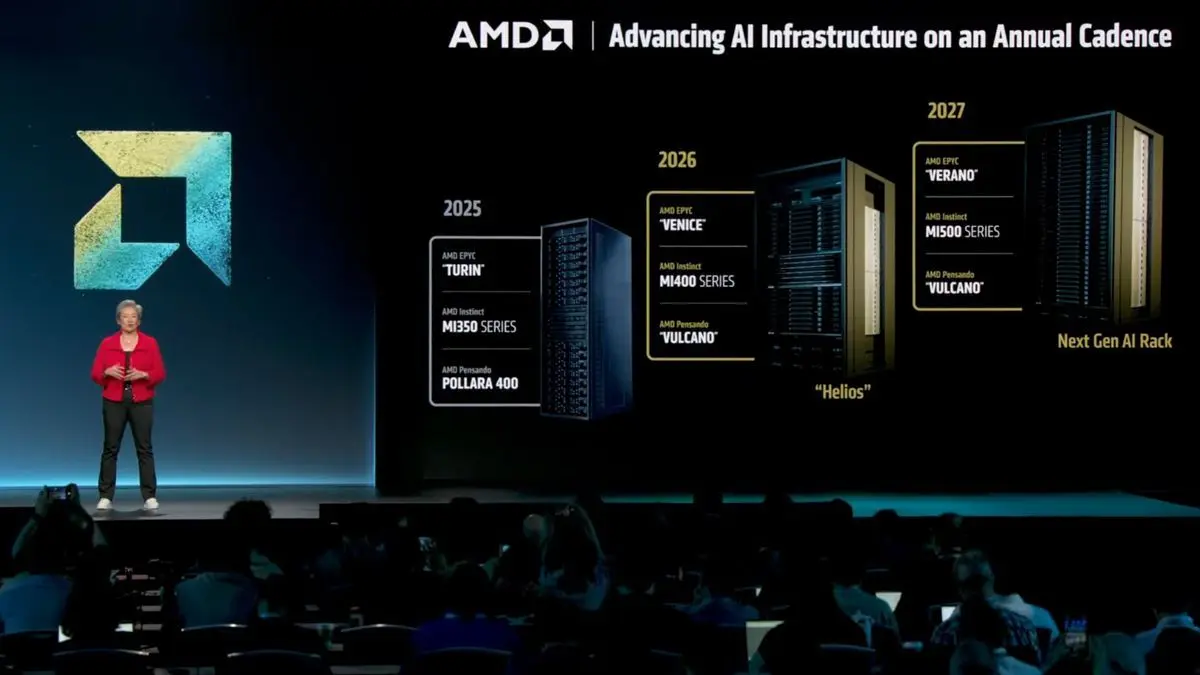
AMD is launching additional ranges next year, with Venice-X targeting HPC with 3D-stack cache, and Verano going directly after Nvidia Vera as an AI host node with an LPDDR5X memory system
1
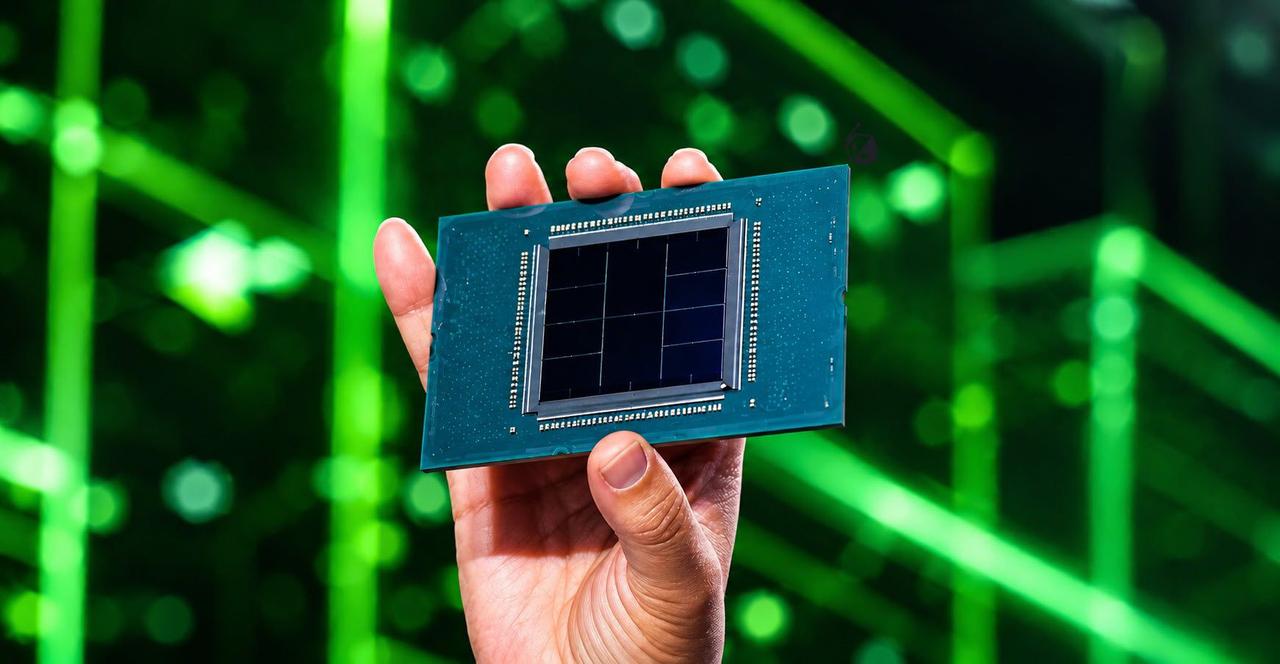
. The AMD EPYC Verano CPUs feature up to 192 cores with LPDDR5X SOCAMM2 memory support, offering up to 0.8 TB/s bandwidth and up to 1.5 TB capacity per socket4
. Using LPDDR5X SOCAMM memory lowers power draw by 30-40% compared to DDR5 RDIMM/MRDIMM at similar bandwidth4
. Verano will come in configurations of both Zen 6 (up to 12 cores per CCD) and Zen 6C (up to 32 cores per CCD), with frequencies reaching up to 5.3GHz on Zen 6 variants4
.
Source: Wccftech
Cloud Deployments and Enterprise Adoption Accelerate
Systems powered by 6th Gen AMD EPYC processors are shipping from all leading server vendors, with cloud instances from Microsoft Azure and OCI coming soon
5
. AMD has positioned the processors to power Microsoft Azure instances optimized for AI inference workloads and chip design software3
. Per-socket memory bandwidth reaches up to 1.6 TB/s in data centers2
. AMD EPYC 9996 CPU-based systems deliver up to 3.7x more performance compared with an Nvidia Vera CPU-based system and up to 2.2x the performance and 2.0x the performance per dollar of an Intel Xeon 6980P system5
. Watch for how server processors OEMs integrate these CPUs for agentic AI as workload characteristics continue evolving beyond simple LLM inference toward complex multi-agent systems requiring diverse server processors capabilities.References
Summarized by

Navi
[3]
Related Stories
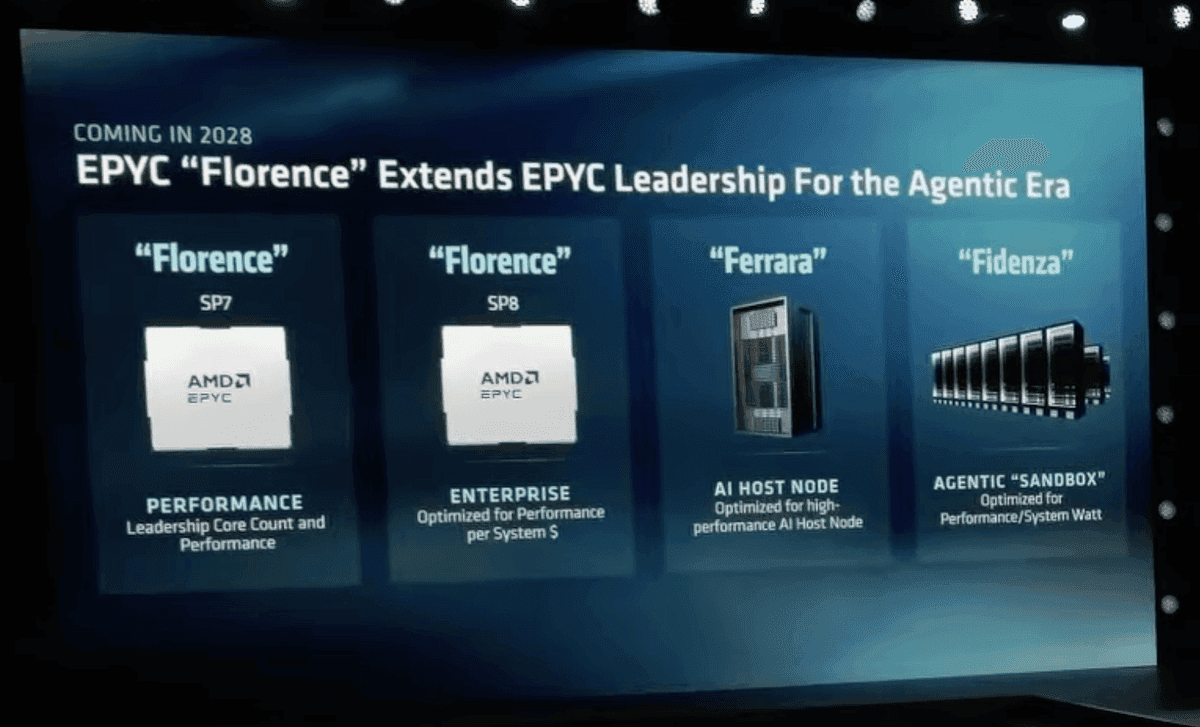
AMD splits Zen 7 into three EPYC families for 2028 as it pushes deeper into AI server market
23 Jul 2026•Technology
AMD Unveils EPYC Verano: Zen 6 Processor With Up to 192 Cores and LPDDR5X Memory for AI Infrastructure
13 Oct 2026•Technology
AMD Zen 6 EPYC CPUs with 256 cores debut at Advancing AI event, promising 1.7x AI speed boost
10 Jul 2026•Technology

Recent Highlights
1
Google's AI Policy Forces Schools to Accept AI Overviews or Lose Search Access Entirely
Technology

2
Jensen Huang's Affair with Suspected Chinese Spy Exposes $7 Billion AI Chip Smuggling Network
Policy and Regulation

3
Anthropic launches Fable 5.2 and Mythos 5.2 with 20% price cut and 30% faster output
Technology

Recent Highlights
Today's Top Stories








Don’t drown in AI news. We cut through the noise - filtering, ranking and summarizing the most important AI news, breakthroughs and research daily. Follow topics that matter to you and stay ahead.


