AMD Ryzen AI Embedded P100 Series Targets Edge AI and Industrial Applications with Zen 5


2 Sources
[1]
AMD Ryzen AI Embedded P100 Series Debuts: Zen 5, RDNA 3.5 and XDNA 2
AMD is widening its embedded roadmap in a way that feels very deliberate, very timely, and frankly rather aggressive. The Ryzen AI Embedded P100 series is no longer just about compact edge compute with modest core counts and respectable graphics. With the arrival of the new 8-core through 12-core
[2]
AMD Introduces Scalable Ryzen AI Embedded Chips for Edge and Industrial Applications
Compared with the prior generation AMD Ryzen™ Embedded 8000 Series, the P100 Series is expected to provide up to 39% higher multithreaded performance and up to 2.1x higher total system TOPS2. The new processors deliver exceptional AI performance-per-watt and support almost twice the number of
Share
Copy Link
AMD expands its Ryzen AI Embedded P100 series with processors featuring up to 12 Zen 5 cores, RDNA 3.5 graphics, and 50 AI TOPS for edge AI and industrial applications. The new chips deliver up to 39% higher multithreaded performance and support advanced workloads including Llama3.2-Vision 11B, while offering ROCm open-source AI software stack compatibility for simplified deployment.
AMD Scales Ryzen AI Embedded Platform for Edge AI and Industrial Deployments
AMD is expanding its Ryzen AI Embedded P100 series with new processors designed specifically for edge AI and industrial applications that demand balanced CPU performance, graphics acceleration, and low-latency AI inference
1
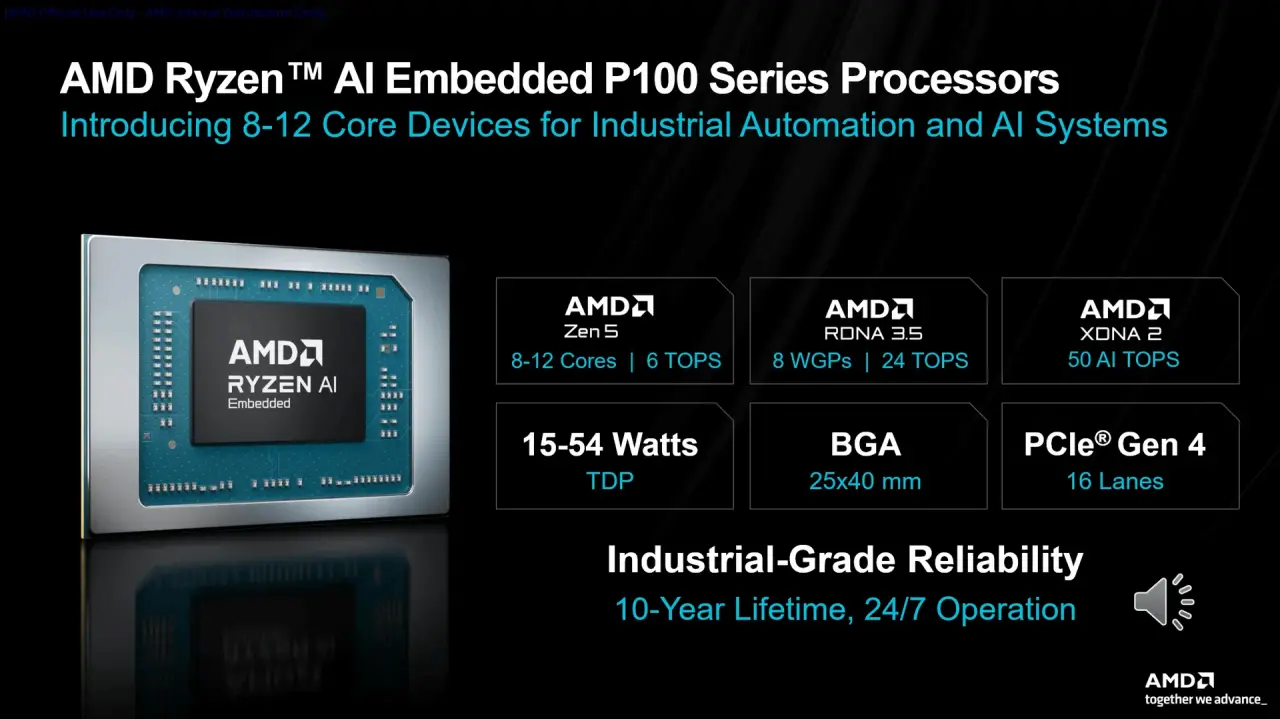
. The lineup now spans from 4-core to 12-core configurations, all built on a monolithic heterogeneous design that integrates CPU, graphics, and NPU capabilities into a compact 25 x 40 mm BGA package1
. This scalability matters for system integrators and OEMs working on machine vision, robotics, smart edge inference, digital signage, and HMI systems, as a single board design can address multiple performance tiers without extensive revalidation1
.
Source: DT
Performance Gains Through Zen 5 Architecture
The Ryzen AI Embedded P100 series leverages Zen 5 cores to deliver up to 39% higher multithreaded performance compared to the previous Ryzen Embedded 8000 Series
2
. The flagship P185 model features 12 Zen 5 cores running at up to 5.1 GHz with 24 MB of L3 cache, while the P174 and P164 offer 10-core and 8-core configurations respectively1
. For embedded applications where platform longevity typically outweighs benchmark performance, this performance-per-watt improvement enables more flexible passive cooling systems, smaller enclosures, and greater headroom for concurrent workloads1
.Hybrid AI Execution with XDNA 2 NPU and RDNA 3.5 Graphics
AMD's approach to compact edge compute centers on a hybrid AI execution model that allocates workloads between the NPU and iGPU based on power and latency requirements
1
. The XDNA 2-based NPU delivers up to 50 AI TOPS for always-on, low-power inference tasks like voice triggers, persistent object detection, and sensor fusion, while the RDNA 3.5 graphics engine with up to eight work group processors running at 2.9 GHz handles burst-oriented AI workloads and visual reasoning1
. This architecture delivers up to 2.1x higher total system AI TOPS compared to the earlier P100 Series2
. The iGPU also supports up to four 4K120 displays or dual 8K120 output, addressing requirements for industrial control rooms, medical imaging terminals, and transportation hubs1
.
Source: Guru3D
Related Stories

ROCm Support Brings Open-Source AI Software Stack to Embedded Applications
AMD is bringing its ROCm open-source AI software stack to the Ryzen AI Embedded platform, allowing developers to run standard AI frameworks without rewriting code for embedded applications
2
. ROCm uses the open-source Heterogeneous-computing Interface for Portability (HIP) at the programming level, which decouples GPU programming from hardware and eliminates vendor lock-in2
. The new processors support nearly twice the number of virtual machines and can handle larger large language models like Llama3.2-Vision 11B compared to existing P100 Series chips2
. This tightly integrated CPU, GPU, and NPU architecture enables efficient workload partitioning and predictable latency under mixed workloads, simplifying development and deployment for system integrators2
.Industrial-Grade Connectivity and Memory Support
The P100 series includes DDR5 support at 5600 MT/s with ECC and LPDDR5X support up to 8533 MT/s in certain configurations
1
. Connectivity options include up to 16 lanes of PCIe Gen 4 for NVMe storage, frame grabbers, AI accelerators, and high-speed networking, along with USB 4 support across much of the lineup1
. Select models feature integrated 10GbE with Time-Sensitive Networking (TSN) support, addressing requirements for industrial networking and deterministic control environments1
. The series spans configurable power envelopes from 15 watts to 54 watts depending on configuration, giving OEMs flexibility in thermal design1
. Watch for adoption in automation systems requiring real-time inference at the edge, as the combination of deterministic networking, ECC memory, and hybrid AI execution positions these chips for safety-critical and time-sensitive industrial applications where reliability matters as much as raw performance.References
Summarized by

Navi
Related Stories
AMD launches Ryzen AI Embedded processors for automotive, industrial and physical AI systems
06 Jan 2026•Technology

AMD Ryzen AI Embedded X100 brings Zen 5 power to autonomous robots and physical AI applications
23 Jul 2026•Technology
AMD Unveils AI-Optimized Processors at CES 2025, Advancing AI PC Market
01 Jan 2025•Technology

Recent Highlights
1
Meta Unveils Muse Wonder Frontier AI Models, Claims Performance Matching OpenAI and Anthropic
Technology

2
IMF Report Warns AI Market Correction Could Spark Global Financial Crisis With $1.4T at Risk
Business and Economy

3
OpenAI Releases 722 AI-Generated Math Solutions, Triggering Existential Crisis in Mathematics
Technology

Recent Highlights
Today's Top Stories






Don’t drown in AI news. We cut through the noise - filtering, ranking and summarizing the most important AI news, breakthroughs and research daily. Follow topics that matter to you and stay ahead.


