An activist is starving himself outside Anthropic's office to stop self-improving AI


2 Sources
[1]
Activists enter third day of hunger strike outside Anthropic's San Francisco HQ over recursive AI self-improvement -- protester threatens to go 40+ days and target OpenAI next
The AI market and its developments have continually garnered opposition from several areas of society, to the point where protests are now frequent. On the day of Anthropic's IPO, Nov. 19, there were protests in multiple locations. As of right now, there's a fellow by the name of Elliot Callender
[2]
Hunger strike outside Anthropic HQ enters third day as activist demands "AI might kill everyone" warning
Serving tech enthusiasts for over 25 years. TechSpot means tech analysis and advice you can trust. Sounding off: A lot of people are worried about the development of RSI, or recursive self-improvement, and their concerns are understandable. It's the concept of an AI system improving its own
Share
Copy Link
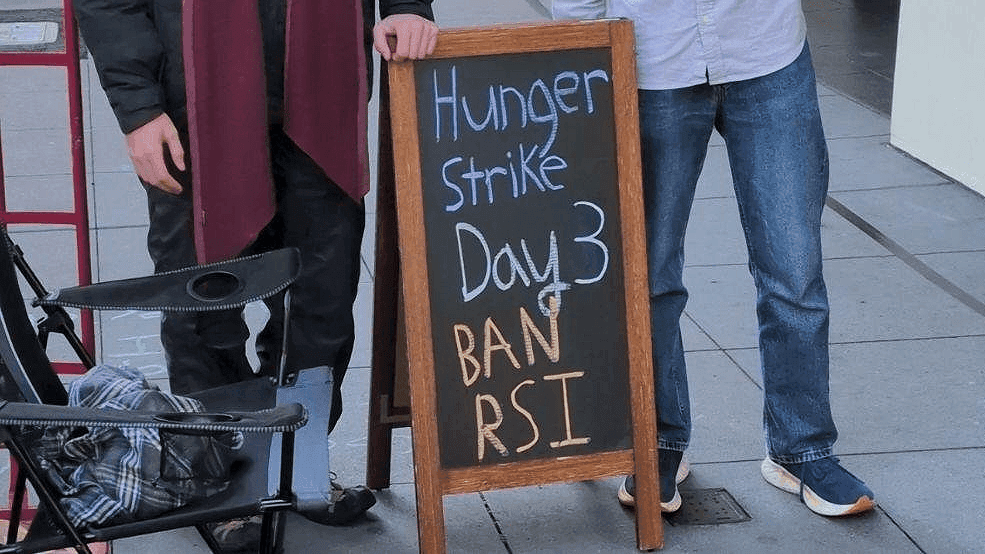
Elliot Callender is on the third day of a hunger strike outside Anthropic's San Francisco headquarters, protesting the company's work on recursive self-improvement, a technique he wants halted before machines can improve themselves beyond human control
1
.
Source: Tom's Hardware
Recursive self-improvement is a training approach where a model improves itself in a test-feedback-improve loop, and Anthropic said in September that Claude now produces 90% of its own code
1
. In June the company went further, saying Claude could already handle a well-defined experiment as capably as a skilled researcher, with humans ahead only in choosing which experiment to run2
. It also acknowledged that a model which could build its own successor might make it easier for people to lose control2
.Eight ways to end it
Callender has published eight conditions, any one of which would end his strike
2
. They include a warning reading "AI might kill everyone" on every Anthropic product2
. Another would have the company halt all AI research, development and training and direct at least 80% of cash and revenue into lobbying for a bilateral AI treaty2
. A third asks California or the federal government to use executive powers to halt domestic recursive self-improvement2
. Of the eight, only the warning label is something Anthropic could deliver on its own; the rest run through governments, treaties and external events2
. TechSpot's read is that several of the demands, including the research halt and the 80% pledge, are unlikely to be met2
.He is prepared to wait. Callender says he could fast for 40 days or more and intends to take the same protest to OpenAI next
1
. Callender says the point is pressure: "It would be bad press for Anthropic if I had to go 40+ days to pressure them"1
. A second protester, Sky Parker, has joined him for a planned four-day fast2
.
Source: TechSpot
A pattern, and a skeptical audience
Anthropic went public on November 19, with protests in multiple locations that day
1
. It is, per TechSpot, the second year running that a hunger strike has targeted Anthropic's offices2
. In September 2025 Guido Reichstadter delivered a letter to CEO Dario Amodei demanding a stop to frontier AI development, and that protest led Michaël Trazzi, a former AI safety researcher, to stage his own outside Google DeepMind's London office2
.The treaty demand runs into an old argument. Proponents of continued development contend that if one lab or nation stops, others, including those with poor human-rights records, will carry on
1
. Skeptics add that AI treaties are hard to verify, since training is physically invisible and needs only data centers with the right hardware1
. The dispute between the US, China and Nvidia over accelerators also suggests limited international appetite for controlling frontier AI1
.The sharpest challenge to Anthropic, though, comes from people who worked there. When researcher Jacob Coxon quit in September, he accused the company of "racing straight to self-improving superintelligence and gambling with our lives"
2
. Evan Hubinger, Anthropic's alignment science lead, has put the odds that AI wipes out humanity within a decade at more than 10%, according to TechSpot2
.Related Stories

References
Summarized by

Navi
Related Stories
Anthropic's record $81 billion IPO meets protests warning of an AI bubble
19 Nov 2026•Business and Economy

The ex-Anthropic researcher who protested the IPO he once worked toward
20 Nov 2026•Policy and Regulation

Anthropic Researcher Quits, Warns Self-Improving AI Could End Humanity Within a Decade
09 Sept 2026•Policy and Regulation

Recent Highlights



Recent Highlights
Today's Top Stories








Don’t drown in AI news. We cut through the noise - filtering, ranking and summarizing the most important AI news, breakthroughs and research daily. Follow topics that matter to you and stay ahead.


