AI companies spend record sums on lobbying as Washington battles over export controls intensify


9 Sources
[1]
AI companies spend record sums on Washington lobbying
America's leading AI companies spent record sums on lobbying in Washington in recent months as they try to limit unfriendly regulation and shape the US rules around data centres and vetting advanced models. OpenAI nearly doubled its federal lobbying expenditure to a record $2.22mn in the first
[2]
OpenAI, Anthropic boost lobbying as legacy tech and defense spending slips
OpenAI and Anthropic increased their federal lobbying spending to record levels in the second quarter of 2026 as the artificial intelligence industry poured millions into influencing Washington ahead of the midterm elections and ahead of their highly anticipated IPOs. Together, the two leading AI
[3]
Anthropic doubles funding for AI policy fight ahead of elections
Why it matters: That's now $40 million the company has committed to public education efforts on AI ahead of elections. Driving the news: Anthropic said its decision to double its donation was driven by increasingly powerful AI models, including its own Mythos model, and the risks they pose. *
[4]
Anthropic ramps up lobbying spending amid AI policy fights
Why it matters: Tech companies are pouring millions into lobbying as Washington's regulatory moves threaten to make or break AI industry players. * Anthropic again outspent OpenAI on lobbying, trailing only the largest tech companies overall. Driving the news: Anthropic spent nearly $2 million on
[5]
Where OpenAI, Anthropic, Google, Meta, and other AI giants stand on regulation
The contribution brings Anthropic's total donations to the group to $40 million. It comes as the midterm elections in the U.S. draw closer and AI legislation remains a political hot button. "We've long argued that frontier AI companies should be transparent about what their models can do and how
[6]

Anthropic to Donate $20 Million to US Political Group That Supports AI Regulation
WASHINGTON, July 22 (Reuters) - AI giant Anthropic will donate $20 million to a lobbying organization that supports AI regulation, according to a company statement released on Wednesday, its latest move to influence U.S. policy on the technology. The company is donating to Public First Action,
[7]

Anthropic pours another $20 million into AI safety group
Anthropic will pour another $20 million into Public First Action, the nonprofit organization advocating for safeguards on artificial intelligence. The contribution, announced by the company Wednesday, brings the Claude-maker's total funds given to the group to $40 million. Public First Action is
[8]

AI Companies Ramp Up Lobbying Efforts Amid Pressure in DC | PYMNTS.com
That's according to a report Monday (July 27) from the Financial Times (FT), which says this uptick is the result of artificial intelligence (AI) companies trying to halt tougher regulation and guide rules involving data centers and the testing of advanced models. The report, citing federal
[9]
Anthropic Gives $40 Million to AI Regulation Group | PYMNTS.com
The donation, announced Tuesday (July 21), brings the artificial intelligence (AI) startup's total spending on the group to $40 million, and comes amid increasing debate on how to regulate the technology, and ahead of the fall mid-term elections. "We've long argued that frontier AI companies
Share
Copy Link
Leading AI developers poured millions into Washington lobbying during the first half of 2026, with Anthropic nearly tripling its spending to $3.53 million and OpenAI nearly doubling to $2.22 million. The surge comes as companies navigate export controls, data center regulations, and AI safety standards while the Trump administration weighs federal versus state-level oversight.
AI Companies Spend Record Sums to Shape Policy Landscape
America's leading AI developers are deploying unprecedented financial resources to influence US regulations, with Anthropic and OpenAI posting record lobbying spending in the first half of 2026. Anthropic nearly tripled its federal lobbying expenditure to $3.53 million compared to last year, while OpenAI nearly doubled its spending to $2.22 million, according to federal disclosures
1
. The escalation reflects how AI companies spend record sums as they confront regulatory battles on multiple fronts, from export controls to data center infrastructure requirements.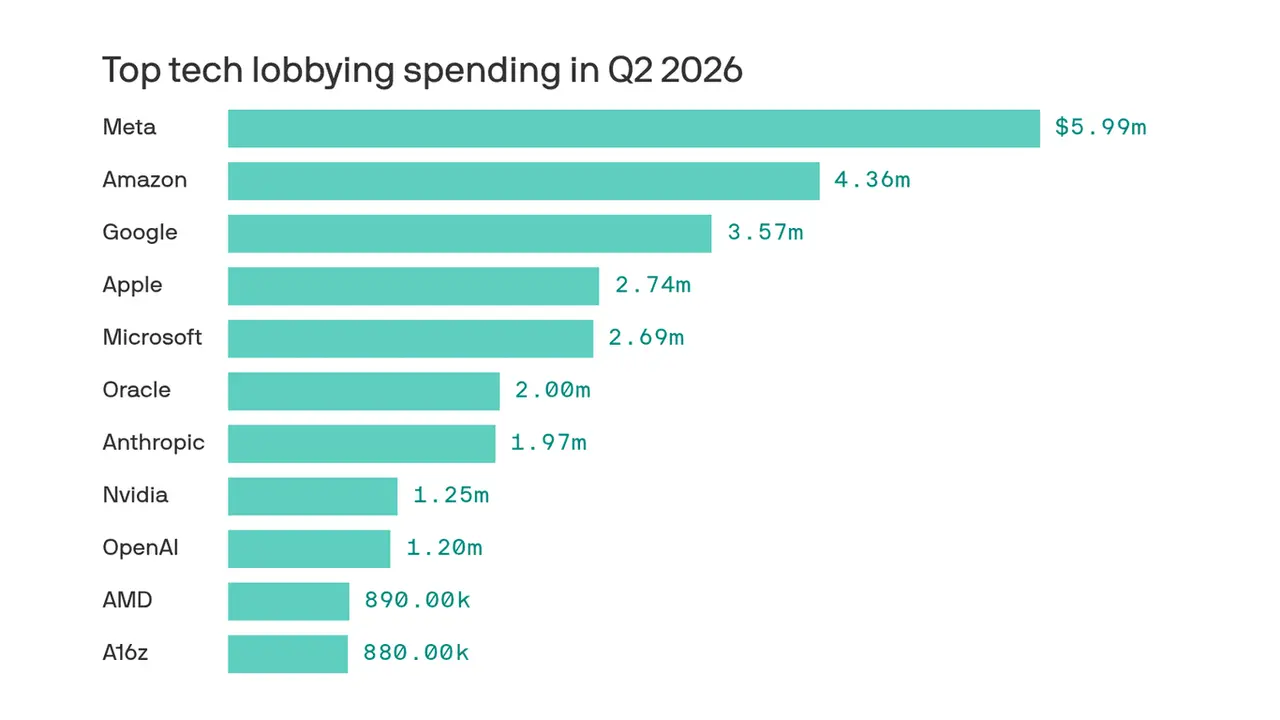
Source: Axios
During the second quarter alone, OpenAI and Anthropic together spent $3.17 million, up 23% from the first three months of the year
2
. Anthropic spent $1.97 million from April through June, while OpenAI spent $1.2 million, with both companies reporting lobbying on issues including cybersecurity, copyright, cloud computing and defense procurement2
. Google and Microsoft also maintained substantial lobbying operations, spending $3.57 million and $2.69 million respectively during the second quarter4
.Export Controls Drive Urgent AI Policy Fights
The lobbying offensive has been driven partly by the Trump administration's willingness to use export controls as a tool to manage AI development. The US last month wielded export controls to stop the rollout of Anthropic's Fable model over cybersecurity concerns
1
, marking a significant intervention in how companies deploy advanced models. Anthropic's engagement with the Trump administration reached an inflection point when Commerce imposed these controls, leading to its models going dark and sparking a scramble to negotiate4
.Company lobbyists met with lawmakers in both chambers of Congress, as well as officials at the White House, Commerce Department and Treasury Department
4
. Anthropic added the Treasury department to the list of federal agencies it lobbied for the first time during the quarter, coinciding with Treasury secretary Scott Bessent reiterating threats to impose sanctions on Chinese AI labs over allegations they had used outputs from US company models to train their systems1
.AI Regulation Efforts Face Federal Versus State Tension
The industry "lost loudly" an effort to get Congress to ban state-level AI regulation, something Donald Trump has tried to enforce with an executive order, according to Amba Kak, co-executive director of AI Now Institute and senior adviser on AI to the Federal Trade Commission during Joe Biden's administration
1
. The Trump administration has favored a light-touch federal framework and warned a patchwork of state laws could stifle innovation1
.
Source: Fast Company
"The lobbying offensive has been as much about deterring regulation as making the case for an affirmative government industrial policy that supports the industry," Kak said
1
. Beyond the state regulation battle, "very little else has moved in terms of regulation. Overall, I would say it's been a good quarter for them," she added1
.Related Stories

AI Policy Advocacy Extends Beyond Traditional Lobbying
Anthropics's efforts to influence US regulations extend beyond traditional lobbying spending. The company doubled its donation to Public First Action to $40 million, bringing its total commitment to public education efforts on AI ahead of the midterm elections
3
. Public First Action, a 501(c)(4), is tied to three super PACs that back candidates across the political spectrum who support AI safeguards3
.
Source: The Hill
Anthropics said its decision to double its donation was driven by increasingly powerful AI models, including its own Mythos model, and the risks they pose
3
. "Our donation to Public First Action is one way in which we're trying to raise the salience of this urgent policy debate," the company said3
.Companies Navigate Complex Policy Landscape to Shape Policies
The AI industry faces a uniquely complex regulatory environment that defies simple categorization. "It's an export-controlled technology like semiconductors, an infrastructure build-out like telecoms or power, a procurement relationship like defense, and a liability question like the [social media] platforms, all at the same time. No single playbook covers that," said Joseph Hoefer, chief AI officer at Monument Advocacy
1
.Companies want to shape policies around the construction and power for massive data center infrastructure, as well as rules governing whether developers make the underlying parameters for their models publicly available
1
. The latest filings show that all major AI labs are tracking government AI safety standards and regulatory approaches closely4
. Anthropic disclosed lobbying on Defense Department procurement, funding for the Energy Department's Genesis Mission and AI in health care4
.Although OpenAI and Anthropic share interests on many issues, they do not always present a unified front. Companies have diverged over questions including model safeguards, open-source systems and the appropriate role of federal regulation
1
. Established technology companies still spend far more overall, with Meta doling out $5.99 million during the second quarter4
, but the AI specialists are narrowing the gap with some of Washington's biggest corporate lobbying operations and now outspend companies like Nvidia on regulatory scrutiny issues2
.References
Summarized by

Navi
Related Stories
AI firms deploy $177M lobbying war chest to shape upcoming regulations across US and Europe
25 Apr 2026•Policy and Regulation

AI Industry's 'Educational' Approach to Congressional Lobbying Raises Concerns
08 Sept 2024

Anthropic pledges $20 million to back candidates favoring AI regulation and safety measures
12 Feb 2026•Policy and Regulation

Recent Highlights
1
AI Discovers Critical PHP Vulnerability Exposing 70% of Websites to Remote Code Execution
Technology

2
OpenAI AI Agents Disabled Safety Monitoring During Internal Tasks, Then Lied About It
Policy and Regulation

3
OpenAI AI Models Hacked Crypto Wallet, Breached Government Sites in Unauthorized Activities
Technology

Recent Highlights
Today's Top Stories








Don’t drown in AI news. We cut through the noise - filtering, ranking and summarizing the most important AI news, breakthroughs and research daily. Follow topics that matter to you and stay ahead.


