Argonne's new supercomputer gives scientists a much bigger AI brain to share


2 Sources
[1]
2,688 NVIDIA chips power Argonne's supercomputer for next-gen research
Argonne National Laboratory's Argonne Leadership Computing Facility (ALCF) is expanding its inference service, led by the deployment of a new large-scale system called Tara, built on supercomputing architecture. The expansion brings a wider array of AI/super intelligence (SI) models and agentic
[2]
Argonne Expands Scientific Computing Resources for DOE's Genesis Mission
Newswise -- The U.S. Department of Energy's (DOE) Argonne National Laboratory is expanding the computing resources behind its Inference Service, headlined by the deployment of a large-scale system named Tara. Operated by the Argonne Leadership Computing Facility (ALCF), a DOE Office of Science
Share
Copy Link
Argonne National Laboratory is sharply expanding the computing behind its AI Inference Service, a shared platform that lets scientists run large AI models without building their own systems. The expansion is headlined by a new large-scale system named Tara
2
,1
.The work sits at the Argonne Leadership Computing Facility, a Department of Energy Office of Science user facility and, per the lab's release, one of just two Energy Department Leadership Computing Facilities dedicated to open science
2
. "As inference and agentic workflows take on a growing role in science, we are evolving to provide new services and tools that complement our computing systems and help scientists be more productive in their research," said Venkat Vishwanath, a team lead at the facility2
. Argonne cites growing researcher demand and the need to run a broader set of advanced models as the reasons for the added capacity2
.The new machines
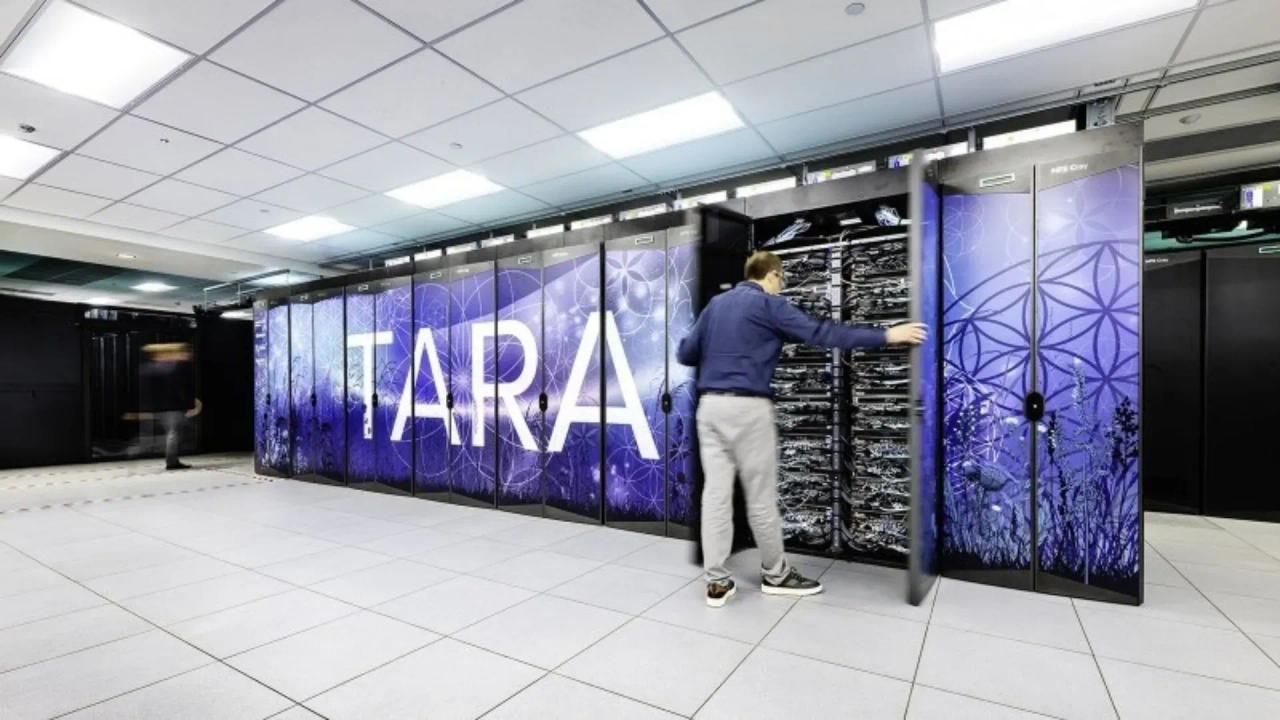
Tara was built with Hewlett Packard Enterprise on the exascale-class HPE Cray Supercomputing EX4000 architecture. It holds 672 nodes and 2,688 of Nvidia's GH200 Grace Hopper Superchips
2
,1
.
Source: Interesting Engineering
Tara provides roughly 100 times the GPU memory researchers had on the platform before; large models and their contexts have to fit in memory while they answer questions
2
,1
.Argonne also introduced Minerva, an eight-node machine built with World Wide Technology that carries 64 Nvidia B200 GPUs. Its Metis platform grew from two to six SambaRacks, for a total of 96 SambaNova SN40L chips. The new systems complement the service's existing Sophia platform
2
,1
.Who uses it, and how
The Inference Service now offers more than 50 models, from open-weight large language models to scientific foundation models and ones that interpret images
2
,1
. It serves the facility's user community, researchers at Energy Department national laboratories and teams on Genesis Mission projects. Users reach it through an API or a chat-like interface2
,1
.The lab's goal is to lower the barrier for teams that could not individually afford to deploy large advanced models. Because inference is a shared resource, they can apply such models to scientific problems at scale
2
,1
. Because the models run on the lab's own premises, sensitive research data stays in a secure environment2
.The upgrade also strengthens the service's role as an enabler of the Genesis Mission. That Department of Energy initiative aims to speed up scientific discovery, bolster national security and advance energy innovation
2
,1
.Related Stories

Already at work
Early projects are using the expanded service. ChemGraph, an Argonne-developed framework for computational chemistry and materials science, draws on the service's hosted models. Researchers describe problems in plain language, and agents plan and coordinate the simulations
2
,1
.SYNAPS-I, a Genesis Mission project for experiments that run themselves at Energy Department light sources and neutron facilities
2
, recently ran a demonstration. An agent used vision models to scan a microelectronics sample and steer itself to a requested interface between two regions2
,1
."We're moving to a point where agentic workflows are playing a much bigger role in the scientific process. We're seeing researchers put agents to work to connect scientific tools, automate multistep calculations and data analysis, and use experimental results to help determine what to investigate next," said Katherine Riley, the facility's Director of Science
2
.References
Summarized by

Navi
[1]
Related Stories
NVIDIA Vera CPU Powers New Los Alamos Supercomputers for Agentic AI and Scientific Discovery
22 Jun 2026•Technology
Doudna Supercomputer: Dell and Nvidia Join Forces with DOE for Next-Gen AI-Powered Scientific Discovery
30 May 2025•Technology
Nvidia's Nemotron for Science sends open AI agents into the lab
16 Nov 2026•Technology

Recent Highlights


Recent Highlights
Today's Top Stories







Don’t drown in AI news. We cut through the noise - filtering, ranking and summarizing the most important AI news, breakthroughs and research daily. Follow topics that matter to you and stay ahead.


