Arm AGI CPU Delivers 2X Performance Over AMD EPYC in New Agentic AI Benchmark Tests


4 Sources
[1]
Arm says its AGI CPU delivers nearly 2X the performance per rack of AMD EPYC 9755 in new agentic AI CPU tests
Arm announced last week that its AGI CPU, the company's data center CPU for agentic AI workloads, delivers twice the performance per rack as AMD EPYC 9755, calculated from chip performance and server-power assumptions measured across seven workloads. The claim stems from modeled rack results from
[2]
Arm fits up to 23 AGI CPU servers into a 24 kW rack
* Arm's AGI CPU nearly doubles AMD's modelled rack-level performance across seven workloads * A 24-kW rack accommodates up to 23 Arm servers under the assessment's assumptions * Arm's rack-level advantage reaches 3.19x in the strongest individual workload Arm's AGI CPU has recorded nearly twice
[3]
AMD's Server CPU Business Faces a New AI Boom
AI agents have put CPU back in the spotlight after years of being relatively overshadowed by GPUs. We're witnessing a 'ChatGPT' moment for AI agents. They're no longer the artisanal workflows that only AI-savvy folks could assemble. Thanks to Muse, Instinct, and a growing number of agents which
[4]
Arm Pits Its AGI CPU Against AMD's Zen 5 EPYC Turin And Claims A 2x Rack-Level Win In Agentic Workloads As AGI Focuses on "Strong Per-Core" Capabilities
Arm's AGI CPU has been benchmarked against AMD EPYC, offering twice the performance uplift in agentic AI workloads. Arm Pits Its AGI CPU Against AMD's EPYC Turin, Showcasing a 2x Uplift, But EPYC Venice With Zen 6 Is Missing From Its Demonstration As the industry continues to roll out agentic
Share
Copy Link
Arm's AGI CPU achieved nearly twice the rack-level performance of AMD's EPYC 9755 across seven agentic AI workloads in independent testing by Signal65. The advantage stems from fitting 21-23 Arm servers versus 13 AMD dual-socket systems in a 24 kW rack, with individual server power ranging from 950-1,050 watts compared to AMD's 1,700 watts.
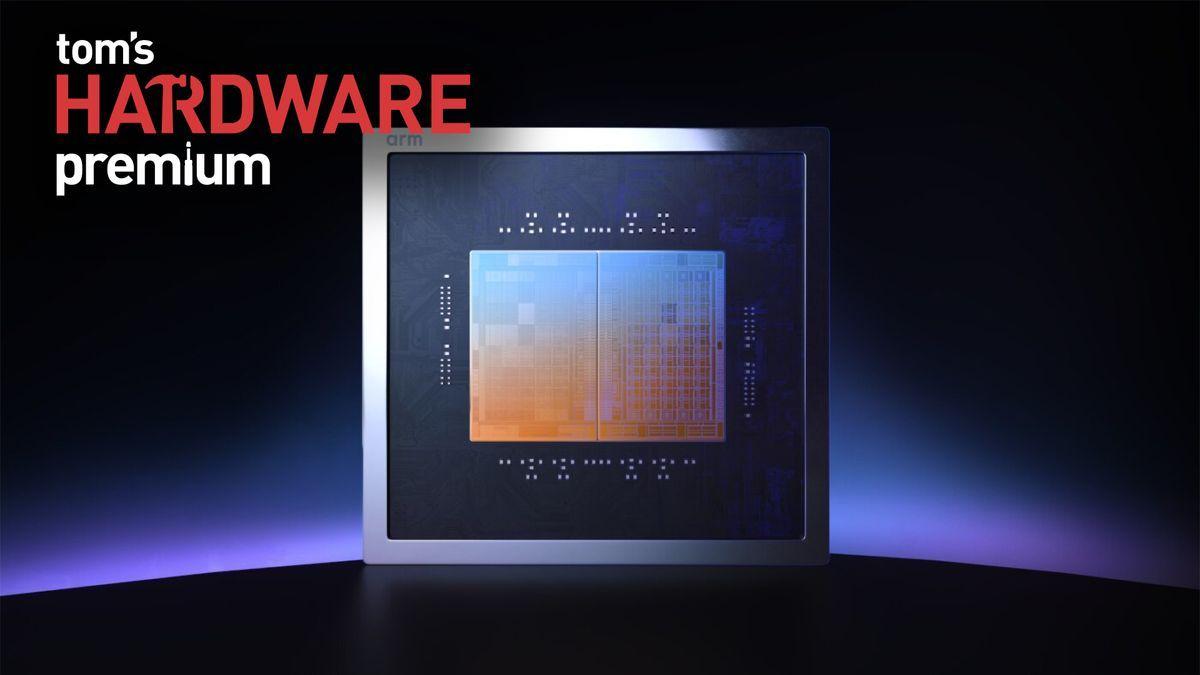
Arm AGI CPU Outperforms AMD EPYC in Independent Agentic AI Testing
Arm announced that its AGI CPU delivers 1.99x the modeled rack-level performance of AMD EPYC 9755 across seven agentic AI workloads, according to an independent analysis conducted by Signal65
1
2
. The AGI CPU is Arm's first server-grade CPU silicon designed specifically for agentic AI workloads, featuring 3rd generation Neoverse cores optimized through partnerships with hyperscalers including Fujitsu, Meta, and OpenAI1
4
. Individual workload results ranged from 1.43x to 3.19x compared to AMD's EPYC 9755 processor2
.Rack Density Drives Performance Advantage
The rack-level performance advantage stems primarily from power efficiency differences between the two architectures. A 24 kW rack can accommodate 21 to 23 AGI CPU servers compared to 13 dual-socket EPYC 9755 systems
2
4
. This configuration provides between 5,712 and 5,888 physical cores for Arm versus 3,328 for AMD2
. Individual server power consumption ranges from 950 to 1,050 watts for Arm's systems, while AMD's dual-socket configurations draw 1,700 watts2
4
.Per-Chip Performance and Testing Methodology
At the chip level, the AGI CPU averaged 1.20x the performance of EPYC 9755 across seven workloads
1
4
. The AGI CPU led by 9% on Terminal-Bench, 13% on SWE-bench, and 97% on fastText, but trailed by 12% in MySQL and 5% in Milvus throughput1
. Testing used two AGI CPU configurations: a 128-core chip at 2.8 GHz with DDR5-7200 for Terminal-Bench 2 and SWE-bench replay, and a 136-core chip at 3.2 GHz with DDR5-8000 for the remaining five workloads1
. The AMD comparison used one socket of the 128-core EPYC 9755 with DDR5-64001
.New CPU Evaluation Framework for Agentic AI
Arm developed a new CPU evaluation methodology specifically for agentic AI workloads, created with support from Fujitsu, Meta, and OpenAI
1
2
. The methodology centers on representative agent workloads, repeatable CPU measurements, and validation against end-to-end task outcomes1
. Agentic AI changes the role of server CPUs in modern AI infrastructure by requiring them to handle complex, multi-step workflows beyond inference, including executing tools, retrieving data, and maintaining state within isolated environments1
. Mohamed Awad, Arm executive vice president for Cloud AI, stated that "The industry needs to measure how well systems handle the work agents actually complete"2
.Sandbox Creation Performance Shows Additional Gains
Separate testing using Sandbench compared the AGI CPU against AMD's EPYC 9965, measuring the time required to establish isolated execution environments
2
4
. Arm completed cold starts 45% faster, warm starts 27% faster, and achieved 41% faster performance in worst-case scenarios under 4x oversubscription2
4
. Faster sandbox creation reduces delays as AI agents frequently create execution environments while accessing services and processing information2
.Related Stories

AMD Responds with Growing Server CPU Market Share
AMD continues expanding its position in the x86 server CPU market despite Arm's challenge. Market research firm Mercury Research shows AMD accounted for 34.5% of x86 server processor shipments in Q2 2026, up 130 basis points quarter-over-quarter, while Intel's share fell to 65.5%
3
. When narrowed to data center processors, AMD's share rises to 46.4% versus Intel's 53.6%3
. Dereck Dicker, corporate vice president of AMD's enterprise business group, explained that AI infrastructure is moving toward a near one-to-one ratio of GPUs to CPUs, driving substantial increases in CPU demand3
. AMD raised its forecast for the server CPU segment from roughly $25 billion today to more than $200 billion by 20303
.Implications for Data Center Infrastructure
The results suggest that Arm-based servers could challenge x86 infrastructure in agentic AI deployments where rack power limits constrain computing capacity
2
. Higher rack-level performance could enable operators to accommodate more AI workloads within existing power allocations2
. Across workload categories, Arm recorded modeled rack-level advantages averaging 1.7x for tooling, 2.0x for agentic workflows, and 2.2x for reasoning and planning2
4
. However, software compatibility, deployment costs, and real-world operating conditions will influence whether the modeled advantage translates into wider adoption2
. Watch for how AMD responds with its upcoming EPYC Venice processors featuring Zen 6 architecture, and whether industry adoption of Arm's proposed evaluation methodology gains traction beyond the initial supporters at OCP 20264
.References
Summarized by

Navi
[1]
[2]
Related Stories
Arm AGI CPU takes on x86 with first server chip as Meta and OpenAI join agentic AI push
26 Mar 2026•Technology

Agentic AI Drives Surge in Data Center CPU Demand as Intel Unveils 36,864-Core Rack Systems
02 Jun 2026•Technology
AMD claims EPYC Venice delivers 3.3X performance lead over Nvidia Vera in AI infrastructure
11 Jun 2026•Technology
Recent Highlights



Recent Highlights
Today's Top Stories





Don’t drown in AI news. We cut through the noise - filtering, ranking and summarizing the most important AI news, breakthroughs and research daily. Follow topics that matter to you and stay ahead.


