8 Sources
[1]
Datacenter to become Arm's biggest business 'soon'
Chip design company Arm says the datacenter will soon be its biggest source of revenue. Arm rose to prominence as a purveyor of chip designs for low-powered devices and then became the de facto standard for smartphone processors. In recent years, the company created more powerful chips, and datacenter players took note: Amazon and Microsoft built their own datacenter silicon on Arm designs. In March, Arm announced a new CPU design called "AGI" aimed at powering agentic AI applications. During its Q4 FY 2025/26 earnings call on Wednesday, CEO Rene Haas said "Customer response to the Arm AGI CPU has been very strong. We now have more than $2 billion of customer demand across fiscal 2027 and fiscal 2028. This is more than double what we stated at launch." The CEO also admitted that Arm is yet to assemble the supply chain to deliver $2 billion worth of AGI silicon - but is working to get that right. Haas theorized one reason for customer interest is that they see AI agents running on dedicated processor cores and Arm's AGI chips have 136 of them. He thinks datacenter operators will therefore run racks full of Arm CPUs alongside racks full of GPUs. "I think one thing we know for sure is that we probably have under-called the CPU demand in terms of the transition here," Haas said. He then said Arm is "on track towards our forecast of $15 billion" annual revenue for AI infrastructure , and added: "Soon, the datacenter will be Arm's largest business. The direction is clear. Customers want Arm at the center of the AI datacenter." CFO Jason Child chimed in with a prediction Arm is also on track to double annual revenue from selling its IP to $10 billion by 2031, with most of that coming from datacenter products. Revenue for the company's most recent quarter landed at $1.49 billion, up 20 percent year-over-year. Full-year revenue of $4.9 billion represented a 22.8 percent increase. The company forecast $1.25 billion revenue for its current quarter, and said cash from AGI chip sales will start to arrive in volume starting FY 27/28. Investors weren't quite sure what to make of this, first sending the company's share price up ten percent above its $237 close, before pushing it down to $222. ®
[2]
Arm projects $2bn in sales of its new AI chip from next year
Arm shares jumped 10 per cent on Wednesday after it said strong demand for its new AI chip would drive $2bn in sales in 2027 and 2028, the first indication of the pay-off from a high-stakes shift into selling its own chips. The SoftBank-backed UK chip designer reported revenue of $1.5bn in the quarter to the end of March, roughly in line with Wall Street estimates. It said it expected $1.26bn for the current quarter, slightly above the $1.2bn expected by analysts. Chief executive Rene Haas said demand for Arm's first data centre chip had "exceeded expectations, reinforcing Arm as the compute platform for the AI era". The $2bn forecast doubles what the company had guided for the same period at the launch of its chip about a month ago. The stock jumped in after-hours trading. The company reported $671mn in revenue from the royalties it receives on products using its intellectual property, slightly below the $700mn expected by analysts, according to Visible Alpha. But its licensing revenue was $819mn, above the $775mn analysts expected, which Arm attributed to demand for its AI chip designs. Arm and other chip companies, such as Intel and AMD, have all benefited from surging demand for central processing units. These chips were less in demand during the earlier stage of the AI boom, and clients rushed to buy Nvidia's graphics processing units to train AI models. CPUs are now increasingly sought after to help run AI applications. Arm said on Wednesday that CPU demand was set to quadruple. Arm's results followed AMD reporting strong results on Tuesday. AMD's shares rose around 18 per cent on Wednesday after chief executive Lisa Su doubled her prediction for AI CPU market growth into 2030. Arm shares have more than doubled in value since the start of the year, helped by the company's long-awaited announcement of its own AI processor chip in March. Arm's move from offering intellectual property for other chip designers to offering its own complete AI chip marked a big shift, raising the potential for the company to grab a much larger share of the global market in data centre infrastructure. Haas predicted in March that the new chip would drive a fivefold increase in revenue over the next five years. But the launch of the "AGI CPU" will also pit Arm against its own customers such as Nvidia, Google and Amazon. It comes as SoftBank chief executive Masayoshi Son pushes ahead with "Project Izanagi", an effort to create a challenger to Nvidia. Last month, Haas was appointed chief executive of SoftBank's international group, as the FT previously reported.
[3]
Arm forecasts higher-than-expected revenue on surging AI data center demand
May 6 (Reuters) - Arm Holdings (O9Ty.F), opens new tab, forecast first-quarter revenue above Wall Street expectations on Wednesday, benefiting from higher adoption of its chip technology as tech companies spend heavily on artificial intelligence compute. Arm shares jumped 12% in after-hours trading. The company expects quarterly revenue of $1.26 billion, compared with analysts' estimates of $1.25 billion, according to data compiled by LSEG. Arm generates revenue by licensing its technology to companies such as Nvidia (NVDA.O), opens new tab and Apple (AAPL.O), opens new tab, collecting royalty payments for every product built using its designs. These chip architectures are highly valued for consuming relatively little power -- a key advantage for data center operators who are under increasing pressure to control the rising energy demand and heat output that come with running large-scale AI models. ARM DESIGNS DOMINATE SMARTPHONES Arm's designs power virtually every smartphone in the world, giving it an important role in the vast handheld market. However, a shortage of memory chips has strained the industry, hiking the prices of consumer electronics and stalling sales, leaving Arm with potentially lower royalties. Smartphone chip designer Qualcomm (QCOM.O), opens new tab last week provided a dour quarterly revenue forecast due to the memory issues, but its stock jumped on upbeat comments of a demand rebound. Arm shares have soared this year, climbing more than 91%, and outperforming other major chip makers including Nvidia, Advanced Micro Devices (AMD.O), opens new tab and Broadcom (AVGO.O), opens new tab, as of Tuesday's close. Arm's fourth-quarter revenue came in at $1.49 billion, beating estimates of $1.47 billion. Royalty revenue was $671 million, compared with expectations of $697.1 million. Licensing and other revenue was $819 million, while analysts had expected $774 million. Arm forecast first-quarter adjusted earnings per share of 40 cents, compared with Wall Street estimates of 36 cents. Arm, like its peers, has tapped into the growing market for central processing units, as the rise of artificial intelligence agents introduces the need for substantial general-purpose compute. "We are very bullish about this data center demand," Arm CEO Rene Haas said in an interview, adding the current quarter includes a "pretty healthy uptick in terms of royalties associated with the data center." AMD forecast quarterly revenue above estimates on Tuesday, and said it expects the server CPU addressable market to grow at greater than 35% annually, reaching over $120 billion by 2030. That compares with the 18% growth rate it forecast in November. Earlier this year, Arm announced the AGI CPU, a data center chip that will address data-crunching needed for a specific type of AI that is able to act on behalf of users with minimal oversight, instead of responding to queries as part of a chatbot. Arm has said the chip will add billions of dollars of revenue. The company said on Wednesday it has secured $2 billion worth of customer demand for the processor across fiscal 2027 and 2028. Arm has enough capacity secured to fulfill $1 billion of demand the company discussed when it launched the AGI CPU, but has not yet secured it for the second billion dollars' worth of orders, Haas said. "We're working really hard with the supply chain to fulfill that demand," the CEO said. Reporting by Zaheer Kachwala in Bengaluru; Editing by Sriraj Kalluvila and Bill Berkrot Our Standards: The Thomson Reuters Trust Principles., opens new tab
[4]
Arm's quarter shows how it's carving a lucrative path in the crowded CPU resurgence
Arm Holdings shares fell Wednesday evening despite the chip designer reporting a better-than-expected quarter and giving an upbeat outlook for its data center CPU business. Revenue for the company's fiscal 2026 fourth quarter ended March 31 increased 20% year-over-year to $1.49 billion, ahead of the LSEG-compiled analysts' consensus estimate of $1.47 billion. Non-GAAP earnings per share (EPS) increased 9% to 60 cents, beating the 58 cents expected. ARM YTD mountain Arm Holdings YTD Shares of Arm dipped roughly 6% in after-hours trading, giving back about half the gains they had during the regular session. We pointed out in Wednesday's Morning Meeting for Club members that this could happen -- great numbers and a possible pullback in the stock because of the run-up ahead of the print. It's exactly what happened. The stock closed at a record high of $237 -- padding out year-to-date gains to 117%. Bottom line When we started a position in Arm last month at around $170 per share, we wanted to ensure the portfolio had exposure to the data center CPU market. See, the artificial intelligence revolution has evolved in a major way over the past six months. At first, everything was about having the best graphics processing units (GPUs) to train large language models. Then the focus shifted to inference, and now those workloads are evolving again, from handling human-generated prompts to supporting continuous, agent-driven tasks. While GPUs still have a critical role to play in the future of AI, the once left for dead central processing units (CPUs) are having a major moment. This CPU renaissance was confirmed when Intel reported two weeks ago. Intel CEO Lip Bu Tan said on the April 23 earnings call that the CPU-to-GPU ratio in AI racks used to be 1-to-8. But with the rise of agentics, it's more like 1-to-4 -- and in the future, it could be parity, meaning 1-to-1. In other words, a lot more CPUs are needed than a few years ago. Advanced Micro Devices told a similar story on its earnings call Tuesday night. Quantifying how big the CPU market is getting, AMD CEO Lisa Su said she now expects the CPU server total addressable market to grow at a greater than 35% clip annually, reaching over $120 billion by 2030. In an interview with Jim on CNBC on Wednesday, Su said , "Agents are really driving tremendous demand in the overall AI adoption cycle." It's hard for a stock to go up three times on the same information, so we're not surprised to see Arm give back some of its recent parabolic gains. However, we thought the post-earnings call solidified our thesis. Arm-based CPUs represent more than 50% share among top hyperscalers. AMD and Intel may claim they have the market share edge, but Arm pointed out on the call that the three largest AI accelerator providers pair their chips with Arm-based ones. Nvidia 's Rubin GPUs are integrated with Vera (Arm-based) CPUs; Google has its Tensor Processing Units (TPUs) with its Axion (Arm-based) CPUs, and Amazon has Trainium with the Graviton (Arm-based) chips. All three are also portfolio names. "Whether it's Nvidia, whether it's Amazon, whether it's Google, the very largest and most prevalent accelerators by volume are the TPU, it's Trainium, and it's Rubin. ... Those all connect to Arm," CEO Renee Haas explained on the call. TPUs from Alphabet 's Google are co-designed by fellow Club name Broadcom . Why we own it Chip designer Arm is at the center of the CPU revival. The move from AI training to running the models has reignited demand for central processing units. Arm has lucrative licensing and royalty businesses for its chip architecture, which is widely used by major hyperscalers. In March 2026, Arm unveiled the next chapter in its story: the company's first in-house data center CPU, designed specifically for agentic AI workloads. Competitors : Advanced Micro Devices , Intel Most recent buy : April 20, 2026 Initiated : April 20, 2026 The biggest players in AI are increasingly favoring Arm-based CPUs over traditional x86 processors, an architecture dominated by AMD and Intel, because of their performance advantages and greater efficiency. While Arm's business model has traditionally centered on collecting upfront license fees and royalties tied to chip shipments, the new leg to the story is the development of its own chip. The customer response to the ARM AGI CPU looks terrific. When introducing its first-ever in-house data center CPU at its Arm Everywhere event back in March, the company said it had a line of sight to more than $1 billion of demand over the next two years. It hasn't even been two months, and management has already doubled this view. They now see over $2 billion of customer demand across fiscal year-end 2027 and 2028. However, they did soften this upbeat guide slightly by noting they are maintaining the initial $1 billion outlook because they have to line up the supply chain capacity to meet the demand. Concerns over these supply constraints are what caused the stock to give up its initial pop after hours. As we said when we first added Arm to the portfolio, the company has a great sales pitch with its CPU. It believes hyperscalers could potentially reduce AI data center capital expenditures (capex) by up to $10 billion per gigawatt. That's everything, given the market's focus on free cash flow. The longer-term target is still $15 billion in fiscal year-end 2031, and these sales are not expected to cannibalize Arm's existing business, which is an important push back to a bear thesis. "The primary reason we did this," Haas said, in reference to developing its own chip, "was that our customers asked for it. At the end of the day, we are responding to customer demand in a market." The bottom line is that demand for Arm-based data center CPUs is off the charts and supportive of strong double-digit revenue growth for the foreseeable future. The story gets even better with the success of its in-house chips, and now it's up to management to navigate a tight and complex supply chain environment to over-deliver on its goals. We're maintaining our price target of $250 and hold-equivalent 2 rating, given the recent parabolic move in share price. In the short time since we put Arm into the portfolio, the stock has gained nearly 40% as of Wednesday's close. If the after-hours move holds, we'll be giving back some of that advance. But the rally in Arm shares our April 20 initiation and in 2026, for that matter, has been nothing short of incredible. Commentary As for the quarterly results, License and Other revenue grew about 29% year over year to $819 million, beating Street estimates. These revenue streams are from the upfront license fee the company collects from customers who want access to its CPU architecture and designs. Royalty revenue increased 11% year over year to $671 million, but that actually missed what the Street expected. However, the shortfall was probably due to the smartphone market. This piece of the business still grew year over year, but there's weakness in the end market due to the memory shortage. More importantly, the company saw an accelerated ramp of Arm-based server chips by all major hyperscalers, as well as increased deployment of data center networking chips. We were also pleased to see Arm's gross margins and operating margins come in better than expected. Arm's current revenue streams are all from licenses and royalties, creating some extremely attractive gross margins. They were 98.32% on a non-GAAP basis in the quarter. (GAAP stands for generally accepted accounting principles. Non-GAAP, sometimes referred to as adjusted, strips out one-time factors in hopes of delivering an apples-to-apples comparison from quarter to quarter.) Non-GAAP operating margins were better than expected, too, and we should see more operational leverage in the future as cost growth decelerates from a 26% compound annual growth rate (CAGR) in fiscal year 2024 through fiscal year 2026 to a mid-teens CAGR from fiscal year 2026 through fiscal year 2031. Outlook Arm provides guidance on a quarterly basis. For the first quarter of fiscal year 2027, the company expects revenue of $1.26 billion plus or minus $50 million, meaning a range of $1.255 billion to $1.265 billion. That's slightly better than the consensus estimate of $1.25 billion, according to LSEG. (However, that would be lower sequentially as fiscal Q4 was $1.49 billion.) The company expects non-GAAP operating expenses of $760 million, which is a little higher than the FactSet consensus estimate of $742 million. Non-GAAP earnings per share are expected to be 40 cents, plus or minus 4 cents, meaning a range of 36 cents to 44 cents. This is above the consensus estimate of 36 cents, according to LSEG. (Jim Cramer's Charitable Trust is long ARM, NVDA, GOOGL, AMZN. See here for a full list of the stocks.) As a subscriber to the CNBC Investing Club with Jim Cramer, you will receive a trade alert before Jim makes a trade. Jim waits 45 minutes after sending a trade alert before buying or selling a stock in his charitable trust's portfolio. If Jim has talked about a stock on CNBC TV, he waits 72 hours after issuing the trade alert before executing the trade. THE ABOVE INVESTING CLUB INFORMATION IS SUBJECT TO OUR TERMS AND CONDITIONS AND PRIVACY POLICY , TOGETHER WITH OUR DISCLAIMER . NO FIDUCIARY OBLIGATION OR DUTY EXISTS, OR IS CREATED, BY VIRTUE OF YOUR RECEIPT OF ANY INFORMATION PROVIDED IN CONNECTION WITH THE INVESTING CLUB. NO SPECIFIC OUTCOME OR PROFIT IS GUARANTEED.
[5]
Arm's stock sinks as it reveals strong interest in its CPUs for AI servers - SiliconANGLE
Arm's stock sinks as it reveals strong interest in its CPUs for AI servers Shares of the chipmaker Arm Holdings plc surprisingly lost ground in extended trading today after it reported fourth-quarter financial results that surpassed Wall Street's expectations. It also revealed an encouraging figure relating to its plans to start manufacturing complete central processing units itself. The chip design firm reported earnings before certain costs such as stock compensation of 60 cents per share, edging past the Street's target of 58 cents. Revenue for the period came to $1.49 billion, up 20% from a year earlier and above the consensus estimate of $1.47 billion. Arm said that its licensing segment did especially well, with revenue reaching $819 million at the end of the March quarter, up 29% and topping the $781 million analyst consensus estimate. But while sales from the royalty business rose 11% to $671 million, they fell short of the Street's target of $690 million. For the current quarter, Arm said it's looking for sales of around $1.26 billion at the midpoint of its guidance range, just ahead of the Street's $1.25 billion forecast. It's also looking for earnings of 40 cents per share, versus the 37 cent-per-share analyst consensus. Wall Street reacted negatively to the report, with Arm's stock sliding more than 6% in after-hours trading, eroding some of the gains made earlier in the day. During the regular trading session, its stock had risen 13%. However, Arm is still one of the best performing stocks this year, up more than 114% in the year to date. Arm is best known for designing CPU cores, the parts of a processor that carry out calculations, and various other components, which are sold to other chipmakers to aid in their chip designs. However, the company last year revealed that it's planning to manufacture its own complete CPU for the first time, and in March it revealed more about that upcoming processor. It's called the Arm AGI CPU, and it's said to provide more than twice as much performance per server rack as Intel Corp.'s rival x86 silicon. Additionally, Arm claims, the AGI CPU can help data center operators reduce hardware costs. The company expects the chip to provide savings of up to $10 billion per gigawatt of data center capacity. In a conference call with analysts, Arm Chief Executive Rene Haas (pictured) said the company has already generated more than $2 billion in customer demand for its first CPU, stretching through fiscal 2028. It's set to ensure that Arm's data center business will soon become its largest segment overall. Haas told analysts that he expects the company to have the largest market share by CPU type by the end of the decade. "We think it's a market that we can play into in a very large way," he insisted. The Arm AGI CPU was co-developed with Meta Platforms Inc. and designed specifically for agentic artificial intelligence systems that can perform business tasks autonomously, with minimal human input. "Data centers are expected to require more than four-times the current CPU capacity per gigawatt as agentic AI scales, creating a market opportunity of more than $100 billion by 2030," Haas added. Traditionally, Arm has always been seen as a leader in the smartphone industry, licensing its instruction-set architecture to companies such as Apple Inc. and Qualcomm Inc. that design chips for low-powered devices. It's often said that Arm's chip designs power 99% of the world's smartphones. But in recent years, the company has massively expanded its footprint in data center servers, which used to be dominated by Intel's and Advanced Micro Devices Inc.'s x86 CPUs. Chips such as Nvidia Corp.'s Grace CPUs, Amazon Web Services Inc.'s Graviton CPUs and Google Cloud's Axion CPUs are all based on Arm designs, which focus on energy efficiency. The rise of agentic AI has increased demand for CPUs. While most AI training workloads are run on Nvidia's graphics processing units, they can be overkill for a lot of inference jobs, when fully-trained models are run in production. Tim Arcuri, an analyst with UBS, told MarketWatch that he expects the total addressable market for data center CPUs to reach around $170 billion by 2030. That would "translate to across-the-board upside" for Arm, Intel and AMD, he added. One reason for that is the growing "attach rate" of CPUs to GPUs in AI servers. Traditionally, AI training workloads have required one CPU for eight GPUs, but the ratio for inference is increasingly one CPU for four GPUs. In addition, Arcuri said he's seeing more demand for "standalone CPU-only server racks." Arm, Intel and AMD will all benefit from this growing demand for CPUs for AI workloads, but Arcuri said he believes Arm's instruction set will likely capture the biggest market share. That's because of the way it's optimized to scale core count and throughput while boosting energy efficiency, he explained.
[6]
Arm forecasts higher-than-expected revenue on surging AI data center demand - The Economic Times
Arm Holdings anticipates higher first-quarter revenue, boosted by strong demand for its AI chip technology. However, the company has not yet secured enough supplies for a new chip, raising concerns among analysts. Despite this, Arm's designs power most smartphones globally, and its data center business shows significant growth potential. Arm Holdings forecast first-quarter revenue above Wall Street expectations on Wednesday, benefiting from higher adoption of its chip technology as tech companies spend heavily on artificial intelligence compute. Arm shares jumped 12% in after-hours trading, but reversed course to drop 5.49% after executives told analysts on a conference call that they have not yet secured supplies to meet the demand for a new chip and after analysts probed about the costs of getting into the business of making its own chips. The company expects quarterly revenue of $1.26 billion, compared with analysts' estimates of $1.25 billion, according to data compiled by LSEG. Arm generates revenue by licensing its technology to companies such as Nvidia and Apple, collecting royalty payments for every product built using its designs. These chip architectures are highly valued for consuming relatively little power - a key advantage for data center operators who are under increasing pressure to control the rising energy demand and heat output that come with running large-scale AI models. Arm designs dominate smartphones Arm's designs power virtually every smartphone in the world, giving it an important role in the vast handheld market. However, a shortage of memory chips has strained the industry, driving up the prices of consumer electronics and stalling sales, leaving Arm with potentially lower royalties. Smartphone chip designer Qualcomm last week provided a dour quarterly revenue forecast due to the memory issues, but its stock jumped on upbeat comments of a demand rebound. Arm shares have soared this year, climbing more than 91%, and outperforming other major chip makers including Nvidia, Advanced Micro Devices and Broadcom, as of Tuesday's close. "It was a very tough setup for them - the expectations were just so high," said Seaport Research Partners analyst Jay Goldberg. "They were good numbers, but not good enough." Arm's fourth-quarter revenue came in at $1.49 billion, beating estimates of $1.47 billion. Royalty revenue was $671 million, compared with expectations of $697.1 million. Licensing and other revenue was $819 million, while analysts had expected $774 million. Arm forecast first-quarter adjusted earnings per share of 40 cents, compared with Wall Street estimates of 36 cents. Arm, like its peers, has tapped into the growing market for central processing units, as the rise of artificial intelligence agents introduces the need for substantial general-purpose compute. "We are very bullish about this data center demand," Arm CEO Rene Haas said in an interview, adding the current quarter includes a "pretty healthy uptick in terms of royalties associated with the data center." Earlier this year, Arm announced the AGI CPU, a data center chip that will address data-crunching needed for a specific type of AI that is able to act on behalf of users with minimal oversight, instead of responding to queries as part of a chatbot. Arm has said the chip will add billions of dollars of revenue. Arm has enough capacity secured to fulfill $1 billion of demand the company discussed when it launched the AGI CPU, but has not yet secured it for the second billion dollars' worth of orders, Haas said. "The market sees that as a party spoiler," said Michael Ashley Schulman, partner at wealth management firm Cerity Partners. They will likely get the supply but the market doubt hinges on whether it will be quick enough and then what happens when more demand arrives."
[7]
Arm Faces Questions Over AI CPU Niche Erosion As Competition From AMD, Intel, Nvidia Heats Up, But CEO Sa
ARM Says AI Demand Is Expanding CPU Market Haas brushed off concerns about market crowding, saying Arm was among the first companies to project a $100 billion AI CPU opportunity during its "Arm Everywhere" event earlier this year. "Now it's sort of nice to see the rest of the market catching up and going higher than the number," Haas said. He added that AI workloads are driving a sharp increase in CPU core counts as AI agents run multiple independent tasks simultaneously. Haas said ARM has already unveiled AGI CPU features 136 cores and suggested future chips could eventually scale to 256 or even 512 cores. "In a very, very high core-count design, what really matters is efficiency per core and that's where we're world-class," he said. ARM Highlights Nvidia, Amazon And Google Partnerships "The very largest and most prevalent accelerators by volume ... all connect to ARM," Haas said, referring to Nvidia's Blackwell and Rubin platforms, Google's TPU systems and Amazon's Trainium chips. "Increasingly, they are going to be 100% ARM," he stated. "I'm actually confident that by the end of the decade, I believe the largest market share by CPU type will be Arm," he said. Arm Beats Q4 Estimates, Guides For 20% Revenue Growth Arm reported fourth-quarter earnings of 60 cents per share, topping Wall Street estimates of 58 cents. Revenue for the quarter came in at $1.49 billion, ahead of analyst expectations of $1.47 billion. For the first quarter, the company forecast revenue of approximately $1.26 billion, plus or minus $50 million, implying roughly 20% year-over-year growth at the midpoint. Price Action: Shares of Arm jumped 13.63% to close at $237.30 on Wednesday and fell 6.40% in after-hours trading to $222.12, according to Benzinga Pro. According to Benzinga Edge Rankings, ARM ranks in the 94th percentile for Momentum, reflecting strong performance across short, medium and long-term time frames. Disclaimer: This content was partially produced with the help of AI tools and was reviewed and published by Benzinga editors. Photo by Ascannio via Shutterstock Market News and Data brought to you by Benzinga APIs To add Benzinga News as your preferred source on Google, click here.
[8]
Arm Holdings Reports Higher 4Q Profit, Strong Demand for New CPUs
Arm Holdings reported a higher profit in its fiscal fourth quarter, and said it is seeing rampant demand for its new computer chips. The British semiconductor design company said it now has more than $2 billion of demand across fiscal 2027 and 2028 for its new Arm AGI CPUs, following an announcement last month that it would move into the chip-making business. Data centers are now set to be Arm's largest business, and the company remains on track toward its $15 billion forecast, it said Wednesday. The chips are specialized to support agentic AI applications. "The direction is clear: customers want Arm at the center of the AI data center," executives wrote in a letter to shareholders. Shares of Arm were up 11% to $264 after the bell. Arm reported a profit of $313 million, or 29 cents a share. That compares with a profit of $210 million, or 20 cents a share, a year earlier. Stripping out certain one-time items, adjusted earnings were 60 cents a share. Analysts polled by FactSet were expecting 58 cents a share. Revenue grew 20% to a record $1.49 billion, beating analyst estimates of $1.47 billion, according to FactSet. The company said in February that it expects revenue growth would slow in the fourth quarter due to typical seasonality, as well as a tougher year-ago comparison due to higher royalty revenue from a chip by MediaTek. Royalty revenue rose 11% to $671 million, driven by growth in smartphones and artificial-intelligence applications. Royalty from AI data centers more than doubled year-over-year. License and other revenue jumped 29% to $819 million, which the company attributed to strong demand for its platform. For the current first quarter, the company guided for adjusted earnings in a range of 36 cents to 44 cents a share on revenue between $1.21 billion and $1.31 billion. Analysts expect first-quarter adjusted earnings of 37 cents a share on $1.25 billion in revenue. Write to Elias Schisgall at [email protected]
Share
Copy Link
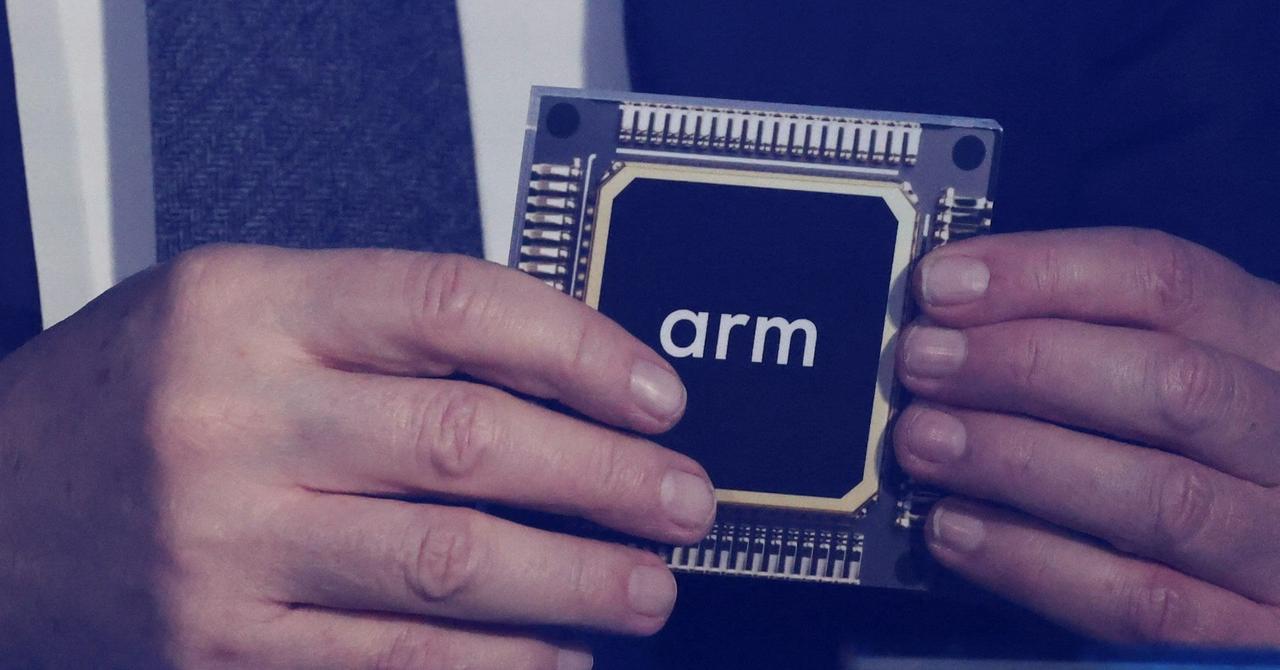
Arm doubled its demand forecast for the AGI CPU to over $2 billion across fiscal 2027 and 2028, just weeks after launch. The chip design company reported Q4 revenue of $1.49 billion, up 20% year-over-year, as CEO Rene Haas declared data centers will soon become Arm's largest business segment. But supply chain constraints and mixed investor response sent shares down 6% despite beating expectations.
Arm announced that strong customer demand for its AGI CPU has exceeded initial projections, with the chip design company now seeing more than $2 billion in orders across fiscal 2027 and fiscal 2028
1
. This figure represents more than double the $1 billion forecast Arm provided when it launched the data center chip in March2
.
Source: Reuters
CEO Rene Haas revealed the updated numbers during the company's Q4 FY 2025/26 earnings call on Wednesday, stating that "customer response to the Arm AGI CPU has been very strong"
1
. The AGI CPU was designed specifically for agentic AI applications that can perform business tasks autonomously with minimal human oversight5
. Haas theorized that customers are drawn to the processor because AI agents require dedicated processor cores, and Arm's AGI CPU features 136 of them1
.While the demand figures paint an optimistic picture, Haas acknowledged that Arm has yet to assemble the supply chain capacity to deliver $2 billion worth of AGI silicon
1
. The company has secured enough capacity to fulfill the initial $1 billion in demand discussed at launch but is still working to secure manufacturing for the additional billion dollars' worth of orders3
. "We're working really hard with the supply chain to fulfill that demand," the CEO said3
.
Source: SiliconANGLE
The company indicated that cash from AGI CPU sales will start arriving in volume beginning in fiscal year 2027/28
1
. These supply chain concerns contributed to investor uncertainty, with Arm's share price initially jumping 10% in after-hours trading before ultimately falling to $222, down from a $237 close1
.Haas declared that "soon, the datacenter will be Arm's largest business," marking a significant shift for a company that rose to prominence designing power-efficient chip designs for smartphones
1
. The CEO stated Arm is "on track towards our forecast of $15 billion" in annual revenue for AI infrastructure1
. CFO Jason Child added that the company expects to double annual revenue from selling its intellectual property to $10 billion by 2031, with most growth coming from data center products1
.
Source: FT
Arm-based CPUs already represent more than 50% share among top hyperscalers
4
. Major AI accelerator providers including Nvidia, Google, and Amazon pair their chips with Arm-based processors—Nvidia's Rubin GPUs work with Vera CPUs, Google's TPUs connect to Axion CPUs, and Amazon's Trainium pairs with Graviton chips, all built on chip architecture from Arm4
.Related Stories
Arm reported Q4 revenue of $1.49 billion, up 20% year-over-year and exceeding the $1.47 billion analyst consensus
3
. Full-year revenue reached $4.9 billion, representing a 22.8% increase1
. Licensing revenue came in particularly strong at $819 million, above the $775 million analysts expected, which Arm attributed to demand for its AI chip designs2
. Royalties totaled $671 million, slightly below the $700 million forecast2
. For the current quarter, Arm forecast $1.25 billion in revenue1
. The results reflect the broader CPU resurgence driven by AI workloads, particularly CPU-intensive inference tasks required for agentic AI4
. Intel CEO Lip Bu Tan noted that CPU-to-GPU ratios in AI racks have shifted from 1-to-8 to 1-to-4, with potential for 1-to-1 parity in the future4
. AMD CEO Lisa Su projects the server CPU addressable market will grow at greater than 35% annually, reaching over $120 billion by 20303
.Arm's move into manufacturing complete CPUs marks a strategic shift from its traditional business model of licensing chip architecture and collecting royalties
3
. This positions Arm in direct competition with Intel and AMD in the x86 processors market, though analysts suggest the expanding total addressable market leaves room for all players. UBS analyst Tim Arcuri expects the data center CPU market to reach approximately $170 billion by 2030, translating to "across-the-board upside" for Arm, Intel, and AMD5
. However, Arcuri believes Arm's instruction set will likely capture the largest market share due to its optimization for scaling core count and throughput while boosting energy efficiency5
. Haas stated he expects Arm to have the largest market share by CPU type by the end of the decade5
. The AGI CPU, co-developed with Meta, provides more than twice the performance per server rack compared to Intel's rival silicon and can help operators reduce hardware costs by up to $10 billion per gigawatt of AI data center capacity5
. Haas noted that data centers are expected to require more than four times the current CPU capacity per gigawatt as agentic AI scales, creating a market opportunity exceeding $100 billion by 20305
. Training workloads still rely heavily on Nvidia GPUs, but inference and agent-driven tasks increasingly favor CPUs, with analysts observing growing demand for standalone CPU-only server racks5
.Summarized by
Navi
[1]
01 Aug 2024

06 Feb 2025•Business and Economy

24 Mar 2026•Technology

1
Health

2
Technology

3
Technology